
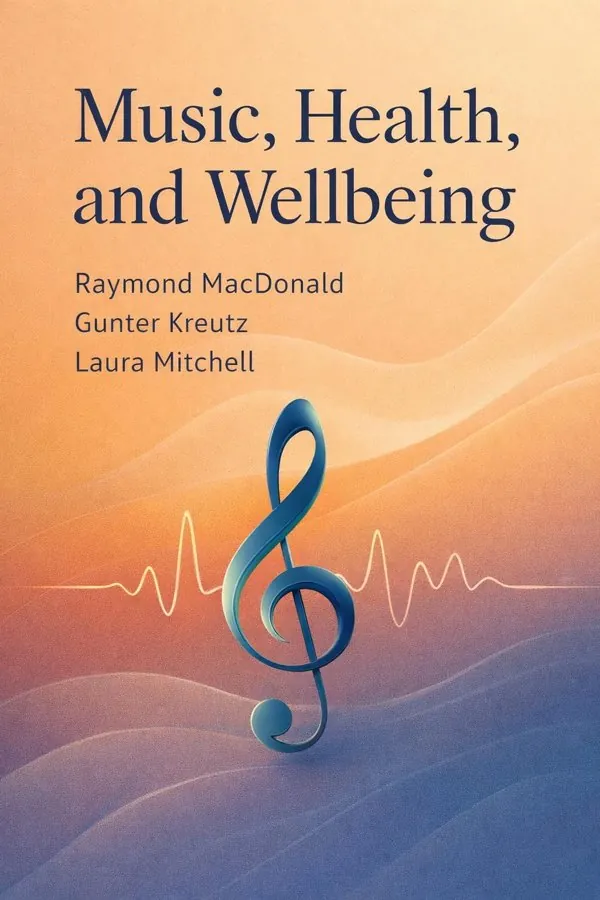
Music, Health, and Wellbeing: Summary & Key Insights
by Raymond MacDonald, Gunter Kreutz, Laura Mitchell
 10 min9 chaptersAudio available
Key Takeaways from Music, Health, and Wellbeing
Across ancient cultures, music accompanied ceremonies, grief, celebration, childbirth, warfare, and recovery from illness.
A striking insight from the book is that music does not affect us passively; it engages complex psychological processes that shape how we feel, think, and cope.
Music influences health not only through the mind but also through the body, and that dual effect is one of the book’s most important contributions.
Many people assume that if music can make us feel better, then any enjoyable listening counts as therapy.
One of the book’s most refreshing insights is that health benefits from music are not limited to clinics, hospitals, or laboratories.
What Is Music, Health, and Wellbeing About?
Music, Health, and Wellbeing by Raymond MacDonald, Gunter Kreutz, Laura Mitchell is a health_med book spanning 12 pages. Music, Health, and Wellbeing examines a question that feels intuitive yet demands rigorous evidence: how does music shape human health? Edited by Raymond MacDonald, Gunter Kreutz, and Laura Mitchell, the book brings together leading voices from psychology, neuroscience, music therapy, medicine, education, and community practice to show that music is far more than entertainment. It can calm stress responses, support emotional expression, strengthen social bonds, aid recovery, and improve quality of life across the lifespan. What makes this volume especially valuable is its balance between theory and application. Rather than making vague claims about music as a universal cure, the contributors ask when, how, and for whom musical engagement helps. They explore structured music therapy, everyday listening habits, group singing, healthcare interventions, and the cultural contexts that shape musical meaning. MacDonald, Kreutz, and Mitchell are respected scholars in music psychology and health research, and their editorial guidance gives the collection both depth and credibility. For clinicians, educators, researchers, and general readers alike, this book offers a thoughtful, evidence-based map of music’s therapeutic potential.
This FizzRead summary covers all 9 key chapters of Music, Health, and Wellbeing in approximately 10 minutes, distilling the most important ideas, arguments, and takeaways from Raymond MacDonald, Gunter Kreutz, Laura Mitchell's work. Also available as an audio summary and Key Quotes Podcast.
Music, Health, and Wellbeing
Music, Health, and Wellbeing examines a question that feels intuitive yet demands rigorous evidence: how does music shape human health? Edited by Raymond MacDonald, Gunter Kreutz, and Laura Mitchell, the book brings together leading voices from psychology, neuroscience, music therapy, medicine, education, and community practice to show that music is far more than entertainment. It can calm stress responses, support emotional expression, strengthen social bonds, aid recovery, and improve quality of life across the lifespan. What makes this volume especially valuable is its balance between theory and application. Rather than making vague claims about music as a universal cure, the contributors ask when, how, and for whom musical engagement helps. They explore structured music therapy, everyday listening habits, group singing, healthcare interventions, and the cultural contexts that shape musical meaning. MacDonald, Kreutz, and Mitchell are respected scholars in music psychology and health research, and their editorial guidance gives the collection both depth and credibility. For clinicians, educators, researchers, and general readers alike, this book offers a thoughtful, evidence-based map of music’s therapeutic potential.
Who Should Read Music, Health, and Wellbeing?
This book is perfect for anyone interested in health_med and looking to gain actionable insights in a short read. Whether you're a student, professional, or lifelong learner, the key ideas from Music, Health, and Wellbeing by Raymond MacDonald, Gunter Kreutz, Laura Mitchell will help you think differently.
- ✓Readers who enjoy health_med and want practical takeaways
- ✓Professionals looking to apply new ideas to their work and life
- ✓Anyone who wants the core insights of Music, Health, and Wellbeing in just 10 minutes
Want the full summary?
Get instant access to this book summary and 100K+ more with Fizz Moment.
Get Free SummaryAvailable on App Store • Free to download
Key Chapters
One of the most powerful ideas in this book is that music did not become therapeutic only when modern science discovered it; humans have long turned to music for healing, comfort, ritual, and connection. Across ancient cultures, music accompanied ceremonies, grief, celebration, childbirth, warfare, and recovery from illness. Philosophers and physicians once treated music as a force capable of rebalancing mind and body, and many indigenous traditions still understand sound as inseparable from wellbeing. This historical perspective matters because it reminds us that contemporary research is not inventing music’s health value from scratch. It is testing, refining, and contextualizing an old human intuition.
The book shows that these historical and theoretical foundations help explain why music remains such a compelling area of health research. Music can organize emotion, coordinate movement, and create shared meaning. Unlike many clinical tools, it is already woven into daily life, which makes it especially accessible. At the same time, the editors are careful not to romanticize the past. Traditional beliefs about music’s healing powers need to be distinguished from evidence-based practice. The point is not that every ancient claim was correct, but that music’s persistent place in human cultures signals an enduring relationship between sound and wellbeing.
In practical terms, this means modern health professionals can benefit from respecting both science and lived experience. A hospital music therapist, a community choir leader, or even a parent singing to a child all participate in a long lineage of care through music. The actionable takeaway is simple: treat music not as a luxury added after “real” treatment, but as a deeply human resource with roots worth understanding and applying thoughtfully.
A striking insight from the book is that music does not affect us passively; it engages complex psychological processes that shape how we feel, think, and cope. When we listen to or make music, we are not merely receiving sound. We are predicting patterns, recalling memories, attaching meanings, regulating attention, and responding emotionally. This is why a song can motivate exercise, reduce anxiety before surgery, or bring tears decades after a life event. Music works through expectation, familiarity, association, imagination, and identity.
The contributors explain that these psychological mechanisms are central to wellbeing. Music can shift mood by giving form to emotion, helping people process feelings that may be difficult to express in words. It can also create mental structure during chaos. Someone under stress may use a calming playlist to slow racing thoughts, while a person dealing with sadness may choose music that first matches their mood and then gradually lifts it. In therapeutic settings, improvisation or songwriting can help clients explore internal conflicts safely. In everyday life, music often supports concentration, memory, and resilience.
The book also highlights that musical responses are highly individual. The same piece may soothe one person and irritate another depending on taste, personal history, and context. That is why effective use of music requires sensitivity rather than one-size-fits-all assumptions. A practical example is in education or mental health support: encouraging people to build intentional playlists for focus, relaxation, or emotional release can be far more effective than prescribing generic “healing music.” The actionable takeaway is to become more deliberate about your musical habits: notice how different kinds of music influence your attention, memories, and mood, and use that awareness to support mental wellbeing.
Music influences health not only through the mind but also through the body, and that dual effect is one of the book’s most important contributions. Rhythm, tempo, volume, and melodic contour can alter physiological states in measurable ways. Researchers have observed changes in heart rate, breathing, muscle tension, hormonal responses, and arousal levels during musical engagement. This means music is not just something we “feel emotionally”; it can help regulate the nervous system and support physical comfort.
The editors discuss how slower, predictable music may encourage relaxation by reducing stress-related activation, while energetic rhythms can stimulate movement and increase alertness. These effects are especially relevant in medical and rehabilitation settings. Patients awaiting procedures may benefit from calming music that reduces anxiety. People recovering motor function may use rhythm to support coordinated movement. Group drumming or structured rhythmic activities can help reconnect bodily awareness and social timing. Even outside formal therapy, people routinely use music to pace walking, improve workouts, or wind down before sleep.
Importantly, the book avoids simplistic claims. Music is not a magic biochemical switch, and bodily responses vary across individuals and situations. Personal preference matters, as does the listening environment. Loud or unwanted music can elevate stress rather than reduce it. The strongest applications arise when music is chosen intentionally and matched to a specific goal, such as relaxation, activation, pain distraction, or movement support.
A practical example is pre-sleep listening: selecting familiar, low-arousal music and keeping volume moderate can become part of a consistent bedtime routine. In rehabilitation, matching movement exercises to a steady beat can improve motivation and timing. The actionable takeaway is to think of music as a tool for bodily regulation: choose it based on the physical state you want to encourage, whether that is calm, energy, endurance, or coordinated movement.
Many people assume that if music can make us feel better, then any enjoyable listening counts as therapy. The book challenges that assumption by drawing a clear distinction between everyday beneficial music use and professional music therapy. Music therapy is a structured, evidence-informed clinical practice carried out by trained practitioners who use musical experiences to meet therapeutic goals. These goals may include emotional expression, communication, pain management, social connection, trauma processing, or support for neurological rehabilitation.
This distinction matters because the effectiveness of music often depends on intention, relationship, and method. In music therapy, the therapist does not simply play relaxing tracks. They assess the client’s needs, select or co-create musical activities, observe responses, and adapt interventions over time. Techniques may include improvisation, songwriting, movement to music, guided listening, singing, or instrument play. For a child with communication difficulties, musical turn-taking may support interaction. For a person living with dementia, familiar songs may stimulate memory and orientation. For someone facing depression, songwriting may offer a safe container for difficult feelings.
The book’s framework helps readers understand both the promise and the limits of music-based care. Not every positive musical experience is therapy, and not every health need can be addressed through music alone. Yet when used skillfully, music therapy can become a powerful complement to medical, psychological, and educational support.
In practical settings, this means healthcare institutions should not treat music therapy as optional decoration. It should be integrated where evidence and patient need align. For general readers, the lesson is to appreciate professional expertise rather than reducing therapeutic music to background sound. The actionable takeaway is this: if the goal is clinical change rather than general enjoyment, seek structured support from a qualified music therapist or evidence-based music program.
One of the book’s most refreshing insights is that health benefits from music are not limited to clinics, hospitals, or laboratories. Much of music’s impact happens in ordinary life: during commuting, cooking, exercise, parenting, worship, work, celebration, and rest. These everyday patterns of engagement can significantly influence mood, stress, identity, and social connection. In other words, the soundtrack of daily life is also part of the architecture of wellbeing.
The editors emphasize that people use music in highly practical ways. A student may listen to instrumental tracks to sustain concentration. A parent may sing lullabies to regulate a child’s emotions and strengthen bonding. A runner may choose rhythmically driving songs to improve motivation and pacing. Someone going through loss may return repeatedly to meaningful music that helps them feel less alone. These examples show that musical engagement can serve as a self-care strategy long before professional intervention is needed.
However, the book also warns against assuming all musical habits are beneficial. Repetitive listening that intensifies rumination, emotional avoidance, or social withdrawal may undermine wellbeing. The key is not simply listening more, but listening more reflectively. Why am I choosing this music right now? Is it helping me shift, process, connect, focus, or rest? Or is it trapping me in an unhelpful state?
This perspective has broad applications in education, workplace wellbeing, and family life. Encouraging intentional musical routines can make emotional regulation more accessible and enjoyable than abstract advice alone. A family might create calming evening playlists; a workplace might use music strategically in breaks rather than as constant background noise.
The actionable takeaway is to audit your daily musical life. Identify which habits genuinely support focus, comfort, motivation, sleep, or connection, and build them into your routines with conscious purpose.
If there is one domain where music’s health value becomes especially clear, it is emotion regulation. The book shows that music offers people an unusually flexible way to influence emotional states: it can soothe, energize, validate, release, organize, intensify, or transform feelings. This is not a trivial effect. Emotional regulation sits at the center of mental wellbeing, coping, relationships, and resilience. Music helps because it can meet people where they are while also guiding them somewhere else.
The contributors explain that people often use music for several emotional purposes. Sometimes they seek comfort through familiarity. Sometimes they want catharsis, using intense music to safely experience anger, grief, or longing. At other times, they use music to shift state, such as moving from lethargy to motivation or from agitation to calm. In therapy, these processes can become explicit and supported. A client may improvise on an instrument to externalize anxiety, then gradually move toward steadier patterns that create containment and relief.
The book also complicates the popular belief that “happy music makes people happy.” Emotional regulation is more nuanced. Sad music, for example, can be deeply beneficial if it creates reflection, meaning, or emotional companionship. The real question is whether the music helps the person process emotion constructively rather than reinforcing helplessness or avoidance.
Practical applications are easy to see. Mental health practitioners can help clients develop playlists for grounding, activation, grief work, or relaxation. Teachers can use songs to help children transition between emotional states. Individuals can notice what kinds of music help them recover from stress after work.
The actionable takeaway is to use music with emotional intention: build separate musical resources for calming, energizing, grieving, focusing, and reconnecting, so that music becomes an active emotional skill rather than an unconscious habit.
Another major contribution of the book is its lifespan perspective: music matters differently, but consistently, from infancy to old age. This broad view prevents us from limiting music and health to one population, such as patients in therapy or older adults with memory loss. Instead, the editors show that musical engagement can support development, identity, coping, and care at every life stage.
In infancy and early childhood, music supports bonding, communication, and emotional regulation. Caregivers naturally use singing and rhythm to soothe, engage attention, and establish routines. In school-age children and adolescents, music becomes a powerful medium for learning, self-expression, peer belonging, and identity formation. It can help young people manage emotion, navigate social worlds, and build confidence. In adulthood, music often supports work-life balance, stress management, exercise, meaning-making, and community participation. Later in life, it can preserve identity, stimulate autobiographical memory, reduce isolation, and enrich care for those experiencing cognitive decline.
The book is especially strong in showing that music’s value changes with developmental needs. Teenagers may use music to define who they are; older adults may use it to reconnect with who they have been. Someone in rehabilitation may use rhythm to rebuild movement, while someone grieving may use familiar songs to maintain continuity of self.
These lifespan insights have practical implications for families, schools, care homes, and health systems. Music should not be treated as an optional cultural extra reserved for the talented. It is a developmental and relational resource. A nursery using songs for transitions, a school preserving music education, and a dementia unit incorporating familiar singing all draw on the same principle: music supports human functioning across time.
The actionable takeaway is to tailor musical engagement to life stage and personal need, recognizing that the healthiest musical use is the one that fits a person’s current developmental context.
Perhaps the book’s most intellectually important lesson is that music and health cannot be separated from culture, context, and research quality. Music is never just sound in the abstract; it carries identity, memory, values, tradition, and social meaning. A song that comforts one person may be irrelevant or distressing to another. This is why culturally sensitive practice is essential. Healthcare providers and researchers must consider not only what music does biologically or psychologically, but what it means to the person hearing or making it.
The editors also devote attention to measurement and methodology, which is crucial in a field often surrounded by enthusiastic but exaggerated claims. Studying music’s health effects is challenging because outcomes vary, interventions differ, and musical experiences are deeply personal. Strong research therefore requires clear definitions, suitable outcome measures, attention to context, and honest reporting of limitations. Without this rigor, the field risks reducing music to vague inspiration instead of credible health practice.
At the same time, the book is optimistic about future directions. Interdisciplinary collaboration between musicians, therapists, psychologists, neuroscientists, physicians, educators, and community workers can deepen understanding and improve care. Music-based interventions may become more integrated into hospitals, public health initiatives, mental health services, and aging support, provided they remain evidence-informed and person-centered.
Practical applications follow naturally. A clinician should ask what kind of music matters to this patient, not assume universal preferences. A researcher should study not only whether music helps, but under what conditions and for whom. A policymaker should support music programs that are accessible, culturally relevant, and evaluable.
The actionable takeaway is to combine enthusiasm with discipline: value music’s potential, but always anchor practice in cultural awareness, personal meaning, and sound evidence.
All Chapters in Music, Health, and Wellbeing
About the Authors
Raymond MacDonald, Gunter Kreutz, and Laura Mitchell are respected contributors to the interdisciplinary study of music, psychology, and health. MacDonald is a leading scholar in music psychology and improvisation, known for exploring how music supports communication, identity, therapy, and wellbeing. Kreutz has built a strong reputation through research on music and emotion, singing, and the psychological and social effects of musical participation. Mitchell has contributed to research and editorial work connecting music practice with health outcomes and wellbeing studies. Together, they represent the kind of cross-disciplinary expertise this subject demands, combining perspectives from psychology, therapy, music research, and applied health contexts. Their collaborative work helps readers understand music not simply as an art form, but as a meaningful and evidence-informed resource for human flourishing.
Get This Summary in Your Preferred Format
Read or listen to the Music, Health, and Wellbeing summary by Raymond MacDonald, Gunter Kreutz, Laura Mitchell anytime, anywhere. FizzRead offers multiple formats so you can learn on your terms — all free.
Available formats: App · Audio · PDF · EPUB — All included free with FizzRead
Download Music, Health, and Wellbeing PDF and EPUB Summary
Key Quotes from Music, Health, and Wellbeing
“Across ancient cultures, music accompanied ceremonies, grief, celebration, childbirth, warfare, and recovery from illness.”
“A striking insight from the book is that music does not affect us passively; it engages complex psychological processes that shape how we feel, think, and cope.”
“Music influences health not only through the mind but also through the body, and that dual effect is one of the book’s most important contributions.”
“Many people assume that if music can make us feel better, then any enjoyable listening counts as therapy.”
“One of the book’s most refreshing insights is that health benefits from music are not limited to clinics, hospitals, or laboratories.”
Frequently Asked Questions about Music, Health, and Wellbeing
Music, Health, and Wellbeing by Raymond MacDonald, Gunter Kreutz, Laura Mitchell is a health_med book that explores key ideas across 9 chapters. Music, Health, and Wellbeing examines a question that feels intuitive yet demands rigorous evidence: how does music shape human health? Edited by Raymond MacDonald, Gunter Kreutz, and Laura Mitchell, the book brings together leading voices from psychology, neuroscience, music therapy, medicine, education, and community practice to show that music is far more than entertainment. It can calm stress responses, support emotional expression, strengthen social bonds, aid recovery, and improve quality of life across the lifespan. What makes this volume especially valuable is its balance between theory and application. Rather than making vague claims about music as a universal cure, the contributors ask when, how, and for whom musical engagement helps. They explore structured music therapy, everyday listening habits, group singing, healthcare interventions, and the cultural contexts that shape musical meaning. MacDonald, Kreutz, and Mitchell are respected scholars in music psychology and health research, and their editorial guidance gives the collection both depth and credibility. For clinicians, educators, researchers, and general readers alike, this book offers a thoughtful, evidence-based map of music’s therapeutic potential.
You Might Also Like

On Immunity
Eula Biss
10 min
The Three-Body Problem
Liu Cixin
10 min
Community Health Volunteer Toolkit: Training and Practical Activities
World Health Organization
10 min
Healing Back Pain: The Mind-Body Connection
John E. Sarno
10 min
Health Literacy for All: Practical Guides to Communicate Health Information (Compilations)
World Health Organization
10 min
The Complete Guide to Sports Supplements: An Evidence-Based Review
Anita Bean
10 minBrowse by Category
Ready to read Music, Health, and Wellbeing?
Get the full summary and 100K+ more books with Fizz Moment.