
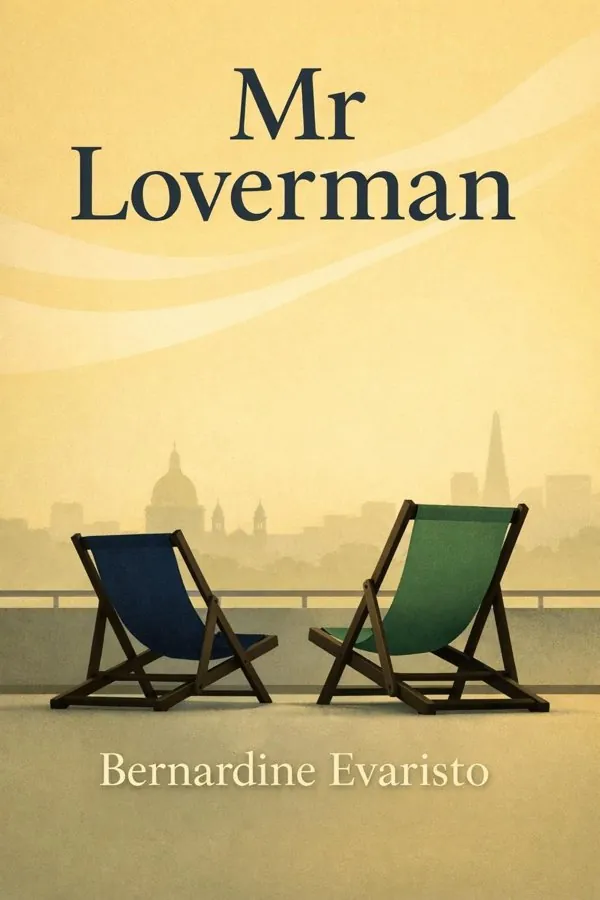
Mr Loverman: Summary & Key Insights
 10 min9 chaptersAudio available
Key Takeaways from Mr Loverman
A life built on concealment does not stay neatly divided; it leaks into every relationship.
The betrayed spouse is often flattened into a side character, but Mr Loverman refuses that simplification.
Longevity does not automatically make love easier; sometimes it deepens the tragedy of what remains unspoken.
Freedom is often imagined as a clean escape, but Evaristo shows that real liberation is messy, painful, and deeply relational.
No one in Mr Loverman can be explained by a single label.
What Is Mr Loverman About?
Mr Loverman by Bernardine Evaristo is a bestsellers book spanning 5 pages. Mr Loverman is a witty, tender, and emotionally layered novel about the cost of living behind a mask for far too long. Bernardine Evaristo centers the story on Barrington Jedidiah Walker, known as Barry, a seventy-four-year-old Antiguan-born Londoner whose polished suits, sharp tongue, and easy charm conceal a lifelong secret: he has been in love with his best friend, Morris, for decades. To the outside world, Barry is a husband, father, grandfather, and respected elder in the Caribbean community. Privately, he is a man split between duty and desire, performance and truth. What makes the novel so powerful is the way Evaristo refuses to reduce Barry to a symbol. She gives us a full human being: funny, vain, selfish, loving, frightened, and brave. The book matters because it explores sexuality, aging, marriage, migration, religion, and cultural expectation with unusual warmth and honesty. It also gives voice to Carmel, Barry’s wife, whose pain and awakening are central to the story. Evaristo, one of Britain’s most acclaimed contemporary writers, brings literary precision and social insight to a narrative that is both deeply specific and universally resonant.
This FizzRead summary covers all 9 key chapters of Mr Loverman in approximately 10 minutes, distilling the most important ideas, arguments, and takeaways from Bernardine Evaristo's work. Also available as an audio summary and Key Quotes Podcast.
Mr Loverman
Mr Loverman is a witty, tender, and emotionally layered novel about the cost of living behind a mask for far too long. Bernardine Evaristo centers the story on Barrington Jedidiah Walker, known as Barry, a seventy-four-year-old Antiguan-born Londoner whose polished suits, sharp tongue, and easy charm conceal a lifelong secret: he has been in love with his best friend, Morris, for decades. To the outside world, Barry is a husband, father, grandfather, and respected elder in the Caribbean community. Privately, he is a man split between duty and desire, performance and truth.
What makes the novel so powerful is the way Evaristo refuses to reduce Barry to a symbol. She gives us a full human being: funny, vain, selfish, loving, frightened, and brave. The book matters because it explores sexuality, aging, marriage, migration, religion, and cultural expectation with unusual warmth and honesty. It also gives voice to Carmel, Barry’s wife, whose pain and awakening are central to the story. Evaristo, one of Britain’s most acclaimed contemporary writers, brings literary precision and social insight to a narrative that is both deeply specific and universally resonant.
Who Should Read Mr Loverman?
This book is perfect for anyone interested in bestsellers and looking to gain actionable insights in a short read. Whether you're a student, professional, or lifelong learner, the key ideas from Mr Loverman by Bernardine Evaristo will help you think differently.
- ✓Readers who enjoy bestsellers and want practical takeaways
- ✓Professionals looking to apply new ideas to their work and life
- ✓Anyone who wants the core insights of Mr Loverman in just 10 minutes
Want the full summary?
Get instant access to this book summary and 100K+ more with Fizz Moment.
Get Free SummaryAvailable on App Store • Free to download
Key Chapters
A life built on concealment does not stay neatly divided; it leaks into every relationship. That is the central tension of Mr Loverman. Barry has spent decades performing the role expected of him: elegant husband, proud father, Caribbean patriarch, and local charmer. Yet beneath that polished exterior lies a private self he has never fully allowed into the open. His secret love for Morris is not a recent complication but the hidden architecture of his adult life.
Evaristo shows how double lives are sustained by routine, style, and self-justification. Barry is brilliant at narration, especially when narrating himself. He tells stories that make his choices sound reasonable, even glamorous. But the novel steadily reveals the emotional wreckage of this compartmentalization. His marriage to Carmel is not merely unhappy; it has been shaped by decades of dishonesty. His daughters inherit confusion, tension, and unresolved hurt. Even his relationship with Morris is compromised by fear and delay.
This idea extends beyond sexuality. Many people maintain split identities to survive family expectations, cultural codes, or social prejudice. Someone may present confidence at work while hiding grief, or appear dutiful in family life while suppressing core desires. Mr Loverman asks what such division costs over time.
In practical terms, the novel invites readers to examine where they perform rather than live truthfully. Are there roles you keep playing because they once protected you? Are you using charm, success, or busyness to avoid honesty? Barry’s story suggests that secrecy may preserve stability in the short term, but it corrodes intimacy in the long term.
Actionable takeaway: identify one area of your life where appearance and reality diverge, and ask what small act of honesty could begin to close that gap.
The betrayed spouse is often flattened into a side character, but Mr Loverman refuses that simplification. Carmel is not just the woman Barry deceives; she is a fully realized person whose suffering, faith, memory, and eventual self-reclamation give the novel much of its moral force. Her perspective transforms the story from a tale of hidden love into a deeper examination of what secrecy does to everyone trapped inside it.
Carmel has lived within the constraints imposed on many women of her generation: endure marriage, preserve respectability, lean on religion, and absorb pain quietly. She has been mocked, dismissed, and emotionally neglected, often by Barry himself, whose wit can shade into cruelty. Yet Evaristo shows that endurance is not the same as passivity. Carmel’s inner life is rich with anger, longing, spiritual struggle, and a slowly emerging sense that she deserves something more than humiliation.
Her development matters because it resists the temptation to frame Barry’s liberation as the only liberation that counts. Carmel also needs release: from shame, from emotional dependence, and from a marriage defined by imbalance. As she begins to see herself differently, the novel opens into a broader meditation on women reclaiming personhood after years of diminishment.
Readers can apply this insight by reconsidering stories of betrayal through a wider lens. In families, workplaces, or communities, we often focus on the person pursuing freedom while ignoring those harmed by their silence. True empathy requires holding both truths at once.
Actionable takeaway: when assessing a conflict, ask not only who feels trapped, but also who has been carrying the hidden emotional burden of that entrapment.
Longevity does not automatically make love easier; sometimes it deepens the tragedy of what remains unspoken. Barry and Morris have loved each other for roughly half a century, and their bond is one of the most moving elements of Mr Loverman. This is not a brief affair or youthful experiment. It is a relationship shaped by desire, tenderness, resentment, routine, and missed opportunities. Their history gives the novel emotional depth because it shows how love can endure even when courage fails.
Evaristo presents their connection with nuance. Morris is not simply Barry’s fantasy of freedom. He is a real partner with his own frustrations, his own compromises, and his own limits. The men share intimacy and understanding, but they are also damaged by the secrecy that has defined them. Over the years, they have built a private world while remaining publicly unclaimed. That strain accumulates. Love survives, but not untouched.
The novel’s portrayal of long-hidden queer love is especially significant because it centers older men, a group rarely granted complexity, sexuality, or emotional visibility in fiction. Barry and Morris challenge assumptions that coming out is only for the young, or that later life is a time of emotional closure rather than transformation.
In everyday life, the relationship offers a broader lesson about deferred authenticity. People often tell themselves there will be a better time to have the necessary conversation, make the difficult change, or claim the life they want. But years can pass in that postponement.
Actionable takeaway: if a relationship or truth matters deeply, stop assuming time will solve what only honesty and decision can change.
Freedom is often imagined as a clean escape, but Evaristo shows that real liberation is messy, painful, and deeply relational. Barry cannot simply decide to live openly and expect the past to disappear. His movement toward truth requires confrontation: with Carmel, with his daughters, with Morris, with the Caribbean community around him, and most of all with himself. Mr Loverman insists that self-liberation is not just an internal awakening; it is a social event with consequences.
Barry has spent years treating openness as a future possibility, something just beyond the horizon. Yet when disclosure begins to press in, he discovers that the fantasy of freedom is easier than freedom itself. The people around him have their own histories, wounds, and expectations. Carmel’s pain cannot be edited out. Morris cannot indefinitely accept half-measures. Adult children cannot be expected to absorb family revelations without complexity. Truth enters a web of existing loyalties.
This is one of the novel’s strongest insights: delayed honesty increases the cost of honesty. That does not mean truth should be avoided. On the contrary, it means that postponement rarely prevents pain; it compounds it.
This idea applies broadly. Leaving a misaligned career, ending a dishonest relationship, addressing addiction, or naming a family secret all involve disruption. Many people avoid action because they want a change process without fallout. Evaristo reminds us that growth usually arrives through discomfort, not around it.
Actionable takeaway: if you are postponing a necessary truth because you fear conflict, ask whether delay is truly protecting anyone or merely enlarging the eventual damage.
No one in Mr Loverman can be explained by a single label. Barry is Antiguan and British, masculine and vulnerable, stylish and emotionally evasive, aging and still intensely desirous. Carmel is religious and restless, wounded and strong, traditional and capable of reinvention. Evaristo’s great achievement is to show identity as layered rather than fixed. Race, migration, class, gender, religion, sexuality, and generation all shape how people see themselves and how others police them.
The Caribbean diaspora setting is essential here. Barry and Carmel belong to a community with deeply rooted values about respectability, marriage, gender roles, and public reputation. Their lives in London are also marked by migration and adaptation. They are not simply carrying old-world customs unchanged; they are negotiating what those customs become in a different country, across decades, and under the pressures of assimilation and discrimination.
The novel therefore rejects simplistic ideas of authenticity. Barry’s problem is not that he is “really” one thing and “falsely” another. Rather, he is many things at once, and some of those dimensions have been forced into conflict by social expectations. Identity is not an essence waiting to be discovered in isolation. It is a lived negotiation among desire, history, culture, and power.
Readers can use this insight to think more carefully about their own categories. In family or workplace settings, people are often reduced to a role: the immigrant parent, the dutiful spouse, the rebel child, the religious elder. Such labels can obscure inner complexity.
Actionable takeaway: replace one simplifying label you use for yourself or someone else with a fuller description that acknowledges contradiction, context, and change.
One of the novel’s boldest assertions is that old age is not the end of becoming. Barry is seventy-four, and yet his life is not emotionally settled. He is still capable of desire, denial, vanity, fear, and transformation. This alone makes Mr Loverman distinctive. Literature and popular culture often portray older people as either wise and resolved or comic and irrelevant. Evaristo rejects both patterns. She gives older age erotic charge, moral complexity, and the possibility of reinvention.
Barry’s age intensifies the stakes. He has less time ahead than behind. Every postponed truth now carries the weight of irretrievability. At the same time, his age gives his journey dignity. He is not “too late” to confront himself. The novel suggests that authenticity matters even when it cannot restore lost decades. A truthful life in the present still has value.
This perspective can be liberating for readers at any stage of life. Younger readers may see a warning against postponement. Older readers may recognize permission to make difficult changes without shame. Whether the issue is identity, work, love, friendship, or family boundaries, the story argues against the idea that there is an expiration date on self-knowledge.
Practically, this means questioning narratives like “I’m too old to start over,” “It’s pointless now,” or “People my age should just accept things.” Reinvention may not look dramatic. It can begin through a conversation, a decision, a refusal, or a reimagined future.
Actionable takeaway: challenge one age-based story limiting your choices, and replace it with one concrete action that affirms growth is still possible.
Some of the novel’s deepest truths arrive wearing a smile. Barry is funny, flamboyant, observant, and often gloriously cutting. His voice animates the book with energy and charm. But Evaristo uses humor for more than entertainment. Jokes, verbal flair, and social performance become tools for revealing what shame tries to hide. Barry’s comedy is often a defense mechanism, a way to maintain control, dodge vulnerability, or turn discomfort into style.
This is why the tone of Mr Loverman feels so rich. It can be laugh-out-loud funny and quietly devastating within the same scene. Humor becomes part of the novel’s moral design. It keeps characters human rather than exemplary. It also captures how many people survive pain: by making it narratable, manageable, or socially acceptable through wit.
The same applies to communities. In families marked by secrecy or repression, humor often carries truths people cannot state directly. Teasing may signal tension. Anecdotes may disguise grief. Glamour and performance may cover loneliness. Evaristo understands that emotional realism includes these tonal contradictions.
For readers, this creates a useful lens. Pay attention not only to what people say seriously, but also to what they repeatedly joke about. In your own life, ask whether humor is helping you cope or helping you avoid. Both can be true, but they are not the same.
Actionable takeaway: notice one recurring joke, in yourself or a close relationship, and ask what fear, longing, or truth might be sitting underneath the laughter.
Families do not transmit only values and stories; they also pass down avoidance, distortion, and emotional habits. Mr Loverman is deeply interested in inheritance, not simply in the material sense but in the psychological one. Barry and Carmel’s daughters grow up in a home shaped by tension, concealment, religious pressure, resentment, and fractured communication. Even when children do not know the exact secret, they often feel its effects.
Evaristo shows how silence functions as a family system. People learn what may not be asked, what feelings are dangerous, and which appearances must be protected at any cost. Such systems can persist across generations. A parent’s denial becomes a child’s anxiety. A spouse’s humiliation becomes a family’s emotional weather. Respectability can become an organizing principle that suppresses truth while claiming to preserve order.
This theme broadens the novel beyond one marriage. It asks how families are formed by what they refuse to name. It also suggests that breaking a pattern is disruptive but necessary. Openness does not guarantee harmony, but silence guarantees distortion.
In practical life, this idea is highly relevant. Many families carry unspoken material: addiction, debt, illness, affairs, estrangement, migration trauma, or mental health struggles. Members often adapt by normalizing confusion. Yet what remains unnamed still shapes behavior.
Actionable takeaway: reflect on one recurring tension in your family and ask what unspoken rule keeps honest conversation from happening; naming the rule is often the first break in the pattern.
The desire to be seen as respectable can protect dignity in a hostile world, but it can also become a prison. In Mr Loverman, respectability is tied to marriage, church, gender norms, parenthood, public image, and cultural pride. For Barry and Carmel, these expectations are not trivial. They come from histories of migration, racism, community surveillance, and the need to maintain standing. Yet Evaristo shows how the pursuit of proper appearance can harden into a force that stifles truth.
Barry clings to style and status partly because they help him perform control. Carmel clings to faith and social codes partly because they provide structure and meaning. Neither impulse is mocked. The novel understands why respectability matters. But it also exposes the damage that occurs when image is valued above emotional reality. What looks orderly from the outside may be hollow, painful, or false inside.
This tension remains relevant today. Many people feel pressure to maintain the optics of success, stability, romance, or family unity even when those images no longer match lived experience. Social media often intensifies this dynamic, but the pattern predates technology. Communities of all kinds can reward appearance while punishing truth.
The practical lesson is not to reject standards entirely, but to question whether your public identity serves your life or controls it. Respectability becomes dangerous when it requires silence, self-erasure, or the suffering of others.
Actionable takeaway: identify one image you feel compelled to maintain, and ask whether keeping it is enhancing your integrity or preventing your honesty.
All Chapters in Mr Loverman
About the Author
Bernardine Evaristo is an acclaimed British writer, professor, and advocate for inclusive literature. Born in London to an English mother and Nigerian father, she has built a distinguished career through fiction, poetry, essays, and criticism that examine race, identity, gender, sexuality, class, and the histories of marginalized communities. Evaristo is widely known for her stylistic innovation and for creating vivid, polyphonic narratives that expand the boundaries of contemporary literary fiction. She achieved global recognition when Girl, Woman, Other won the Booker Prize in 2019, making her the first Black woman to receive the award. Alongside her writing, she has played a major role in supporting emerging writers and championing greater diversity in publishing. Her work is celebrated for its intelligence, humanity, and cultural reach.
Get This Summary in Your Preferred Format
Read or listen to the Mr Loverman summary by Bernardine Evaristo anytime, anywhere. FizzRead offers multiple formats so you can learn on your terms — all free.
Available formats: App · Audio · PDF · EPUB — All included free with FizzRead
Download Mr Loverman PDF and EPUB Summary
Key Quotes from Mr Loverman
“A life built on concealment does not stay neatly divided; it leaks into every relationship.”
“The betrayed spouse is often flattened into a side character, but Mr Loverman refuses that simplification.”
“Longevity does not automatically make love easier; sometimes it deepens the tragedy of what remains unspoken.”
“Freedom is often imagined as a clean escape, but Evaristo shows that real liberation is messy, painful, and deeply relational.”
“No one in Mr Loverman can be explained by a single label.”
Frequently Asked Questions about Mr Loverman
Mr Loverman by Bernardine Evaristo is a bestsellers book that explores key ideas across 9 chapters. Mr Loverman is a witty, tender, and emotionally layered novel about the cost of living behind a mask for far too long. Bernardine Evaristo centers the story on Barrington Jedidiah Walker, known as Barry, a seventy-four-year-old Antiguan-born Londoner whose polished suits, sharp tongue, and easy charm conceal a lifelong secret: he has been in love with his best friend, Morris, for decades. To the outside world, Barry is a husband, father, grandfather, and respected elder in the Caribbean community. Privately, he is a man split between duty and desire, performance and truth. What makes the novel so powerful is the way Evaristo refuses to reduce Barry to a symbol. She gives us a full human being: funny, vain, selfish, loving, frightened, and brave. The book matters because it explores sexuality, aging, marriage, migration, religion, and cultural expectation with unusual warmth and honesty. It also gives voice to Carmel, Barry’s wife, whose pain and awakening are central to the story. Evaristo, one of Britain’s most acclaimed contemporary writers, brings literary precision and social insight to a narrative that is both deeply specific and universally resonant.
More by Bernardine Evaristo

You Might Also Like

The Godfather
Mario Puzo
10 min
The Handmaid's Tale
Margaret Atwood
10 min
The Hunger Games
Suzanne Collins
10 min
The Nightingale
Kristin Hannah
10 min
The Seven Husbands of Evelyn Hugo
Taylor Jenkins Reid
10 min
Backwater Justice
Fern Michaels
10 minBrowse by Category
Ready to read Mr Loverman?
Get the full summary and 100K+ more books with Fizz Moment.