
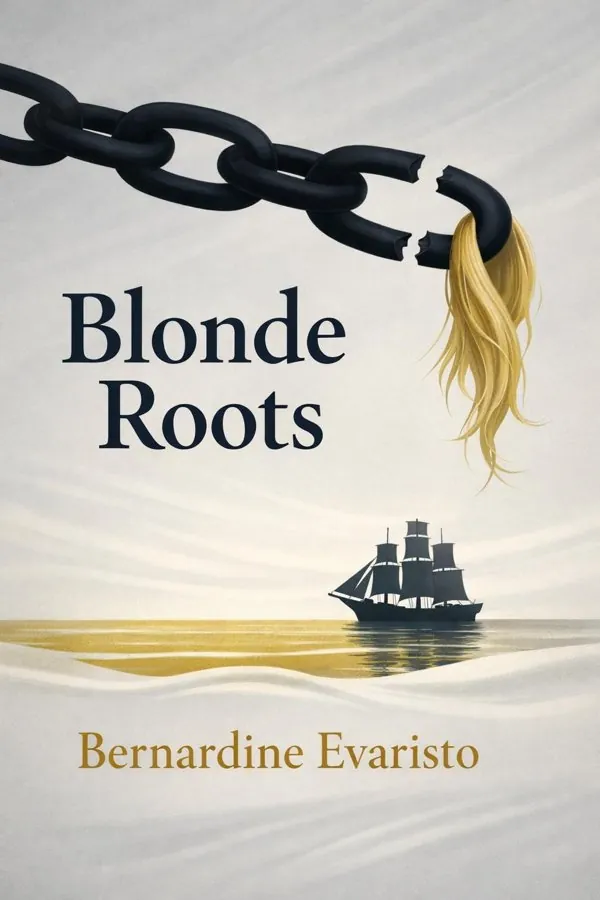
Blonde Roots: Summary & Key Insights
 10 min9 chaptersAudio available
Key Takeaways from Blonde Roots
Sometimes the fastest way to understand injustice is to flip it upside down.
Oppression often begins not with grand ideology, but with the destruction of an ordinary day.
Cruelty becomes most dangerous when it is organized.
When everything external is taken away, memory can become a form of survival.
People in power rarely describe themselves as cruel; they prefer to call themselves necessary, civilized, or benevolent.
What Is Blonde Roots About?
Blonde Roots by Bernardine Evaristo is a bestsellers book spanning 5 pages. Blonde Roots is Bernardine Evaristo’s daring, funny, and deeply unsettling reimagining of history. Set in an alternate world where Africans are the dominant global power and Europeans are the enslaved, the novel follows Doris Scagglethorpe, a young woman taken from England and transported across the Atlantic into bondage. By reversing the racial hierarchy that shaped the modern world, Evaristo exposes how arbitrary and constructed ideas of race, beauty, civilization, and human worth really are. The book is not simply a clever premise; it is a sharp moral and political intervention. Through satire, emotional realism, and historical echoes, Evaristo invites readers to confront the brutality of slavery and colonial thinking from a newly disorienting angle. That reversal makes familiar injustices feel shocking again. Evaristo writes with unusual authority on questions of identity, power, and belonging. One of Britain’s most acclaimed contemporary authors, she is celebrated for work that pushes formal boundaries while illuminating race, gender, and history. Blonde Roots matters because it turns empathy into revelation: it asks readers not only to understand oppression, but to feel how absurd and devastating its logic truly is.
This FizzRead summary covers all 9 key chapters of Blonde Roots in approximately 10 minutes, distilling the most important ideas, arguments, and takeaways from Bernardine Evaristo's work. Also available as an audio summary and Key Quotes Podcast.
Blonde Roots
Blonde Roots is Bernardine Evaristo’s daring, funny, and deeply unsettling reimagining of history. Set in an alternate world where Africans are the dominant global power and Europeans are the enslaved, the novel follows Doris Scagglethorpe, a young woman taken from England and transported across the Atlantic into bondage. By reversing the racial hierarchy that shaped the modern world, Evaristo exposes how arbitrary and constructed ideas of race, beauty, civilization, and human worth really are. The book is not simply a clever premise; it is a sharp moral and political intervention. Through satire, emotional realism, and historical echoes, Evaristo invites readers to confront the brutality of slavery and colonial thinking from a newly disorienting angle. That reversal makes familiar injustices feel shocking again. Evaristo writes with unusual authority on questions of identity, power, and belonging. One of Britain’s most acclaimed contemporary authors, she is celebrated for work that pushes formal boundaries while illuminating race, gender, and history. Blonde Roots matters because it turns empathy into revelation: it asks readers not only to understand oppression, but to feel how absurd and devastating its logic truly is.
Who Should Read Blonde Roots?
This book is perfect for anyone interested in bestsellers and looking to gain actionable insights in a short read. Whether you're a student, professional, or lifelong learner, the key ideas from Blonde Roots by Bernardine Evaristo will help you think differently.
- ✓Readers who enjoy bestsellers and want practical takeaways
- ✓Professionals looking to apply new ideas to their work and life
- ✓Anyone who wants the core insights of Blonde Roots in just 10 minutes
Want the full summary?
Get instant access to this book summary and 100K+ more with Fizz Moment.
Get Free SummaryAvailable on App Store • Free to download
Key Chapters
Sometimes the fastest way to understand injustice is to flip it upside down. That is the radical brilliance of Blonde Roots. Bernardine Evaristo imagines a world in which Africans colonize Europe, dominate global trade, and enslave white people. This reversal is not a gimmick. It is a literary strategy that makes the logic of racism visible by removing the false sense of normality that history often gives it.
In the real world, many assumptions about power, civilization, and beauty have been shaped by colonial history. Because those assumptions have been repeated for centuries, they can begin to feel natural. Evaristo disrupts that comfort. When white skin becomes the mark of inferiority and African empires become the global standard of power, readers are forced to confront a disturbing truth: racial hierarchies are invented systems, not biological facts. The categories change, but the cruelty remains recognizable.
Doris’s story works because she experiences oppression as ordinary life violently interrupted. Her capture and enslavement show how quickly a human being can be turned into a social category, a commodity, a stereotype. The reversal strips away excuses. It becomes harder for readers to hide behind distance, historical abstraction, or familiar narratives.
In everyday life, this idea can help readers question the social stories they inherit. Ask which identities are treated as default, which are treated as suspect, and who benefits when these roles seem natural. A useful takeaway is this: whenever a hierarchy feels inevitable, imagine it reversed. That thought experiment can expose prejudice more clearly than argument alone.
Oppression often begins not with grand ideology, but with the destruction of an ordinary day. Doris’s life starts in relative simplicity in an impoverished English village, where she is known as a daughter, a friend, and a person with a place in the world. Her kidnapping turns that familiar world into a memory almost instantly. Evaristo uses this transformation to show how slavery depends on severing people from home, language, and identity before it exploits their labor.
The voyage across the sea echoes the historical Middle Passage, but by placing Europeans in that role, Evaristo makes the horror newly legible for readers who may have grown numb to historical retellings. The ship is a mechanism of dehumanization. Bodies are packed together, names lose value, fear becomes constant, and the future disappears. Doris is not simply being transported geographically; she is being forced into a system designed to erase the person she has been.
What makes this section especially powerful is the contrast between innocence and brutality. Doris has done nothing to deserve her fate, and that is precisely the point. Slavery never required moral justification in any true sense; it merely invented one. By showing a white English girl subjected to arguments historically used against Africans, Evaristo reveals the absurdity and cruelty of those rationalizations.
This idea has practical relevance beyond the novel. Dehumanization still often begins by reducing people to labels before policies harm them. Pay attention to rhetoric that turns groups into threats, burdens, or faceless masses. The actionable takeaway: defend people’s full humanity early, before language becomes the first stage of violence.
Cruelty becomes most dangerous when it is organized. Once Doris arrives in the New World, she is sold into plantation life under Chief Kaga Konata Katamba I. The plantation is not just a setting of suffering; it is an entire social machine built to normalize domination. Evaristo shows how violence works best when it is woven into routines, roles, laws, religion, and economics until it appears efficient rather than monstrous.
Chief Kaga presents one of the novel’s sharpest ironies. He carries dignity, wealth, and authority, yet his entire status rests on owning other people. That contrast matters because oppressive systems often cloak themselves in refinement. Plantation life includes discipline, hierarchy, and cultivated appearances, but beneath the order lies theft of freedom, family, and selfhood. Doris is treated as property, and that legal fiction allows everyone around her to participate in her degradation while pretending it is normal.
Evaristo also highlights the social architecture that supports slavery: overseers, traders, buyers, household staff, and cultural beliefs that classify some people as naturally suited for servitude. The plantation survives not only through brute force but through stories people tell themselves about merit, destiny, and civilization.
Readers can apply this insight by looking at how systems operate today. Harm is rarely only the result of one cruel individual; it is often sustained by incentives, institutions, and habits that make injustice seem ordinary. In workplaces, schools, or governments, ask who is protected by the rules and who is reduced by them. The practical takeaway: challenge systems, not just villains. Lasting harm is usually structural before it is personal.
When everything external is taken away, memory can become a form of survival. One of the most moving elements of Blonde Roots is Doris’s struggle to hold on to who she is while living inside a system designed to rename, recategorize, and remake her. Enslavement is not only physical bondage. It is also an attack on selfhood. Evaristo shows that resistance begins in the mind long before it appears as escape.
Doris remembers her English village, her family, her language, and the texture of a life in which she existed as more than labor. Those memories are painful because they remind her of what has been stolen, but they are also sustaining. They prevent the slave system from fully defining her. Even when she must adapt to survive, an inner record remains. She knows that the plantation’s version of her is incomplete and false.
This tension between adaptation and resistance is central to the novel. Survival may require silence, caution, or temporary compliance. That does not erase dignity. Evaristo refuses simplistic notions of heroism. Doris resists not only through dramatic action but through remembering, observing, enduring, and refusing to surrender her inner life.
In modern terms, this speaks to anyone navigating environments that pressure them to shrink or assimilate. People often preserve themselves through stories, family memory, language, ritual, or private conviction. These acts may look small, but they protect personhood. The actionable takeaway is to cultivate identity anchors: write down your story, remember where you come from, and hold onto the values no hostile system should be allowed to define for you.
People in power rarely describe themselves as cruel; they prefer to call themselves necessary, civilized, or benevolent. Blonde Roots excels at exposing that hypocrisy. Through the perspective and behavior of masters, traders, and elites, Evaristo shows how oppressive systems survive because those who benefit from them develop stories that make exploitation seem moral, inevitable, or even charitable.
Chief Kaga and others like him do not think of themselves as villains in the melodramatic sense. They see themselves as guardians of order, prosperity, and culture. This is what makes the novel’s satire so effective. The arguments they use to justify white enslavement echo real historical language about Africans: claims of inferiority, dependency, and natural fitness for labor. By hearing those arguments directed at Europeans, readers can finally hear their grotesque absurdity without the camouflage of familiarity.
Evaristo also points to a universal danger: power encourages self-deception. Individuals and societies often believe they are ethical while enjoying systems built on unequal suffering. That pattern is not confined to slavery. It appears whenever comfort depends on ignoring whose labor, exclusion, or humiliation makes that comfort possible.
A practical example might be how institutions celebrate fairness while quietly maintaining biased access to opportunity. The lesson is to distrust moral narratives that always flatter the powerful. Ask what interests are being protected, who gets to define virtue, and whose pain is being minimized. The actionable takeaway: whenever someone justifies inequality as natural or necessary, examine what they stand to gain from that belief.
Words do not merely describe power; they help create it. Evaristo’s satire is especially sharp in the way she uses language to expose the politics of naming. In Blonde Roots, racial categories, national identities, and cultural labels are rearranged in ways that feel strange at first and then eerily familiar. That estrangement is deliberate. It reveals how much authority lies in who gets to define whom.
Satire works here by making readers laugh and recoil at the same time. The absurdity of pseudo-scientific racial classifications, beauty ideals, and civilizing rhetoric becomes impossible to miss when applied to white Europeans. The novel reminds us that oppressive language often pretends to be objective. It categorizes people by appearance, creates myths of natural difference, and then treats those myths as evidence. Naming becomes a political act: once a group is labeled inferior, primitive, or suited to servitude, exploitation appears easier to justify.
Doris’s own experience shows the intimate violence of this process. To be renamed or reclassified is to have one’s story interrupted by someone else’s authority. Yet satire pushes back by exposing these labels as ridiculous constructions rather than truths.
This has clear real-world application. Think about media narratives, workplace labels, or school assumptions that define some people as articulate, threatening, difficult, or a good fit. These judgments often carry hidden hierarchies. The practical takeaway is simple but powerful: listen carefully to the language used about groups of people. Challenge labels that reduce complexity, because naming is often where inequality first becomes believable.
Slavery is always about power over bodies, but Evaristo makes clear that gender shapes how that power is experienced. Doris’s story is not only about race reversed; it is also about the specific vulnerabilities faced by women under systems of domination. Her body becomes a site of labor, surveillance, fear, and control, reminding readers that oppression is rarely single-layered.
The novel shows how enslaved women can be valued, threatened, and punished in ways tied to both productivity and sexual power. Doris is judged physically, handled as property, and made subject to forms of exposure that deepen her lack of autonomy. Evaristo does not separate racial oppression from gendered violence; she shows how each intensifies the other. The body becomes the place where ideology is enforced.
At the same time, the book avoids reducing Doris to victimhood alone. Her perceptions, emotions, and decisions keep her fully human on the page. This matters because one of oppression’s tactics is to flatten people into symbolic roles. Evaristo restores complexity. Doris fears, hopes, remembers, calculates, and adapts.
This idea applies broadly to how we understand injustice now. Different identities alter how power is felt in schools, workplaces, policing, healthcare, and public life. Looking at only one dimension can hide the full reality of harm. The actionable takeaway: practice intersectional thinking. When evaluating a situation, ask not only what form of power is present, but how race, gender, class, and body shape the experience of vulnerability and resistance.
Freedom is not always a clean ending. In many narratives, escape marks the triumphant conclusion, but Blonde Roots is more honest than that. Doris’s movement toward freedom is charged with danger, uncertainty, and emotional complexity. Evaristo suggests that surviving oppression does not erase what oppression has done. Escape matters, but it cannot magically restore the self, the past, or the world that was lost.
This ambiguity is one of the novel’s great strengths. Doris’s desire to return to England carries hope, yet return itself is complicated. Home is no longer untouched. She has been transformed by trauma, and the society she returns to cannot simply rewind history. Freedom, then, is both external and internal. One can leave captivity physically while still carrying fear, grief, and fractured identity.
Evaristo resists sentimental closure because she wants readers to understand the long afterlife of violence. Historical injustices do not end when laws change or chains are removed. Their effects persist in memory, institutions, and relationships. That insight makes the novel feel contemporary, especially in societies still wrestling with colonial legacies and inherited inequality.
In practical life, many people expect healing to be linear: leave the bad situation, and everything improves. But recovery often involves confusion, mourning, and rebuilding. That does not make freedom less real; it makes it more demanding. The actionable takeaway is to respect the complexity of survival. Do not expect neat endings from people recovering from harm. Freedom often begins as a process, not a moment.
Facts teach us what happened; imaginative fiction can teach us how it felt and why it matters. Blonde Roots demonstrates the unique power of alternative history to sharpen moral imagination. By inventing a world that never existed, Evaristo helps readers see the real world more clearly. The novel bypasses defensiveness by making the familiar unfamiliar.
Many readers know slavery was evil in an abstract sense. Yet abstraction can become emotionally dull through repetition. Alternative history disrupts that dullness. When Europeans are enslaved and African empires dominate global systems, readers must actively reprocess assumptions they may not even know they hold. The emotional jolt creates space for empathy, reflection, and critique.
This technique also reminds us that history is shaped by power, contingency, and storytelling. The world we inherited was not inevitable. That matters because if oppressive orders were made, they can also be challenged. Evaristo’s imagined universe reveals how arbitrary many supposedly natural arrangements really are.
Beyond literature, this is a useful mental tool. In ethics, education, and leadership, counterfactual thinking can help expose hidden bias. Ask how a policy, custom, or social norm would look if different groups occupied different roles. Would it still seem fair? Would it still seem rational? The practical takeaway: use imaginative reversals to test your moral assumptions. Fiction can become a disciplined way of seeing blind spots that ordinary argument leaves untouched.
All Chapters in Blonde Roots
About the Author
Bernardine Evaristo is an award-winning British author and professor whose work explores race, gender, history, identity, and belonging. Known for her inventive style and genre-defying approach, she has written novels, verse fiction, essays, and criticism that challenge conventional literary boundaries. Her international reputation grew significantly with Girl, Woman, Other, which won the Booker Prize in 2019, making her the first Black woman to receive the honor. Evaristo has long been an advocate for greater inclusion in literature and the arts, supporting underrepresented writers and reshaping conversations about British culture. Her fiction is admired for combining formal innovation with emotional depth and political intelligence. Blonde Roots exemplifies her distinctive voice: bold, satirical, humane, and sharply attentive to the structures of power that shape people’s lives.
Get This Summary in Your Preferred Format
Read or listen to the Blonde Roots summary by Bernardine Evaristo anytime, anywhere. FizzRead offers multiple formats so you can learn on your terms — all free.
Available formats: App · Audio · PDF · EPUB — All included free with FizzRead
Download Blonde Roots PDF and EPUB Summary
Key Quotes from Blonde Roots
“Sometimes the fastest way to understand injustice is to flip it upside down.”
“Oppression often begins not with grand ideology, but with the destruction of an ordinary day.”
“Cruelty becomes most dangerous when it is organized.”
“When everything external is taken away, memory can become a form of survival.”
“People in power rarely describe themselves as cruel; they prefer to call themselves necessary, civilized, or benevolent.”
Frequently Asked Questions about Blonde Roots
Blonde Roots by Bernardine Evaristo is a bestsellers book that explores key ideas across 9 chapters. Blonde Roots is Bernardine Evaristo’s daring, funny, and deeply unsettling reimagining of history. Set in an alternate world where Africans are the dominant global power and Europeans are the enslaved, the novel follows Doris Scagglethorpe, a young woman taken from England and transported across the Atlantic into bondage. By reversing the racial hierarchy that shaped the modern world, Evaristo exposes how arbitrary and constructed ideas of race, beauty, civilization, and human worth really are. The book is not simply a clever premise; it is a sharp moral and political intervention. Through satire, emotional realism, and historical echoes, Evaristo invites readers to confront the brutality of slavery and colonial thinking from a newly disorienting angle. That reversal makes familiar injustices feel shocking again. Evaristo writes with unusual authority on questions of identity, power, and belonging. One of Britain’s most acclaimed contemporary authors, she is celebrated for work that pushes formal boundaries while illuminating race, gender, and history. Blonde Roots matters because it turns empathy into revelation: it asks readers not only to understand oppression, but to feel how absurd and devastating its logic truly is.
More by Bernardine Evaristo

You Might Also Like

The Godfather
Mario Puzo
10 min
The Handmaid's Tale
Margaret Atwood
10 min
The Hunger Games
Suzanne Collins
10 min
The Nightingale
Kristin Hannah
10 min
The Seven Husbands of Evelyn Hugo
Taylor Jenkins Reid
10 min
Backwater Justice
Fern Michaels
10 minBrowse by Category
Ready to read Blonde Roots?
Get the full summary and 100K+ more books with Fizz Moment.