
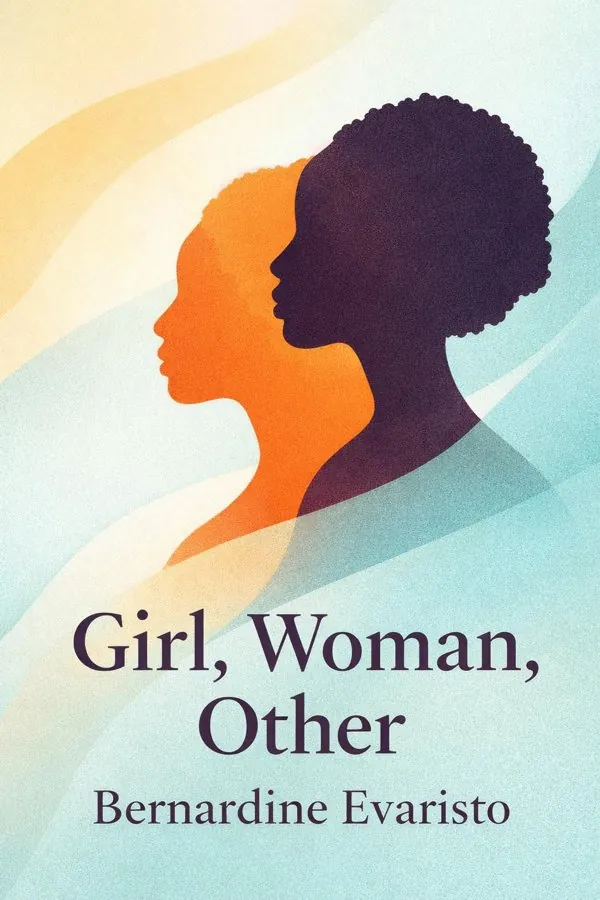
Girl, Woman, Other: Summary & Key Insights
 10 min9 chaptersAudio available
Key Takeaways from Girl, Woman, Other
Success can feel most disorienting when it arrives after years of resistance.
Every generation believes it has invented a sharper language for justice.
Oppression does not always arrive wearing a recognizable face.
Mobility can open doors while quietly closing emotional ones.
A life can look chaotic from the outside and still contain extraordinary discipline.
What Is Girl, Woman, Other About?
Girl, Woman, Other by Bernardine Evaristo is a bestsellers book spanning 8 pages. Girl, Woman, Other is Bernardine Evaristo’s bold, form-breaking 2019 novel about connection, inheritance, and the many ways people create themselves within history. Moving across generations, classes, sexual identities, and regions, it follows twelve interconnected characters—most of them Black British women—as their lives intersect in expected and surprising ways. Set largely in Britain but stretching across more than a century, the novel explores race, feminism, motherhood, queerness, ambition, friendship, migration, and the search for belonging without reducing any character to a single label. What makes this book so powerful is not only what it says, but how it says it. Evaristo uses a fluid, poetic prose style and a polyphonic structure that allows each character to speak from her own complexity. The result is a panoramic portrait of contemporary Britain that feels intimate at every turn. The novel matters because it widens the cultural frame: it places Black British lives, especially women’s lives, at the center of literary attention and treats them as rich, contradictory, and fully human. Evaristo, an acclaimed British writer and the first Black woman to win the Booker Prize, brings exceptional authority, craft, and vision to this unforgettable work.
This FizzRead summary covers all 9 key chapters of Girl, Woman, Other in approximately 10 minutes, distilling the most important ideas, arguments, and takeaways from Bernardine Evaristo's work. Also available as an audio summary and Key Quotes Podcast.
Girl, Woman, Other
Girl, Woman, Other is Bernardine Evaristo’s bold, form-breaking 2019 novel about connection, inheritance, and the many ways people create themselves within history. Moving across generations, classes, sexual identities, and regions, it follows twelve interconnected characters—most of them Black British women—as their lives intersect in expected and surprising ways. Set largely in Britain but stretching across more than a century, the novel explores race, feminism, motherhood, queerness, ambition, friendship, migration, and the search for belonging without reducing any character to a single label.
What makes this book so powerful is not only what it says, but how it says it. Evaristo uses a fluid, poetic prose style and a polyphonic structure that allows each character to speak from her own complexity. The result is a panoramic portrait of contemporary Britain that feels intimate at every turn. The novel matters because it widens the cultural frame: it places Black British lives, especially women’s lives, at the center of literary attention and treats them as rich, contradictory, and fully human. Evaristo, an acclaimed British writer and the first Black woman to win the Booker Prize, brings exceptional authority, craft, and vision to this unforgettable work.
Who Should Read Girl, Woman, Other?
This book is perfect for anyone interested in bestsellers and looking to gain actionable insights in a short read. Whether you're a student, professional, or lifelong learner, the key ideas from Girl, Woman, Other by Bernardine Evaristo will help you think differently.
- ✓Readers who enjoy bestsellers and want practical takeaways
- ✓Professionals looking to apply new ideas to their work and life
- ✓Anyone who wants the core insights of Girl, Woman, Other in just 10 minutes
Want the full summary?
Get instant access to this book summary and 100K+ more with Fizz Moment.
Get Free SummaryAvailable on App Store • Free to download
Key Chapters
Success can feel most disorienting when it arrives after years of resistance. Amma, the novel’s opening character, stands outside the National Theatre on the night her play premieres, and that moment captures one of the book’s deepest insights: achievement does not erase the history of exclusion that came before it. Amma has spent decades as a radical, lesbian, anti-establishment artist making work on the margins. Now the cultural institution that once ignored people like her is finally opening its doors. The question is not only whether she has won, but what winning means when recognition comes from the very structures she once challenged.
Through Amma, Evaristo explores the tension between integrity and acceptance. Amma’s journey is not a simple upward arc from struggle to triumph. She remains skeptical, funny, wounded, proud, and alert to compromise. Her life also shows how politics evolve with age. The certainties of youth soften into reflection, but not surrender. She is still committed to feminist and queer liberation, yet she must confront the fact that younger generations, including her daughter Yazz, inherit these gains without always understanding their cost.
In practical terms, Amma’s story speaks to anyone navigating institutions that were not built for them—whether in the arts, academia, business, or public life. Being invited in can be validating, but it can also provoke questions about identity, loyalty, and the price of visibility.
Actionable takeaway: When you reach a long-sought milestone, pause to ask not just “Have I made it?” but “How do I want to inhabit this new space without abandoning the values that brought me here?”
Every generation believes it has invented a sharper language for justice. Yazz, Amma’s outspoken university-aged daughter, embodies this idea with energy, wit, and occasional arrogance. She is politically alert, socially fluent, and deeply shaped by a world of digital discourse, identity labels, and performative debates. Through Yazz, Evaristo examines what happens when children inherit a revolution but know it mainly as atmosphere rather than struggle.
Yazz represents the strengths and limits of contemporary progressivism. She is informed and articulate, quick to challenge sexism, racism, and hypocrisy. Yet she can also be dismissive of older women whose activism made her confidence possible. Her interactions reveal a familiar pattern: younger people often see themselves as more enlightened, while underestimating the complexity of the battles fought before them. Evaristo does not mock Yazz, nor does she idealize her. Instead, she presents a character in formation—someone trying to understand freedom while still learning humility.
This idea matters beyond the novel. In workplaces, universities, and families, people often talk past one another because they confuse new vocabulary with deeper wisdom. Yazz’s story suggests that social change is strongest when generations listen across differences instead of competing for moral authority.
A useful application is intergenerational conversation. Ask an older relative, mentor, or colleague what conditions shaped their politics, then compare that history with your own assumptions. You may discover continuity where you expected conflict.
Actionable takeaway: Pair conviction with curiosity. Before judging a previous generation’s language or choices, learn what risks they took so that your own voice could be heard more freely.
Oppression does not always arrive wearing a recognizable face. Dominique’s storyline is one of the novel’s most unsettling because it shows how abuse can emerge inside communities that claim liberation. Once part of Amma’s radical feminist circle, Dominique enters a relationship with Nzinga, a charismatic American woman whose political language initially sounds empowering. But over time, ideological certainty becomes control, and intimacy turns into isolation.
Evaristo uses Dominique’s experience to challenge simplistic ideas about power. Abuse is not limited to heterosexual relationships, traditional households, or obviously conservative settings. It can occur wherever one person manipulates another’s need for belonging, purpose, or love. Dominique is not portrayed as weak; rather, she is human. She wants meaning, community, and recognition. Those desires make her vulnerable to someone who presents domination as enlightenment.
This section of the novel has practical relevance because it broadens our understanding of coercion. Warning signs include a partner who cuts you off from friends, insists they know your true self better than you do, or frames disagreement as betrayal. Such dynamics can appear in romantic relationships, activist spaces, workplaces, and even friendships.
Dominique’s arc is also about recovery. Leaving a controlling environment often requires more than one act of bravery. It may involve rebuilding self-trust, reconnecting with others, and accepting that intelligence does not make anyone immune to manipulation.
Actionable takeaway: If a relationship—personal or ideological—demands that you shrink your independent judgment, treat that as a red flag. Freedom should expand your world, not narrow it.
Mobility can open doors while quietly closing emotional ones. Through Carole and her mother Bummi, Evaristo examines the psychological cost of class ascent. Bummi is a Nigerian immigrant who works tirelessly, often in low-status jobs, to secure a better future for her daughter. Carole, brilliant and disciplined, fulfills that dream by excelling academically and entering elite professional spaces. Yet the very education and refinement that elevate her also create distance from the woman whose sacrifices made her success possible.
Their relationship reveals that class is not only about money; it is also about language, manners, shame, aspiration, and the performance of belonging. Carole learns how to move within privileged institutions, but she also internalizes their judgments. She becomes embarrassed by her mother’s accent, style, and social codes. Bummi, meanwhile, sees her daughter’s success as vindication but also senses herself being left behind.
Evaristo’s insight is sharp: upward mobility is often narrated as a triumph of effort, but it can demand emotional disavowal. People who “make it” may feel pressure to edit their backgrounds to appear seamless in elite environments. This is common for first-generation graduates, immigrants, and anyone crossing class lines.
A practical application is to notice when advancement begins to harden into contempt—for your origins, your family, or the communities that shaped you. Growth does not require erasing where you come from. It requires integrating it.
Actionable takeaway: If you are moving into new social or professional spaces, define success broadly enough to include gratitude and connection, not just status. Achievement becomes richer when it does not depend on disowning your roots.
A life can look chaotic from the outside and still contain extraordinary discipline. LaTisha’s story pushes back against easy assumptions about class, motherhood, and female agency. As a working-class Black woman with multiple children, a difficult romantic history, and limited formal opportunity, she is exactly the kind of person society often stereotypes before listening. Evaristo refuses that simplification. Instead, she reveals LaTisha as practical, adaptive, emotionally perceptive, and constantly calculating how to keep life moving under pressure.
LaTisha’s journey reminds readers that competence does not always appear in polished forms. She may not possess institutional prestige, but she develops sharp situational intelligence: how to manage risk, stretch resources, read people, and persist in systems that offer little support. Her life is a patchwork not because she lacks direction, but because survival itself demands improvisation.
This portrayal matters because many social narratives confuse vulnerability with failure. Parents in precarious situations are often judged by middle-class standards that ignore structural inequality. LaTisha’s choices may be messy, but they are made in real conditions, not abstract ideals.
In everyday life, her story encourages a more humane reading of others. The colleague who seems scattered, the parent who appears late, or the person juggling unstable work may be performing remarkable feats of endurance unseen by outsiders.
Actionable takeaway: Before equating polish with capability, look for the skills survival cultivates—resourcefulness, stamina, and improvisation. Respecting those forms of intelligence can change how you evaluate both others and yourself.
Many people build respectable lives only to discover that respectability offers no guarantee of fulfillment. Shirley, a teacher, and her mother Winsome, a Caribbean immigrant of an older generation, embody the burdens of endurance. Shirley has dedicated herself to caring work and social uplift, yet she feels drained by marriage, disappointed by the education system, and underappreciated by those around her. Winsome carries her own history of migration, discipline, thrift, and emotional restraint, shaped by the necessity of making do in an often hostile society.
Together, they reveal how duty can become a trap when it leaves too little room for self-knowledge. Shirley has done many of the “right” things: worked hard, served others, maintained appearances. But beneath this sits resentment, exhaustion, and a sense that life has narrowed. Winsome, meanwhile, represents a generation that often survived by suppressing vulnerability. Love exists, but it is not always spoken in the language younger generations want.
Evaristo uses these characters to ask a difficult question: what happens when women are praised for sacrifice so consistently that they lose contact with desire? This is relevant to teachers, caregivers, professionals, and parents who become identified entirely with their roles.
A practical application is to distinguish commitment from self-erasure. Burnout often begins when obligation becomes identity. Taking stock of resentment can be useful; it often points toward needs that have gone unnamed for too long.
Actionable takeaway: If your life is built around service, regularly ask what replenishes you. Responsibility is sustainable only when it includes honest attention to your own emotional reality.
The self is not a fixed destination but an ongoing negotiation. Through Morgan, a nonbinary social media influencer, and Hattie, an elderly rural woman whose life stretches back across much of the twentieth century, Evaristo creates one of the novel’s most striking pairings. On the surface they seem worlds apart: one is immersed in contemporary conversations about gender fluidity and self-definition, while the other has lived through older, harsher structures of class, labor, and family. Yet their stories reveal a shared truth: identity is always in motion, even when language for it changes.
Morgan’s presence brings the novel decisively into the present, where categories of gender are being rethought and contested. Evaristo treats this not as trend but as a serious attempt to live more truthfully. At the same time, Hattie’s long life reminds readers that people have always exceeded the labels available to them. Past generations may not have had current terminology, but they, too, contained contradictions, secrets, reinventions, and unlived possibilities.
This dual perspective has practical value because it softens the false divide between “traditional” and “new” identities. Human beings have always been more complex than social norms permit. The language evolves, but the underlying search for recognition is enduring.
In daily life, this can translate into more generous listening. Instead of demanding that others fit your familiar categories, ask how they understand themselves and what forms of respect matter most to them.
Actionable takeaway: Treat identity as a conversation rather than a verdict. Allow people—including yourself—the dignity of becoming, revising, and naming life on terms that feel more truthful over time.
No life is solitary for long; we are constantly being shaped by people we barely notice. One of Girl, Woman, Other’s greatest achievements is structural rather than thematic: Evaristo builds a chorus instead of a single plotline. Characters connect through family, friendship, school, work, romance, and coincidence. A teacher influences a student. A mother’s private pain echoes in a daughter’s ambition. A hidden ancestry reframes several lives at once. The novel’s form itself becomes an argument that identity is relational.
This matters because contemporary culture often encourages highly individualistic stories of self-making. We are told to imagine ourselves as self-authored brands, heroes, or isolated strivers. Evaristo offers a richer model. Each person is singular, but no one is self-created. We inherit language, trauma, desire, expectations, and opportunities from others. Even rebellion usually begins in relation to what came before.
The book’s interconnected design also encourages empathy. A person who seems irritating in one chapter may become legible in another. Judgment softens when context expands. This has real-world application in families, organizations, and communities, where conflict often grows from seeing people only in one role instead of across the fullness of their lives.
One practical exercise is to map your own network of influence: who shaped your politics, your fears, your habits, your ambitions? Such reflection often reveals dependence not as weakness but as the basic condition of being human.
Actionable takeaway: When evaluating someone—or yourself—look beyond isolated behavior to the web of relationships and histories around it. Understanding deepens when you ask not only “What did they do?” but “What made this life possible?”
All Chapters in Girl, Woman, Other
About the Author
Bernardine Evaristo is a British author born in London in 1959 to an English mother and a Nigerian father. She is widely recognized for expanding the landscape of British literature through works that foreground the African diaspora, mixed heritage, gender, sexuality, and overlooked histories. A novelist, poet, playwright, and academic, Evaristo is known for blending formal innovation with sharp social observation and emotional depth. Her books include Lara, Blonde Roots, Mr Loverman, and Girl, Woman, Other, the novel that brought her international acclaim. In 2019, she became the first Black woman to win the Booker Prize for Girl, Woman, Other. Beyond her writing, she has been an influential advocate for diversity in publishing and the arts, helping create greater visibility for underrepresented voices in literature.
Get This Summary in Your Preferred Format
Read or listen to the Girl, Woman, Other summary by Bernardine Evaristo anytime, anywhere. FizzRead offers multiple formats so you can learn on your terms — all free.
Available formats: App · Audio · PDF · EPUB — All included free with FizzRead
Download Girl, Woman, Other PDF and EPUB Summary
Key Quotes from Girl, Woman, Other
“Success can feel most disorienting when it arrives after years of resistance.”
“Every generation believes it has invented a sharper language for justice.”
“Oppression does not always arrive wearing a recognizable face.”
“Mobility can open doors while quietly closing emotional ones.”
“A life can look chaotic from the outside and still contain extraordinary discipline.”
Frequently Asked Questions about Girl, Woman, Other
Girl, Woman, Other by Bernardine Evaristo is a bestsellers book that explores key ideas across 9 chapters. Girl, Woman, Other is Bernardine Evaristo’s bold, form-breaking 2019 novel about connection, inheritance, and the many ways people create themselves within history. Moving across generations, classes, sexual identities, and regions, it follows twelve interconnected characters—most of them Black British women—as their lives intersect in expected and surprising ways. Set largely in Britain but stretching across more than a century, the novel explores race, feminism, motherhood, queerness, ambition, friendship, migration, and the search for belonging without reducing any character to a single label. What makes this book so powerful is not only what it says, but how it says it. Evaristo uses a fluid, poetic prose style and a polyphonic structure that allows each character to speak from her own complexity. The result is a panoramic portrait of contemporary Britain that feels intimate at every turn. The novel matters because it widens the cultural frame: it places Black British lives, especially women’s lives, at the center of literary attention and treats them as rich, contradictory, and fully human. Evaristo, an acclaimed British writer and the first Black woman to win the Booker Prize, brings exceptional authority, craft, and vision to this unforgettable work.
More by Bernardine Evaristo




You Might Also Like

The Godfather
Mario Puzo
10 min
The Handmaid's Tale
Margaret Atwood
10 min
The Hunger Games
Suzanne Collins
10 min
The Nightingale
Kristin Hannah
10 min
The Seven Husbands of Evelyn Hugo
Taylor Jenkins Reid
10 min
Backwater Justice
Fern Michaels
10 minBrowse by Category
Ready to read Girl, Woman, Other?
Get the full summary and 100K+ more books with Fizz Moment.