
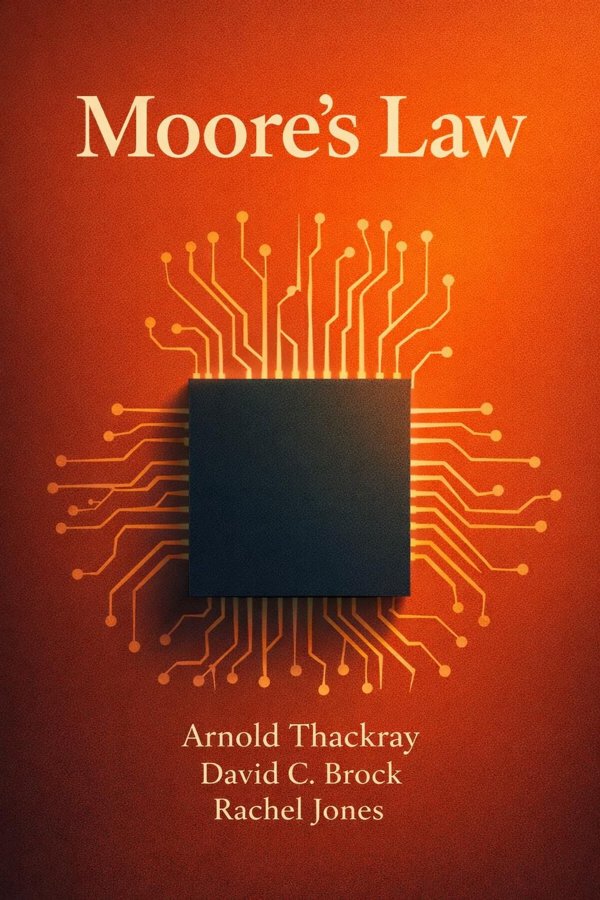
Moore's Law: Summary & Key Insights
by Arnold Thackray, David C. Brock, Rachel Jones
 10 min5 chaptersAudio available
What Is Moore's Law About?
Moore's Law by Arnold Thackray, David C. Brock, Rachel Jones is a biographies book spanning 5 pages. Moore's Law: The Life of Gordon Moore, Silicon Valley's Quiet Revolutionary es una biografía detallada del cofundador de Intel, Gordon Moore, quien formuló la famosa ley que predijo el crecimiento exponencial de la capacidad de los microchips. El libro explora su vida personal, su papel en el desarrollo de la industria de los semiconductores y su impacto en la revolución tecnológica global.
This FizzRead summary covers all 5 key chapters of Moore's Law in approximately 10 minutes, distilling the most important ideas, arguments, and takeaways from Arnold Thackray, David C. Brock, Rachel Jones's work. Also available as an audio summary and Key Quotes Podcast.
Moore's Law
Moore's Law: The Life of Gordon Moore, Silicon Valley's Quiet Revolutionary es una biografía detallada del cofundador de Intel, Gordon Moore, quien formuló la famosa ley que predijo el crecimiento exponencial de la capacidad de los microchips. El libro explora su vida personal, su papel en el desarrollo de la industria de los semiconductores y su impacto en la revolución tecnológica global.
Who Should Read Moore's Law?
This book is perfect for anyone interested in biographies and looking to gain actionable insights in a short read. Whether you're a student, professional, or lifelong learner, the key ideas from Moore's Law by Arnold Thackray, David C. Brock, Rachel Jones will help you think differently.
- ✓Readers who enjoy biographies and want practical takeaways
- ✓Professionals looking to apply new ideas to their work and life
- ✓Anyone who wants the core insights of Moore's Law in just 10 minutes
Want the full summary?
Get instant access to this book summary and 100K+ more with Fizz Moment.
Get Free SummaryAvailable on App Store • Free to download
Key Chapters
Gordon Moore’s story begins in the rural simplicity of Pescadero and the coastal expanses of San Mateo County, California. It was a world that offered space to explore and the freedom to tinker—perfect for a boy fascinated by how things worked. The biography paints a vivid picture of a young Moore scavenging chemicals, performing simple experiments, and cultivating a genuine love of chemistry. This curiosity, the authors suggest, was not a passing childhood fancy but the bedrock of a lifelong relationship with the scientific method.
At San Jose State College and later at the University of California, Berkeley, Moore’s fascination matured into formal study. At Berkeley, he fell in love with the elegance and precision of chemical analysis, absorbing the postwar excitement that surrounded the emerging physical sciences. The professors at Berkeley imbued him with a rigor that would define his later career—an insistence that intuition be verified by data and that every result be reproducible. It was at Caltech, though, that Moore found his intellectual home. There, surrounded by some of the most demanding scientific minds of his generation, he refined both his analytical skills and his belief in the practical application of science.
Through these formative years, what stands out is Moore’s balance of humility and ambition. He was not driven by wealth or fame, but by an internal compass pointing toward precision and usefulness. Thackray and his coauthors emphasize that this quiet confidence became his hallmark in every phase of his career. His education was not just an accumulation of knowledge, but the shaping of a disciplined observer—someone who could look at a pattern of data and detect the hidden rhythm of progress.
After earning his doctorate, Moore joined William Shockley’s laboratory, a new firm built around the Nobel laureate’s pioneering transistor research. Yet, Shockley’s brilliance came packaged with authoritarian control and erratic behavior. The young scientists under him—among them Moore and Robert Noyce—felt increasingly stifled. In one of Silicon Valley’s foundational stories, they decided to leave en masse, forming what history would remember as the 'Traitorous Eight.'
Thackray and his colleagues recount this episode not as a tale of rebellion, but as a decisive act of self-determination. Moore’s decision to join Fairchild Semiconductor was guided less by defiance than by scientific pragmatism: he wanted a place where innovation could flourish free from intimidation. Fairchild quickly became the crucible of the semiconductor revolution. It was here that Moore’s skill as a chemist found its industrial expression. He worked on processes to purify silicon, refine transistor designs, and streamline mass production. Under his meticulous direction and Noyce’s visionary energy, Fairchild produced the planar transistor—a device that would revolutionize electronics by making components smaller, cheaper, and easier to integrate.
Through this chapter, the biography captures Moore’s temperament: collaborative yet quietly defiant, deeply focused on the technical details yet always aware of their broader implications. Fairchild’s culture reflected his ethos—flat hierarchies, open communication, and a belief that science could power economic transformation. It was the first true incarnation of Silicon Valley’s innovative spirit.
+ 3 more chapters — available in the FizzRead app
All Chapters in Moore's Law
About the Authors
Arnold Thackray es historiador de la ciencia y fundador del Chemical Heritage Foundation. David C. Brock es historiador especializado en tecnología y semiconductores. Rachel Jones es escritora y periodista científica.
Get This Summary in Your Preferred Format
Read or listen to the Moore's Law summary by Arnold Thackray, David C. Brock, Rachel Jones anytime, anywhere. FizzRead offers multiple formats so you can learn on your terms — all free.
Available formats: App · Audio · PDF · EPUB — All included free with FizzRead
Download Moore's Law PDF and EPUB Summary
Key Quotes from Moore's Law
“Gordon Moore’s story begins in the rural simplicity of Pescadero and the coastal expanses of San Mateo County, California.”
“After earning his doctorate, Moore joined William Shockley’s laboratory, a new firm built around the Nobel laureate’s pioneering transistor research.”
Frequently Asked Questions about Moore's Law
Moore's Law by Arnold Thackray, David C. Brock, Rachel Jones is a biographies book that explores key ideas across 5 chapters. Moore's Law: The Life of Gordon Moore, Silicon Valley's Quiet Revolutionary es una biografía detallada del cofundador de Intel, Gordon Moore, quien formuló la famosa ley que predijo el crecimiento exponencial de la capacidad de los microchips. El libro explora su vida personal, su papel en el desarrollo de la industria de los semiconductores y su impacto en la revolución tecnológica global.
You Might Also Like

An American Marriage
Tayari Jones
10 min
Benjamin Franklin: An American Life
Walter Isaacson
10 min
I Know Why The Caged Bird Sings
Maya Angelou
10 min
Long Walk to Freedom
Nelson Mandela
10 min
Persepolis
Marjane Satrapi
10 min
Surely You're Joking, Mr. Feynman!
Richard P. Feynman
10 minBrowse by Category
Ready to read Moore's Law?
Get the full summary and 100K+ more books with Fizz Moment.