
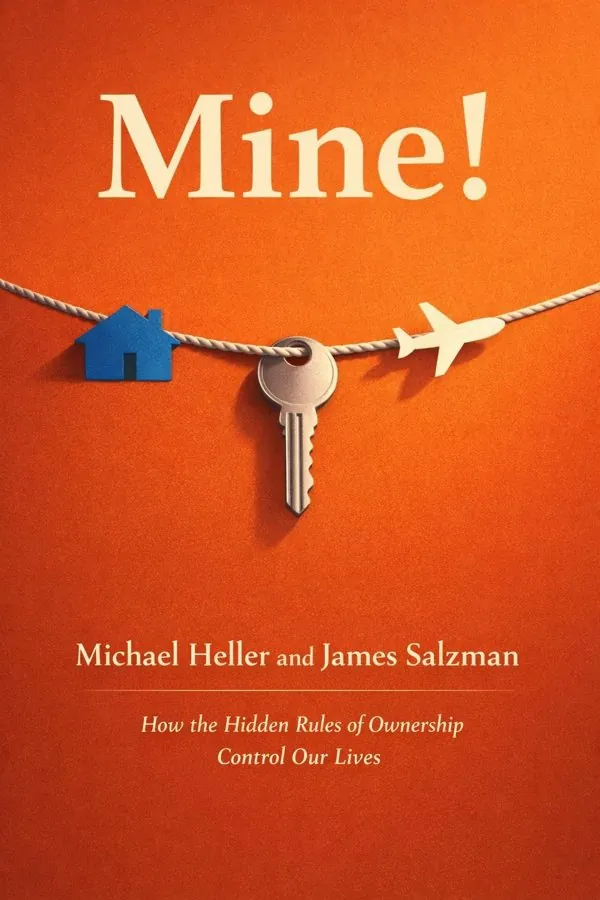
Mine!: How the Hidden Rules of Ownership Control Our Lives: Summary & Key Insights
by Michael Heller, James Salzman
 10 min9 chaptersAudio available
Key Takeaways from Mine!: How the Hidden Rules of Ownership Control Our Lives
The fastest way to understand property is to notice when it breaks down.
People rarely argue about ownership in abstract legal terms.
One of the oldest ownership instincts is brutally simple: if I control it, it is mine.
We often believe effort should be rewarded.
Nothing feels more inherently ours than our own body, yet the book shows that self-ownership is one of the most complex and contested ideas in law.
What Is Mine!: How the Hidden Rules of Ownership Control Our Lives About?
Mine!: How the Hidden Rules of Ownership Control Our Lives by Michael Heller and James Salzman is a law_crime book spanning 11 pages. Ownership seems obvious until it suddenly isn’t. We assume we know what belongs to us, what belongs to others, and what rules decide the boundary. But everyday life is full of ownership conflicts that reveal how unstable those assumptions really are: a shoveled parking spot, a reserved seat, an idea at work, your personal data online, even parts of your own body. In Mine!, legal scholars Michael Heller and James Salzman uncover the invisible system of rules, customs, and moral intuitions that quietly governs these disputes. Their central insight is that ownership is not just about law on paper. It is also shaped by social expectations, historical habits, economic incentives, and raw power. By showing how people make claims over land, objects, identities, inventions, genes, and digital traces, the authors reveal that property is one of the deepest organizing forces in modern life. It determines not only who gets what, but also who has freedom, security, dignity, and control. Heller, a leading property theorist, and Salzman, an expert in environmental and regulatory law, bring authority, clarity, and wit to a subject that affects everyone. This book turns ordinary disputes into a sharp guide to how society really works.
This FizzRead summary covers all 9 key chapters of Mine!: How the Hidden Rules of Ownership Control Our Lives in approximately 10 minutes, distilling the most important ideas, arguments, and takeaways from Michael Heller and James Salzman's work. Also available as an audio summary and Key Quotes Podcast.
Mine!: How the Hidden Rules of Ownership Control Our Lives
Ownership seems obvious until it suddenly isn’t. We assume we know what belongs to us, what belongs to others, and what rules decide the boundary. But everyday life is full of ownership conflicts that reveal how unstable those assumptions really are: a shoveled parking spot, a reserved seat, an idea at work, your personal data online, even parts of your own body. In Mine!, legal scholars Michael Heller and James Salzman uncover the invisible system of rules, customs, and moral intuitions that quietly governs these disputes.
Their central insight is that ownership is not just about law on paper. It is also shaped by social expectations, historical habits, economic incentives, and raw power. By showing how people make claims over land, objects, identities, inventions, genes, and digital traces, the authors reveal that property is one of the deepest organizing forces in modern life. It determines not only who gets what, but also who has freedom, security, dignity, and control.
Heller, a leading property theorist, and Salzman, an expert in environmental and regulatory law, bring authority, clarity, and wit to a subject that affects everyone. This book turns ordinary disputes into a sharp guide to how society really works.
Who Should Read Mine!: How the Hidden Rules of Ownership Control Our Lives?
This book is perfect for anyone interested in law_crime and looking to gain actionable insights in a short read. Whether you're a student, professional, or lifelong learner, the key ideas from Mine!: How the Hidden Rules of Ownership Control Our Lives by Michael Heller and James Salzman will help you think differently.
- ✓Readers who enjoy law_crime and want practical takeaways
- ✓Professionals looking to apply new ideas to their work and life
- ✓Anyone who wants the core insights of Mine!: How the Hidden Rules of Ownership Control Our Lives in just 10 minutes
Want the full summary?
Get instant access to this book summary and 100K+ more with Fizz Moment.
Get Free SummaryAvailable on App Store • Free to download
Key Chapters
The fastest way to understand property is to notice when it breaks down. Ownership often feels natural and settled, but the authors show that we usually become aware of it only in moments of friction: someone “saves” a seat before a show, shovels out a parking space after a snowstorm, claims a desk in a shared office, or insists that a borrowed item should have been returned already. These disputes seem trivial, yet they expose something profound. Ownership is not self-evident. It depends on hidden rules that people absorb from law, habit, and social norms.
Heller and Salzman use these familiar puzzles to demonstrate that ownership is less like a simple fact and more like a social technology. We rely on shared expectations to coordinate behavior, reduce conflict, and decide when claims are legitimate. But those expectations are often unstable. One person thinks labor creates ownership: “I shoveled the space, so it’s mine.” Another thinks public rules matter more: “It’s a public street, so no one owns it.” Both are drawing on recognizable ownership logics.
This matters because the same hidden rules shape much larger conflicts over housing, ideas, privacy, natural resources, and bodily autonomy. Once you see that property claims rest on competing stories rather than obvious truths, you begin to understand why ownership disputes are emotionally charged and politically important.
A useful takeaway is to pause whenever a conflict feels like “common sense” and ask: what rule is actually being invoked here—law, labor, possession, fairness, or custom? Naming the rule is the first step toward understanding the dispute.
People rarely argue about ownership in abstract legal terms. Instead, they tell stories. One of the book’s most powerful ideas is that across cultures and legal systems, ownership claims tend to rely on a limited set of recurring narratives. These include first possession, labor and investment, control, attachment, family connection, and rights rooted in personhood or identity. Each story offers a different answer to the question: why should this be mine?
The brilliance of this framework is that it makes ownership disputes readable. If two neighbors fight over a boundary tree, one may rely on possession and legal title, while the other appeals to years of care and emotional attachment. If a company uses customer data, it may claim control through contract, while users may claim personal ownership because the data reflects their identity. The stories differ, but the structure is similar.
None of these stories is universally correct. Each works well in some contexts and badly in others. “First come” can reward initiative, but it can also entrench unfair advantage. Labor can justify reward, but not every effort creates a valid claim. Family inheritance preserves continuity, yet it may perpetuate inequality. The point is not to find one master rule. It is to recognize that ownership is built from competing moral grammars.
In practical life, this insight helps you decode conflicts at work, online, in families, and in public policy. When people disagree about what belongs to whom, they are often not disagreeing over facts alone. They are relying on different ownership stories.
The actionable takeaway is simple: when evaluating any ownership dispute, identify which story each side is telling. That shift often clarifies why agreement feels so difficult—and where compromise may be possible.
One of the oldest ownership instincts is brutally simple: if I control it, it is mine. Possession carries force because it is visible, practical, and easy for others to recognize. A person sitting in a chair, occupying land, holding an object, or controlling access to a resource often gains an immediate advantage, even before formal legal rights are sorted out. Heller and Salzman show that possession is not just a legal principle; it is a deeply rooted social heuristic.
This is why so many ownership systems begin by protecting possession. It reduces chaos. If every object were always open to contest, social life would become unmanageable. But possession can also distort justice. Squatters may gain rights through long occupation; colonial powers historically converted possession into title; companies that control digital platforms may behave as if user spaces and user data are simply theirs because they hold the infrastructure.
In everyday life, possession influences more than we admit. In offices, people mark desks with laptops and coffee mugs. In households, family members treat drawers, shelves, and corners as territory. In public space, a jacket on a chair functions like a temporary claim. These habits work because others usually respect them, but the norm is fragile when stakes rise or expectations differ.
The authors encourage readers to see both the usefulness and danger of possession-based thinking. Control can establish order, yet it can also reward power over legitimacy. Just because someone has their hands on something does not mean their claim is morally or legally strongest.
The practical lesson is to distinguish between physical control and justified ownership. Before accepting a claim based on possession, ask whether it rests on fairness, law, consent, or merely advantage.
We often believe effort should be rewarded. If you work on something, improve it, build it, or care for it, your claim feels stronger. Heller and Salzman show how deeply this intuition runs. The person who gardens a neglected plot, repairs a broken house, curates a shared project, or spends hours clearing snow from a parking spot feels entitled because labor creates a sense of moral desert. Ownership, in this view, is not just about taking possession; it is about putting part of yourself into the thing.
Attachment adds another layer. Sometimes what matters is not market value but personal significance. A worn-out childhood blanket, a family home, or a pet carries meaning that exceeds legal title or monetary worth. Law sometimes recognizes this through protections for heirlooms, homes, and personal effects, but social norms often go further. We intuitively treat emotionally charged objects differently from interchangeable ones.
Yet labor and attachment do not always align neatly with law. An employee may pour creativity into work product owned by the firm. A tenant may lovingly improve a property without gaining any ownership stake. A birth parent, adoptive parent, and child may all have powerful attachments that legal categories simplify imperfectly. That tension is one of the book’s recurring themes: ownership rules often struggle to reflect human investment.
The insight has practical importance in workplaces, families, and communities. Conflicts intensify when people feel that their effort or emotional connection has been ignored, even if the legal answer seems clear.
The takeaway is to recognize that ownership disputes are not only about rules but about recognition. If you manage shared spaces, projects, or relationships, acknowledge labor and attachment early. Doing so can prevent resentment long before a legal conflict begins.
Nothing feels more inherently ours than our own body, yet the book shows that self-ownership is one of the most complex and contested ideas in law. We speak easily of bodily autonomy, but rights over organs, tissue samples, genetic material, reproductive capacity, and medical information are fragmented and conditional. Once body parts are removed, stored, tested, or commercialized, the question “Whose is this?” becomes surprisingly difficult.
Heller and Salzman explore the uneasy border between personhood and property. On one hand, treating the body as property can support autonomy: if my body is mine, others should not use it without consent. On the other hand, full commodification raises moral concerns. Should organs be bought and sold? Can sperm, eggs, embryos, or cell lines be patented, inherited, or controlled by institutions? Can companies profit from genetic information derived from individuals who never truly understood what they were giving up?
These questions matter because modern medicine and biotechnology constantly convert bodily material into data, products, and profit. Legal systems often lag behind these transformations, leaving individuals with incomplete control over things they assumed were deeply personal. The issue is no longer theoretical. Health apps collect intimate metrics, DNA testing firms build databases, and research institutions monetize discoveries built partly from human tissue and information.
The authors do not offer one easy formula, but they force readers to see that bodily rights are shaped by law, ethics, markets, and institutional power. Self-ownership is not a settled fact; it is an ongoing social negotiation.
The actionable takeaway is to treat consent and control over bodily data and materials with more seriousness than convenience culture encourages. Read permissions, ask questions, and assume that what feels personal may still be governed by someone else’s rules.
Inheritance is often described as the transfer of property after death, but Heller and Salzman show that it does much more than move assets. It transmits identity, obligation, memory, privilege, and conflict. Family ownership is never purely economic. A house, a ring, a business, or a collection may symbolize continuity, love, sacrifice, or status. That emotional charge is why inheritance disputes can become so bitter. People are not only fighting over objects; they are fighting over recognition and belonging.
The book explains that family claims draw on special ownership stories. We accept that relatives may have rights others do not because kinship creates duties and expectations across generations. Parents save for children, children care for aging parents, and families preserve property as a form of legacy. Yet inheritance also raises hard questions about fairness. Why should birth determine access to resources? When does honoring family intention become entrenching inequality?
Modern life complicates these issues further. Blended families, adoption, surrogacy, estrangement, and global mobility make “who counts as family” less obvious than traditional property law once assumed. Even within close families, informal promises can clash with written wills, and caregiving labor may go unrewarded if ownership rules privilege title over contribution.
These tensions appear everywhere, from disputes over vacation homes to succession planning in family businesses. The authors reveal that inheritance law is not merely technical. It encodes society’s answers to questions about duty, desert, and the role of family in distributing opportunity.
The practical takeaway is to make ownership intentions explicit before conflict erupts. Clear estate planning, open discussion, and acknowledgment of both financial and caregiving contributions can protect relationships that ambiguity often destroys.
Much of what matters today is intangible, and that has scrambled traditional ideas of ownership. We no longer own only land, cars, books, and furniture. We also interact with software, subscriptions, passwords, playlists, avatars, photos in the cloud, and vast quantities of personal data. Heller and Salzman show that in digital environments, the language of ownership is often misleading. What feels like ownership may legally be a license, temporary access right, or conditional permission that can be modified or revoked.
This is why people are surprised when an e-book disappears, a gaming account is suspended, a social media platform controls content visibility, or a smart device stops functioning after a software change. The old intuition—“I paid for it, so it’s mine”—does not reliably hold in digital markets. Companies design ecosystems where users feel possessive, but legal fine print often preserves control for the platform.
Intellectual property adds another layer. Society wants to reward creators and innovators, but excessive rights can block follow-on creativity, access, and competition. The challenge is to protect invention without turning culture and information into fenced-off territory. Data intensifies the problem further. Your online behavior generates value, but ownership of that value is diffuse and often captured by firms that aggregate, analyze, and monetize it.
The authors make clear that digital property is not a niche issue. It affects identity, privacy, expression, and economic power. As more of life moves online, hidden ownership rules increasingly govern daily freedom.
The actionable takeaway is to stop assuming digital access equals ownership. Check whether you truly own, license, or merely borrow digital goods and services, and prioritize platforms that offer portability, transparency, and meaningful user control.
Perhaps the book’s deepest message is that ownership is never just about things. It is about power: who gets to decide, exclude, profit, inherit, access, and belong. Hidden ownership rules structure social life so thoroughly that they can appear natural even when they are historically contingent and politically contested. Heller and Salzman urge readers to see that what counts as property has expanded and shifted over time, often in response to technology, markets, moral change, and social struggle.
This perspective explains why ownership battles are really battles over social order. Debates over housing rights, intellectual property, Indigenous land claims, reproductive rights, environmental protection, and platform control are all arguments about which ownership stories society should prioritize. Law does not merely recognize ownership; it actively creates and allocates it. That means property systems can entrench inequality, but they can also be redesigned.
The authors do not dismiss ownership. Stable property rights can protect liberty, investment, and personal security. But they reject the myth that existing rules are fixed or neutral. Every ownership regime makes choices: whose labor counts, whose possession matters, which attachments deserve respect, and which interests are ignored. Seeing those choices opens the door to reform.
For readers, this is an empowering conclusion. You do not need to accept ownership categories as inevitable simply because they are familiar. The parking space argument and the data privacy debate are points on the same spectrum: both reveal how societies draw lines of control and justify them.
The actionable takeaway is to treat ownership as a design problem, not a natural fact. When a rule seems unfair or outdated, ask not only “Who owns this now?” but also “What rule created that result, and what alternative rule might work better?”
All Chapters in Mine!: How the Hidden Rules of Ownership Control Our Lives
About the Authors
Michael Heller is a leading property law scholar and professor at Columbia Law School. He is best known for developing the idea of the “tragedy of the anticommons,” a concept that explains how excessive or fragmented ownership rights can block productive use. James Salzman is a distinguished legal scholar in environmental and administrative law, with academic appointments linked to UCLA and UC Santa Barbara. His work focuses on environmental governance, natural resources, and the ways regulation shapes public and private rights. Together, Heller and Salzman bring a rare combination of theoretical depth and practical legal insight. In Mine!, they use that expertise to explain how ownership works not only in courts and statutes, but also in ordinary social life, modern technology, bodily autonomy, and environmental conflict.
Get This Summary in Your Preferred Format
Read or listen to the Mine!: How the Hidden Rules of Ownership Control Our Lives summary by Michael Heller and James Salzman anytime, anywhere. FizzRead offers multiple formats so you can learn on your terms — all free.
Available formats: App · Audio · PDF · EPUB — All included free with FizzRead
Download Mine!: How the Hidden Rules of Ownership Control Our Lives PDF and EPUB Summary
Key Quotes from Mine!: How the Hidden Rules of Ownership Control Our Lives
“The fastest way to understand property is to notice when it breaks down.”
“People rarely argue about ownership in abstract legal terms.”
“One of the oldest ownership instincts is brutally simple: if I control it, it is mine.”
“We often believe effort should be rewarded.”
“Nothing feels more inherently ours than our own body, yet the book shows that self-ownership is one of the most complex and contested ideas in law.”
Frequently Asked Questions about Mine!: How the Hidden Rules of Ownership Control Our Lives
Mine!: How the Hidden Rules of Ownership Control Our Lives by Michael Heller and James Salzman is a law_crime book that explores key ideas across 9 chapters. Ownership seems obvious until it suddenly isn’t. We assume we know what belongs to us, what belongs to others, and what rules decide the boundary. But everyday life is full of ownership conflicts that reveal how unstable those assumptions really are: a shoveled parking spot, a reserved seat, an idea at work, your personal data online, even parts of your own body. In Mine!, legal scholars Michael Heller and James Salzman uncover the invisible system of rules, customs, and moral intuitions that quietly governs these disputes. Their central insight is that ownership is not just about law on paper. It is also shaped by social expectations, historical habits, economic incentives, and raw power. By showing how people make claims over land, objects, identities, inventions, genes, and digital traces, the authors reveal that property is one of the deepest organizing forces in modern life. It determines not only who gets what, but also who has freedom, security, dignity, and control. Heller, a leading property theorist, and Salzman, an expert in environmental and regulatory law, bring authority, clarity, and wit to a subject that affects everyone. This book turns ordinary disputes into a sharp guide to how society really works.
You Might Also Like
Abortion and the Law in America: Roe v. Wade to the Present
Mary Ziegler
10 min
Black Edge: Inside Information, Dirty Money, and the Quest to Bring Down the Most Wanted Man on Wall Street
Sheelah Kolhatkar
10 min
Blood Feud: The Man Who Blew the Whistle on One of the Deadliest Prescription Drugs Ever
Kathleen Sharp
10 min
Catch and Kill: Lies, Spies, and a Conspiracy to Protect Predators
Ronan Farrow
10 min
Chaos: Charles Manson, the CIA, and the Secret History of the Sixties
Tom O'Neill with Dan Piepenbring
10 min
Code and Other Laws of Cyberspace
Lawrence Lessig
10 minBrowse by Category
Ready to read Mine!: How the Hidden Rules of Ownership Control Our Lives?
Get the full summary and 100K+ more books with Fizz Moment.