
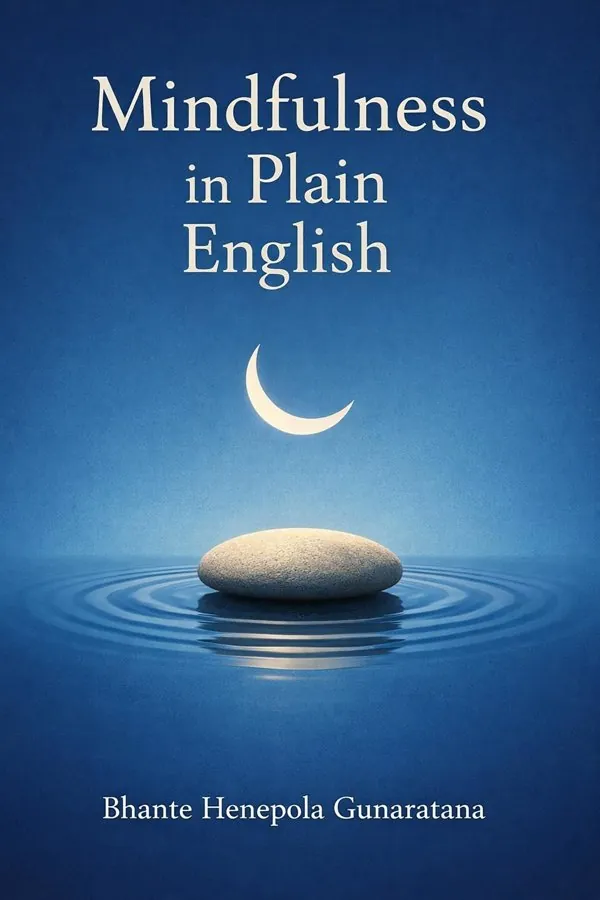
Mindfulness in Plain English: Summary & Key Insights
 10 min9 chaptersAudio available
Key Takeaways from Mindfulness in Plain English
Most people begin meditation hoping to feel better, but the deeper gift of practice is that it helps us see more clearly.
We often assume that awareness is automatic, yet much of life is spent in distraction, memory, anticipation, and interpretation.
Insight does not come from believing spiritual ideas; it comes from observing the mind carefully enough to understand its patterns.
A meditation practice succeeds less through inspiration than through consistency.
The body is not separate from the mind; how you sit influences how you attend.
What Is Mindfulness in Plain English About?
Mindfulness in Plain English by Bhante Henepola Gunaratana is a eastern_wisdom book spanning 12 pages. Mindfulness in Plain English is one of the clearest modern introductions to meditation ever written. In this practical and approachable guide, Bhante Henepola Gunaratana explains Vipassana, or insight meditation, without mysticism, jargon, or vague promises. He shows that meditation is not about escaping life, suppressing thoughts, or becoming instantly peaceful. It is a disciplined way of learning how the mind works, so that we can meet experience with clarity instead of confusion. The book matters because it takes a practice that often seems intimidating and makes it usable for ordinary people. Whether you are dealing with stress, restlessness, emotional reactivity, or a deeper search for wisdom, Gunaratana offers a step-by-step method for training attention and developing insight. His authority comes not only from scholarship, but from decades of monastic practice and teaching in the Theravada Buddhist tradition. What makes this book enduring is its rare combination of warmth, honesty, and precision: it respects the depth of meditation while making it accessible enough for anyone willing to sit, observe, and begin.
This FizzRead summary covers all 9 key chapters of Mindfulness in Plain English in approximately 10 minutes, distilling the most important ideas, arguments, and takeaways from Bhante Henepola Gunaratana's work. Also available as an audio summary and Key Quotes Podcast.
Mindfulness in Plain English
Mindfulness in Plain English is one of the clearest modern introductions to meditation ever written. In this practical and approachable guide, Bhante Henepola Gunaratana explains Vipassana, or insight meditation, without mysticism, jargon, or vague promises. He shows that meditation is not about escaping life, suppressing thoughts, or becoming instantly peaceful. It is a disciplined way of learning how the mind works, so that we can meet experience with clarity instead of confusion. The book matters because it takes a practice that often seems intimidating and makes it usable for ordinary people. Whether you are dealing with stress, restlessness, emotional reactivity, or a deeper search for wisdom, Gunaratana offers a step-by-step method for training attention and developing insight. His authority comes not only from scholarship, but from decades of monastic practice and teaching in the Theravada Buddhist tradition. What makes this book enduring is its rare combination of warmth, honesty, and precision: it respects the depth of meditation while making it accessible enough for anyone willing to sit, observe, and begin.
Who Should Read Mindfulness in Plain English?
This book is perfect for anyone interested in eastern_wisdom and looking to gain actionable insights in a short read. Whether you're a student, professional, or lifelong learner, the key ideas from Mindfulness in Plain English by Bhante Henepola Gunaratana will help you think differently.
- ✓Readers who enjoy eastern_wisdom and want practical takeaways
- ✓Professionals looking to apply new ideas to their work and life
- ✓Anyone who wants the core insights of Mindfulness in Plain English in just 10 minutes
Want the full summary?
Get instant access to this book summary and 100K+ more with Fizz Moment.
Get Free SummaryAvailable on App Store • Free to download
Key Chapters
Most people begin meditation hoping to feel better, but the deeper gift of practice is that it helps us see more clearly. Gunaratana dismantles the common fantasy that meditation is a way to float above life, silence the mind forever, or withdraw from the world’s messiness. In his view, meditation is not retreat from reality but intimate contact with it. It trains us to notice what is actually happening in the body and mind instead of living through habit, impulse, and emotional momentum.
This is why meditation can feel surprisingly uncomfortable at first. When you sit quietly, you meet the very restlessness, irritation, fear, and craving that usually stay hidden beneath busyness. That encounter is not failure. It is the practice. You begin to recognize that suffering often comes less from events themselves than from the mind’s reactions to them: resistance, storytelling, grasping, and avoidance.
In practical terms, this changes how you approach daily problems. A difficult conversation at work becomes a chance to notice defensiveness as it arises. A stressful commute becomes an opportunity to observe impatience without feeding it. Even physical discomfort can be studied instead of immediately resisted. Meditation teaches response instead of reflex.
Gunaratana emphasizes that the point is not to manufacture a special state, but to cultivate a different relationship to experience. Calm may come, but it comes as a byproduct of understanding, not as something to be forced.
Actionable takeaway: Stop judging meditation by whether it feels pleasant. Judge it by whether it helps you notice your reactions more clearly and meet life with more honesty and steadiness.
We often assume that awareness is automatic, yet much of life is spent in distraction, memory, anticipation, and interpretation. Gunaratana explains mindfulness, or sati, as direct awareness of what is happening right now, exactly as it is. It is not analysis, self-commentary, or intellectual reflection. It is the simple but powerful act of knowing experience while it is unfolding.
This distinction matters. Suppose you feel anger. Usually, the mind jumps into stories: who was wrong, what should have happened, what you will say next. Mindfulness interrupts that chain. Instead of becoming the anger, you observe it: heat in the body, tightening in the jaw, fast thoughts, pressure in the chest. That observing does not suppress the emotion. It reveals it. And in revealing it, mindfulness weakens the automatic identification that makes emotions so consuming.
Gunaratana presents mindfulness as nonjudgmental but not passive. It sees clearly without immediately dividing experience into good and bad, wanted and unwanted. This does not make you indifferent. It makes you less reactive, which often leads to wiser action. In daily life, mindfulness can appear in small moments: noticing the first bite of food instead of eating unconsciously, hearing someone fully before preparing your reply, recognizing anxiety before it turns into panic.
Mindfulness also has a stabilizing quality. The more often you return to present-moment awareness, the less you are dragged around by every passing impulse. You discover that attention can be trained.
Actionable takeaway: Several times today, pause for ten seconds and notice one breath, one body sensation, and one mental state without trying to change any of them.
Insight does not come from believing spiritual ideas; it comes from observing the mind carefully enough to understand its patterns. That is the heart of Vipassana meditation. Gunaratana describes Vipassana as a method of seeing deeply into the nature of experience by paying close attention to the body, feelings, thoughts, and mental processes as they arise and pass away.
Unlike practices focused mainly on tranquility, Vipassana uses calm as a foundation for investigation. You may begin with the breath to steady attention, but the larger aim is to recognize impermanence, reactivity, and the absence of a fixed, controlling self in moment-to-moment experience. For example, an itch appears, intensifies, changes, and disappears. A thought arrives uninvited, lingers briefly, and fades. A mood that feels solid is revealed to be a stream of changing sensations and narratives.
This kind of observation changes your relationship with suffering. If you see that every experience is in motion, you cling less tightly to pleasure and panic less quickly in discomfort. You stop expecting lasting security from fleeting mental states. In ordinary life, this can help with everything from cravings to conflict. Instead of saying, “I am anxious,” you begin to notice, “Anxiety is present, and it is changing.” That slight shift creates space.
Gunaratana makes clear that Vipassana is not abstract philosophy. It is hands-on inner science. The laboratory is your own mind, and the evidence comes through repeated observation.
Actionable takeaway: During your next meditation, choose one recurring sensation, thought, or emotion and watch how it changes over time instead of labeling it as permanent or personal.
A meditation practice succeeds less through inspiration than through consistency. Gunaratana removes unnecessary ceremony from meditation while still emphasizing the importance of preparation. You do not need a perfect room, special clothing, or exotic rituals. But you do need conditions that make regular practice more likely.
Preparation begins with intention. Why are you meditating? If your only goal is to feel peaceful every session, you may quit when the mind becomes noisy. A wiser intention is to learn, observe, and train attention over time. Next comes practical structure: a regular time, a quiet place, and a clear commitment about duration. Even ten or fifteen minutes daily can become transformative if done consistently. Without a routine, meditation remains an idea rather than a discipline.
Gunaratana also highlights the role of attitude. You sit neither aggressively nor lazily. You show up with patience, curiosity, and willingness to begin again. If you expect instant mastery, frustration will dominate. If you approach practice as gentle training, progress becomes possible. Preparation also means reducing avoidable obstacles: turning off notifications, sitting when you are alert rather than exhausted, and deciding beforehand that distractions will be part of the process.
In everyday terms, this resembles any worthwhile skill. A musician prepares the instrument. An athlete prepares the body. A meditator prepares the mind by creating supportive conditions. The simplicity is part of the power: less drama, more repetition.
Actionable takeaway: Choose one specific meditation time and place for the next seven days, and treat that appointment with the same seriousness you would give an important meeting.
The body is not separate from the mind; how you sit influences how you attend. Gunaratana gives practical guidance on posture not because meditation is about looking spiritual, but because physical alignment supports alertness and ease. The ideal posture is stable, comfortable enough to sustain, and upright enough to prevent dullness. Whether seated on a cushion or chair, the principle is the same: balance without rigidity.
Once the body is settled, the breath becomes the primary object of attention. This is central because breathing is always available, natural, and intimate without being overly complicated. You do not control it or beautify it. You observe it as it is: short or long, rough or smooth, deep or shallow. By returning again and again to the breath, the scattered mind gradually learns steadiness.
This sounds simple, but simplicity exposes the mind’s habits. Within seconds, attention may wander into planning, remembering, fantasizing, or worrying. The instruction is not to fight those movements but to notice them and return. In that repetition, concentration develops. The breath becomes an anchor, not a prison.
Outside formal meditation, the breath remains a powerful stabilizer. Before answering an upsetting email, one conscious breath can interrupt reflexive reaction. During a tense conversation, awareness of breathing can help you stay grounded enough to listen. The breath is both meditation object and portable refuge.
Gunaratana’s key lesson is that technique should support clarity, not perfectionism. Good posture and breath awareness are tools for becoming more collected and observant.
Actionable takeaway: In your next session, focus on feeling the breath at one spot, such as the nostrils or abdomen, and gently return there every time the mind wanders.
What if the wandering mind is not the enemy but the teacher? One of Gunaratana’s most reassuring insights is that distractions do not ruin meditation; they reveal what the mind is doing. Every itch, memory, fantasy, sound, irritation, and burst of sleepiness is part of the field of awareness. The problem is not that distractions occur. The problem is that we get lost in them unconsciously.
When a distraction arises, the first step is recognition. You notice, for example, “thinking,” “hearing,” “itching,” or “planning.” That naming can be very light, just enough to acknowledge what has pulled attention away. The second step is observation. What does this distraction feel like? Is it pleasant or unpleasant? Does it grow stronger when resisted? Does it dissolve when seen clearly? The final step is return: once the distraction is known, you come back to the breath or primary object.
This process strengthens both mindfulness and equanimity. You learn that you do not have to obey every impulse. An itch can be felt before being scratched. A worry can be noticed without becoming a twenty-minute mental movie. This has enormous practical value. In everyday life, distractions become cravings, grudges, doom-scrolling, and compulsive multitasking. The same meditative skill applies: recognize, observe, return.
Gunaratana also warns against harshness. If you react to distraction with anger, you have simply created another distraction. Patience is not a side virtue here; it is part of the method.
Actionable takeaway: The next time you notice your mind wandering, label the distraction softly, observe it for one moment, and then return without self-criticism.
A mind that cannot stay anywhere long enough cannot see very deeply. For Gunaratana, concentration and mindfulness are distinct but mutually supportive. Concentration gathers attention onto a chosen object. Mindfulness notices what is happening with clarity. Without concentration, awareness is weak and fragmented. Without mindfulness, concentration can become narrow and mechanical. Together, they make meditation transformative.
Developing concentration means learning to remain with the breath for longer stretches without constant mental scattering. This does not happen through force. It happens through repeated returning, reduced agitation, and increasing interest in the present moment. Over time, the mind settles. When it settles, subtle aspects of experience become visible: the beginning of a thought, the emotional tone behind a reaction, the fine-grained changing nature of sensations.
In practical life, concentration is more than a meditation skill. It affects work, relationships, and learning. A concentrated person listens better, finishes tasks more effectively, and is less vulnerable to digital fragmentation. Imagine reading a page without checking your phone, or listening to a friend without rehearsing your own response. That, too, is concentration.
Gunaratana cautions that concentration should not become a way of escaping insight. Pleasant stillness can be seductive. But the purpose of collected attention is to support wisdom, not to hide in tranquility. A steady mind is useful because it can examine reality carefully.
Actionable takeaway: Build concentration by choosing one daily activity, such as drinking tea or brushing your teeth, and doing it with full attention from beginning to end.
The most liberating truths are often the ones we resist most. Gunaratana teaches that sustained mindfulness reveals three basic features of experience: impermanence, unsatisfactoriness, and non-self. These are not doctrines to memorize but realities to observe directly. Everything changes. Clinging creates tension. What we call “self” is not a fixed entity but a shifting process of sensations, perceptions, impulses, and thoughts.
This is not meant to be bleak. It is meant to be freeing. Much of our suffering comes from trying to make changing things stay stable: moods, relationships, reputations, bodies, achievements. When mindfulness shows that all experience is fluid, the grip of attachment loosens. You enjoy what is present more honestly and suffer less when it changes.
Take an ordinary example: praise at work. Without insight, praise may quickly become something you need to repeat and defend. With insight, you can appreciate it while recognizing its passing nature. The same applies to criticism, anxiety, boredom, or pleasure. Seeing change clearly reduces the illusion that any single moment defines you.
Non-self is especially practical. You begin to notice that thoughts appear on their own, emotions surge and fade, and identities shift depending on conditions. This does not erase responsibility. It weakens egoic rigidity. You become less trapped by statements like “This is just who I am.”
Insight, then, is not abstract metaphysics. It is a way of perceiving that makes clinging less compulsive and compassion more possible.
Actionable takeaway: When a strong emotion arises today, ask, “What is changing in this experience right now?” and watch the answer unfold in real time.
If mindfulness only exists on the cushion, it remains incomplete. Gunaratana insists that formal meditation and daily life should support each other. Sitting practice sharpens awareness, but ordinary activities test and deepen it. The real measure of meditation is not how serene you look with closed eyes; it is how you respond when life is inconvenient, painful, or unpredictable.
Daily-life mindfulness begins with simple acts. You notice the sensation of walking instead of rushing mentally ahead. You listen to the tone of your voice while speaking. You become aware of irritation while washing dishes, hunger while shopping, or anxiety while waiting for a message. These moments may seem trivial, but they are where habits live. A person who cannot be mindful in small frustrations will struggle in larger crises.
Gunaratana also addresses common misunderstandings that arise off the cushion. Mindfulness is not detachment in the cold sense. It does not mean suppressing feeling, becoming passive, or pretending everything is fine. It means bringing awareness to experience so that action becomes less blind. You may still set boundaries, disagree, grieve, or work hard. The difference is that you do so with more clarity and less compulsion.
As practice matures, mindfulness naturally supports wisdom and compassion. You understand your own suffering more directly, so you become less judgmental of others. You see how craving and aversion shape behavior, in yourself and everyone else.
Actionable takeaway: Pick one routine activity today, such as eating lunch or walking to your car, and do it as a deliberate mindfulness exercise with full sensory attention.
All Chapters in Mindfulness in Plain English
About the Author
Bhante Henepola Gunaratana is a Sri Lankan Theravada Buddhist monk, meditation teacher, and author best known for bringing traditional Buddhist meditation into clear modern language. Ordained as a monk in childhood, he received extensive training in Buddhist philosophy and practice before teaching internationally. He later became a leading figure at the Bhavana Society in West Virginia, where he guided students in mindfulness, concentration, and insight meditation. Gunaratana is especially respected for his ability to explain profound teachings without jargon or mystification. His work combines deep monastic experience with practical instruction for everyday readers. Through books such as Mindfulness in Plain English, he has helped countless people begin a serious meditation practice and understand mindfulness as a disciplined path to wisdom rather than a trend or quick fix.
Get This Summary in Your Preferred Format
Read or listen to the Mindfulness in Plain English summary by Bhante Henepola Gunaratana anytime, anywhere. FizzRead offers multiple formats so you can learn on your terms — all free.
Available formats: App · Audio · PDF · EPUB — All included free with FizzRead
Download Mindfulness in Plain English PDF and EPUB Summary
Key Quotes from Mindfulness in Plain English
“Most people begin meditation hoping to feel better, but the deeper gift of practice is that it helps us see more clearly.”
“We often assume that awareness is automatic, yet much of life is spent in distraction, memory, anticipation, and interpretation.”
“Insight does not come from believing spiritual ideas; it comes from observing the mind carefully enough to understand its patterns.”
“A meditation practice succeeds less through inspiration than through consistency.”
“The body is not separate from the mind; how you sit influences how you attend.”
Frequently Asked Questions about Mindfulness in Plain English
Mindfulness in Plain English by Bhante Henepola Gunaratana is a eastern_wisdom book that explores key ideas across 9 chapters. Mindfulness in Plain English is one of the clearest modern introductions to meditation ever written. In this practical and approachable guide, Bhante Henepola Gunaratana explains Vipassana, or insight meditation, without mysticism, jargon, or vague promises. He shows that meditation is not about escaping life, suppressing thoughts, or becoming instantly peaceful. It is a disciplined way of learning how the mind works, so that we can meet experience with clarity instead of confusion. The book matters because it takes a practice that often seems intimidating and makes it usable for ordinary people. Whether you are dealing with stress, restlessness, emotional reactivity, or a deeper search for wisdom, Gunaratana offers a step-by-step method for training attention and developing insight. His authority comes not only from scholarship, but from decades of monastic practice and teaching in the Theravada Buddhist tradition. What makes this book enduring is its rare combination of warmth, honesty, and precision: it respects the depth of meditation while making it accessible enough for anyone willing to sit, observe, and begin.
You Might Also Like

A New Earth
Eckhart Tolle
10 min
The Daily Stoic
Ryan Holiday, Stephen Hanselman
10 min
Buddhism: Plain and Simple
Steve Hagen
10 min
Enchiridion
Epictetus
10 min
The Book of Tea
Kakuzō Okakura
10 min
The Light We Give: How Sikh Wisdom Can Transform Your Life
Simran Jeet Singh
10 minBrowse by Category
Ready to read Mindfulness in Plain English?
Get the full summary and 100K+ more books with Fizz Moment.