
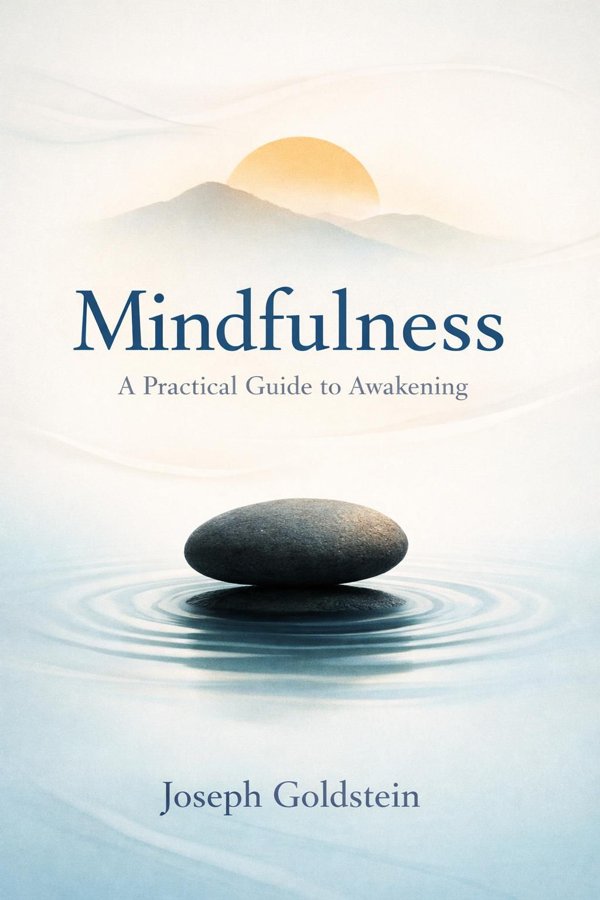
Mindfulness: A Practical Guide to Awakening: Summary & Key Insights
 10 min3 chaptersAudio available
What Is Mindfulness: A Practical Guide to Awakening About?
Mindfulness: A Practical Guide to Awakening by Joseph Goldstein is a eastern_wisdom book spanning 3 pages. In this comprehensive guide, Joseph Goldstein distills over four decades of meditation teaching into a clear and accessible exploration of mindfulness. Drawing from the Satipatthana Sutta, the Buddha’s foundational discourse on mindfulness, Goldstein offers practical instructions and deep insights into cultivating awareness, concentration, and wisdom in everyday life. The book serves as both a manual for meditation practice and a philosophical reflection on awakening.
This FizzRead summary covers all 3 key chapters of Mindfulness: A Practical Guide to Awakening in approximately 10 minutes, distilling the most important ideas, arguments, and takeaways from Joseph Goldstein's work. Also available as an audio summary and Key Quotes Podcast.
Mindfulness: A Practical Guide to Awakening
In this comprehensive guide, Joseph Goldstein distills over four decades of meditation teaching into a clear and accessible exploration of mindfulness. Drawing from the Satipatthana Sutta, the Buddha’s foundational discourse on mindfulness, Goldstein offers practical instructions and deep insights into cultivating awareness, concentration, and wisdom in everyday life. The book serves as both a manual for meditation practice and a philosophical reflection on awakening.
Who Should Read Mindfulness: A Practical Guide to Awakening?
This book is perfect for anyone interested in eastern_wisdom and looking to gain actionable insights in a short read. Whether you're a student, professional, or lifelong learner, the key ideas from Mindfulness: A Practical Guide to Awakening by Joseph Goldstein will help you think differently.
- ✓Readers who enjoy eastern_wisdom and want practical takeaways
- ✓Professionals looking to apply new ideas to their work and life
- ✓Anyone who wants the core insights of Mindfulness: A Practical Guide to Awakening in just 10 minutes
Want the full summary?
Get instant access to this book summary and 100K+ more with Fizz Moment.
Get Free SummaryAvailable on App Store • Free to download
Key Chapters
The Satipatthana Sutta is often referred to as the direct path to liberation because it encompasses the full range of human experience. It begins with the most tangible — the body — and moves progressively inward toward the subtle layers of mind and wisdom. Each foundation of mindfulness trains us to observe with clarity, without clinging or aversion.
Mindfulness of the body grounds us in the immediacy of experience. By observing the breath, postures, and movements, we return again and again to the reality of the present moment. This practice is profoundly humbling. We discover that the body is not a solid, permanent 'thing' but a continuous field of changing sensations. Awareness of breathing, for instance, reveals that each inhalation arises and passes away, leaving no trace — a living lesson in impermanence.
As we deepen this observation, mindfulness extends to feelings — the simple tones of pleasant, unpleasant, or neutral that accompany every perception. The Buddha encouraged us to notice these feelings without grasping at the pleasant or resisting the unpleasant. In doing so, we begin to free ourselves from habitual reactions that bind us to suffering. Feelings become an opportunity for investigation, not identification.
Mindfulness of mind invites us into the dynamic landscape of thought, emotion, and mood. Here we observe mental states such as desire, aversion, sloth, restlessness, and doubt — the very forces that shape perception and action. Recognizing these states as passing phenomena rather than as 'me' or 'mine' is an act of profound liberation. Awareness itself becomes the refuge.
Finally, mindfulness of dhammas, or mental objects, expands the field of observation to include the underlying principles of awakening: the hindrances that obscure clarity, the factors that lead to enlightenment, and the truths that define the nature of existence. By contemplating these patterns, mindfulness matures into wisdom. We no longer relate to experience as a self-centered narrative but as the unfolding of natural law.
As mindfulness deepens, concentration (samadhi) naturally develops. Concentration stabilizes the mind, allowing it to rest upon its object without distraction. This collectedness is not forced or rigid; it is the serene unification of awareness and attention. Through steady practice, we discover how mindfulness and concentration work together like two sides of the same coin — mindfulness gives the breadth of awareness, and concentration provides its depth.
From that union arises insight. The more clearly we see phenomena arise and pass away, the more deeply we understand impermanence (anicca). Impermanence is not a philosophical idea; it is the direct perception that everything — breath, thought, sensation, emotion — is in continuous flux. To see this with equanimity is to loosen the grip of clinging. We stop seeking permanence in a world that cannot provide it.
Insight into impermanence leads naturally to an understanding of dukkha, the unsatisfactory nature of conditioned experience. This is not a pessimistic view; it is an honest one. Even in pleasure we sense the seeds of loss. Clinging to what changes inevitably brings unease. When we accept this truth deeply, compassion arises — for ourselves and for all beings caught in the same current of impermanent conditions.
Ultimately, mindfulness reveals the emptiness of self (anatta). When observed carefully, no thought, emotion, or perception can be found to be 'I' or 'mine.' The sense of self, once believed to be fixed and real, is seen as a construction, arising from habit and identification. What remains is awareness itself — open, vast, and free. This recognition is not annihilation but liberation, the release from the narrow confines of self-centeredness.
+ 1 more chapters — available in the FizzRead app
All Chapters in Mindfulness: A Practical Guide to Awakening
About the Author
Joseph Goldstein is a co-founder of the Insight Meditation Society in Barre, Massachusetts, and one of the most respected teachers of Vipassana meditation in the West. He has studied and practiced Buddhist meditation since 1967 and is the author of several influential works on mindfulness and insight meditation.
Get This Summary in Your Preferred Format
Read or listen to the Mindfulness: A Practical Guide to Awakening summary by Joseph Goldstein anytime, anywhere. FizzRead offers multiple formats so you can learn on your terms — all free.
Available formats: App · Audio · PDF · EPUB — All included free with FizzRead
Download Mindfulness: A Practical Guide to Awakening PDF and EPUB Summary
Key Quotes from Mindfulness: A Practical Guide to Awakening
“The Satipatthana Sutta is often referred to as the direct path to liberation because it encompasses the full range of human experience.”
“As mindfulness deepens, concentration (samadhi) naturally develops.”
Frequently Asked Questions about Mindfulness: A Practical Guide to Awakening
Mindfulness: A Practical Guide to Awakening by Joseph Goldstein is a eastern_wisdom book that explores key ideas across 3 chapters. In this comprehensive guide, Joseph Goldstein distills over four decades of meditation teaching into a clear and accessible exploration of mindfulness. Drawing from the Satipatthana Sutta, the Buddha’s foundational discourse on mindfulness, Goldstein offers practical instructions and deep insights into cultivating awareness, concentration, and wisdom in everyday life. The book serves as both a manual for meditation practice and a philosophical reflection on awakening.
You Might Also Like

A New Earth
Eckhart Tolle
10 min
The Daily Stoic
Ryan Holiday, Stephen Hanselman
10 min
Buddhism: Plain and Simple
Steve Hagen
10 min
Enchiridion
Epictetus
10 min
The Book of Tea
Kakuzō Okakura
10 min
The Light We Give: How Sikh Wisdom Can Transform Your Life
Simran Jeet Singh
10 minBrowse by Category
Ready to read Mindfulness: A Practical Guide to Awakening?
Get the full summary and 100K+ more books with Fizz Moment.