
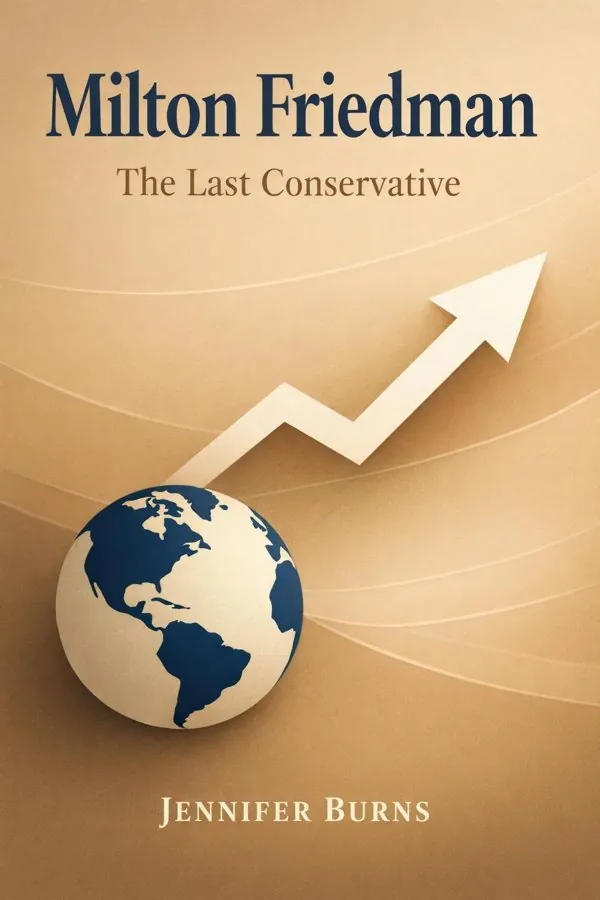
Milton Friedman: The Last Conservative: Summary & Key Insights
 10 min8 chaptersAudio available
Key Takeaways from Milton Friedman: The Last Conservative
A society can be transformed not only by elections or wars, but by one persuasive set of ideas.
Economic arguments become politically potent when they are tied to human values.
Nothing elevates an intellectual faster than being right when the mainstream is wrong.
Brilliant ideas alone rarely shape public life; they need a messenger capable of turning argument into influence.
Political movements often embrace thinkers whose ideas they only partly share.
What Is Milton Friedman: The Last Conservative About?
Milton Friedman: The Last Conservative by Jennifer Burns is a biographies book. Jennifer Burns’s Milton Friedman: The Last Conservative is far more than the life story of a famous economist. It is a sweeping intellectual biography of the man who helped reshape modern debates about markets, government, freedom, inflation, education, and the proper scope of the state. Burns traces Friedman from his immigrant family background and academic rise to his public role as one of the most influential economists of the twentieth century. Along the way, she shows how his ideas moved from university seminars into politics, media, and everyday public life. What makes this book especially valuable is its refusal to treat Friedman as either a saint or a villain. Burns, a distinguished historian of ideas and American political thought, carefully reconstructs his arguments, his ambitions, his moral convictions, and the controversies that followed him. She places Friedman within the evolution of conservatism, revealing both how central he became to the movement and how often he stood apart from it. The result is a nuanced portrait of a thinker whose belief in individual liberty changed policy and public conversation alike. For anyone trying to understand modern capitalism, American conservatism, or the power of economic ideas, this biography is essential reading.
This FizzRead summary covers all 8 key chapters of Milton Friedman: The Last Conservative in approximately 10 minutes, distilling the most important ideas, arguments, and takeaways from Jennifer Burns's work. Also available as an audio summary and Key Quotes Podcast.
Milton Friedman: The Last Conservative
Jennifer Burns’s Milton Friedman: The Last Conservative is far more than the life story of a famous economist. It is a sweeping intellectual biography of the man who helped reshape modern debates about markets, government, freedom, inflation, education, and the proper scope of the state. Burns traces Friedman from his immigrant family background and academic rise to his public role as one of the most influential economists of the twentieth century. Along the way, she shows how his ideas moved from university seminars into politics, media, and everyday public life.
What makes this book especially valuable is its refusal to treat Friedman as either a saint or a villain. Burns, a distinguished historian of ideas and American political thought, carefully reconstructs his arguments, his ambitions, his moral convictions, and the controversies that followed him. She places Friedman within the evolution of conservatism, revealing both how central he became to the movement and how often he stood apart from it. The result is a nuanced portrait of a thinker whose belief in individual liberty changed policy and public conversation alike. For anyone trying to understand modern capitalism, American conservatism, or the power of economic ideas, this biography is essential reading.
Who Should Read Milton Friedman: The Last Conservative?
This book is perfect for anyone interested in biographies and looking to gain actionable insights in a short read. Whether you're a student, professional, or lifelong learner, the key ideas from Milton Friedman: The Last Conservative by Jennifer Burns will help you think differently.
- ✓Readers who enjoy biographies and want practical takeaways
- ✓Professionals looking to apply new ideas to their work and life
- ✓Anyone who wants the core insights of Milton Friedman: The Last Conservative in just 10 minutes
Want the full summary?
Get instant access to this book summary and 100K+ more with Fizz Moment.
Get Free SummaryAvailable on App Store • Free to download
Key Chapters
A society can be transformed not only by elections or wars, but by one persuasive set of ideas. One of the central insights of Jennifer Burns’s biography is that Milton Friedman mattered because he changed the intellectual climate before he changed policy. He was not simply an academic economist producing technical work for specialists. He became a public thinker who translated complex economic arguments into moral and political language that ordinary citizens, journalists, and lawmakers could understand.
Burns shows how Friedman built influence step by step. He developed rigorous economic arguments at the University of Chicago, wrote for general audiences, appeared on television, advised political figures, and debated opponents in language that felt clear and confident. His ideas about inflation, taxation, school choice, regulation, and monetary policy did not spread because they were inevitable. They spread because he was unusually skilled at framing them as common sense defenses of freedom.
This is part of what makes the book important. It reveals that political change often begins years earlier in classrooms, magazines, think tanks, and public debate. Friedman understood that if you want policy to change, you must first make your worldview seem intellectually serious and morally compelling. His success demonstrates the long-term power of patient persuasion.
In practical terms, this applies far beyond economics. Whether in business, education, or civic life, lasting change usually requires more than technical expertise. It requires explaining why an idea matters, anticipating criticism, and reaching people beyond your immediate professional circle.
Actionable takeaway: If you want to influence institutions, don’t just refine your expertise—learn to communicate your core ideas clearly, repeatedly, and to audiences outside your field.
Economic arguments become politically potent when they are tied to human values. Burns emphasizes that Friedman’s enduring appeal came from his insistence that markets were not merely efficient mechanisms for allocating resources. To him, they were instruments of personal freedom. A competitive market, in his view, reduced coercion by dispersing power. If the state controlled too much of economic life, it could also control the terms on which people worked, learned, spent, and lived.
This moral dimension separated Friedman from economists who defended markets only on technical grounds. He argued that voluntary exchange allows people with different beliefs and backgrounds to cooperate without requiring political agreement. You do not need to share someone’s religion, class, or ideology to trade with them. In this sense, markets could support pluralism and peaceful coexistence.
Burns also shows, however, that this was not a simple or uncontested claim. Critics argued that private concentrations of wealth can also limit freedom, and that unequal bargaining power may make “choice” less voluntary than Friedman assumed. By presenting these tensions, the biography helps readers see both the force and the limits of his philosophy.
The practical lesson is that policy debates are rarely only about numbers. They are also about competing visions of autonomy, dignity, fairness, and authority. Friedman won many arguments because he connected economics to a larger defense of individual agency.
In everyday life, this perspective can shape how we think about institutions. Do rules empower individuals to make meaningful choices, or do they centralize control? Asking that question can clarify debates about schools, workplaces, healthcare, and technology platforms.
Actionable takeaway: When evaluating any policy or organization, ask not only whether it is efficient, but also how it affects people’s real capacity to choose and act freely.
Nothing elevates an intellectual faster than being right when the mainstream is wrong. Burns shows that Friedman’s greatest rise to prominence came from his challenge to prevailing views on inflation and monetary policy. At a time when many economists and policymakers put more faith in fiscal management and accepted a stable trade-off between inflation and unemployment, Friedman argued that inflation was fundamentally a monetary phenomenon and that governments could not permanently buy lower unemployment with higher inflation.
This was not just a technical dispute. It became one of the decisive economic debates of the postwar era. When high inflation and economic stagnation shook the 1970s, Friedman’s warnings appeared prophetic. His critique of overconfident government management gained credibility precisely because events seemed to validate it. Burns carefully traces how this intellectual victory helped move Friedman from respected scholar to public authority.
The significance of this episode extends beyond monetary economics. It illustrates how expert consensus can harden into dogma, and how dissenters can reshape a field when reality exposes the weaknesses of dominant theories. Friedman’s success also came from his ability to simplify without entirely distorting. He gave the public a memorable explanation: if governments create too much money, prices rise.
A practical application of this idea is humility in forecasting and management. Complex systems often resist fine-tuning. Leaders in business or government may think they can micromanage outcomes, only to produce unintended consequences. Friedman’s career reminds us that interventions can have delayed effects and hidden costs.
Actionable takeaway: Be skeptical of policies that promise easy trade-offs in complex systems; ask what long-term consequences may emerge after the short-term benefits fade.
Brilliant ideas alone rarely shape public life; they need a messenger capable of turning argument into influence. One of Burns’s most revealing contributions is her portrait of Friedman as a master public intellectual. He wrote columns, appeared on television, debated critics, and embraced popular communication without abandoning his confidence in economic theory. He understood that if economists stayed inside academic journals, others would define the public meaning of economic policy.
This helps explain why Friedman’s impact exceeded that of many equally talented scholars. He could condense a large theory into a few memorable propositions. He had a calm, persuasive style and projected moral certainty without sounding obscure. Through books like Capitalism and Freedom, television projects such as Free to Choose, and his regular media presence, he shaped how millions of people thought about the economy.
Burns also makes clear that public prominence has trade-offs. Simplification can harden nuance into slogan. Media visibility can make a thinker seem more ideologically rigid than their scholarly work actually is. Friedman’s public reputation sometimes turned him into a symbol for agendas broader than his own. Yet the biography suggests that he accepted this risk because he believed the stakes were too high to leave economic literacy to specialists.
There is a broader lesson here for professionals in any field. Expertise becomes socially valuable when it can travel. Teachers, analysts, scientists, and leaders often fail not because they lack insight, but because they cannot translate it for others.
In practical terms, this means learning to adapt your communication to different audiences: a technical paper for peers, a short explanation for managers, a visual example for the public, and a moral rationale for skeptics.
Actionable takeaway: If your ideas matter, build the skill of explaining them in clear language to non-experts without losing their core meaning.
Political movements often embrace thinkers whose ideas they only partly share. Burns’s title, The Last Conservative, points to one of the most intriguing themes of the book: Friedman became an icon of modern conservatism, yet he never fit neatly inside it. He championed free markets, limited government, and individual liberty, all of which made him central to conservative politics. But he also held positions that unsettled many conservatives, including support for drug legalization, skepticism of military conscription, and a principled libertarian streak that did not always align with traditional moral or nationalist agendas.
Burns uses this tension to illuminate the evolution of American conservatism itself. Friedman represented a version of conservatism grounded in economic liberty and suspicion of centralized authority. Over time, however, the movement absorbed religious, cultural, and populist energies that did not always share his priorities. He was therefore both a builder of the conservative coalition and a figure partly out of step with where it eventually went.
This complexity matters because it resists simplistic labels. The book reminds readers that influential thinkers are often reduced to partisan symbols, even when their actual views are more internally coherent than the movements claiming them. Friedman cared deeply about freedom as a principle, not just as a campaign slogan.
The practical value of this insight is considerable. In workplaces, institutions, and politics, alliances are often strategic rather than complete. You may share goals with a group while differing on values, methods, or long-term direction. Understanding that helps explain many internal tensions within movements and organizations.
Actionable takeaway: Do not assume a public label captures a person’s full philosophy; look closely at the underlying principles and where they align—or clash—with the groups that celebrate them.
Some of the most consequential ideas in public life begin as elegant theories and end as messy institutions. Burns highlights this pattern in Friedman’s policy legacy, especially around proposals such as school vouchers, the negative income tax, and deregulation. Friedman often advanced broad principles designed to increase choice, reduce bureaucracy, and improve outcomes through competition. Yet once such ideas entered political systems, they encountered interests, compromises, and unintended effects.
Take school vouchers. Friedman saw them as a way to separate the financing of education from direct government operation, thereby increasing parental choice and encouraging innovation. Supporters viewed this as empowerment; critics feared greater inequality, weakened public schools, and selective access. The gap between a clean theoretical model and real-world implementation became one of the recurring dramas of his career.
Similarly, the negative income tax reflected his effort to simplify welfare while preserving incentives to work. It was not an anti-poverty idea born from indifference, but from a desire to replace fragmented systems with a more direct mechanism. Burns’s account helps readers see Friedman not as someone uninterested in social policy, but as someone convinced that simpler, less paternalistic tools could better serve human needs.
The larger lesson is that policy design matters as much as policy philosophy. A compelling principle does not guarantee a good institution. Incentives, administration, political constraints, and unequal access can alter outcomes dramatically.
This applies in organizations too. A new compensation system, hiring process, or performance metric may look elegant in theory but produce distortions in practice if people respond strategically.
Actionable takeaway: Whenever you encounter a reform proposal, ask not only whether the idea is attractive in principle, but how it will function under real incentives, real politics, and real human behavior.
Grand theories often appear abstract until we see the life that produced them. One of the strengths of Burns’s biography is that it restores Milton Friedman as a person rather than a bundle of policy positions. She traces his immigrant family background, intellectual ambitions, personal relationships, professional rivalries, and deep partnership with Rose Friedman. This human context matters because ideas do not emerge in a vacuum. They are shaped by temperament, upbringing, opportunities, and lived experience.
Burns shows, for example, how Friedman’s confidence in self-direction and suspicion of centralized authority were not merely academic conclusions. They resonated with his broader worldview, his sense of American opportunity, and his belief in the dignity of individual striving. His marriage and intellectual collaboration with Rose also reveal that his public voice was not entirely solitary; it was sharpened within a shared life of argument and purpose.
Seeing the man behind the doctrine also clarifies his contradictions. Friedman could be principled and strategic, empirically minded and ideologically steadfast, deeply committed to liberty yet sometimes less attentive to structural inequalities than his critics wished. These tensions make him more interesting, not less. Burns succeeds because she neither flattens him into hero worship nor reduces him to historical backlash.
For readers, this offers a practical reminder about leadership and influence. People are more than their public brands. Understanding someone’s motivations, formative experiences, and moral intuitions often explains their decisions better than slogans do.
In professional settings, this matters when evaluating founders, executives, academics, or policymakers. To understand what they build, look at the personal convictions and experiences driving them.
Actionable takeaway: When assessing a powerful thinker or leader, study the life behind the ideas; biography often reveals the assumptions that theory leaves unstated.
To understand Friedman fully, you must also understand what he was arguing against. Burns places him within a larger twentieth-century struggle over liberalism, state power, expertise, and the management of modern economies. Friedman emerged in an era when many intellectuals believed government could and should play a far more active role in securing stability, growth, and social welfare. He challenged not only particular policies but the confidence that experts could direct economic life from the center.
This is one reason the biography has significance beyond economics. It helps explain a major ideological realignment in American life. Friedman’s criticism of New Deal and postwar assumptions contributed to a broader shift toward market-oriented thinking. He questioned licensing, price controls, military conscription, and expansive bureaucratic authority, urging that many social goals could be pursued with fewer mandates and more room for voluntary action.
Burns does not portray this shift as simple progress or decline. Instead, she shows how Friedman’s interventions exposed genuine failures in state-centered policy while also opening debates that remain unresolved. How much inequality can a free society tolerate? When does regulation protect freedom rather than restrict it? Where do markets fail, and who should correct them? These are still our questions.
The practical application is that ideological battles never fully disappear; they evolve. Current disputes over technology regulation, healthcare, housing, and education still reflect the same deeper tension between centralized expertise and decentralized choice.
Actionable takeaway: Use Friedman’s debates as a framework for modern issues—before choosing a side, identify what problem is best solved by markets, what requires public rules, and where both approaches may be necessary.
All Chapters in Milton Friedman: The Last Conservative
About the Author
Jennifer Burns is a historian of American ideas, politics, and capitalism, known for her clear and deeply researched work on influential public thinkers. She has taught at Stanford University and earned recognition for her ability to explain complex intellectual movements in an engaging, accessible way. Burns previously wrote a notable biography of Ayn Rand, establishing herself as a leading interpreter of modern conservative and libertarian thought. In Milton Friedman: The Last Conservative, she brings that same historical rigor and balance to one of the most consequential economists of the twentieth century. Her work stands out for resisting easy ideological judgments and instead situating thinkers within the cultural, political, and institutional worlds that shaped them. She is widely respected as a serious scholar of American intellectual history.
Get This Summary in Your Preferred Format
Read or listen to the Milton Friedman: The Last Conservative summary by Jennifer Burns anytime, anywhere. FizzRead offers multiple formats so you can learn on your terms — all free.
Available formats: App · Audio · PDF · EPUB — All included free with FizzRead
Download Milton Friedman: The Last Conservative PDF and EPUB Summary
Key Quotes from Milton Friedman: The Last Conservative
“A society can be transformed not only by elections or wars, but by one persuasive set of ideas.”
“Economic arguments become politically potent when they are tied to human values.”
“Nothing elevates an intellectual faster than being right when the mainstream is wrong.”
“Brilliant ideas alone rarely shape public life; they need a messenger capable of turning argument into influence.”
“Political movements often embrace thinkers whose ideas they only partly share.”
Frequently Asked Questions about Milton Friedman: The Last Conservative
Milton Friedman: The Last Conservative by Jennifer Burns is a biographies book that explores key ideas across 8 chapters. Jennifer Burns’s Milton Friedman: The Last Conservative is far more than the life story of a famous economist. It is a sweeping intellectual biography of the man who helped reshape modern debates about markets, government, freedom, inflation, education, and the proper scope of the state. Burns traces Friedman from his immigrant family background and academic rise to his public role as one of the most influential economists of the twentieth century. Along the way, she shows how his ideas moved from university seminars into politics, media, and everyday public life. What makes this book especially valuable is its refusal to treat Friedman as either a saint or a villain. Burns, a distinguished historian of ideas and American political thought, carefully reconstructs his arguments, his ambitions, his moral convictions, and the controversies that followed him. She places Friedman within the evolution of conservatism, revealing both how central he became to the movement and how often he stood apart from it. The result is a nuanced portrait of a thinker whose belief in individual liberty changed policy and public conversation alike. For anyone trying to understand modern capitalism, American conservatism, or the power of economic ideas, this biography is essential reading.
You Might Also Like
An American Marriage
Tayari Jones
10 min
Benjamin Franklin: An American Life
Walter Isaacson
10 min
I Know Why The Caged Bird Sings
Maya Angelou
10 min
Long Walk to Freedom
Nelson Mandela
10 min
Persepolis
Marjane Satrapi
10 min
Surely You're Joking, Mr. Feynman!
Richard P. Feynman
10 minBrowse by Category
Ready to read Milton Friedman: The Last Conservative?
Get the full summary and 100K+ more books with Fizz Moment.