
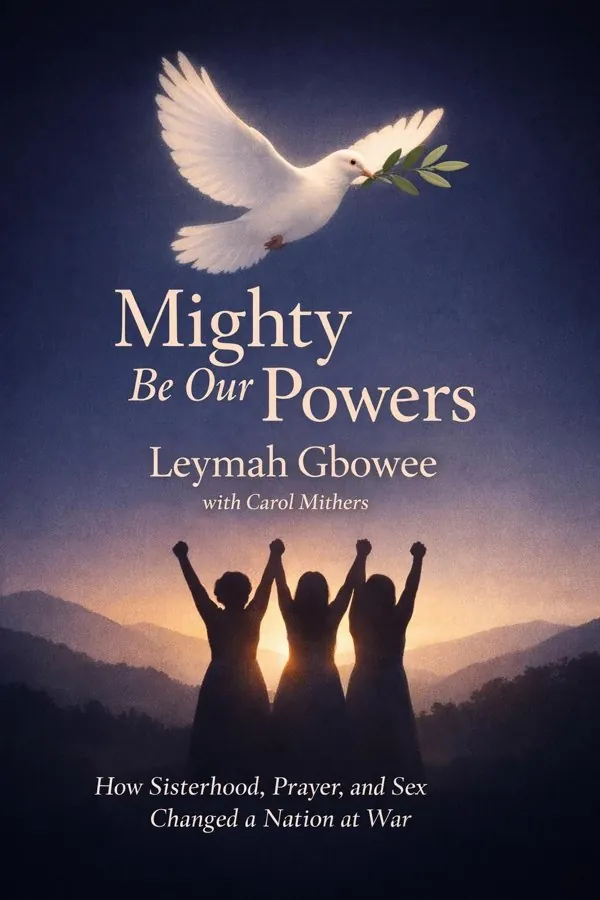
Mighty Be Our Powers: How Sisterhood, Prayer, and Sex Changed a Nation at War: Summary & Key Insights
by Leymah Gbowee with Carol Mithers
 10 min5 chaptersAudio available
What Is Mighty Be Our Powers: How Sisterhood, Prayer, and Sex Changed a Nation at War About?
Mighty Be Our Powers: How Sisterhood, Prayer, and Sex Changed a Nation at War by Leymah Gbowee with Carol Mithers is a biographies book spanning 5 pages. Leymah Gbowee, a Liberian peace activist and Nobel Peace Prize laureate, recounts her journey from a young mother during Liberia’s brutal civil war to the leader of a women’s movement that helped bring peace to her country. The memoir explores themes of resilience, faith, and the transformative power of collective action among women in the face of violence and oppression.
This FizzRead summary covers all 5 key chapters of Mighty Be Our Powers: How Sisterhood, Prayer, and Sex Changed a Nation at War in approximately 10 minutes, distilling the most important ideas, arguments, and takeaways from Leymah Gbowee with Carol Mithers's work. Also available as an audio summary and Key Quotes Podcast.
Mighty Be Our Powers: How Sisterhood, Prayer, and Sex Changed a Nation at War
Leymah Gbowee, a Liberian peace activist and Nobel Peace Prize laureate, recounts her journey from a young mother during Liberia’s brutal civil war to the leader of a women’s movement that helped bring peace to her country. The memoir explores themes of resilience, faith, and the transformative power of collective action among women in the face of violence and oppression.
Who Should Read Mighty Be Our Powers: How Sisterhood, Prayer, and Sex Changed a Nation at War?
This book is perfect for anyone interested in biographies and looking to gain actionable insights in a short read. Whether you're a student, professional, or lifelong learner, the key ideas from Mighty Be Our Powers: How Sisterhood, Prayer, and Sex Changed a Nation at War by Leymah Gbowee with Carol Mithers will help you think differently.
- ✓Readers who enjoy biographies and want practical takeaways
- ✓Professionals looking to apply new ideas to their work and life
- ✓Anyone who wants the core insights of Mighty Be Our Powers: How Sisterhood, Prayer, and Sex Changed a Nation at War in just 10 minutes
Want the full summary?
Get instant access to this book summary and 100K+ more with Fizz Moment.
Get Free SummaryAvailable on App Store • Free to download
Key Chapters
I grew up in Liberia before the war, in a world where the rhythms of our days were simple and secure. My parents were hardworking, strict, and loving. We had our small joys, our laughter, our school routines. When Charles Taylor’s rebels stormed the country in 1989, that childhood dissolved overnight. The civil war came like a storm cloud spreading over every household, scattering families, reducing homes to rubble. Suddenly, I was a young woman whose daily reality was shaped by fear. We fled from city to city, dodging checkpoints, fleeing fighters who, in their rage and hunger, erased the boundary between civilian and combatant.
Those were the beginnings of my understanding of loss and resilience. I was still just a teenager, but the war taught me how quickly humanity can be stripped away—and how fiercely one must fight to preserve it. I saw mothers like me clutching their children, young boys being turned into soldiers, women fleeing sexual violence, and communities fragmenting before my eyes. In the midst of this chaos, I began to feel the stirrings of a question: if all of this destruction came from men wielding guns, could women—unarmed and principled—ever bring peace?
The breakdown of social life forced me to confront my own fear and helplessness. But every time I saw another woman face horrors and still get up to search for food or shelter, I began to see the outlines of something sacred in that strength. The sisterhood born of survival was the seed of my political awakening. Long before I knew the words feminism or activism, I was living them in the rawest form imaginable—women binding together to keep each other alive.
Becoming a mother in wartime was both a blessing and a burden. My children anchored me, gave me a reason to fight against despair, but they also became the measure of my vulnerability. When bombs fell, I thought only of how to keep them safe. Poverty stripped away dignity, hunger gnawed at our spirits, and yet, in that battlefield of survival, I felt a quiet call begin to take root. It was not the sound of guns or the shouting of commanders—it was the whisper of conscience.
I wanted to understand the madness that had consumed our men and our country. The trauma was visible in every eye—vacant stares, trembling hands, bodies that moved but souls that were frozen. I began training as a social worker, seeking not only to heal others but to reclaim my own shattered peace. In learning to listen, I encountered pain that seemed immeasurable. But I also discovered the power of empathy—the ability to help others find voice and witness amid silence.
As I worked with survivors, I began to see patterns: how violence against women had been normalized, how sexual abuse was treated as inevitable, how communities had lost their moral glue. The therapy sessions became moments of revelation. Healing was not an individual act; it was a communal one. Each woman’s story made me realize that if our nation were ever to recover, it would do so through the voices of those who had borne its deepest scars. My vocation was no longer just social work—it was calling forth the collective soul of Liberian women. Faith guided me, and so did anger—the holy anger of mothers who refused to watch their children die.
+ 3 more chapters — available in the FizzRead app
All Chapters in Mighty Be Our Powers: How Sisterhood, Prayer, and Sex Changed a Nation at War
About the Author
Leymah Gbowee is a Liberian peace activist, social worker, and women’s rights advocate who led a nonviolent movement that helped end Liberia’s second civil war. She was awarded the Nobel Peace Prize in 2011 for her efforts to promote peace and women’s participation in peacebuilding.
Get This Summary in Your Preferred Format
Read or listen to the Mighty Be Our Powers: How Sisterhood, Prayer, and Sex Changed a Nation at War summary by Leymah Gbowee with Carol Mithers anytime, anywhere. FizzRead offers multiple formats so you can learn on your terms — all free.
Available formats: App · Audio · PDF · EPUB — All included free with FizzRead
Download Mighty Be Our Powers: How Sisterhood, Prayer, and Sex Changed a Nation at War PDF and EPUB Summary
Key Quotes from Mighty Be Our Powers: How Sisterhood, Prayer, and Sex Changed a Nation at War
“I grew up in Liberia before the war, in a world where the rhythms of our days were simple and secure.”
“Becoming a mother in wartime was both a blessing and a burden.”
Frequently Asked Questions about Mighty Be Our Powers: How Sisterhood, Prayer, and Sex Changed a Nation at War
Mighty Be Our Powers: How Sisterhood, Prayer, and Sex Changed a Nation at War by Leymah Gbowee with Carol Mithers is a biographies book that explores key ideas across 5 chapters. Leymah Gbowee, a Liberian peace activist and Nobel Peace Prize laureate, recounts her journey from a young mother during Liberia’s brutal civil war to the leader of a women’s movement that helped bring peace to her country. The memoir explores themes of resilience, faith, and the transformative power of collective action among women in the face of violence and oppression.
You Might Also Like

An American Marriage
Tayari Jones
10 min
Benjamin Franklin: An American Life
Walter Isaacson
10 min
I Know Why The Caged Bird Sings
Maya Angelou
10 min
Long Walk to Freedom
Nelson Mandela
10 min
Persepolis
Marjane Satrapi
10 min
Surely You're Joking, Mr. Feynman!
Richard P. Feynman
10 minBrowse by Category
Ready to read Mighty Be Our Powers: How Sisterhood, Prayer, and Sex Changed a Nation at War?
Get the full summary and 100K+ more books with Fizz Moment.