
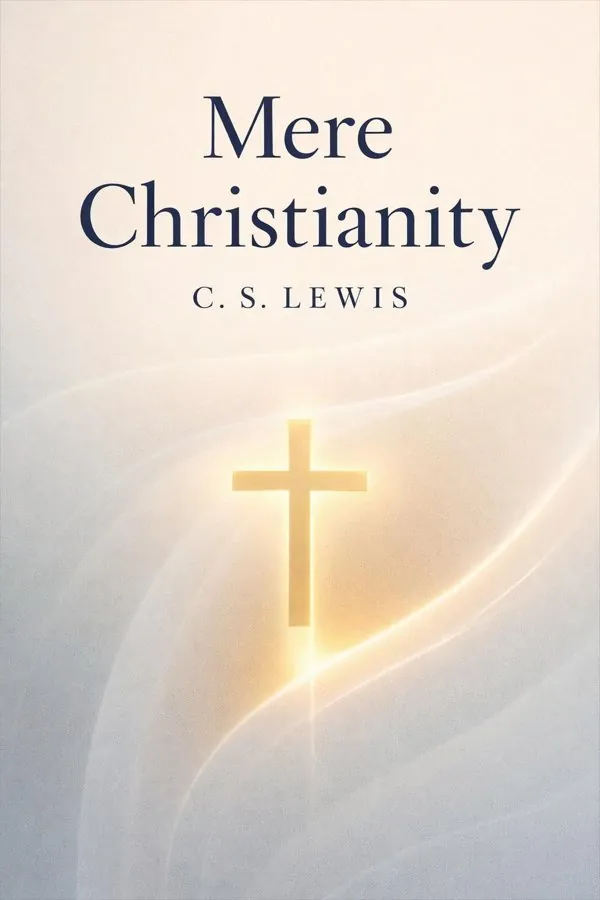
Mere Christianity: Summary & Key Insights
by C. S. Lewis
 10 min4 chaptersAudio available
What Is Mere Christianity About?
Mere Christianity by C. S. Lewis is a western_phil book spanning 4 pages. Mere Christianity is a theological work by C. S. Lewis, adapted from a series of BBC radio talks made between 1941 and 1944. It explores the common ground of Christian belief, presenting a rational case for Christianity and discussing moral law, human nature, and the essence of faith. Lewis aims to explain and defend the core tenets of Christianity without focusing on denominational differences.
This FizzRead summary covers all 4 key chapters of Mere Christianity in approximately 10 minutes, distilling the most important ideas, arguments, and takeaways from C. S. Lewis's work. Also available as an audio summary and Key Quotes Podcast.
Mere Christianity
Mere Christianity is a theological work by C. S. Lewis, adapted from a series of BBC radio talks made between 1941 and 1944. It explores the common ground of Christian belief, presenting a rational case for Christianity and discussing moral law, human nature, and the essence of faith. Lewis aims to explain and defend the core tenets of Christianity without focusing on denominational differences.
Who Should Read Mere Christianity?
This book is perfect for anyone interested in western_phil and looking to gain actionable insights in a short read. Whether you're a student, professional, or lifelong learner, the key ideas from Mere Christianity by C. S. Lewis will help you think differently.
- ✓Readers who enjoy western_phil and want practical takeaways
- ✓Professionals looking to apply new ideas to their work and life
- ✓Anyone who wants the core insights of Mere Christianity in just 10 minutes
Want the full summary?
Get instant access to this book summary and 100K+ more with Fizz Moment.
Get Free SummaryAvailable on App Store • Free to download
Key Chapters
Every one of us has, at one time or another, appealed to a notion of fairness. 'That’s not right!' or 'You ought not to have done that!' are not merely expressions of disapproval; they reveal something profound—that we believe in a standard that our own desires cannot erase. This is the Moral Law, a reality as objective and unavoidable as the laws of gravity. It does not describe what we in fact do, but what we know we ought to do.
When I say that there is such a law, I do not mean that moral codes never vary. Of course they do, just as languages vary. But beneath those variations lies a stubborn similarity: honesty is admired, cowardice despised, justice praised. Disagreement itself implies a shared ideal—we argue because we assume some standard of behavior that both sides recognize but fail to meet. That standard cannot be the creation of human society, for societies can be perverse as well as kind. The Moral Law, then, points beyond us to something—or Someone—who is its source.
Yet, when we face this law honestly, we discover another truth: we break it constantly. We know what is right and fail to do it. That sense of guilt is not an illusion to be explained away; it is evidence that something is wrong within us, and that whatever power stands behind the universe is, at least in moral terms, not neutral. It is good—and we are not. That recognition brings us to our need for a remedy beyond self-improvement.
Standing upon the foundation of that moral awareness, we face the question of who—or what—the Moral Lawgiver is. Many philosophies have offered answers. Pantheists tell us that God and the universe are one, that good and evil are illusions within a divine whole. But Christianity insists on the contrary: God is distinct from the world He made. Like an artist and his painting, He stands outside His work, yet His likeness runs through it. This God is personal, moral, and intensely concerned with the behavior of His creatures.
The Christian story begins well but turns dark. God created us to live in harmony with Him and with one another, but we rebelled. That act—call it pride, self-will, or sin—introduced a rift no human effort can mend. Yet God, who is both just and merciful, devised a way of repair. He entered His own creation in the person of Jesus Christ, fully God and fully man, to suffer the punishment that justice demands and to restore us through love.
Many stumble over the idea of atonement—how one man’s death could set others right. But if we think of life as belonging to God, then Christ’s self-offering was the only perfect surrender ever made. In Him, the human race started anew, and through our union with Him we may share in that new life. Christianity, then, is not mere moral reform but divine rescue. Belief in Christ is less about subscribing to a theory than about entrusting oneself to the living Reason and Love that rule the universe.
+ 2 more chapters — available in the FizzRead app
All Chapters in Mere Christianity
About the Author
Clive Staples Lewis (1898–1963) was a British writer, scholar, and lay theologian. He is best known for his works on Christian apologetics, including The Screwtape Letters and The Problem of Pain, as well as for his beloved fantasy series The Chronicles of Narnia. Lewis was a fellow and tutor in English literature at Oxford University and later held the chair of Medieval and Renaissance Literature at Cambridge University.
Get This Summary in Your Preferred Format
Read or listen to the Mere Christianity summary by C. S. Lewis anytime, anywhere. FizzRead offers multiple formats so you can learn on your terms — all free.
Available formats: App · Audio · PDF · EPUB — All included free with FizzRead
Download Mere Christianity PDF and EPUB Summary
Key Quotes from Mere Christianity
“Every one of us has, at one time or another, appealed to a notion of fairness.”
“Standing upon the foundation of that moral awareness, we face the question of who—or what—the Moral Lawgiver is.”
Frequently Asked Questions about Mere Christianity
Mere Christianity by C. S. Lewis is a western_phil book that explores key ideas across 4 chapters. Mere Christianity is a theological work by C. S. Lewis, adapted from a series of BBC radio talks made between 1941 and 1944. It explores the common ground of Christian belief, presenting a rational case for Christianity and discussing moral law, human nature, and the essence of faith. Lewis aims to explain and defend the core tenets of Christianity without focusing on denominational differences.
More by C. S. Lewis

You Might Also Like
A Little History of Philosophy
Nigel Warburton
10 min
Areopagitica
John Milton
10 min
How To Think Like A Philosopher: Essential Principles For Clear Thinking
Peter Cave
10 min
Language, Truth and Logic
A. J. Ayer
10 min
The Age of Reason
Thomas Paine
10 min
The Essays
Michel De Montaigne
10 minBrowse by Category
Ready to read Mere Christianity?
Get the full summary and 100K+ more books with Fizz Moment.