
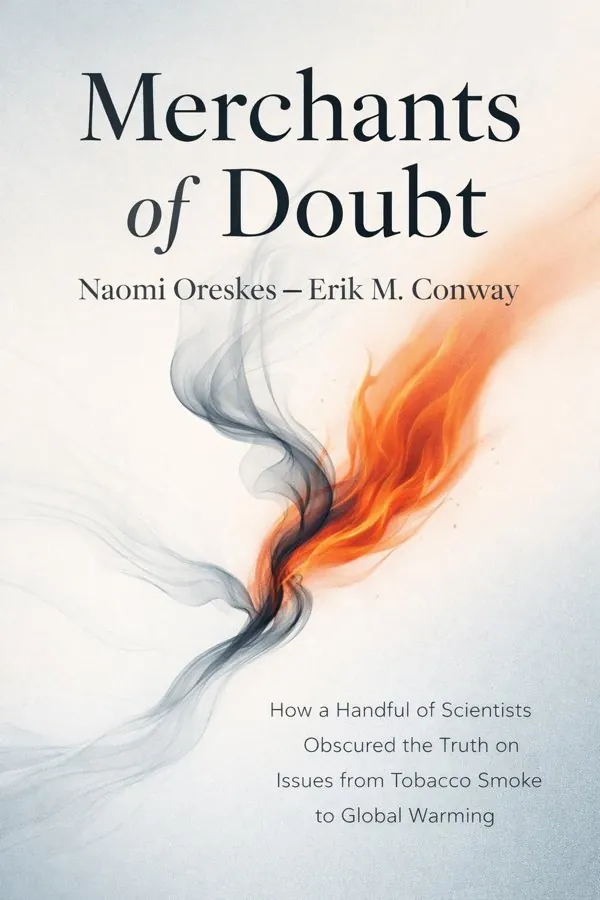
Merchants of Doubt: How a Handful of Scientists Obscured the Truth on Issues from Tobacco Smoke to Global Warming: Summary & Key Insights
by Naomi Oreskes, Erik M. Conway
 10 min9 chaptersAudio available
What Is Merchants of Doubt: How a Handful of Scientists Obscured the Truth on Issues from Tobacco Smoke to Global Warming About?
Merchants of Doubt: How a Handful of Scientists Obscured the Truth on Issues from Tobacco Smoke to Global Warming by Naomi Oreskes, Erik M. Conway is a environment book spanning 9 pages. Merchants of Doubt es un libro de no ficción que examina cómo un pequeño grupo de científicos, con vínculos estrechos con la política y la industria, sembró la duda sobre temas científicos clave como el tabaco, el cambio climático, los CFC y la lluvia ácida. A través de una investigación exhaustiva, los autores muestran cómo las estrategias de desinformación utilizadas por estos científicos influyeron en la opinión pública y en las políticas gubernamentales.
This FizzRead summary covers all 9 key chapters of Merchants of Doubt: How a Handful of Scientists Obscured the Truth on Issues from Tobacco Smoke to Global Warming in approximately 10 minutes, distilling the most important ideas, arguments, and takeaways from Naomi Oreskes, Erik M. Conway's work. Also available as an audio summary and Key Quotes Podcast.
Merchants of Doubt: How a Handful of Scientists Obscured the Truth on Issues from Tobacco Smoke to Global Warming
Merchants of Doubt es un libro de no ficción que examina cómo un pequeño grupo de científicos, con vínculos estrechos con la política y la industria, sembró la duda sobre temas científicos clave como el tabaco, el cambio climático, los CFC y la lluvia ácida. A través de una investigación exhaustiva, los autores muestran cómo las estrategias de desinformación utilizadas por estos científicos influyeron en la opinión pública y en las políticas gubernamentales.
Who Should Read Merchants of Doubt: How a Handful of Scientists Obscured the Truth on Issues from Tobacco Smoke to Global Warming?
This book is perfect for anyone interested in environment and looking to gain actionable insights in a short read. Whether you're a student, professional, or lifelong learner, the key ideas from Merchants of Doubt: How a Handful of Scientists Obscured the Truth on Issues from Tobacco Smoke to Global Warming by Naomi Oreskes, Erik M. Conway will help you think differently.
- ✓Readers who enjoy environment and want practical takeaways
- ✓Professionals looking to apply new ideas to their work and life
- ✓Anyone who wants the core insights of Merchants of Doubt: How a Handful of Scientists Obscured the Truth on Issues from Tobacco Smoke to Global Warming in just 10 minutes
Want the full summary?
Get instant access to this book summary and 100K+ more with Fizz Moment.
Get Free SummaryAvailable on App Store • Free to download
Key Chapters
The roots of the doubt campaign stretch back to the ideological battleground of the Cold War. After World War II, the United States built a formidable scientific establishment dedicated to national defense. Many of its leaders—men like Frederick Seitz, William Nierenberg, and Robert Jastrow—were physicists who had contributed to the Manhattan Project and later to missile defense and space research. They viewed science as a bulwark against Soviet communism, and with good reason; science had been the front line of Western superiority. Yet, as the Cold War matured, environmental science began to unveil an inconvenient truth: that industrial progress itself carried unintended consequences for air, water, and the planet.
For scientists who had fought ideological battles for freedom, these findings appeared as Trojan horses. To them, calls for environmental regulation smacked of government control, the very thing they had spent their careers opposing. Thus began the intellectual evolution from anti-communism to anti-environmentalism—a continuity rooted less in evidence and more in fear of political change. The physicists who once advised the Pentagon now lent their reputations to think tanks that would challenge the scientific consensus on entirely different fronts.
The George C. Marshall Institute, founded in the early 1980s by Seitz, Jastrow, and Nierenberg, became a crucible for this transformation. Originally a platform to advocate for missile defense, the Institute later retooled its expertise toward discrediting environmental science. We show in the book how this ideological shift allowed these scientists to reinterpret public debates as matters of political belief rather than empirical data. Their influence would reach far beyond policy papers; through strategic alliances with industries and foundations, they learned to frame doubt as patriotism and regulation as tyranny.
If the Cold War set the ideological stage, the tobacco industry wrote the practical script. By the 1950s, medical research had clearly linked cigarette smoking to lung cancer. Public health experts expected swift policy intervention. But instead, they encountered one of the most sophisticated campaigns of scientific obfuscation in modern history. Tobacco executives recognized an existential threat—not just to profits, but to an entire cultural norm built around consumption. They adopted a cunning strategy: rather than disprove the science, they would amplify uncertainty.
The industry's most famous internal memo captured this philosophy perfectly: 'Doubt is our product.' Funding streams were established to support legitimate scientists who were willing to question any element of the epidemiological consensus, however technically or tangentially. Journalists were supplied with reports that stressed controversy where none substantively existed. The Tobacco Institute and the Council for Tobacco Research maintained an appearance of scientific inquiry while cherry-picking data and publicizing anomalies to keep debate alive.
Frederick Seitz himself, once a revered president of the U.S. National Academy of Sciences, later accepted grants from R.J. Reynolds to manage research funds ostensibly directed toward health issues. While he denied direct manipulation, the effect was unmistakable: the credibility of established science was diluted by association with eminent names. Our analysis shows how this model of manufacturing doubt became the template for later campaigns. The method was simple: emphasize uncertainty, question consensus, and equate scientific debate with freedom of speech. The tobacco playbook proved that public confusion was cheaper—and more effective—than outright denial.
+ 7 more chapters — available in the FizzRead app
All Chapters in Merchants of Doubt: How a Handful of Scientists Obscured the Truth on Issues from Tobacco Smoke to Global Warming
About the Authors
Naomi Oreskes es historiadora de la ciencia y profesora en la Universidad de Harvard, reconocida por su trabajo sobre el consenso científico y el cambio climático. Erik M. Conway es historiador de la ciencia y tecnología en el Jet Propulsion Laboratory de la NASA, especializado en la historia de la ciencia atmosférica y la política científica estadounidense.
Get This Summary in Your Preferred Format
Read or listen to the Merchants of Doubt: How a Handful of Scientists Obscured the Truth on Issues from Tobacco Smoke to Global Warming summary by Naomi Oreskes, Erik M. Conway anytime, anywhere. FizzRead offers multiple formats so you can learn on your terms — all free.
Available formats: App · Audio · PDF · EPUB — All included free with FizzRead
Download Merchants of Doubt: How a Handful of Scientists Obscured the Truth on Issues from Tobacco Smoke to Global Warming PDF and EPUB Summary
Key Quotes from Merchants of Doubt: How a Handful of Scientists Obscured the Truth on Issues from Tobacco Smoke to Global Warming
“The roots of the doubt campaign stretch back to the ideological battleground of the Cold War.”
“If the Cold War set the ideological stage, the tobacco industry wrote the practical script.”
Frequently Asked Questions about Merchants of Doubt: How a Handful of Scientists Obscured the Truth on Issues from Tobacco Smoke to Global Warming
Merchants of Doubt: How a Handful of Scientists Obscured the Truth on Issues from Tobacco Smoke to Global Warming by Naomi Oreskes, Erik M. Conway is a environment book that explores key ideas across 9 chapters. Merchants of Doubt es un libro de no ficción que examina cómo un pequeño grupo de científicos, con vínculos estrechos con la política y la industria, sembró la duda sobre temas científicos clave como el tabaco, el cambio climático, los CFC y la lluvia ácida. A través de una investigación exhaustiva, los autores muestran cómo las estrategias de desinformación utilizadas por estos científicos influyeron en la opinión pública y en las políticas gubernamentales.
You Might Also Like

A Life on Our Planet: My Witness Statement and a Vision for the Future
David Attenborough
10 min
A Sky Full Of Birds
Matt Merritt
10 min
Carbon Zero: Imagining Cities That Can Save the Planet
Alex Steffen
10 min
Eaarth: Making a Life on a Tough New Planet
Bill McKibben
10 min
The Social Contract and Environmental Governance
Various Editors
10 min
The Wild Places
Robert Macfarlane
10 minBrowse by Category
Ready to read Merchants of Doubt: How a Handful of Scientists Obscured the Truth on Issues from Tobacco Smoke to Global Warming?
Get the full summary and 100K+ more books with Fizz Moment.