
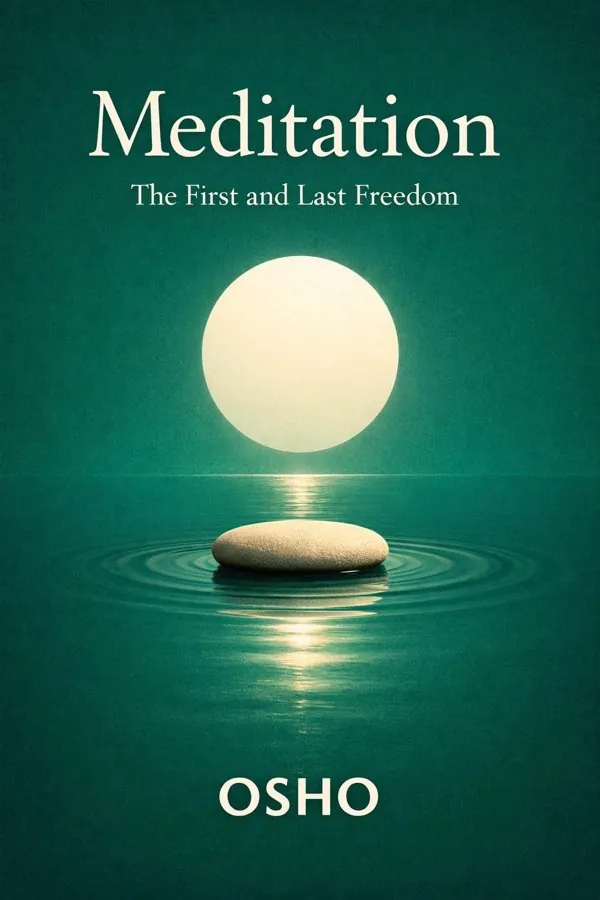
Meditation: The First and Last Freedom: Summary & Key Insights
by Osho
 10 min8 chaptersAudio available
Key Takeaways from Meditation: The First and Last Freedom
One of the book’s central insights is that the mind is a beautiful instrument, but a terrible master.
A startling idea in this book is that much of what you call your identity has been installed from the outside.
Osho repeatedly returns to one radical simplicity: meditation is awareness.
If meditation remains confined to a cushion, its power stays limited.
A profound theme in the book is witnessing: the art of observing inner experience without becoming entangled in it.
What Is Meditation: The First and Last Freedom About?
Meditation: The First and Last Freedom by Osho is a eastern_wisdom book spanning 11 pages. Meditation: The First and Last Freedom is Osho’s invitation to rediscover meditation not as a rigid practice, but as your most natural state. Rather than treating meditation as a solemn ritual, a religious obligation, or a difficult mental exercise, Osho presents it as a way of being awake, relaxed, and fully alive. The book explores how human beings become trapped in thought, habit, fear, and social conditioning—and how awareness can gently dissolve those inner prisons. It combines philosophical insight with practical guidance, showing that meditation is not limited to monasteries or retreat centers, but can be woven into walking, working, loving, breathing, and simply observing oneself. What makes this book especially compelling is Osho’s ability to speak both to the modern restless mind and to the timeless spiritual search for freedom. Drawing from Eastern wisdom, psychology, and direct experience, he reframes meditation as the doorway to silence, clarity, and inner independence. For readers overwhelmed by mental noise or hungry for deeper presence, this book offers both a challenge and a path.
This FizzRead summary covers all 8 key chapters of Meditation: The First and Last Freedom in approximately 10 minutes, distilling the most important ideas, arguments, and takeaways from Osho's work. Also available as an audio summary and Key Quotes Podcast.
Meditation: The First and Last Freedom
Meditation: The First and Last Freedom is Osho’s invitation to rediscover meditation not as a rigid practice, but as your most natural state. Rather than treating meditation as a solemn ritual, a religious obligation, or a difficult mental exercise, Osho presents it as a way of being awake, relaxed, and fully alive. The book explores how human beings become trapped in thought, habit, fear, and social conditioning—and how awareness can gently dissolve those inner prisons. It combines philosophical insight with practical guidance, showing that meditation is not limited to monasteries or retreat centers, but can be woven into walking, working, loving, breathing, and simply observing oneself. What makes this book especially compelling is Osho’s ability to speak both to the modern restless mind and to the timeless spiritual search for freedom. Drawing from Eastern wisdom, psychology, and direct experience, he reframes meditation as the doorway to silence, clarity, and inner independence. For readers overwhelmed by mental noise or hungry for deeper presence, this book offers both a challenge and a path.
Who Should Read Meditation: The First and Last Freedom?
This book is perfect for anyone interested in eastern_wisdom and looking to gain actionable insights in a short read. Whether you're a student, professional, or lifelong learner, the key ideas from Meditation: The First and Last Freedom by Osho will help you think differently.
- ✓Readers who enjoy eastern_wisdom and want practical takeaways
- ✓Professionals looking to apply new ideas to their work and life
- ✓Anyone who wants the core insights of Meditation: The First and Last Freedom in just 10 minutes
Want the full summary?
Get instant access to this book summary and 100K+ more with Fizz Moment.
Get Free SummaryAvailable on App Store • Free to download
Key Chapters
One of the book’s central insights is that the mind is a beautiful instrument, but a terrible master. Osho does not ask you to destroy the mind or declare war on thought. Instead, he argues that suffering begins when you become identified with your mental activity. Thoughts, memories, fantasies, fears, and borrowed beliefs start running your life, and you forget that there is an awareness behind them all. In that state, the mind is no longer serving consciousness; consciousness is serving the mind.
Osho’s distinction is subtle but transformative. The problem is not thinking itself. The problem is unconscious thinking—thinking that continues automatically, compulsively, and without your participation. You replay old conversations, imagine future disasters, judge yourself, compare yourself to others, and call this inner noise “me.” Meditation begins the moment you notice that thoughts are appearing within awareness, but are not the totality of who you are.
In practical terms, this means learning to step back. When anger arises, for example, instead of saying “I am angry,” you might notice, “Anger is passing through me.” When anxiety appears before a meeting, you observe the racing heart, the mental stories, and the tension in the stomach. That small shift creates space. In that space, freedom begins.
Osho’s message is not anti-intellectual; it is liberating. Use the mind when needed—for planning, language, creativity, and problem-solving—but do not live imprisoned inside it. Actionable takeaway: several times a day, pause for one minute and silently watch your thoughts without following them. Practice remembering: you are the witness, not the mental traffic.
A startling idea in this book is that much of what you call your identity has been installed from the outside. Osho suggests that society conditions people from childhood through reward, punishment, fear, morality, imitation, and the desire to belong. You are taught what to believe, what to desire, what success looks like, what is respectable, what is shameful, and even how to experience yourself. Over time, this conditioning becomes so familiar that it feels natural.
Meditation matters because it loosens this hypnosis. According to Osho, freedom is not gained by adopting a new ideology; it comes by seeing clearly how deeply programmed the old one is. If you feel guilty without knowing why, if you chase approval compulsively, if you fear silence, if your values are inherited rather than examined, then awareness has work to do. Meditation is the process of observing these patterns without immediately obeying them.
Consider ordinary examples: someone works in a prestigious profession but feels inwardly dead, yet continues because family expectation has become internal law. Another person cannot sit quietly for five minutes because busyness has become a substitute for self-contact. Conditioning often survives because it is never questioned.
Osho’s approach is not rebellion for its own sake. He does not ask you to become anti-society in a reactive way. He asks for consciousness. Once you see a pattern fully, your relationship to it changes. Some habits fall away. Others remain, but now by choice rather than compulsion.
Actionable takeaway: write down three beliefs you live by—about work, love, success, or spirituality—and ask, “Did I discover this through direct experience, or did I inherit it?” Let awareness, not habit, guide the answer.
Osho repeatedly returns to one radical simplicity: meditation is awareness. Not concentration, not control, not suppression, not self-punishment—awareness. This matters because many people approach meditation as another achievement project. They try to force the mind into silence, sit rigidly, judge themselves for being distracted, and end up turning a liberating practice into another source of tension. Osho reverses the whole model. Awareness is not something you manufacture through strain; it is something you allow by becoming present.
Awareness means seeing what is happening in you and around you without immediately interfering. You notice breath, sensation, thoughts, moods, impulses, sounds, and silence. You do not cling, resist, analyze endlessly, or label every experience as good or bad. In that nonjudgmental seeing, a shift happens: the mechanical mind slows, the observer strengthens, and a quieter intelligence appears.
This teaching is deeply practical. While washing dishes, can you feel the temperature of the water, the movement of your hands, the tendency of the mind to wander? While waiting in traffic, can you observe impatience as a passing phenomenon rather than feeding it with stories? Awareness does not require a special room or perfect conditions. It asks only for sincerity and remembrance.
Osho also emphasizes that awareness grows by use. The more often you return to seeing, the less identified you become with mental storms. Gradually, meditation ceases to be an activity you perform for twenty minutes and becomes a quality of consciousness you carry throughout the day.
Actionable takeaway: choose one daily routine—drinking tea, showering, commuting, or eating—and do it today with total awareness. Stay with direct experience instead of drifting into thought.
If meditation remains confined to a cushion, its power stays limited. Osho insists that real meditation must enter the marketplace, the kitchen, relationships, work, and solitude. A person who appears calm in formal practice but becomes unconscious the moment life becomes demanding has not yet understood the essence of meditation. The test is not how silent you are in isolation, but how present you remain in movement.
This does not mean you should never sit quietly. Formal meditation can help establish a foundation. But Osho’s larger point is that life itself provides countless opportunities for wakefulness. Walking can become meditation if you feel each step. Listening can become meditation if you are not preparing your reply. Eating can become meditation if you taste the food instead of scrolling your phone or replaying worries. Even conflict can become meditation if you watch the body tighten, hear the tone of your voice, and sense the ego’s need to be right.
This teaching makes the path accessible. A parent caring for children, a student under pressure, or an office worker in constant meetings does not need to wait for a retreat in the mountains. Every ordinary situation can become a laboratory of consciousness. In fact, daily life is where hidden patterns reveal themselves most honestly.
Osho’s contribution is to remove the divide between the spiritual and the practical. Meditation is not an escape from life; it is a way of inhabiting life more deeply. Presence can accompany action without reducing effectiveness. Often, it enhances it.
Actionable takeaway: set three “awareness bells” in your day—perhaps breakfast, lunch, and evening—and at each one, stop for thirty seconds to feel your body, breath, and mental state before continuing.
A profound theme in the book is witnessing: the art of observing inner experience without becoming entangled in it. Osho sees witnessing as the master key because most people try to change themselves through conflict. They fight desire, condemn anger, suppress sadness, and then wonder why these forces return even stronger. What is resisted often persists. Witnessing offers another route: transformation through awareness rather than violence.
To witness means to watch thoughts, emotions, and bodily states as passing events. You do not deny them, indulge them, or justify them. You remain present. When jealousy arises, witness it. When pride swells, witness it. When boredom appears in meditation, witness that too. Through this simple but demanding practice, you discover that all experiences are transient. The witness remains while mental weather changes.
This has powerful psychological consequences. A witnessed emotion loses some of its unconscious grip. Suppose someone criticizes you. The old pattern might be instant defensiveness. With witnessing, you notice the flush of heat, the tightening jaw, the thought “I must attack back.” That observation interrupts the chain reaction. You may still respond, but now with choice.
Osho treats witnessing not as passivity but as intelligence. It lets you see causes and consequences directly. It also introduces compassion, because once you see your own mind clearly, you become less self-righteous about others.
The challenge is consistency. Witnessing is easy to admire and hard to sustain, especially in emotionally charged moments. But every moment of observation strengthens the capacity.
Actionable takeaway: the next time a strong emotion appears, do not immediately act or explain it. For one minute, name internally what is happening—“tightness,” “fear,” “anger,” “thoughts”—and let observation come before reaction.
Osho gives unusual importance to the body, especially for modern people who live heavily in the head. He argues that meditation is not merely mental or philosophical; it is embodied. The body stores tension, repression, fatigue, trauma, desire, and unexpressed feeling. If you ignore it, meditation may remain abstract and shallow. If you include it, awareness becomes grounded and immediate.
This is one reason Osho is associated with active and dynamic meditation methods. For many people, jumping straight into silent sitting is difficult because the system is too restless. The body is full of agitation; the breath is shallow; emotions are unfinished. Movement, breathing, shaking, catharsis, dancing, and conscious release can help discharge excess energy and prepare the ground for silence. Rather than imposing stillness on chaos, Osho suggests moving consciously through chaos until stillness arises naturally.
Even outside formal techniques, the body is a constant anchor for awareness. You can notice posture while working, tension in the shoulders during stress, shallow breathing during fear, heaviness after overeating, or a sense of openness when relaxed. The body tells the truth faster than thought does. Often, your mind says “I’m fine” while your clenched jaw says otherwise.
This approach is especially helpful for readers who feel disconnected from themselves. Body awareness brings meditation out of abstraction and into lived experience. It also prevents spirituality from becoming a purely verbal or intellectual exercise.
Actionable takeaway: once today, spend five minutes doing nothing except feeling your body from head to toe. Notice areas of contraction, ease, heat, numbness, or movement. Breathe into what you find instead of trying to fix it.
The book offers practical guidance on meditation techniques, but Osho is careful not to let methods become another attachment. Different people need different doors. Some are suited to silence, others to movement, breath, sound, dance, inquiry, or observation. Temperament, emotional state, and life circumstance all matter. A restless person may need active methods first; a naturally quiet person may enter through simple witnessing. The technique is not sacred in itself. What matters is whether it awakens presence.
This is an important corrective to spiritual rigidity. People often ask, “Which is the best meditation?” Osho’s answer, in essence, is: the one that makes you more conscious. A method should be a raft, not a prison. If it becomes mechanical, ego-driven, or performative, it has lost its purpose. Even the most respected technique can become lifeless if repeated unconsciously.
Osho also warns against common misconceptions. Meditation is not concentration alone. It is not thinking positive thoughts. It is not auto-suggestion. It is not escape, trance, belief, or pious seriousness. Nor is it measured by mystical experiences. Lights, visions, or unusual sensations may come and go; they are not the essence. The essence is growing awareness, freedom from identification, and an increase in clarity, aliveness, and inner ease.
A practical reader can experiment. Try silent sitting for a week, then walking meditation, then conscious breathing, then simply witnessing during daily tasks. Observe not what seems impressive, but what deepens awareness and honesty.
Actionable takeaway: choose one meditation method and practice it consistently for seven days. At the end, reflect not on whether it felt dramatic, but on whether you became more aware, balanced, and present.
For Osho, meditation does not end with stress reduction or mental calm. Its deepest promise is an inner revolution: silence, emptiness, love, and freedom. These words can sound abstract, but in the book they point to lived states. Silence is not merely the absence of noise; it is the quieting of compulsive psychological chatter. Emptiness is not depression or lack; it is spaciousness—the release of the crowded ego-self. Love is no longer possession or dependency, but a natural overflow from an unburdened being. Freedom is not doing whatever you want; it is not being ruled from within by fear, conditioning, and unconscious reaction.
This culminates the entire teaching. When identification with mind loosens, when witnessing deepens, when awareness enters daily life, a new quality of existence appears. You become less driven to prove yourself, less desperate for external validation, less afraid of aloneness. In that inner spaciousness, relating to others changes too. Love becomes less manipulative because it no longer arises from inner poverty. Creativity blossoms because energy is not constantly tied up in psychological conflict.
This transformation is gradual, not theatrical. Osho does not present freedom as a badge of enlightenment to display. It is visible in simpler ways: more ease in uncertainty, greater honesty, spontaneous joy, a capacity to be alone without loneliness, and the ability to meet life directly.
The path begins with awareness, but its flowering is a freer human being. Actionable takeaway: at the end of the day, ask yourself four questions: Was I aware? Was I less reactive? Was I more loving? Was I more inwardly free? Let these become your true measures of progress.
All Chapters in Meditation: The First and Last Freedom
About the Author
Osho (1931–1990), born Chandra Mohan Jain in India, was a mystic, spiritual teacher, and provocative commentator on consciousness, meditation, love, and human freedom. Trained in philosophy, he became known for his public talks, which blended insights from Buddhism, Zen, Taoism, Sufism, Tantra, and Western psychology. Rather than promoting a fixed belief system, Osho emphasized direct experience, awareness, and inner transformation. He challenged social conditioning, religious dogma, and psychological repression, often with an unconventional style that made him both influential and controversial. Much of his published work was compiled from recorded discourses rather than traditional written manuscripts. Today, he remains widely read by seekers interested in meditation as a lived, experiential path rather than a purely doctrinal or ritual practice.
Get This Summary in Your Preferred Format
Read or listen to the Meditation: The First and Last Freedom summary by Osho anytime, anywhere. FizzRead offers multiple formats so you can learn on your terms — all free.
Available formats: App · Audio · PDF · EPUB — All included free with FizzRead
Download Meditation: The First and Last Freedom PDF and EPUB Summary
Key Quotes from Meditation: The First and Last Freedom
“One of the book’s central insights is that the mind is a beautiful instrument, but a terrible master.”
“A startling idea in this book is that much of what you call your identity has been installed from the outside.”
“Osho repeatedly returns to one radical simplicity: meditation is awareness.”
“If meditation remains confined to a cushion, its power stays limited.”
“A profound theme in the book is witnessing: the art of observing inner experience without becoming entangled in it.”
Frequently Asked Questions about Meditation: The First and Last Freedom
Meditation: The First and Last Freedom by Osho is a eastern_wisdom book that explores key ideas across 8 chapters. Meditation: The First and Last Freedom is Osho’s invitation to rediscover meditation not as a rigid practice, but as your most natural state. Rather than treating meditation as a solemn ritual, a religious obligation, or a difficult mental exercise, Osho presents it as a way of being awake, relaxed, and fully alive. The book explores how human beings become trapped in thought, habit, fear, and social conditioning—and how awareness can gently dissolve those inner prisons. It combines philosophical insight with practical guidance, showing that meditation is not limited to monasteries or retreat centers, but can be woven into walking, working, loving, breathing, and simply observing oneself. What makes this book especially compelling is Osho’s ability to speak both to the modern restless mind and to the timeless spiritual search for freedom. Drawing from Eastern wisdom, psychology, and direct experience, he reframes meditation as the doorway to silence, clarity, and inner independence. For readers overwhelmed by mental noise or hungry for deeper presence, this book offers both a challenge and a path.
You Might Also Like
A New Earth
Eckhart Tolle
10 min
The Daily Stoic
Ryan Holiday, Stephen Hanselman
10 min
Buddhism: Plain and Simple
Steve Hagen
10 min
Enchiridion
Epictetus
10 min
The Book of Tea
Kakuzō Okakura
10 min
The Light We Give: How Sikh Wisdom Can Transform Your Life
Simran Jeet Singh
10 minBrowse by Category
Ready to read Meditation: The First and Last Freedom?
Get the full summary and 100K+ more books with Fizz Moment.