
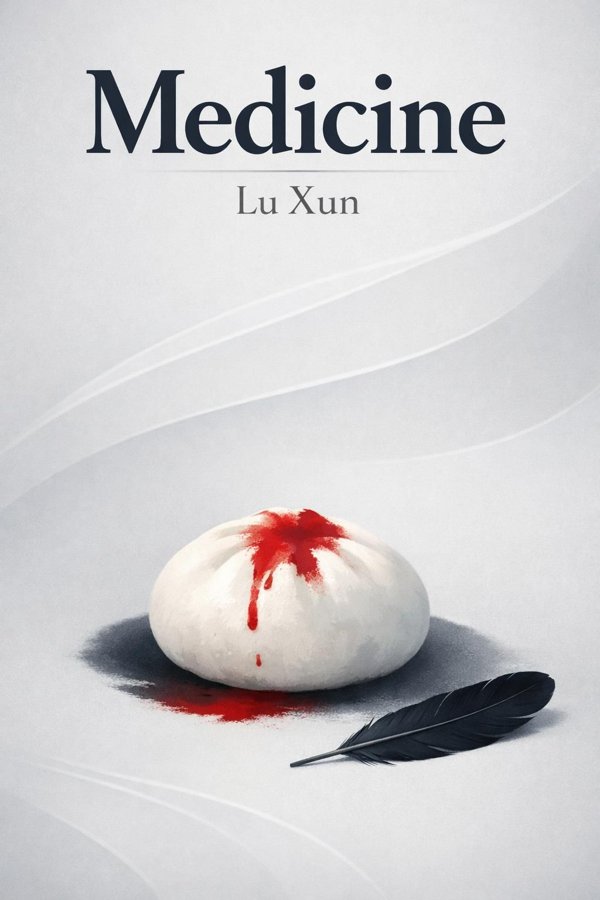
Medicine: Summary & Key Insights
by Lu Xun
 10 min8 chaptersAudio available
Key Takeaways from Medicine
A society often exposes its deepest wounds through the remedies it trusts.
The most intimate suffering can reflect the fate of an entire nation.
People rarely choose superstition because they are foolish; they choose it because credible knowledge is inaccessible, unaffordable, or culturally outmatched.
A martyr means little to the public if the public cannot understand the cause.
Human beings can suffer under a broken system while also helping to sustain it.
What Is Medicine About?
Medicine by Lu Xun is a classics book. What if the cure a society trusts most is actually part of its illness? Lu Xun’s “Medicine,” first published in 1919 in the landmark collection Call to Arms, is a brief but devastating story about ignorance, superstition, poverty, and political blindness in early modern China. On the surface, it tells a simple tale: a poor family buys a supposed folk remedy to save their sick son. But beneath that plot lies a fierce critique of a society unable to recognize either real disease or real healing. Tuberculosis, public execution, revolutionary sacrifice, and ordinary desperation all converge in a narrative that is as symbolic as it is realistic. Lu Xun matters because he is widely regarded as the father of modern Chinese literature, a writer who used fiction not merely to entertain but to diagnose the spiritual and cultural crises of his time. “Medicine” remains powerful because its central question is timeless: when fear, habit, and false belief govern people’s choices, how can genuine renewal begin? This story is short, but its moral, political, and emotional reach is enormous.
This FizzRead summary covers all 8 key chapters of Medicine in approximately 10 minutes, distilling the most important ideas, arguments, and takeaways from Lu Xun's work. Also available as an audio summary and Key Quotes Podcast.
Medicine
What if the cure a society trusts most is actually part of its illness? Lu Xun’s “Medicine,” first published in 1919 in the landmark collection Call to Arms, is a brief but devastating story about ignorance, superstition, poverty, and political blindness in early modern China. On the surface, it tells a simple tale: a poor family buys a supposed folk remedy to save their sick son. But beneath that plot lies a fierce critique of a society unable to recognize either real disease or real healing. Tuberculosis, public execution, revolutionary sacrifice, and ordinary desperation all converge in a narrative that is as symbolic as it is realistic. Lu Xun matters because he is widely regarded as the father of modern Chinese literature, a writer who used fiction not merely to entertain but to diagnose the spiritual and cultural crises of his time. “Medicine” remains powerful because its central question is timeless: when fear, habit, and false belief govern people’s choices, how can genuine renewal begin? This story is short, but its moral, political, and emotional reach is enormous.
Who Should Read Medicine?
This book is perfect for anyone interested in classics and looking to gain actionable insights in a short read. Whether you're a student, professional, or lifelong learner, the key ideas from Medicine by Lu Xun will help you think differently.
- ✓Readers who enjoy classics and want practical takeaways
- ✓Professionals looking to apply new ideas to their work and life
- ✓Anyone who wants the core insights of Medicine in just 10 minutes
Want the full summary?
Get instant access to this book summary and 100K+ more with Fizz Moment.
Get Free SummaryAvailable on App Store • Free to download
Key Chapters
The most intimate suffering can reflect the fate of an entire nation. “Medicine” appears to center on one poor family trying to save a dying child, yet Lu Xun deliberately enlarges that sorrow into a portrait of China’s broader spiritual and political decay. Little Bolt’s tuberculosis is not only a physical illness; it also suggests a weakened social body, exhausted, vulnerable, and unable to recover because it cannot correctly identify its disease. The family’s choices become a miniature version of the country’s condition.
What makes the story so effective is Lu Xun’s refusal to separate private pain from public life. The parents’ fear drives them into the marketplace of false hope, where the death of a political revolutionary is transformed into a folk cure. This means the state’s violence, the people’s superstition, and the family’s grief are not separate events. They form one interconnected system. The executed man gave his life for change, but his blood is consumed as a commodity by people who do not understand what he stood for. In that moment, Lu Xun suggests that revolutionary sacrifice itself can become meaningless in a society still trapped in ignorance.
This pattern appears in many eras. Families struggling with unemployment, illness, or insecurity are often affected by forces larger than themselves: broken institutions, miseducation, fear-driven politics, and public cynicism. Literature matters because it reveals how these levels overlap. A single household can show a nation’s strengths and failures more clearly than a political speech.
Actionable takeaway: when evaluating any personal crisis, look beyond the individual story. Ask what wider systems, beliefs, or structures are shaping the outcome. Understanding the bigger picture is often the first step toward meaningful change.
People rarely choose superstition because they are foolish; they choose it because credible knowledge is inaccessible, unaffordable, or culturally outmatched. In “Medicine,” Lu Xun shows how dangerous beliefs survive not simply because people enjoy irrationality, but because desperation narrows judgment. The old couple is poor, frightened, and eager to save their son. In that emotional state, a ritualized cure backed by community belief feels more trustworthy than abstract medical reasoning they have likely never been taught to trust.
This is one of Lu Xun’s sharpest insights. Superstition in the story is not random. It is socially reinforced. The blood-soaked bun comes with the authority of custom, spectacle, and shared expectation. It has a narrative attached to it: fresh blood, dramatic execution, whispered confidence, sacrificial power. These elements create the illusion of effectiveness. By contrast, genuine medicine appears absent, distant, or invisible. Lu Xun therefore criticizes not only credulous individuals but also a society that has failed to build reliable public understanding.
The story remains strikingly modern. False health claims spread quickly when experts are distrusted, institutions communicate poorly, or people feel humiliated by systems that seem indifferent to them. In such settings, emotionally vivid explanations often defeat scientifically sound ones. The lesson is not to mock those who believe false cures but to understand the vacuum in which such beliefs flourish.
On a practical level, the story encourages intellectual humility. It is easy to imagine we would not make the same mistake, but human beings still confuse confidence with truth. Good information must be cultivated, translated, and made socially credible.
Actionable takeaway: strengthen your defenses against misinformation by checking claims with reliable sources, especially when the claim is dramatic, traditional, or emotionally persuasive. Compassion and verification should go together.
A martyr means little to the public if the public cannot understand the cause. One of the cruelest ironies in “Medicine” is that the executed prisoner whose blood is sold as a cure appears to be a revolutionary figure, someone who died for political change, yet his death is absorbed into superstition rather than memory, gratitude, or awakening. Lu Xun’s point is devastating: sacrifice alone does not transform society. If the people remain trapped in ignorance, even noble death can be misunderstood, commercialized, or forgotten.
The story does not romanticize heroism. Instead, it examines the tragic gap between the revolutionary and the masses. The executed man’s blood is treated not as the sign of political courage but as a magical medical ingredient. This is a profound failure of collective consciousness. The people are not moved by his ideals because they do not have the language or education to interpret his death politically. They consume the symbol but miss the meaning.
This insight applies widely. Reformers, whistleblowers, activists, and truth-tellers often imagine that exposing injustice will naturally produce change. Yet audiences may lack the context, courage, or solidarity needed to respond. Important acts are frequently neutralized by public confusion, propaganda, or emotional fatigue. Lu Xun understood that social transformation requires not only brave individuals but also a prepared civic culture capable of receiving their message.
For readers, this idea invites reflection on how we honor sacrifice today. Do we engage with what courageous people actually stood for, or do we reduce them to slogans, images, or passing sentiment? Meaningful remembrance requires interpretation, education, and moral effort.
Actionable takeaway: when you admire a historical or contemporary figure, go beyond symbolic respect. Learn the cause they served, explain it to others clearly, and connect their sacrifice to concrete action in the present.
Human beings can suffer under a broken system while also helping to sustain it. That moral complexity is one reason “Medicine” feels so alive. Lu Xun does not divide the world into simple heroes and villains. The parents are loving but misguided. The townspeople are curious, fearful, and cruel by habit. The execution scene is public entertainment as much as political repression. Everyone is shaped by the environment, yet everyone also contributes to it.
This dual role matters. If the story presented the poor merely as innocent victims, its social criticism would be thinner. Instead, Lu Xun shows how people internalize the values of the world around them. They repeat rumors, trust irrational remedies, consume state violence as spectacle, and fail to recognize the humanity of the condemned. Their participation is often passive and unthinking, but it still has consequences. Social illness persists because it has many small carriers.
That insight is uncomfortable and useful. Modern readers often want to locate blame entirely in institutions or entirely in individuals. Lu Xun suggests the truth is more entangled. Harmful systems endure because people adapt to them, rationalize them, or seek survival within them. This does not erase structural injustice; it clarifies how deeply such injustice enters everyday life.
A practical example might be the spread of dehumanizing online discourse. Platforms and political incentives matter, but so do ordinary users who share, mock, exaggerate, and normalize cruelty. Likewise, failing education systems are sustained not only by policy failures but by communities that accept easy myths in place of hard reform.
Actionable takeaway: examine the harmful norms around you and ask how your small habits may reinforce them. Ethical change begins when we stop seeing ourselves as mere observers and recognize our role in the culture we inhabit.
Grief becomes heavier when a society lacks the language to understand it. In “Medicine,” sorrow is everywhere, yet meaningful communication is almost absent. The old couple cannot truly confront their son’s condition; they cling to ritual instead. The revolutionary’s death is publicly visible but not inwardly understood. In the story’s cemetery scene, the bereaved mothers are linked by loss, yet separated by the social meanings attached to their sons’ deaths. Lu Xun captures a world in which people suffer near one another without genuine connection.
This emotional isolation is part of the story’s brilliance. The narrative is not loudly melodramatic. Instead, it presents grief through gesture, atmosphere, and omission. Characters do not possess the reflective language needed to make sense of what has happened. The result is haunting. Their pain remains private even when it is socially produced. The mothers’ encounter near the graves suggests the possibility of recognition, but that possibility is fragile and incomplete.
Lu Xun seems to argue that cultural awakening requires emotional awakening as well. A society unable to speak honestly about suffering will misdiagnose both personal and collective crises. We see this today when families hide illness out of shame, communities avoid discussing political violence, or institutions offer clichés instead of truth. Silence may preserve surface stability, but it deepens misunderstanding.
Readers can apply this idea in ordinary life. People often respond to loss with formulas, distractions, or unsupported certainty. Yet healing begins when grief is named accurately and shared respectfully. Emotional literacy is not separate from social progress; it is part of it.
Actionable takeaway: when someone around you is suffering, resist the urge to explain it away or fix it too quickly. Ask sincere questions, listen carefully, and create space for realities that are painful but true.
The darkest stories often leave their smallest hope in the margins. “Medicine” is rightly remembered as grim, but Lu Xun does not end in absolute despair. In the cemetery scene, the two mothers stand near the graves of their dead sons, joined by loss though separated by social understanding. The appearance of a wreath on the revolutionary’s grave suggests that someone remembers, someone understands, or at least someone refuses total erasure. This gesture is quiet, but in Lu Xun’s world, quiet recognition matters.
Hope in the story is not sentimental. It does not undo death, cure Little Bolt, or heal society overnight. Instead, it appears as the possibility of consciousness beginning where ignorance once seemed complete. The mothers’ shared presence hints that grief can become a bridge. The wreath hints that sacrifice may yet be interpreted correctly. If the earlier sections show false medicine, the ending hints at another form of remedy: memory, understanding, and moral awakening.
This is a valuable corrective to simplistic readings. Lu Xun is often severe because he wants readers to confront reality without comforting illusions. But exposure is itself a hopeful act. One writes such a story only if one believes diagnosis can precede change. The title “Medicine” therefore contains a challenge: if the current cure is false, what would a true one require? Education, empathy, critical thought, and social courage are implied answers.
In practical life, hope rarely arrives as dramatic transformation. More often it begins with one informed conversation, one act of remembrance, one refusal to repeat a harmful lie.
Actionable takeaway: do not dismiss small signs of understanding as insignificant. Support and create them. Real change often starts with modest acts that preserve truth against forgetfulness.
All Chapters in Medicine
About the Author
Lu Xun, born Zhou Shuren in 1881, was one of the most influential writers in modern Chinese literature. Trained initially in medicine, he later turned to writing after concluding that China’s deepest problems were not only physical but spiritual, cultural, and psychological. His fiction and essays attacked superstition, social cruelty, conformity, and political complacency with remarkable sharpness. Best known for works such as “A Madman’s Diary,” “The True Story of Ah Q,” and “Medicine,” he helped establish modern vernacular Chinese literature and inspired generations of writers and intellectuals. Lu Xun died in 1936, but his work remains central to literary study because of its moral urgency, stylistic precision, and enduring relevance to questions of truth, power, and social awakening.
Get This Summary in Your Preferred Format
Read or listen to the Medicine summary by Lu Xun anytime, anywhere. FizzRead offers multiple formats so you can learn on your terms — all free.
Available formats: App · Audio · PDF · EPUB — All included free with FizzRead
Download Medicine PDF and EPUB Summary
Key Quotes from Medicine
“A society often exposes its deepest wounds through the remedies it trusts.”
“The most intimate suffering can reflect the fate of an entire nation.”
“People rarely choose superstition because they are foolish; they choose it because credible knowledge is inaccessible, unaffordable, or culturally outmatched.”
“A martyr means little to the public if the public cannot understand the cause.”
“Human beings can suffer under a broken system while also helping to sustain it.”
Frequently Asked Questions about Medicine
Medicine by Lu Xun is a classics book that explores key ideas across 8 chapters. What if the cure a society trusts most is actually part of its illness? Lu Xun’s “Medicine,” first published in 1919 in the landmark collection Call to Arms, is a brief but devastating story about ignorance, superstition, poverty, and political blindness in early modern China. On the surface, it tells a simple tale: a poor family buys a supposed folk remedy to save their sick son. But beneath that plot lies a fierce critique of a society unable to recognize either real disease or real healing. Tuberculosis, public execution, revolutionary sacrifice, and ordinary desperation all converge in a narrative that is as symbolic as it is realistic. Lu Xun matters because he is widely regarded as the father of modern Chinese literature, a writer who used fiction not merely to entertain but to diagnose the spiritual and cultural crises of his time. “Medicine” remains powerful because its central question is timeless: when fear, habit, and false belief govern people’s choices, how can genuine renewal begin? This story is short, but its moral, political, and emotional reach is enormous.
More by Lu Xun
You Might Also Like






Browse by Category
Ready to read Medicine?
Get the full summary and 100K+ more books with Fizz Moment.