
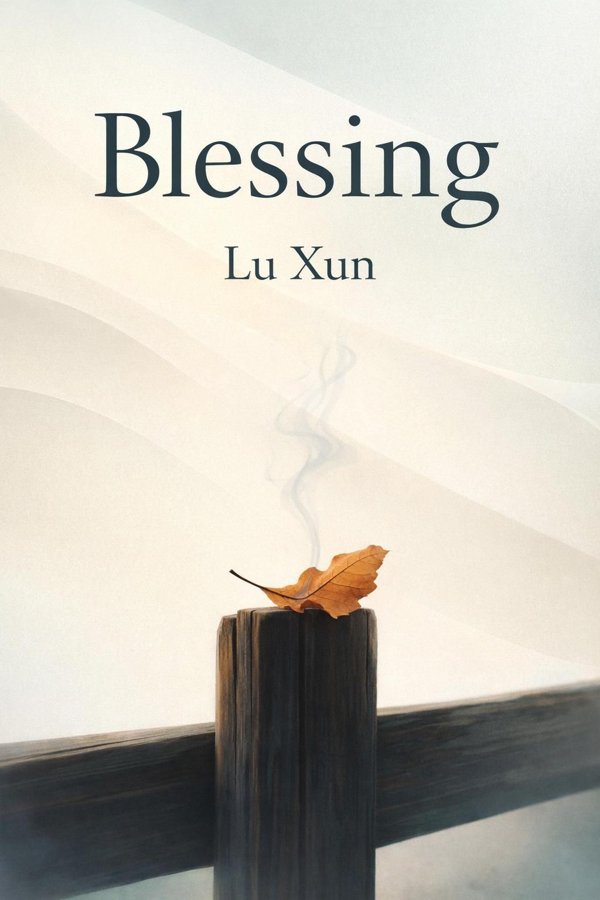
Blessing: Summary & Key Insights
by Lu Xun
 10 min8 chaptersAudio available
Key Takeaways from Blessing
A society often reveals its deepest values not in its laws, but in its rituals.
Reputation is often treated as a social fact, but in reality it is a weapon people use to control one another.
One of Lu Xun’s sharpest criticisms in “Blessing” is that women are condemned not only for wrongdoing, but for trying to survive.
Misfortune becomes far more brutal when it happens to someone without money, status, or protection.
Fear becomes especially destructive when it is given sacred language.
What Is Blessing About?
Blessing by Lu Xun is a classics book. Lu Xun’s “Blessing” is one of the most haunting short stories in modern Chinese literature, a work that turns a single woman’s tragedy into a sharp indictment of an entire social order. First published in 1924 and later included in Wandering, the story follows Xianglin’s Wife, a poor widow whose life is steadily crushed by poverty, superstition, rigid moral codes, and communal cruelty. What makes “Blessing” so powerful is not only its emotional force, but also its precision: Lu Xun shows how ordinary customs, festive rituals, and respectable social rules can become instruments of violence when they strip vulnerable people of dignity. The story matters because it speaks far beyond its historical setting. It asks timeless questions about how societies treat widows, the poor, the traumatized, and anyone marked as “impure” or inconvenient. Lu Xun, widely regarded as the founding master of modern Chinese fiction, wrote with unmatched moral clarity about the spiritual and social sickness of his age. In “Blessing,” his criticism is subtle, devastating, and deeply human, making this short story essential reading for anyone interested in literature, social justice, or the hidden costs of tradition.
This FizzRead summary covers all 8 key chapters of Blessing in approximately 10 minutes, distilling the most important ideas, arguments, and takeaways from Lu Xun's work. Also available as an audio summary and Key Quotes Podcast.
Blessing
Lu Xun’s “Blessing” is one of the most haunting short stories in modern Chinese literature, a work that turns a single woman’s tragedy into a sharp indictment of an entire social order. First published in 1924 and later included in Wandering, the story follows Xianglin’s Wife, a poor widow whose life is steadily crushed by poverty, superstition, rigid moral codes, and communal cruelty. What makes “Blessing” so powerful is not only its emotional force, but also its precision: Lu Xun shows how ordinary customs, festive rituals, and respectable social rules can become instruments of violence when they strip vulnerable people of dignity.
The story matters because it speaks far beyond its historical setting. It asks timeless questions about how societies treat widows, the poor, the traumatized, and anyone marked as “impure” or inconvenient. Lu Xun, widely regarded as the founding master of modern Chinese fiction, wrote with unmatched moral clarity about the spiritual and social sickness of his age. In “Blessing,” his criticism is subtle, devastating, and deeply human, making this short story essential reading for anyone interested in literature, social justice, or the hidden costs of tradition.
Who Should Read Blessing?
This book is perfect for anyone interested in classics and looking to gain actionable insights in a short read. Whether you're a student, professional, or lifelong learner, the key ideas from Blessing by Lu Xun will help you think differently.
- ✓Readers who enjoy classics and want practical takeaways
- ✓Professionals looking to apply new ideas to their work and life
- ✓Anyone who wants the core insights of Blessing in just 10 minutes
Want the full summary?
Get instant access to this book summary and 100K+ more with Fizz Moment.
Get Free SummaryAvailable on App Store • Free to download
Key Chapters
A society often reveals its deepest values not in its laws, but in its rituals. In “Blessing,” Lu Xun places the story against the backdrop of New Year ceremonies and acts of worship that are meant to symbolize prosperity, purity, and communal harmony. Yet the closer we look, the more these rituals expose something darker: a culture that prizes outward order over human compassion. The title itself is bitterly ironic. While the community prepares offerings and blessings for the coming year, Xianglin’s Wife is excluded, shamed, and slowly erased.
Lu Xun’s insight is unsettling because it shows how people can participate in cruelty without seeing themselves as cruel. No one needs to commit spectacular violence for injustice to thrive. It is enough that people continue the customs, repeat moral formulas, and accept social exclusion as normal. The festive atmosphere makes the suffering even harsher, because it highlights who belongs and who does not. Blessings are distributed publicly, but dignity is not.
This idea applies far beyond the story’s historical context. Modern communities also use rituals, traditions, or institutional habits to signal belonging. Workplace celebrations, religious ceremonies, family gatherings, and civic events can all become spaces where certain people are quietly judged or left out: a divorced woman, a grieving parent, a migrant worker, or someone burdened by scandal. What appears harmonious from the outside may conceal silent humiliation.
Lu Xun urges readers to ask a difficult question: when we honor tradition, whom do we protect, and whom do we sacrifice? A custom is not automatically moral just because it is old, respected, or widely practiced. The true measure of any ritual is whether it enlarges human dignity or narrows it.
Actionable takeaway: Examine one tradition in your family, workplace, or community and ask whether it includes the vulnerable or merely preserves appearances.
One of Lu Xun’s sharpest criticisms in “Blessing” is that women are condemned not only for wrongdoing, but for trying to survive. Xianglin’s Wife is trapped in a world where nearly every available path carries punishment. As a widow, she is vulnerable. If she resists control, she is blamed. If she is forced into remarriage, she is judged. If she works, she remains low and disposable. If she suffers, her suffering is interpreted as moral contamination rather than injustice.
This is what makes the story more than a personal tragedy. It reveals a system in which women’s lives are governed by rules designed by others and enforced through shame. Patriarchy in the story is not presented only as male authority in the household. It is embedded in community expectations, religious fears, family structures, and the collective imagination. Even those who seem merely to “follow tradition” help maintain a framework in which women bear disproportionate guilt for circumstances they did not create.
The practical relevance is striking. Even now, women in many societies are still judged more harshly for divorce, widowhood, sexuality, parenthood decisions, financial dependence, aging, or visible trauma. A woman navigating hardship may be scrutinized for how she speaks, dresses, grieves, remarries, works, or raises children. Survival becomes evidence against her character.
Lu Xun’s achievement is to make this injustice visible without preaching abstract theory. By showing how daily life closes around Xianglin’s Wife, he demonstrates that oppression often feels ordinary to those enforcing it. That is precisely why it is so dangerous.
Readers can use this insight by paying attention to double standards in language and behavior. Who gets described as “fallen,” “shameless,” “difficult,” or “impure”? Who is expected to carry family honor through self-denial? These are often signs of deeper structural inequity.
Actionable takeaway: Notice one double standard applied to women in your environment and challenge it directly, whether in conversation, policy, or personal assumptions.
Misfortune becomes far more brutal when it happens to someone without money, status, or protection. In “Blessing,” Xianglin’s Wife is not only a woman marked by tragedy; she is poor, dependent, and socially powerless. That combination matters. Lu Xun shows that the same society that claims to value morality has little interest in shielding those who lack resources. Poverty strips away options, weakens one’s social voice, and makes every setback harder to survive.
The story demonstrates that material insecurity is not separate from moral judgment. The poor are often expected to prove worthiness more constantly than anyone else. Because Xianglin’s Wife occupies a low social position, she cannot easily defend her reputation, choose her circumstances, or escape hostile environments. She must remain where others define her. Her labor may be useful, but her humanity is negotiable.
This dynamic remains deeply familiar. In many modern settings, wealth acts as a shield. People with money can relocate, seek therapy, hire legal support, control their narrative, or move within circles where their mistakes are softened. Poorer people are exposed. Their suffering is public, their choices constrained, and their dignity more easily denied. Society then misreads structural vulnerability as personal failure.
Lu Xun does not romanticize poverty. He shows how it intensifies dependency and makes people susceptible to exploitation by family, employers, and community norms. When basic survival is at stake, resistance becomes harder. Even grief becomes a burden one may not be permitted to carry openly.
The lesson is clear: if we discuss morality without discussing class and power, we risk blaming individuals for conditions they cannot control. Compassion that ignores material reality is often only sentiment.
Actionable takeaway: When evaluating someone’s choices, ask what economic constraints shaped those choices before deciding what they “should have done.”
Fear becomes especially destructive when it is given sacred language. In “Blessing,” Lu Xun shows how superstition can transform pain into permanent guilt. Xianglin’s Wife is not allowed to experience tragedy simply as tragedy; it is interpreted through ideas of impurity, omen, punishment, and spiritual danger. Instead of receiving comfort, she is made to carry metaphysical blame for what she has already endured.
This is one of the story’s most devastating themes. Superstition here is not merely irrational belief in a harmless sense. It functions socially. It gives communities a vocabulary for exclusion and a justification for withholding sympathy. Once a person is seen as spiritually contaminated or unlucky, others can distance themselves while believing they are preserving moral or ritual order. In this way, abstract beliefs produce concrete harm.
Lu Xun’s critique remains highly relevant. Superstition does not only belong to old villages or religious settings. Modern societies also create quasi-sacred narratives about luck, purity, energy, respectability, karma, or “bad influence.” Trauma survivors may be treated as if they bring discomfort into a room. The grieving may be avoided because they disrupt celebration. People who endure repeated hardship may be seen not as wounded, but as somehow marked.
The story encourages a better response: when someone speaks from fear about fate, curse, or contamination, ask what social conditions are reinforcing that fear. Often the real issue is not the supernatural claim itself, but the emotional and institutional structures surrounding it. Belief becomes dangerous when it excuses indifference.
Lu Xun does not argue against meaning, spirituality, or ritual as such. He attacks the use of belief to deny human solidarity. Any worldview that turns the suffering person into the problem has lost its moral center.
Actionable takeaway: When encountering beliefs that stigmatize vulnerable people, respond first with humane reality: suffering is not moral contamination, and pain is not impurity.
People often assume that suffering ends when the original event ends. Lu Xun knew better. In “Blessing,” trauma is not a single wound but a recurring condition, renewed every time Xianglin’s Wife is forced to relive, explain, or socially perform her pain. Her story becomes something others consume, interpret, and eventually grow tired of hearing. What she needs is care, but what she receives is curiosity, discomfort, and withdrawal.
This is a profoundly modern psychological insight. Trauma is sustained not only by memory, but by the environment in which memory must live. If a person is repeatedly shamed, doubted, isolated, or made into a cautionary tale, healing becomes almost impossible. Lu Xun portrays this with remarkable economy: the community first reacts to Xianglin’s Wife’s suffering as news, then as repetition, then as nuisance. The change is subtle but devastating. Her humanity shrinks in the eyes of others precisely because her pain persists.
We see versions of this pattern today among people living with grief, PTSD, depression, displacement, or chronic hardship. At first, communities may offer sympathy. Over time, they may expect recovery on a schedule that suits everyone else. If the person remains affected, support fades. The result is secondary harm: not just the original trauma, but the trauma of being abandoned while still carrying it.
The story invites readers to rethink what help really means. Listening once is not enough. Neither is labeling someone “resilient” and moving on. Care requires sustained patience and the willingness to meet pain without turning it into spectacle.
In practical terms, this can affect how we treat grieving coworkers, struggling relatives, or anyone whose healing does not follow a neat timeline. Real compassion is repetitive because trauma is repetitive.
Actionable takeaway: If someone in your life is carrying ongoing pain, replace “Shouldn’t they be over it?” with “What steady support might they still need?”
Stories do not only reveal their subjects; they also reveal the observer. In “Blessing,” Lu Xun uses a reflective narrator whose presence creates an important moral tension. The narrator is not the direct cause of Xianglin’s Wife’s suffering, yet his perspective helps us see how educated, relatively detached observers can witness social cruelty without fully interrupting it. This narrative choice matters because it complicates the story’s moral landscape. The problem is not only villainy. It is also distance.
The narrator’s return to the hometown and recollection of events allow Lu Xun to examine memory, class, and responsibility all at once. Readers are invited to notice what the narrator understands, what he hesitates to say, and what remains unresolved. This creates a subtle form of self-critique. It is easy to condemn harsh villagers or rigid traditions. It is harder to confront the role of those who perceive injustice clearly but remain constrained by habit, uncertainty, or passivity.
This insight has broad application today. Many educated people recognize unfair systems in theory while participating in them in practice. We may criticize sexism, classism, or stigma, yet still remain silent in meetings, families, schools, or communities where real harm occurs. Awareness can become a substitute for action if we are not careful.
Lu Xun refuses readers the comfort of total innocence. By structuring the story through observation and recollection, he asks us whether seeing clearly is enough. Usually, it is not. Moral intelligence without intervention can shade into complicity.
That does not mean every observer has absolute power. It means that reflection should lead to responsibility rather than self-congratulation. Literature becomes ethically useful when it unsettles not only our opinions, but our habits.
Actionable takeaway: The next time you recognize quiet injustice, do one concrete thing beyond noticing it—speak up, include someone, document the issue, or offer direct support.
All Chapters in Blessing
About the Author
Lu Xun, the pen name of Zhou Shuren, was born in 1881 in Shaoxing, China, and is widely regarded as the founding figure of modern Chinese literature. Originally trained in medicine, he turned to writing after concluding that China’s deepest crises were not only physical but spiritual, cultural, and social. His fiction and essays challenged superstition, feudal values, empty tradition, and the moral complacency of his time. Writing in vernacular Chinese, he helped transform both literary style and public thought. His best-known works include Diary of a Madman, The True Story of Ah Q, and the stories collected in Call to Arms and Wandering. Lu Xun died in 1936, but his influence on literature, criticism, and modern intellectual life remains immense.
Get This Summary in Your Preferred Format
Read or listen to the Blessing summary by Lu Xun anytime, anywhere. FizzRead offers multiple formats so you can learn on your terms — all free.
Available formats: App · Audio · PDF · EPUB — All included free with FizzRead
Download Blessing PDF and EPUB Summary
Key Quotes from Blessing
“A society often reveals its deepest values not in its laws, but in its rituals.”
“Reputation is often treated as a social fact, but in reality it is a weapon people use to control one another.”
“One of Lu Xun’s sharpest criticisms in “Blessing” is that women are condemned not only for wrongdoing, but for trying to survive.”
“Misfortune becomes far more brutal when it happens to someone without money, status, or protection.”
“Fear becomes especially destructive when it is given sacred language.”
Frequently Asked Questions about Blessing
Blessing by Lu Xun is a classics book that explores key ideas across 8 chapters. Lu Xun’s “Blessing” is one of the most haunting short stories in modern Chinese literature, a work that turns a single woman’s tragedy into a sharp indictment of an entire social order. First published in 1924 and later included in Wandering, the story follows Xianglin’s Wife, a poor widow whose life is steadily crushed by poverty, superstition, rigid moral codes, and communal cruelty. What makes “Blessing” so powerful is not only its emotional force, but also its precision: Lu Xun shows how ordinary customs, festive rituals, and respectable social rules can become instruments of violence when they strip vulnerable people of dignity. The story matters because it speaks far beyond its historical setting. It asks timeless questions about how societies treat widows, the poor, the traumatized, and anyone marked as “impure” or inconvenient. Lu Xun, widely regarded as the founding master of modern Chinese fiction, wrote with unmatched moral clarity about the spiritual and social sickness of his age. In “Blessing,” his criticism is subtle, devastating, and deeply human, making this short story essential reading for anyone interested in literature, social justice, or the hidden costs of tradition.
More by Lu Xun
You Might Also Like

Browse by Category
Ready to read Blessing?
Get the full summary and 100K+ more books with Fizz Moment.