
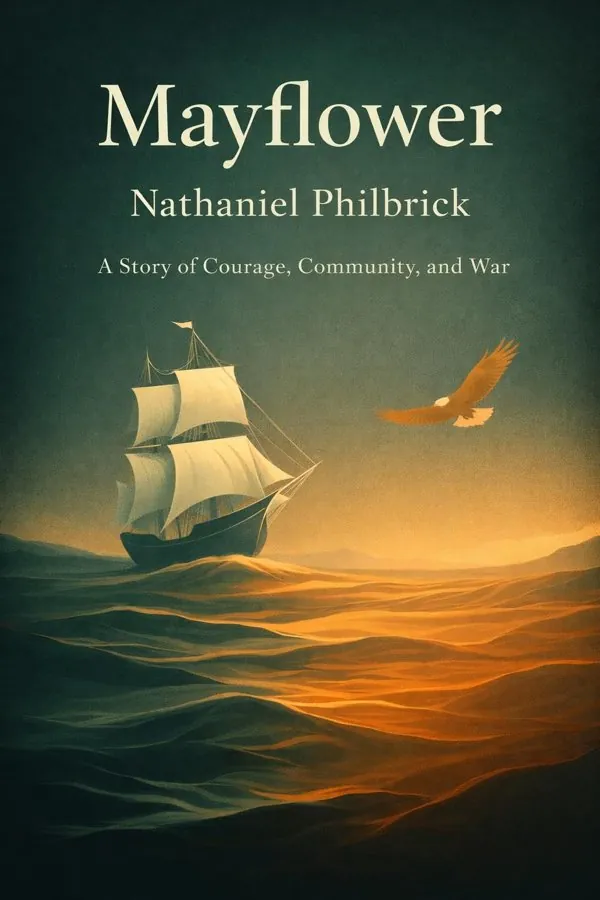
Mayflower: A Story of Courage, Community, and War: Summary & Key Insights
 10 min9 chaptersAudio available
Key Takeaways from Mayflower: A Story of Courage, Community, and War
Founding stories often begin on the ocean, but this one begins with conscience.
We often imagine historic journeys as bold adventures, but the Mayflower voyage was mostly a test of physical endurance and emotional strain.
Settlements are usually remembered by what they became, not by how close they came to failure.
No society survives alone for long, especially in unfamiliar territory.
Some myths survive because they simplify discomfort into ceremony.
What Is Mayflower: A Story of Courage, Community, and War About?
Mayflower: A Story of Courage, Community, and War by Nathaniel Philbrick is a world_history book spanning 9 pages. What if one of America’s most familiar founding stories was not a simple tale of brave settlers, religious freedom, and a friendly Thanksgiving meal, but a far more fragile, tragic, and morally tangled human drama? In Mayflower, Nathaniel Philbrick retells the Pilgrims’ journey from England to Holland, across the Atlantic, and into the uncertain world of New England with vivid narrative force and historical precision. He shows that Plymouth was not just the birthplace of a national myth, but the setting for desperate survival, uneasy diplomacy, cultural misunderstanding, and eventually catastrophic war. Philbrick’s great achievement is that he restores complexity to a story too often flattened into symbols. The book traces how a small community of religious dissenters survived only through discipline, luck, and crucial Native alliances, while also revealing how later expansion and mistrust helped ignite King Philip’s War, one of the deadliest conflicts in early American history. As an acclaimed historian and National Book Award winner, Philbrick brings authority, storytelling skill, and balance to this subject. The result is a gripping history that matters because it forces readers to confront both the courage and the violence embedded in America’s beginnings.
This FizzRead summary covers all 9 key chapters of Mayflower: A Story of Courage, Community, and War in approximately 10 minutes, distilling the most important ideas, arguments, and takeaways from Nathaniel Philbrick's work. Also available as an audio summary and Key Quotes Podcast.
Mayflower: A Story of Courage, Community, and War
What if one of America’s most familiar founding stories was not a simple tale of brave settlers, religious freedom, and a friendly Thanksgiving meal, but a far more fragile, tragic, and morally tangled human drama? In Mayflower, Nathaniel Philbrick retells the Pilgrims’ journey from England to Holland, across the Atlantic, and into the uncertain world of New England with vivid narrative force and historical precision. He shows that Plymouth was not just the birthplace of a national myth, but the setting for desperate survival, uneasy diplomacy, cultural misunderstanding, and eventually catastrophic war.
Philbrick’s great achievement is that he restores complexity to a story too often flattened into symbols. The book traces how a small community of religious dissenters survived only through discipline, luck, and crucial Native alliances, while also revealing how later expansion and mistrust helped ignite King Philip’s War, one of the deadliest conflicts in early American history. As an acclaimed historian and National Book Award winner, Philbrick brings authority, storytelling skill, and balance to this subject. The result is a gripping history that matters because it forces readers to confront both the courage and the violence embedded in America’s beginnings.
Who Should Read Mayflower: A Story of Courage, Community, and War?
This book is perfect for anyone interested in world_history and looking to gain actionable insights in a short read. Whether you're a student, professional, or lifelong learner, the key ideas from Mayflower: A Story of Courage, Community, and War by Nathaniel Philbrick will help you think differently.
- ✓Readers who enjoy world_history and want practical takeaways
- ✓Professionals looking to apply new ideas to their work and life
- ✓Anyone who wants the core insights of Mayflower: A Story of Courage, Community, and War in just 10 minutes
Want the full summary?
Get instant access to this book summary and 100K+ more with Fizz Moment.
Get Free SummaryAvailable on App Store • Free to download
Key Chapters
Founding stories often begin on the ocean, but this one begins with conscience. Before the Pilgrims ever boarded the Mayflower, they were English Separatists who believed the Church of England was too corrupted to be reformed from within. Their decision to worship outside official structures was not merely theological disagreement; it was a direct challenge to political authority in a world where church and state were tightly bound together. That made them dangerous in the eyes of the crown.
Philbrick shows that these people were not romantic adventurers seeking novelty. They were disciplined believers willing to uproot themselves for principle. Their move from England to Leiden in the Dutch Republic gave them temporary religious freedom, but exile created new anxieties. Economic hardship, cultural assimilation, and fear that their children would drift away from English identity pushed them toward an even more radical step: crossing the Atlantic.
This background matters because it explains both the Pilgrims’ strengths and their limitations. Their tight communal bonds helped them endure extraordinary suffering. But the same moral certainty that gave them courage could also make them rigid and suspicious. In modern terms, we can see a familiar pattern: groups formed around deeply held values often display remarkable resilience, yet they may struggle to adapt when their ideals meet complex realities.
A practical lesson emerges for anyone leading a mission-driven group today. Strong purpose can unite people through uncertainty, but purpose alone is not enough. It must be paired with flexibility, economic realism, and an honest understanding of the surrounding world.
Actionable takeaway: When evaluating any movement, team, or institution, begin with its founding beliefs, because those early convictions often shape both its greatest strengths and its deepest blind spots.
We often imagine historic journeys as bold adventures, but the Mayflower voyage was mostly a test of physical endurance and emotional strain. In the autumn of 1620, more than one hundred passengers were crowded into a small merchant vessel not designed for transporting families across the Atlantic. The crossing was slow, storm-ridden, unsanitary, and frightening. Privacy barely existed. Seasickness, dampness, bad food, and constant danger wore people down long before they reached land.
Philbrick emphasizes how vulnerable the passengers really were. They were not arriving as confident colonizers with a clear system and abundant supplies. They were entering winter after a delayed departure, with uncertain legal standing, limited resources, and no reliable idea of what awaited them. Even before they landed, a political problem emerged: because they were blown north of their intended destination, some passengers questioned whether the colony’s leaders had legitimate authority over them.
That tension produced one of the voyage’s most important outcomes: the Mayflower Compact. This agreement was not democracy in its modern form, but it was a practical commitment to civil order under conditions of uncertainty. It showed that survival required consent as well as leadership.
The episode offers a useful real-world lesson. In moments of instability, groups often need simple, shared rules more than grand ideals. Startups, emergency teams, and community organizations all face versions of this challenge. Before pursuing ambition, they must create enough trust and structure to stay functional.
Actionable takeaway: In any high-risk transition, establish clear agreements early, because shared expectations can hold a group together when conditions are chaotic and fear is rising.
Settlements are usually remembered by what they became, not by how close they came to failure. Philbrick makes clear that Plymouth’s early months were defined by hunger, exposure, disease, and death. The colonists arrived too late in the season to plant effectively. They lacked secure shelter. Many remained weakened by the voyage. During the first winter, roughly half the settlers died, including key leaders and family members. Survival itself became the colony’s central achievement.
This brutal beginning strips away sentimental images of tidy colonial purpose. Plymouth was not an orderly implantation of English society but a precarious experiment held together by labor, faith, and necessity. Women and men alike carried crushing burdens, from nursing the sick to constructing housing in deadly weather. Leadership mattered, but so did ordinary perseverance. The colony lived because enough people kept working despite grief and uncertainty.
Philbrick also shows that Plymouth’s survival depended on adaptation. The settlers had to abandon assumptions, improvise routines, and accept help they could not have anticipated. That is often how institutions survive crisis: not by perfectly executing an original plan, but by revising that plan under pressure.
For modern readers, Plymouth offers a more honest model of resilience. Endurance is rarely glamorous. It consists of repetitive, uncelebrated acts that accumulate into stability. A family recovering from hardship, a business in a downturn, or a community after disaster may recognize the same pattern.
Actionable takeaway: When facing a difficult beginning, measure progress by what keeps people alive and functioning, not by whether reality matches the original vision.
No society survives alone for long, especially in unfamiliar territory. One of Philbrick’s most important contributions is his insistence that Plymouth’s story cannot be understood apart from the Native peoples who already shaped New England. The colony’s survival depended heavily on a fragile alliance with the Wampanoag, particularly their sachem Massasoit. This was not an act of simple generosity, nor was it a relationship of equals free from tension. It was a strategic partnership formed in a dangerous world.
The Wampanoag had their own reasons for engaging the English. Epidemic disease had recently devastated Native communities in coastal New England, altering the regional balance of power. Massasoit saw possible value in an alliance with the newcomers against rival tribes such as the Narragansetts. The English, for their part, desperately needed local knowledge, diplomatic protection, and practical instruction in navigating the land.
Figures like Samoset and Tisquantum, known as Squanto, were central in bridging these worlds. Squanto in particular provided translation, agricultural guidance, and political mediation, though Philbrick also presents him as a complex actor with his own ambitions. This is crucial: intermediaries are never just helpers in someone else’s story; they are political agents.
The broader lesson is that cooperation across cultural divides often emerges from overlapping interests rather than mutual innocence. In business, diplomacy, or neighborhood life, alliances work best when each side understands the other’s incentives instead of relying on myths of harmony.
Actionable takeaway: Build partnerships by asking what each side needs, fears, and hopes to gain, because realistic understanding is more durable than sentimental trust.
Some myths survive because they simplify discomfort into ceremony. Philbrick does not deny that a celebratory harvest gathering took place in 1621, often associated with the first Thanksgiving. But he places it back into its proper context: not as the birth of uncomplicated national harmony, but as a brief moment of relief within a much larger story of insecurity, negotiation, and looming conflict.
The event reflected real cooperation. The colonists had survived their first year, and Wampanoag participants joined them in a shared display of diplomacy and provision. Yet the later cultural memory of Thanksgiving often treats this meal as a symbolic resolution of colonial-Native relations, as if mutual goodwill settled everything. Philbrick shows the opposite. The peace was contingent, practical, and temporary. It depended on political calculations and remained vulnerable to changing conditions.
This distinction matters beyond historical accuracy. Societies often create reassuring rituals that hide the harder truths beneath them. Commemorations can preserve memory, but they can also flatten it. A mature relationship to history requires us to hold both facts at once: the meal happened, and the harmony it symbolizes was limited and fragile.
In everyday life, this has a clear application. Organizations and families sometimes cling to founding stories that emphasize unity while ignoring pain, exclusion, or conflict. Those stories may feel inspiring, but they prevent honest growth. Better narratives make room for gratitude without denying complexity.
Actionable takeaway: Revisit the traditions you inherit and ask not only what they celebrate, but also what they leave out, because honest memory creates wiser communities.
Peace can endure for years and still be quietly unraveling underneath. As the English population in New England grew, the conditions that had made the original Plymouth-Wampanoag alliance possible began to change. More settlers meant greater demand for land, stronger assumptions of English political authority, and increasing pressure on Native autonomy. What began as coexistence gradually hardened into competition.
Philbrick is especially effective at showing how conflict often develops incrementally rather than explosively. There was no single moment when everyone suddenly abandoned peace. Instead, small frictions accumulated: disputes over property, livestock destroying Native crops, missionary efforts among Native communities, unequal legal treatment, and deepening cultural misunderstanding. English settlers viewed expansion as natural progress. Native peoples experienced it as encroachment on land, power, and identity.
This dynamic is historically significant because it challenges the simplistic idea that good intentions at the beginning guarantee just outcomes later. A relationship can begin in cooperation and still produce domination if the balance of power shifts. The Pilgrims’ descendants were not operating under the same constraints as the first settlers; they were part of a growing colonial world increasingly confident in its right to control the region.
The modern parallel is easy to recognize. Growth in any institution or society creates stress. A company scaling quickly, a city expanding, or a movement gaining influence can unintentionally abandon the mutual obligations that sustained it early on. Without deliberate safeguards, expansion turns partnership into extraction.
Actionable takeaway: Whenever growth accelerates, examine who bears the cost, because unmanaged expansion often transforms yesterday’s allies into today’s adversaries.
History turns when children no longer see the world as their parents did. One of Philbrick’s most insightful themes is generational change. The first generation of Pilgrims remembered persecution in England, exile in Holland, and near starvation in New England. Their decisions were shaped by vulnerability and gratitude for any stable peace. But the next generations grew up in a different environment: more numerous, more rooted in the land, and less personally tied to the original hardships or diplomatic bargains.
On the Native side, a similar generational shift occurred. Massasoit had negotiated with the English from a position shaped by epidemic loss and regional insecurity. His son Metacom, later called King Philip by the English, inherited a world in which colonial expansion posed a much more direct and humiliating threat. What had once been an alliance of necessity looked increasingly like submission.
Philbrick demonstrates that this change in perspective matters as much as formal policy. Younger generations often reinterpret obligations made by elders. They may value autonomy over compromise, or security over coexistence. That does not make conflict inevitable, but it makes inherited peace difficult to sustain without continual renewal.
This pattern appears everywhere today. Family businesses struggle when founding sacrifices no longer feel relevant. Nations polarize when later generations reject earlier settlements. Institutions fracture when memory fades but structure remains.
Actionable takeaway: If you want a partnership or tradition to endure across generations, do not assume memory will do the work; explain the original bargain, update it for new realities, and invite the next generation to help redefine it.
Some wars are remembered because they create nations; others should be remembered because they reveal the true cost of nation-building. King Philip’s War, fought in 1675 to 1676, was one of the bloodiest conflicts per capita in American history, and Philbrick places it at the center of the New England story. What began as escalating mistrust and scattered incidents became a region-wide war involving Native confederates, English colonists, and shifting local alliances.
Metacom emerged as the symbolic leader of Native resistance, though the conflict was never as simple as one side united against another. Different Native groups made different choices. Some fought the English; others allied with them. The English themselves were divided, fearful, and often militarily unprepared. Towns were burned, civilians killed, economies shattered, and assumptions of security demolished. The violence was intimate and relentless because it took place in settled communities rather than distant battlefields.
Philbrick’s account is powerful partly because it rejects easy moral simplification. The war exposed the brutality, fear, vengeance, and strategic calculation of all sides. Yet it also made one reality unmistakable: colonial expansion had reached a breaking point. The hopeful image of early coexistence could no longer contain the pressure of land hunger and political domination.
For modern readers, the lesson is sobering. Long-suppressed grievances do not disappear because institutions continue functioning. They often intensify until a triggering event unleashes much deeper instability.
Actionable takeaway: Pay attention to conflicts that appear local or manageable, because when underlying injustice and fear are ignored for too long, the eventual rupture is usually far more destructive than early compromise would have been.
The end of a war does not end its consequences; it reorganizes memory, power, and possibility. After King Philip’s War, Native resistance in southern New England was devastated. Many Native people were killed, displaced, enslaved, or forced into dependent arrangements. English settlements expanded with new confidence, and the regional balance of power shifted decisively toward colonial control. In that sense, the war did not merely conclude a chapter in early American history. It fundamentally altered the future.
Philbrick argues, implicitly and sometimes explicitly, that we misunderstand America’s beginnings when we focus only on arrival and survival while ignoring conquest and aftermath. Plymouth’s legacy includes courage and communal endurance, but it also includes dispossession, mythmaking, and selective remembrance. This double truth is the book’s enduring power. It asks readers to resist inherited narratives that celebrate origins while forgetting who paid the price.
That is not simply a scholarly correction. It is a civic one. Nations are healthier when they can face their founding contradictions without collapsing into either self-congratulation or self-hatred. Honest history does not erase bravery; it places bravery inside a larger moral landscape.
This framework is useful in any context where institutions tell stories about themselves. Schools, companies, churches, and nations all develop preferred memories. Those memories shape identity, but they also shape responsibility. If the story is incomplete, the identity will be shallow.
Actionable takeaway: When reflecting on any origin story, ask not only who succeeded, but who was marginalized, displaced, or forgotten, because lasting understanding begins where comforting legend ends.
All Chapters in Mayflower: A Story of Courage, Community, and War
About the Author
Nathaniel Philbrick is an American author and historian celebrated for turning pivotal episodes of history into vivid, readable narratives. He first gained wide recognition with In the Heart of the Sea, his National Book Award-winning account of the whaleship Essex tragedy, and has since written several acclaimed works on maritime history and the American past. Philbrick is especially known for combining meticulous research with the pace and character depth of great storytelling. His books, including Mayflower, Bunker Hill, and Valiant Ambition, often revisit familiar historical events and reveal their overlooked tensions, ambiguities, and human stakes. With a strong interest in how individual lives intersect with larger national forces, Philbrick has become one of the most respected popular historians writing about America’s formative years.
Get This Summary in Your Preferred Format
Read or listen to the Mayflower: A Story of Courage, Community, and War summary by Nathaniel Philbrick anytime, anywhere. FizzRead offers multiple formats so you can learn on your terms — all free.
Available formats: App · Audio · PDF · EPUB — All included free with FizzRead
Download Mayflower: A Story of Courage, Community, and War PDF and EPUB Summary
Key Quotes from Mayflower: A Story of Courage, Community, and War
“Founding stories often begin on the ocean, but this one begins with conscience.”
“We often imagine historic journeys as bold adventures, but the Mayflower voyage was mostly a test of physical endurance and emotional strain.”
“Settlements are usually remembered by what they became, not by how close they came to failure.”
“No society survives alone for long, especially in unfamiliar territory.”
“Some myths survive because they simplify discomfort into ceremony.”
Frequently Asked Questions about Mayflower: A Story of Courage, Community, and War
Mayflower: A Story of Courage, Community, and War by Nathaniel Philbrick is a world_history book that explores key ideas across 9 chapters. What if one of America’s most familiar founding stories was not a simple tale of brave settlers, religious freedom, and a friendly Thanksgiving meal, but a far more fragile, tragic, and morally tangled human drama? In Mayflower, Nathaniel Philbrick retells the Pilgrims’ journey from England to Holland, across the Atlantic, and into the uncertain world of New England with vivid narrative force and historical precision. He shows that Plymouth was not just the birthplace of a national myth, but the setting for desperate survival, uneasy diplomacy, cultural misunderstanding, and eventually catastrophic war. Philbrick’s great achievement is that he restores complexity to a story too often flattened into symbols. The book traces how a small community of religious dissenters survived only through discipline, luck, and crucial Native alliances, while also revealing how later expansion and mistrust helped ignite King Philip’s War, one of the deadliest conflicts in early American history. As an acclaimed historian and National Book Award winner, Philbrick brings authority, storytelling skill, and balance to this subject. The result is a gripping history that matters because it forces readers to confront both the courage and the violence embedded in America’s beginnings.
You Might Also Like
The Age of Capital
Eric Hobsbawm
10 min
The Gulag Archipelago
Aleksandr Solzhenitsyn
10 min
Jerusalem: The Biography
Simon Sebag Montefiore
10 min
The Anglo-Saxons
James Campbell
10 min
The Boer War
Thomas Pakenham
10 min
The Industrial Revolutionaries: The Making of the Modern World 1776–1914
Gavin Weightman
10 minBrowse by Category
Ready to read Mayflower: A Story of Courage, Community, and War?
Get the full summary and 100K+ more books with Fizz Moment.