
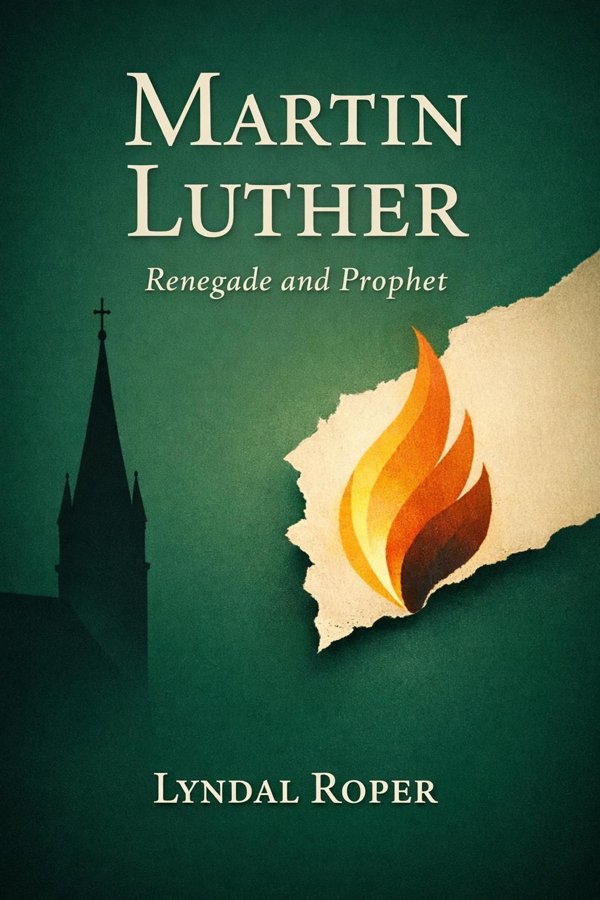
Martin Luther: Renegade and Prophet: Summary & Key Insights
by Lyndal Roper
 10 min6 chaptersAudio available
What Is Martin Luther: Renegade and Prophet About?
Martin Luther: Renegade and Prophet by Lyndal Roper is a biographies book spanning 6 pages. A major biography of Martin Luther by Lyndal Roper, this work explores the life, theology, and personality of the German reformer who changed the course of Western Christianity. Drawing on extensive archival research, Roper presents Luther as a complex and often contradictory figure—both a revolutionary and a man deeply rooted in his time. The book examines his spiritual struggles, his break with the Catholic Church, and his enduring influence on religion and culture.
This FizzRead summary covers all 6 key chapters of Martin Luther: Renegade and Prophet in approximately 10 minutes, distilling the most important ideas, arguments, and takeaways from Lyndal Roper's work. Also available as an audio summary and Key Quotes Podcast.
Martin Luther: Renegade and Prophet
A major biography of Martin Luther by Lyndal Roper, this work explores the life, theology, and personality of the German reformer who changed the course of Western Christianity. Drawing on extensive archival research, Roper presents Luther as a complex and often contradictory figure—both a revolutionary and a man deeply rooted in his time. The book examines his spiritual struggles, his break with the Catholic Church, and his enduring influence on religion and culture.
Who Should Read Martin Luther: Renegade and Prophet?
This book is perfect for anyone interested in biographies and looking to gain actionable insights in a short read. Whether you're a student, professional, or lifelong learner, the key ideas from Martin Luther: Renegade and Prophet by Lyndal Roper will help you think differently.
- ✓Readers who enjoy biographies and want practical takeaways
- ✓Professionals looking to apply new ideas to their work and life
- ✓Anyone who wants the core insights of Martin Luther: Renegade and Prophet in just 10 minutes
Want the full summary?
Get instant access to this book summary and 100K+ more with Fizz Moment.
Get Free SummaryAvailable on App Store • Free to download
Key Chapters
Luther’s beginnings were humble yet charged with ambition. Born in 1483 in the Saxon mining town of Eisleben and raised in Mansfeld, he grew up in a milieu where hard labor met rising civic aspiration. His father, Hans Luther, was a self-made man of the emerging bourgeoisie—tough, pragmatic, and intent on securing social advancement for his son. Martin’s childhood was steeped in discipline, fear of sin, and reverence for authority. The beating heart of the home was both ambition and anxiety—values that would define his later theology.
Luther’s education reflected his father’s upward drive. Hans sent his son to Magdeburg and Eisenach to train for a career in law, a path seen as the route to respectability. Yet it was in these years that Luther began to absorb the devotional world of late medieval piety. He sang in choirs, memorized the Scriptures, and internalized the fear of divine judgment. The structure of the cosmos seemed unforgiving: God was righteous; man was corrupt. For Luther, this was not an academic premise but an emotional certainty.
His decision to enter an Augustinian monastery in 1505 stunned his father and community. The story of the thunderstorm near Stotternheim—where a terrified Luther vowed to become a monk—captures his spiritual intensity. But this choice was not mere panic; it was a radical search for God. Inside the monastery, Luther pursued perfection—fasting, confession, and ritual observance. Yet each act drew him deeper into despair: the harder he tried to please God, the more unworthy he felt.
This period is essential to understanding Luther’s eventual breakthrough. He was not rejecting medieval faith; he was its ultimate product. His anguish mirrored a system built on the belief that one could, through effort and penance, achieve divine favor. For Luther, that effort only proved the impossibility of human righteousness. The monastery did not calm his soul; it intensified his crisis. But it also laid the groundwork for transformation. Through study and prayer, Luther began to see Scripture as a living dialogue rather than a dead authority. The student of sin was becoming, quietly, the challenger of salvation itself.
Luther’s theology did not emerge in isolation. It grew within the hothouse intellectual world of late medieval universities, where scholastic reasoning and biblical exegesis intertwined. At Erfurt, and later Wittenberg, Luther encountered the dominant theology of his age—built on Aristotle’s logic and Aquinas’s system of grace. But the very precision of scholasticism triggered his rebellion. The notion that salvation could be calibrated through rational equations and good works seemed to Luther both spiritually sterile and psychologically unbearable.
He wrestled especially with the meaning of sin and grace. In the confessional, he poured out his guilt, seeking absolution from a system that offered penance as remedy. Yet each absolution felt hollow. The idea that human effort could measure up to divine holiness struck Luther as false. Instead, he turned increasingly to Scripture—particularly Paul’s letters to the Romans and Galatians—where he discovered a God who justified sinners not because they deserved it, but because they trusted His promise.
Luther’s thinking crystallized around the problem of trust: what does it mean to believe? Faith, for him, was not mere assent; it was a living, existential surrender. This insight was revolutionary, and it arose from turmoil, not tranquility. The more Luther reflected on biblical grace, the more he confronted the illusion that human righteousness could claim any merit before God.
In this period, Luther began lecturing on the Psalms and Romans, and his notes reveal the emergence of his new theology. The human being was not an agent of salvation but its recipient. Time and again, he emphasized that salvation rested on God's initiative alone. In doing so, he was dismantling the spiritual economy of the medieval Church—an institution that had, for centuries, mediated grace through its sacraments.
These lectures, still cautious, contained the seeds of a doctrinal revolution. Luther was moving toward the idea that justification was forensic, not transformative—God declared the sinner righteous through faith alone. His theology shifted the entire axis of religious life, from ritual performance to inward conviction. His intellectual battles were inseparable from his emotional ones; theology, for Luther, was not theory but therapy for the tormented soul.
+ 4 more chapters — available in the FizzRead app
All Chapters in Martin Luther: Renegade and Prophet
About the Author
Lyndal Roper is an Australian historian and the Regius Professor of History at the University of Oxford. She is known for her scholarship on early modern Germany, gender history, and the Reformation, and has written extensively on Martin Luther and the social context of his era.
Get This Summary in Your Preferred Format
Read or listen to the Martin Luther: Renegade and Prophet summary by Lyndal Roper anytime, anywhere. FizzRead offers multiple formats so you can learn on your terms — all free.
Available formats: App · Audio · PDF · EPUB — All included free with FizzRead
Download Martin Luther: Renegade and Prophet PDF and EPUB Summary
Key Quotes from Martin Luther: Renegade and Prophet
“Luther’s beginnings were humble yet charged with ambition.”
“Luther’s theology did not emerge in isolation.”
Frequently Asked Questions about Martin Luther: Renegade and Prophet
Martin Luther: Renegade and Prophet by Lyndal Roper is a biographies book that explores key ideas across 6 chapters. A major biography of Martin Luther by Lyndal Roper, this work explores the life, theology, and personality of the German reformer who changed the course of Western Christianity. Drawing on extensive archival research, Roper presents Luther as a complex and often contradictory figure—both a revolutionary and a man deeply rooted in his time. The book examines his spiritual struggles, his break with the Catholic Church, and his enduring influence on religion and culture.
You Might Also Like

An American Marriage
Tayari Jones
10 min
Benjamin Franklin: An American Life
Walter Isaacson
10 min
I Know Why The Caged Bird Sings
Maya Angelou
10 min
Long Walk to Freedom
Nelson Mandela
10 min
Persepolis
Marjane Satrapi
10 min
Surely You're Joking, Mr. Feynman!
Richard P. Feynman
10 minBrowse by Category
Ready to read Martin Luther: Renegade and Prophet?
Get the full summary and 100K+ more books with Fizz Moment.