
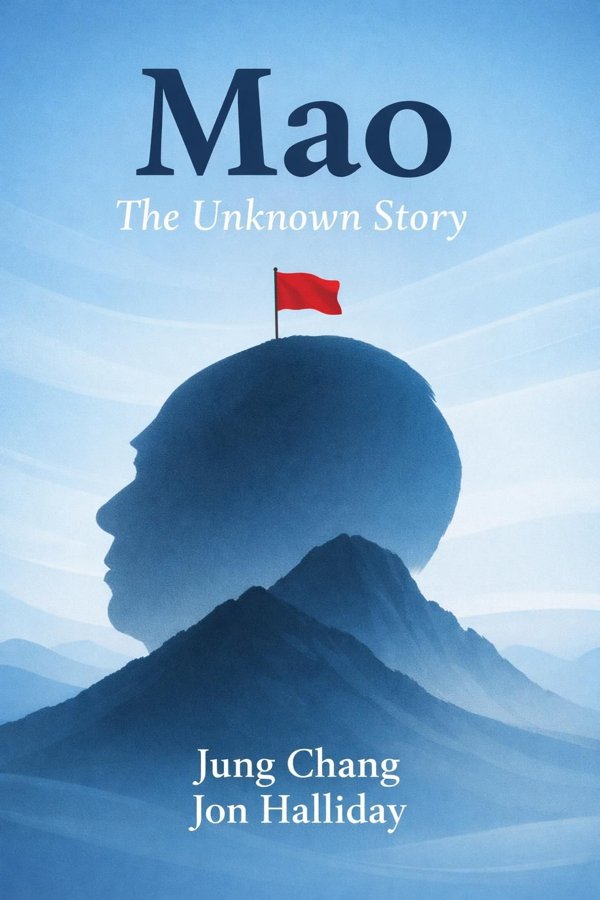
Mao: The Unknown Story: Summary & Key Insights
 10 min9 chapters
Key Takeaways from Mao: The Unknown Story
Great political myths often begin with small personal myths.
Power in revolutionary movements does not always go to the most principled believer; it often goes to the most skillful manipulator.
History’s most powerful events are not only lived; they are edited.
Authoritarian rule rarely begins with tanks; it often begins with controlled language, managed loyalty, and fear disguised as discipline.
Victory in war does not guarantee justice in peace.
What Is Mao: The Unknown Story About?
Mao: The Unknown Story by Jung Chang, Jon Halliday is a biographies book spanning 8 pages. Mao: The Unknown Story is a sweeping, deeply critical biography that challenges one of the most enduring political myths of the twentieth century. In this book, Jung Chang and Jon Halliday argue that Mao Zedong was not a flawed idealist who made tragic mistakes, but a calculating ruler who pursued power with extraordinary ruthlessness and indifference to human suffering. Covering Mao’s life from his youth in Hunan to his death as leader of the People’s Republic of China, the book traces how ambition, manipulation, and political violence shaped both his rise and the fate of modern China. What makes the work so significant is not only its bold thesis, but the scale of its research: the authors draw on interviews, newly available archives, memoirs, and diplomatic records from multiple countries. Chang brings personal knowledge of revolutionary China and the lived effects of Maoism, while Halliday contributes broad historical expertise. The result is a controversial but powerful reassessment of Mao’s legacy, forcing readers to rethink leadership, propaganda, and the human cost of ideological rule.
This FizzRead summary covers all 9 key chapters of Mao: The Unknown Story in approximately 10 minutes, distilling the most important ideas, arguments, and takeaways from Jung Chang, Jon Halliday's work.
Mao: The Unknown Story
Mao: The Unknown Story is a sweeping, deeply critical biography that challenges one of the most enduring political myths of the twentieth century. In this book, Jung Chang and Jon Halliday argue that Mao Zedong was not a flawed idealist who made tragic mistakes, but a calculating ruler who pursued power with extraordinary ruthlessness and indifference to human suffering. Covering Mao’s life from his youth in Hunan to his death as leader of the People’s Republic of China, the book traces how ambition, manipulation, and political violence shaped both his rise and the fate of modern China. What makes the work so significant is not only its bold thesis, but the scale of its research: the authors draw on interviews, newly available archives, memoirs, and diplomatic records from multiple countries. Chang brings personal knowledge of revolutionary China and the lived effects of Maoism, while Halliday contributes broad historical expertise. The result is a controversial but powerful reassessment of Mao’s legacy, forcing readers to rethink leadership, propaganda, and the human cost of ideological rule.
Who Should Read Mao: The Unknown Story?
This book is perfect for anyone interested in biographies and looking to gain actionable insights in a short read. Whether you're a student, professional, or lifelong learner, the key ideas from Mao: The Unknown Story by Jung Chang, Jon Halliday will help you think differently.
- ✓Readers who enjoy biographies and want practical takeaways
- ✓Professionals looking to apply new ideas to their work and life
- ✓Anyone who wants the core insights of Mao: The Unknown Story in just 10 minutes
Want the full summary?
Get instant access to this book summary and 100K+ more with Fizz Moment.
Get Free SummaryAvailable on App Store • Free to download
Key Chapters
Great political myths often begin with small personal myths. Jung Chang and Jon Halliday argue that Mao’s early life was later romanticized into the story of a poor peasant boy rising in righteous rebellion, but the reality was more complicated and far less heroic. Mao grew up in Shaoshan in a family that, while not aristocratic, was relatively secure and better off than many around them. His father was a disciplined and prosperous farmer, and Mao’s formative years were marked less by solidarity with the oppressed than by resentment of authority and a powerful sense of self-importance.
The authors portray young Mao as intellectually curious but emotionally detached, drawn to grand ideas and personal advancement rather than to sacrifice for a cause. His early reading exposed him to rebellion, military glory, and strongman politics. In Chang and Halliday’s telling, this was the seedbed of a personality that valued dominance more than empathy. Even before he became a revolutionary, Mao was learning to narrate his own life in ways that made him appear larger, more visionary, and more destined than others.
This matters because political leaders are often understood through stories created after the fact. The book invites readers to question whether heroic origin tales illuminate character or conceal it. In workplaces, movements, and public life, people often build authority through carefully shaped narratives rather than proven integrity.
A practical lesson is to examine how leaders describe their beginnings. Ask what evidence supports the story, what details are omitted, and whether their actions match the values they claim to have learned early on.
Power in revolutionary movements does not always go to the most principled believer; it often goes to the most skillful manipulator. One of the book’s central claims is that Mao rose within the Chinese Communist Party not primarily because he was its greatest thinker or organizer, but because he mastered internal politics. He learned how to exploit divisions, flatter stronger allies, shift ideological positions when useful, and destroy rivals without appearing openly responsible.
Chang and Halliday show that the early Communist movement in China was shaped by intellectual debate, Soviet influence, and organizational uncertainty. Mao, in their portrait, excelled in this instability. He was less attached to doctrine than to advantage. When alliances helped him, he embraced them; when they threatened him, he recast former colleagues as traitors, incompetents, or enemies of the revolution. His strength lay in understanding that revolutionary parties are especially vulnerable to fear, purity tests, and accusations of disloyalty.
The broader insight reaches far beyond Chinese history. In any institution, systems built around ideology can become easy to capture if loyalty matters more than truth. Teams stop correcting bad decisions when disagreement is treated as betrayal. Leaders then accumulate power not by delivering results, but by making others afraid to challenge them.
A useful example is modern organizational culture: if only one narrative is allowed and critics are sidelined, poor judgment can flourish unchecked. Whether in politics or business, concentrated authority usually grows through tolerated small acts of control before it becomes obvious domination.
The actionable takeaway is simple: pay close attention to how leaders handle dissent. A leader who consistently advances by silencing rivals is revealing more about future governance than any speech or manifesto ever could.
History’s most powerful events are not only lived; they are edited. The Long March has often been celebrated as an epic retreat that forged Communist heroism and elevated Mao through courage and strategic brilliance. Chang and Halliday sharply challenge that interpretation. They argue that the event, while undeniably grueling, was later transformed into a political legend that exaggerated Mao’s role, obscured military failures, and turned survival into proof of greatness.
According to the authors, Mao’s eventual dominance benefited enormously from how the Long March was remembered. Hardship became sanctified, and those who endured it could be woven into a foundational story of purity and destiny. But foundational myths can be selective. Details that complicated Mao’s image were minimized, while episodes that supported his inevitability were amplified. The result was not just a historical memory but a legitimacy machine.
This idea matters because myths are often more politically useful than facts. Nations, companies, and movements all create defining stories about struggle and triumph. These stories can unify people, but they can also become tools that excuse later abuses. If a leader is linked to a sacred origin story, criticism starts to sound like sacrilege rather than accountability.
A practical parallel appears when organizations glorify a difficult founding phase and use it to justify present-day authoritarian habits. “We survived because of this person” can become “therefore this person must never be questioned.” That transition is dangerous.
The takeaway is to separate symbolic meaning from factual history. Respect endurance and sacrifice, but always ask who benefits from the official version of a formative event and what alternative accounts have been pushed aside.
Authoritarian rule rarely begins with tanks; it often begins with controlled language, managed loyalty, and fear disguised as discipline. In the Yan’an period, Mao consolidated not only his political authority but also the psychological foundations of long-term dictatorship. Chang and Halliday describe Yan’an as the place where Mao perfected methods of ideological control, surveillance, and ritualized self-criticism that would later define Communist rule across China.
This was more than ordinary party administration. The authors argue that Mao used rectification campaigns to reshape how people thought, spoke, and judged one another. Cadres were pressured to confess errors, denounce deviations, and internalize Mao’s authority as moral truth. The process bound personal survival to public conformity. Even intimate relationships could become politically dangerous if they suggested independent loyalties.
The book’s deeper point is that the cult of personality is not merely about admiration; it is a system for eliminating alternative centers of trust. Once people fear independent thought, they begin to censor themselves before the state even intervenes. That is one reason personality cults can be so durable: their most effective police force is internalized obedience.
Modern readers can apply this insight wherever institutions use moral language to demand total alignment. In unhealthy environments, employees or members are encouraged to perform belief, confess insufficiency, and celebrate leaders as uniquely wise. Over time, honesty becomes risky and flattery becomes rational.
The actionable lesson is to protect spaces where disagreement can remain normal and safe. Whenever a group starts treating criticism as moral contamination and praise as proof of virtue, it may be building the emotional architecture of authoritarianism.
Victory in war does not guarantee justice in peace. After the Communists prevailed in the civil war and founded the People’s Republic of China in 1949, many inside and outside China hoped a new era of order and national recovery had begun. Chang and Halliday argue, however, that Mao treated state power not as a responsibility to improve lives but as an instrument for domination, ideological ambition, and personal stature on the world stage.
The book portrays the early years of the new regime as a period in which Mao rapidly institutionalized coercion. Land reform, campaigns against “counterrevolutionaries,” and mass political movements were framed as necessary revolutionary cleansing, but they also helped destroy rival power structures and normalize violence as a governing method. The state expanded into every sphere of life, and political loyalty became a condition for social security.
A central theme here is that many regimes begin by promising renewal and then use emergency logic to make control permanent. Because the population has endured war or chaos, people may initially accept harsh measures in the name of stability. But once fear becomes administrative routine, extraordinary powers stop being temporary.
There is a wider lesson for political judgment. Citizens should be cautious when leaders claim that sweeping coercion is justified by national destiny, moral urgency, or historical necessity. Such language can conceal an effort to make accountability impossible.
The practical takeaway is to evaluate new governments by the institutions they build, not the rhetoric they use. Ask whether laws restrain leaders, whether dissent remains possible, and whether “temporary” campaigns are becoming the standard method of rule.
Some of history’s worst disasters are not natural at all; they are created by leaders who refuse to let reality interrupt ideology. In Mao: The Unknown Story, the Great Leap Forward is presented as one of the clearest examples of this pattern. Mao sought to propel China into rapid industrial and agricultural transformation through mass mobilization, collectivization, impossible production targets, and a near-religious belief in human will over material limits. The result, the authors argue, was a famine of staggering scale.
Chang and Halliday emphasize that this was not merely a policy mistake made in ignorance. They contend that information about starvation and failure reached the leadership, including Mao, yet the system kept escalating coercion. Officials inflated harvest numbers to satisfy superiors. Grain was extracted from areas already in crisis. Rural people were trapped inside communes, stripped of local coping mechanisms, and punished for resisting impossible demands. Ideology turned truth-telling into danger.
The modern relevance is sobering. Systems fail catastrophically when leaders reward pleasing reports and punish inconvenient facts. This can happen in governments, corporations, hospitals, or schools. If metrics become sacred, people manipulate them. If leaders treat bad news as sabotage, reality disappears until collapse forces itself back into view.
A practical example is any workplace where teams exaggerate performance because honesty harms careers. Over time, decision-makers operate on fiction, and the cost falls on those with the least power.
The takeaway is to build environments where bad news can travel upward safely. Ambition without feedback becomes delusion, and delusion backed by power can become mass suffering.
A dictator who fears losing control may choose not order, but chaos that only he can arbitrate. Chang and Halliday interpret the Cultural Revolution as exactly this kind of political strategy. Rather than a spontaneous purification movement, they present it as Mao’s deliberate effort to reassert supremacy after earlier setbacks, especially the damage to his prestige following the Great Leap Forward. By mobilizing youth, attacking party institutions, and unleashing ideological violence, Mao turned society into a battleground where all stability depended on him.
The book describes how students were encouraged to become Red Guards, how established officials were humiliated or destroyed, and how accusations replaced law. Families were split, education was shattered, cultural heritage was attacked, and entire communities were pushed into fear and suspicion. In this atmosphere, revolutionary purity became an excuse for cruelty, while Mao’s symbolic authority rose above the wreckage.
The deeper insight is that disorder can be politically useful. Leaders do not always seek calm administration; sometimes they benefit from confusion that weakens institutions and makes personal loyalty the only reliable compass. When rules collapse, access to the leader becomes more valuable than procedure, fairness, or competence.
This pattern appears in smaller settings too. Some managers keep teams unstable, rotate priorities unpredictably, or encourage rivalry because confusion prevents coordinated resistance. People become too busy surviving to question the system itself.
The actionable takeaway is to notice when chaos consistently advantages the person at the top. If instability repeatedly destroys institutions while strengthening one leader’s centrality, the disorder may not be accidental at all.
Revolutionary leaders often claim to serve the nation, but some are driven equally by status, historical grandeur, and geopolitical theater. Chang and Halliday argue that Mao’s foreign policy cannot be understood simply as anti-imperial resistance or communist solidarity. They portray him as a leader intensely concerned with his personal standing in the international revolutionary movement, willing to expose China and others to severe risk in pursuit of prestige.
The book examines Mao’s relationship with Stalin, the Korean War, the Sino-Soviet split, and China’s positioning in the Cold War. In the authors’ account, Mao repeatedly treated human suffering as secondary to strategic image. War could become proof of resolve. Hardship could demonstrate ideological purity. Diplomatic rupture could affirm independence. These choices were not abstract. They shaped military casualties, economic burdens, and the daily lives of ordinary people already strained by domestic upheaval.
The larger lesson is that foreign policy slogans can conceal deeply personal motives. Leaders may describe confrontational decisions as national necessity when they are also seeking legitimacy, fame, or ideological immortality. Citizens therefore need to ask not only what a policy claims to defend, but what symbolic value it gives the leader.
A practical application is to analyze whether international posturing produces measurable public benefit or primarily feeds nationalistic spectacle. When leaders dramatize conflict while domestic accountability is weak, ordinary people often pay the price.
The takeaway is to judge foreign policy by consequences rather than rhetoric. Prestige-driven politics can sound noble, but if a strategy consistently sacrifices lives for image, it deserves skepticism, not admiration.
The end of a ruler’s life does not end the struggle over what that ruler meant. Mao’s death in 1976 closed an era, but it opened a fierce contest over memory, responsibility, and national identity. Chang and Halliday argue that Mao left behind not just a damaged country, but a political problem: how could China acknowledge immense suffering without delegitimizing the revolution that still underpinned the state?
The authors suggest that the answer was partial reckoning. Some excesses, especially of the Cultural Revolution, could be condemned. Certain subordinates could be blamed. But Mao himself had to remain, at least officially, a founding giant whose contributions outweighed his errors. This balancing act allowed the political system to survive while leaving many deeper truths unresolved. The result was a selective memory in which commemoration, silence, and controlled criticism coexisted uneasily.
This chapter of Mao’s story carries a wider warning. Societies often struggle to confront charismatic leaders who delivered national transformation alongside massive destruction. Memory becomes political terrain. Too much honesty threatens legitimacy; too little honesty guarantees repetition.
The same principle can apply in institutions after abusive leadership. Organizations may remove the worst symbols of a failed era yet preserve flattering narratives because full accountability feels too costly. But unfinished reckoning distorts learning.
The actionable takeaway is to treat historical memory as a civic responsibility. When evaluating any legacy, resist the comfort of all-hero or all-villain simplifications, but do not let complexity become an excuse for evading evidence, victims, or consequences.
All Chapters in Mao: The Unknown Story
About the Authors
Jung Chang is a Chinese-born British author whose writing has helped global readers understand the human experience behind modern Chinese history. She became internationally famous with Wild Swans, a multigenerational memoir that blended family history with the story of twentieth-century China. Jon Halliday is a British historian and writer known for his work on modern political history, revolution, and international affairs. Together, Chang and Halliday collaborated on Mao: The Unknown Story, combining Chang’s personal knowledge of Maoist China’s legacy with Halliday’s historical research skills and international perspective. Their partnership produced one of the most widely discussed and controversial biographies of Mao Zedong, notable for its extensive interviews, archival material, and uncompromising challenge to the leader’s heroic reputation.
Get This Summary in Your Preferred Format
Read or listen to the Mao: The Unknown Story summary by Jung Chang, Jon Halliday anytime, anywhere. FizzRead offers multiple formats so you can learn on your terms — all free.
Available formats: App · Audio · PDF · EPUB — All included free with FizzRead
Download Mao: The Unknown Story PDF and EPUB Summary
Key Quotes from Mao: The Unknown Story
“Great political myths often begin with small personal myths.”
“Power in revolutionary movements does not always go to the most principled believer; it often goes to the most skillful manipulator.”
“History’s most powerful events are not only lived; they are edited.”
“Authoritarian rule rarely begins with tanks; it often begins with controlled language, managed loyalty, and fear disguised as discipline.”
“Victory in war does not guarantee justice in peace.”
Frequently Asked Questions about Mao: The Unknown Story
Mao: The Unknown Story by Jung Chang, Jon Halliday is a biographies book that explores key ideas across 9 chapters. Mao: The Unknown Story is a sweeping, deeply critical biography that challenges one of the most enduring political myths of the twentieth century. In this book, Jung Chang and Jon Halliday argue that Mao Zedong was not a flawed idealist who made tragic mistakes, but a calculating ruler who pursued power with extraordinary ruthlessness and indifference to human suffering. Covering Mao’s life from his youth in Hunan to his death as leader of the People’s Republic of China, the book traces how ambition, manipulation, and political violence shaped both his rise and the fate of modern China. What makes the work so significant is not only its bold thesis, but the scale of its research: the authors draw on interviews, newly available archives, memoirs, and diplomatic records from multiple countries. Chang brings personal knowledge of revolutionary China and the lived effects of Maoism, while Halliday contributes broad historical expertise. The result is a controversial but powerful reassessment of Mao’s legacy, forcing readers to rethink leadership, propaganda, and the human cost of ideological rule.
You Might Also Like
An American Marriage
Tayari Jones
10 min
Benjamin Franklin: An American Life
Walter Isaacson
10 min
I Know Why The Caged Bird Sings
Maya Angelou
10 min
Long Walk to Freedom
Nelson Mandela
10 min
Persepolis
Marjane Satrapi
10 min
Surely You're Joking, Mr. Feynman!
Richard P. Feynman
10 minBrowse by Category
Ready to read Mao: The Unknown Story?
Get the full summary and 100K+ more books with Fizz Moment.