
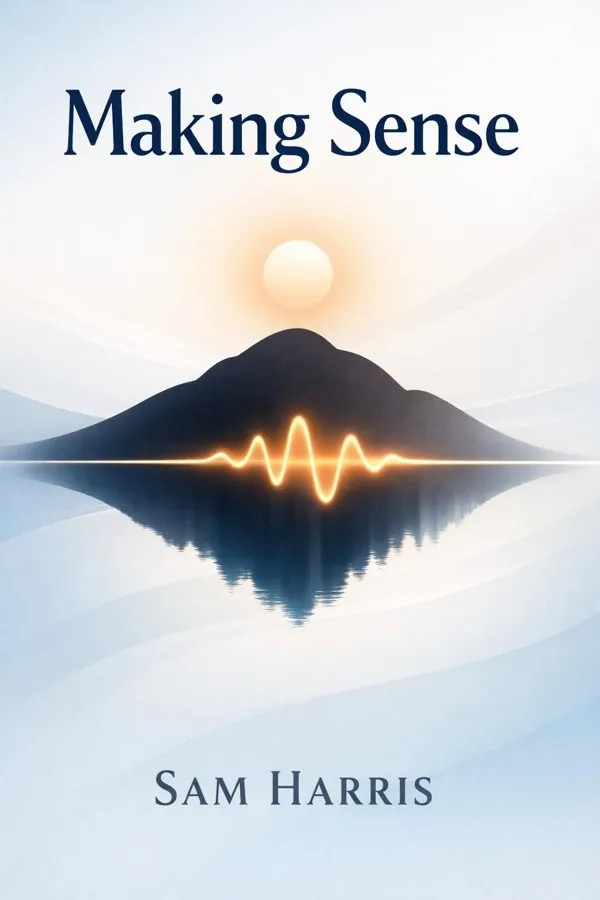
Making Sense: Conversations on Consciousness, Morality, and the Future of Humanity: Summary & Key Insights
by Sam Harris
 10 min8 chaptersAudio available
What Is Making Sense: Conversations on Consciousness, Morality, and the Future of Humanity About?
Making Sense: Conversations on Consciousness, Morality, and the Future of Humanity by Sam Harris is a philosophy book spanning 8 pages. A collection of conversations between neuroscientist and philosopher Sam Harris and a range of thinkers, exploring topics such as consciousness, free will, morality, politics, and the future of humanity. The book distills key insights from Harris’s popular podcast, offering readers a window into some of the most pressing intellectual and ethical questions of our time.
This FizzRead summary covers all 8 key chapters of Making Sense: Conversations on Consciousness, Morality, and the Future of Humanity in approximately 10 minutes, distilling the most important ideas, arguments, and takeaways from Sam Harris's work. Also available as an audio summary and Key Quotes Podcast.
Making Sense: Conversations on Consciousness, Morality, and the Future of Humanity
A collection of conversations between neuroscientist and philosopher Sam Harris and a range of thinkers, exploring topics such as consciousness, free will, morality, politics, and the future of humanity. The book distills key insights from Harris’s popular podcast, offering readers a window into some of the most pressing intellectual and ethical questions of our time.
Who Should Read Making Sense: Conversations on Consciousness, Morality, and the Future of Humanity?
This book is perfect for anyone interested in philosophy and looking to gain actionable insights in a short read. Whether you're a student, professional, or lifelong learner, the key ideas from Making Sense: Conversations on Consciousness, Morality, and the Future of Humanity by Sam Harris will help you think differently.
- ✓Readers who enjoy philosophy and want practical takeaways
- ✓Professionals looking to apply new ideas to their work and life
- ✓Anyone who wants the core insights of Making Sense: Conversations on Consciousness, Morality, and the Future of Humanity in just 10 minutes
Want the full summary?
Get instant access to this book summary and 100K+ more with Fizz Moment.
Get Free SummaryAvailable on App Store • Free to download
Key Chapters
Consciousness has always been the mystery at the heart of philosophy and science. In my discussions with neuroscientists and thinkers like Anil Seth and David Chalmers, we explored the profound question: What does it mean to have a subjective experience? Why should physical processes in the brain give rise to the feeling of being an individual self, perceiving colors, emotions, and thoughts? This question—the so-called ‘hard problem of consciousness’—reveals both the power and the limits of scientific inquiry.
From my perspective, consciousness isn’t merely another phenomenon to explain like gravity or digestion—it’s the very medium through which everything else is known. Without consciousness, the universe would be dark and silent, devoid of experience. This insight changes how we think about what truly matters. Every moral stance, every human intention, ultimately rests on the reality of experience and the avoidance of suffering. It’s not the external world alone but the way it appears in consciousness that defines our lives.
In these dialogues, we also considered how the self might be an illusion—a construct arising from neural processes that bind attention, memory, and perception into a narrative. Meditation provided a unique angle here; through mindfulness practice, one can observe the transient nature of thought and emotion and glimpse awareness without the usual identification with a personal self. As someone trained in neuroscience, I find that convergence between contemplative insight and empirical evidence thrilling. It suggests that what ancient contemplatives observed directly through introspection can align with what modern science uncovers about the brain.
To make sense of consciousness, we must hold two perspectives simultaneously: the scientific and the experiential. Neither alone can fully describe what it is like to be. This dance between objectivity and subjectivity forms the core of our inquiry. In learning to perceive experience without the illusions of self or separateness, we glimpse a deeper truth—perhaps the foundation on which a rational, ethical worldview must stand.
Few ideas are as central to how we think about ourselves as free will—the belief that we are autonomous agents, authors of our actions. Yet when we examine this concept closely, the illusion begins to unravel. In conversations with philosophers and neuroscientists, I’ve often argued that free will, as most people conceive it, simply doesn’t exist. Our thoughts and intentions arise out of preceding causes—genetic, environmental, neurological—over which we had no ultimate control. You did not choose your parents, the culture that shaped you, or the synaptic events that triggered your last decision.
This realization can feel unsettling. If we are not truly free, what happens to moral responsibility? I suggest that understanding determinism actually expands compassion. When you see that even the worst behavior stems from causes that were not self-authored, you begin to judge people differently. You no longer imagine a truly evil soul; you see a complex system of biology and experience gone awry. This shift doesn’t excuse wrongdoing—it transforms our approach to justice from punishment to prevention, from retribution to rehabilitation.
Neuroscience makes this argument tangible. Every moment of decision is preceded by brain activity that occurs before conscious awareness. The popular notion that we ‘choose’ freely is replaced by a continuum of causality. Yet acknowledging this truth doesn’t strip life of meaning—it reveals a deeper dimension of ethical responsibility. We can still act intentionally, cultivate wisdom, and respond with compassion, even as we recognize that beneath the surface, we are fully part of a causal network.
In embracing this understanding, we step out of illusion into clarity. The question is not how to preserve the fantasy of free will, but how to live wisely once we see through it. This insight—though challenging—can profoundly change how we view ourselves and others: not as blameworthy agents but as beings caught in a web of causes and conditions, capable of understanding and transformation.
+ 6 more chapters — available in the FizzRead app
All Chapters in Making Sense: Conversations on Consciousness, Morality, and the Future of Humanity
About the Author
Sam Harris is an American author, neuroscientist, and philosopher known for his writings on religion, ethics, free will, and human consciousness. He is the host of the podcast 'Making Sense' and the author of several bestselling books including 'The End of Faith' and 'Waking Up'.
Get This Summary in Your Preferred Format
Read or listen to the Making Sense: Conversations on Consciousness, Morality, and the Future of Humanity summary by Sam Harris anytime, anywhere. FizzRead offers multiple formats so you can learn on your terms — all free.
Available formats: App · Audio · PDF · EPUB — All included free with FizzRead
Download Making Sense: Conversations on Consciousness, Morality, and the Future of Humanity PDF and EPUB Summary
Key Quotes from Making Sense: Conversations on Consciousness, Morality, and the Future of Humanity
“Consciousness has always been the mystery at the heart of philosophy and science.”
“Few ideas are as central to how we think about ourselves as free will—the belief that we are autonomous agents, authors of our actions.”
Frequently Asked Questions about Making Sense: Conversations on Consciousness, Morality, and the Future of Humanity
Making Sense: Conversations on Consciousness, Morality, and the Future of Humanity by Sam Harris is a philosophy book that explores key ideas across 8 chapters. A collection of conversations between neuroscientist and philosopher Sam Harris and a range of thinkers, exploring topics such as consciousness, free will, morality, politics, and the future of humanity. The book distills key insights from Harris’s popular podcast, offering readers a window into some of the most pressing intellectual and ethical questions of our time.
More by Sam Harris

You Might Also Like




Browse by Category
Ready to read Making Sense: Conversations on Consciousness, Morality, and the Future of Humanity?
Get the full summary and 100K+ more books with Fizz Moment.