
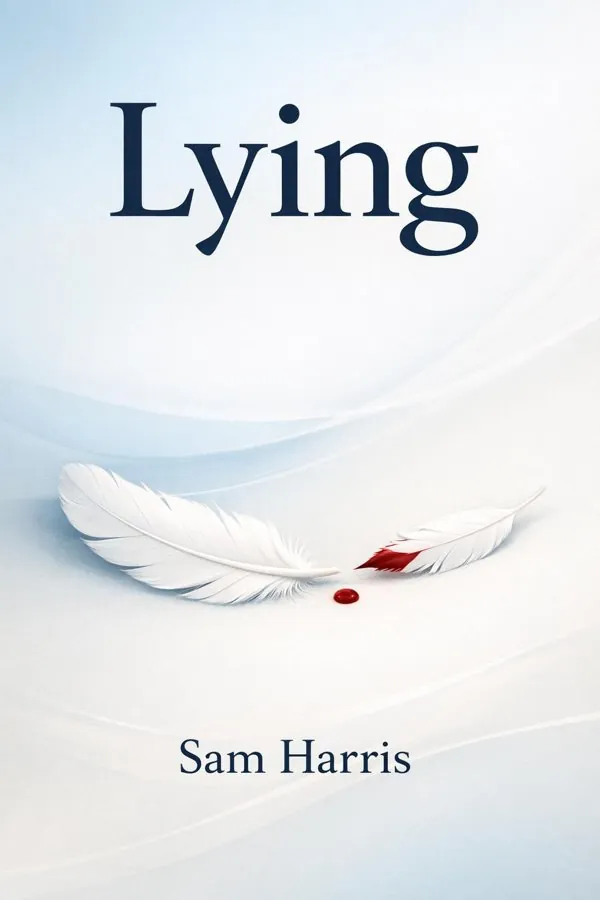
Lying: Summary & Key Insights
by Sam Harris
 10 min10 chaptersAudio available
Key Takeaways from Lying
A lie begins the moment we intentionally cause someone to believe what we think is false.
Most lies are not born from cruelty but from discomfort.
A lie is rarely as contained as it appears.
Harris’s strongest moral claim is that lying is wrong because it denies other people the ability to navigate their own lives.
The phrase white lie suggests moral innocence, as though some falsehoods are too small or too polite to matter.
What Is Lying About?
Lying by Sam Harris is a ethics book spanning 10 pages. What if many of the daily frictions, anxieties, and broken relationships in modern life could be traced to something we treat as harmless: the casual lie? In Lying, Sam Harris makes a strikingly simple but far-reaching argument: honesty is not merely a personal virtue but a practical necessity for human flourishing. In this short yet provocative essay, he challenges the comforting belief that small deceptions are often kind, useful, or unavoidable. Instead, he shows how even minor lies create confusion, manipulate other people’s choices, and slowly erode trust in families, friendships, workplaces, and public life. Harris approaches the subject not as a preacher but as a thinker interested in the real consequences of behavior. Drawing on moral philosophy, psychology, and ordinary experience, he examines why people lie, why self-deception is so common, and why truthfulness often requires more courage than we admit. His authority comes from his broader work in ethics, reason, and human behavior, where he consistently asks how people can live more honestly and clearly. Lying matters because it turns a familiar habit into a serious moral question: what do we owe one another when we speak, stay silent, or choose to mislead?
This FizzRead summary covers all 10 key chapters of Lying in approximately 10 minutes, distilling the most important ideas, arguments, and takeaways from Sam Harris's work. Also available as an audio summary and Key Quotes Podcast.
Lying
What if many of the daily frictions, anxieties, and broken relationships in modern life could be traced to something we treat as harmless: the casual lie? In Lying, Sam Harris makes a strikingly simple but far-reaching argument: honesty is not merely a personal virtue but a practical necessity for human flourishing. In this short yet provocative essay, he challenges the comforting belief that small deceptions are often kind, useful, or unavoidable. Instead, he shows how even minor lies create confusion, manipulate other people’s choices, and slowly erode trust in families, friendships, workplaces, and public life.
Harris approaches the subject not as a preacher but as a thinker interested in the real consequences of behavior. Drawing on moral philosophy, psychology, and ordinary experience, he examines why people lie, why self-deception is so common, and why truthfulness often requires more courage than we admit. His authority comes from his broader work in ethics, reason, and human behavior, where he consistently asks how people can live more honestly and clearly. Lying matters because it turns a familiar habit into a serious moral question: what do we owe one another when we speak, stay silent, or choose to mislead?
Who Should Read Lying?
This book is perfect for anyone interested in ethics and looking to gain actionable insights in a short read. Whether you're a student, professional, or lifelong learner, the key ideas from Lying by Sam Harris will help you think differently.
- ✓Readers who enjoy ethics and want practical takeaways
- ✓Professionals looking to apply new ideas to their work and life
- ✓Anyone who wants the core insights of Lying in just 10 minutes
Want the full summary?
Get instant access to this book summary and 100K+ more with Fizz Moment.
Get Free SummaryAvailable on App Store • Free to download
Key Chapters
A lie begins the moment we intentionally cause someone to believe what we think is false. Harris insists that deception is not limited to outright false statements. A shrug, a carefully edited story, a convenient omission, or silence at a crucial moment can all serve the same purpose: to distort another person’s understanding of reality. This broader definition matters because it strips away many of the excuses people use to preserve a positive self-image. We often say, “I didn’t technically lie,” when what we really mean is, “I successfully misled someone without using a false sentence.”
This is not a semantic point. When you deceive someone, you interfere with their ability to make informed choices. If a friend asks whether you shared a private secret and you answer ambiguously to avoid accountability, you are still steering their beliefs. If a company advertises a product in a way that hides important risks, it may be legally careful while remaining morally dishonest. In both cases, the victim is denied access to reality.
Harris’s insight reframes lying as a violation of another person’s autonomy. Truth is not just information; it is the basis on which people organize their lives. To deceive is to quietly take control of someone else’s decision-making. That is why even polished, socially acceptable forms of dishonesty deserve moral scrutiny.
Actionable takeaway: When you wonder whether you are lying, ask a stricter question: “Am I trying to make this person believe something I think is false or incomplete?” If the answer is yes, choose clarity instead.
Most lies are not born from cruelty but from discomfort. Harris argues that people usually lie because they fear immediate consequences: embarrassment, conflict, rejection, punishment, or shame. Deception becomes a form of emotional self-protection. In the short term, it seems efficient. A lie can spare us an awkward conversation, preserve a polished image, or postpone someone’s disappointment. That is precisely why lying is so tempting.
Psychologically, this makes sense. Human beings are deeply social, and social threats often feel urgent. Telling a supervisor, “I’m almost done,” when you are far behind may feel safer than admitting failure. Complimenting a gift you dislike may seem kinder than risking hurt feelings. Saying “I’m fine” when you are not can feel easier than revealing vulnerability. In each case, the lie reduces immediate tension. But Harris asks us to notice what happens next: the tension does not disappear; it merely changes form. Now you must maintain a false impression, remember what you said, and live with the knowledge that your comfort was purchased at someone else’s expense.
Over time, lying can become a reflex. Instead of confronting reality directly, we become dependent on impression management. This weakens character because courage is replaced by avoidance. Honesty, by contrast, often feels harder at first but easier afterward. It ends the mental split between what is true and what must be defended.
Actionable takeaway: The next time you feel tempted to lie, pause and identify the fear underneath it. Name the threat honestly, then ask whether a brief moment of discomfort is better than a longer period of concealment.
Harris’s strongest moral claim is that lying is wrong because it denies other people the ability to navigate their own lives. To tell the truth is not merely to avoid sin or obey convention; it is to respect another person as a conscious being entitled to reality. When you deceive someone, you are not just hiding facts. You are covertly influencing their choices by controlling the information available to them.
This idea elevates honesty from a private virtue to a public service. A patient cannot give meaningful consent if a doctor withholds critical information. A voter cannot make sound political choices if leaders manipulate facts. A friend cannot respond appropriately to your needs if you present a false emotional state. In each case, dishonesty is a form of domination, even when it looks gentle or sophisticated.
Harris does not claim that truth must be delivered harshly. Honesty can be kind, tactful, and well-timed. The point is that kindness should shape how we communicate truth, not whether we communicate it at all. Many people confuse honesty with bluntness and dishonesty with compassion. Harris rejects this false choice. We can be both truthful and humane.
Once honesty is understood as respect, ethical communication becomes clearer. The question is no longer “What story gets me the outcome I want?” but “What does this person need in order to make free, informed decisions?” This standard is demanding, but it creates relationships grounded in mutual dignity rather than manipulation.
Actionable takeaway: In difficult conversations, frame honesty as an act of respect. Aim to tell the truth in the most compassionate form, without depriving the other person of reality.
The phrase white lie suggests moral innocence, as though some falsehoods are too small or too polite to matter. Harris challenges this assumption. He argues that even socially accepted lies often carry real ethical costs because they manipulate another person’s experience for our own convenience. The lie may be mild, but the principle is the same: we decide that another person cannot be trusted with the truth.
Take common examples. You tell a dinner host you loved the meal when you did not. You praise a colleague’s idea you believe is weak. You reassure a friend that everything is fine while privately resenting them. These moments may seem too trivial for moral concern, yet they shape the texture of relationships. False praise distorts feedback. Fake agreement prevents improvement. Pretended ease conceals tension until it erupts in less manageable ways.
Harris’s argument is not that every truth must be delivered in full detail at every moment. Social life requires discretion, tact, and proportion. But discretion is not the same as deception. You do not need to say, “Your food was terrible,” to avoid lying. You can redirect honestly: “Thank you for inviting me,” or “I appreciated the evening.” The challenge is creative truthfulness, not cruelty.
White lies often persist because people underestimate alternatives. They assume the only options are a hurtful truth or a pleasant falsehood. Harris invites a third path: honest speech shaped by kindness and restraint. That path demands more skill, but it preserves integrity.
Actionable takeaway: Replace reflexive politeness with tactful honesty. Before using a white lie, ask whether you can be truthful, brief, and kind at the same time.
Some of the most emotionally compelling lies are told in the name of protection. We hide difficult diagnoses, conceal family secrets, soften betrayals, or distort circumstances because we believe the truth would cause pain. Harris takes this justification seriously but remains skeptical. He argues that lying to protect others often assumes a power we do not rightfully possess: the power to decide what another person should know about their own life.
This can easily slide into paternalism. A parent may hide a serious financial problem from an adult child to spare worry, but in doing so prevents that child from helping or preparing. A partner may withhold a betrayal to “protect” the relationship, when in fact the deception primarily protects the betrayer from consequences. Even professionals sometimes misuse this logic by shielding clients, patients, or employees from difficult realities under the banner of benevolence.
Harris acknowledges that extreme situations can complicate the issue. If a murderer asks where a victim is hiding, truthfulness may not be the overriding value. But such cases are exceptional and should not be used to justify the ordinary habit of deception in daily life. Most people do not lie under conditions of moral emergency. They lie because truth is uncomfortable, unpredictable, or emotionally costly.
The deeper question is whether pain caused by truth is always worse than pain caused by deceit. Usually it is not. Truth can hurt, but it allows adaptation. Lies defer pain while removing agency. Protection without consent often becomes control.
Actionable takeaway: When tempted to lie “for someone’s own good,” ask whether you are preserving their well-being or preserving your ability to manage their reaction.
People often imagine lying as a clear-eyed act: we know the truth and intentionally conceal it. Harris adds a subtler layer by examining self-deception. Many lies are sustained because people blur reality for themselves first. We rationalize motives, reinterpret events, and construct flattering narratives that make our behavior easier to defend. Once this happens, deception toward others becomes almost effortless.
Self-deception is attractive because it protects identity. If you see yourself as generous, you may describe selfish behavior as necessary self-care. If you think of yourself as loyal, you may minimize a betrayal as harmless. In professional life, ambition can disguise itself as service; in romance, possessiveness can masquerade as love. The mind is remarkably skilled at editing facts in ways that preserve self-esteem.
Harris suggests that this inner dishonesty is especially dangerous because it blocks moral learning. If you cannot see your own motives clearly, you cannot correct them. The problem is not only that others are misled; it is that your character becomes organized around falsehood. This creates a feedback loop: the more invested you are in a self-serving story, the more aggressively you defend it.
Combating self-deception requires humility and attention. It means welcoming disconfirming evidence, listening carefully to criticism, and noticing when you feel defensive or unusually eager to justify yourself. Those moments often reveal where truth is under pressure.
Actionable takeaway: Build a habit of self-audit. When conflict arises, ask, “What story about myself am I trying to protect here?” Then look for the facts that challenge that story.
Harris does not advocate reckless confession or theatrical bluntness. What he defends is something closer to radical honesty as a disciplined refusal to deceive. The appeal of this approach is not only moral purity but practical simplicity. When you stop lying, your life becomes easier to manage. You no longer need to remember fabricated details, maintain conflicting stories, or calculate how much truth each person can handle. Reality becomes sufficient.
This simplification can be transformative. In close relationships, honesty reduces suspicion and creates conditions for deeper trust. In work, it sharpens communication and lowers the cost of mistakes because problems are surfaced early. Internally, it brings relief. Many people do not realize how much mental energy is consumed by image management until they stop doing it. Truthfulness restores coherence between inner life and outward speech.
Of course, radical honesty requires judgment. It does not mean saying everything you think. Some thoughts are immature, irrelevant, or unkind in ways that need not be expressed. Harris’s concern is not total disclosure but the abandonment of deception. You can keep confidences, preserve privacy, and choose silence without manufacturing falsehoods.
The discipline also changes identity. Instead of seeing yourself as someone who skillfully manages impressions, you become someone who can be known. That is a different kind of strength. It trades short-term control for long-term trustworthiness.
Actionable takeaway: Experiment with one week of no intentional deception. Do not exaggerate, mislead, or hide behind convenient half-truths. Notice how this changes your conversations, anxiety level, and sense of self.
Many people resist Harris’s argument because they assume honesty inevitably becomes harshness. But one of the most practical lessons of Lying is that truthfulness is a communication skill. The goal is not to dump facts carelessly or weaponize sincerity. It is to learn how to say what is true in a way that is timely, proportionate, and constructive. Honest people are not exempt from tact; they simply refuse to substitute manipulation for it.
For example, if a friend asks for feedback on a project you think is weak, honesty does not require humiliation. You can say, “I think the idea has potential, but this part isn’t working for me yet.” If you cannot attend an event, you do not need to invent illness or scheduling chaos; “I’m not able to make it” may be enough. If someone asks a question you prefer not to answer, you can decline directly rather than fabricate. These alternatives preserve both truth and dignity.
Harris’s broader point is that practical honesty often depends on emotional maturity. You must tolerate awkwardness, allow others their reactions, and resist the urge to control outcomes. The temptation to lie is frequently a temptation to engineer how other people feel. Truthful speech accepts that we cannot do this without moral cost.
In that sense, honesty is less about perfect wording than about clean intention. If your aim is clarity rather than domination, you can usually find language that serves both truth and kindness.
Actionable takeaway: Prepare truthful default phrases for common situations, such as declining invitations, giving feedback, or setting boundaries. Rehearsed honesty makes deception less tempting in the moment.
All Chapters in Lying
About the Author
Sam Harris is an American author, neuroscientist, philosopher, and podcast host known for his work on ethics, belief, meditation, and human reasoning. He earned a Ph.D. in neuroscience from UCLA, where he studied the neural basis of belief, disbelief, and uncertainty. Harris rose to prominence with The End of Faith and went on to write several influential books, including Letter to a Christian Nation, The Moral Landscape, Free Will, and Waking Up. Across his work, he combines scientific inquiry with philosophical analysis, often addressing difficult questions about morality, consciousness, and public discourse. His writing is noted for its clarity, directness, and willingness to challenge conventional assumptions. In Lying, he applies this style to a basic but consequential ethical question: why honesty matters so deeply in everyday life.
Get This Summary in Your Preferred Format
Read or listen to the Lying summary by Sam Harris anytime, anywhere. FizzRead offers multiple formats so you can learn on your terms — all free.
Available formats: App · Audio · PDF · EPUB — All included free with FizzRead
Download Lying PDF and EPUB Summary
Key Quotes from Lying
“A lie begins the moment we intentionally cause someone to believe what we think is false.”
“Most lies are not born from cruelty but from discomfort.”
“A lie is rarely as contained as it appears.”
“Harris’s strongest moral claim is that lying is wrong because it denies other people the ability to navigate their own lives.”
“The phrase white lie suggests moral innocence, as though some falsehoods are too small or too polite to matter.”
Frequently Asked Questions about Lying
Lying by Sam Harris is a ethics book that explores key ideas across 10 chapters. What if many of the daily frictions, anxieties, and broken relationships in modern life could be traced to something we treat as harmless: the casual lie? In Lying, Sam Harris makes a strikingly simple but far-reaching argument: honesty is not merely a personal virtue but a practical necessity for human flourishing. In this short yet provocative essay, he challenges the comforting belief that small deceptions are often kind, useful, or unavoidable. Instead, he shows how even minor lies create confusion, manipulate other people’s choices, and slowly erode trust in families, friendships, workplaces, and public life. Harris approaches the subject not as a preacher but as a thinker interested in the real consequences of behavior. Drawing on moral philosophy, psychology, and ordinary experience, he examines why people lie, why self-deception is so common, and why truthfulness often requires more courage than we admit. His authority comes from his broader work in ethics, reason, and human behavior, where he consistently asks how people can live more honestly and clearly. Lying matters because it turns a familiar habit into a serious moral question: what do we owe one another when we speak, stay silent, or choose to mislead?
More by Sam Harris

You Might Also Like
What We Owe the Future
William MacAskill
10 min
Abortion
David Boonin
10 min
Blind Spots: Why We Fail to Do What's Right and What to Do About It
Max H. Bazerman, Ann E. Tenbrunsel
10 min
Digital Ethics: Research and Practice
Christopher Burr, Luciano Floridi (Editors)
10 min
Doing Good Better: Effective Altruism and a Radical New Way to Make a Difference
William MacAskill
10 min
Eating Animals
Jonathan Safran Foer
10 minBrowse by Category
Ready to read Lying?
Get the full summary and 100K+ more books with Fizz Moment.