
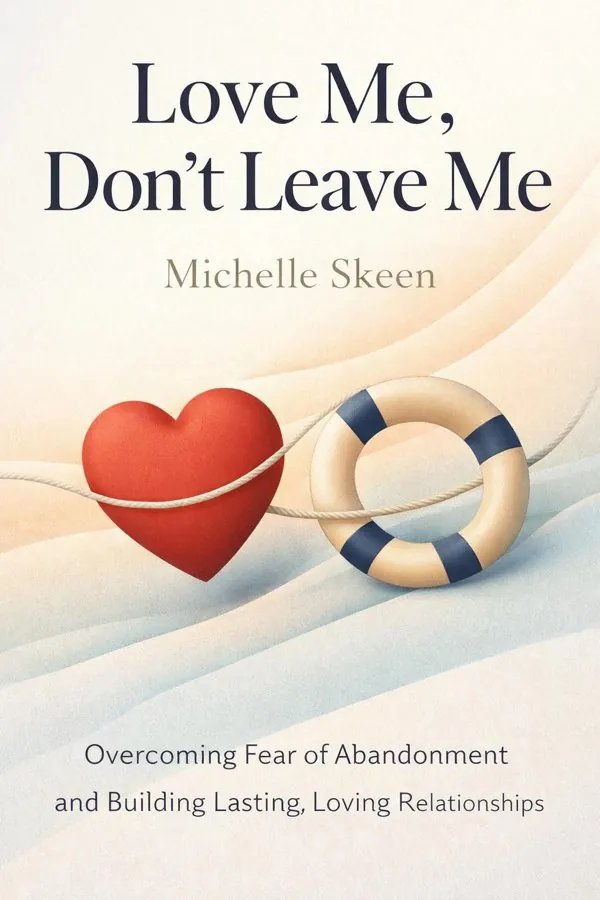
Love Me, Don’t Leave Me: Overcoming Fear of Abandonment and Building Lasting, Loving Relationships: Summary & Key Insights
 10 min5 chaptersAudio available
What Is Love Me, Don’t Leave Me: Overcoming Fear of Abandonment and Building Lasting, Loving Relationships About?
Love Me, Don’t Leave Me: Overcoming Fear of Abandonment and Building Lasting, Loving Relationships by Michelle Skeen is a relationships book spanning 5 pages. This book helps readers understand and overcome the fear of abandonment that can undermine relationships. Drawing on cognitive behavioral therapy and mindfulness techniques, Michelle Skeen guides readers to identify patterns of insecurity, heal emotional wounds, and build healthy, lasting connections.
This FizzRead summary covers all 5 key chapters of Love Me, Don’t Leave Me: Overcoming Fear of Abandonment and Building Lasting, Loving Relationships in approximately 10 minutes, distilling the most important ideas, arguments, and takeaways from Michelle Skeen's work. Also available as an audio summary and Key Quotes Podcast.
Love Me, Don’t Leave Me: Overcoming Fear of Abandonment and Building Lasting, Loving Relationships
This book helps readers understand and overcome the fear of abandonment that can undermine relationships. Drawing on cognitive behavioral therapy and mindfulness techniques, Michelle Skeen guides readers to identify patterns of insecurity, heal emotional wounds, and build healthy, lasting connections.
Who Should Read Love Me, Don’t Leave Me: Overcoming Fear of Abandonment and Building Lasting, Loving Relationships?
This book is perfect for anyone interested in relationships and looking to gain actionable insights in a short read. Whether you're a student, professional, or lifelong learner, the key ideas from Love Me, Don’t Leave Me: Overcoming Fear of Abandonment and Building Lasting, Loving Relationships by Michelle Skeen will help you think differently.
- ✓Readers who enjoy relationships and want practical takeaways
- ✓Professionals looking to apply new ideas to their work and life
- ✓Anyone who wants the core insights of Love Me, Don’t Leave Me: Overcoming Fear of Abandonment and Building Lasting, Loving Relationships in just 10 minutes
Want the full summary?
Get instant access to this book summary and 100K+ more with Fizz Moment.
Get Free SummaryAvailable on App Store • Free to download
Key Chapters
Every pattern has a beginning. The fear of being left often emerges from early life experiences where love felt uncertain, inconsistent, or conditional. In the first major chapters, I help you trace your own narrative back to those origins. Perhaps you grew up with emotionally unavailable caregivers, volatile relationships, or subtle messages that your worth depended on pleasing others. These formative moments taught your nervous system a harsh lesson: connection equals risk.
Psychologist John Bowlby’s attachment theory provides the foundation for this exploration. I explain how our attachment style — secure, anxious, avoidant, or disorganized — shapes our reactions in adulthood. If you identify with anxious attachment, you may vacillate between yearning and mistrust. If you lean avoidant, you may protect yourself through emotional distance and self-reliance. The fear of abandonment often bridges both these poles — craving closeness but fearing the pain that closeness can bring.
In our journey through this section, I emphasize that these patterns are not conscious choices; they are emotional reflexes. Beneath them lies a schema — a deeply ingrained belief such as “I am unlovable” or “People always leave me.” Schema therapy helps us bring those beliefs to light and challenge their power. I encourage you to write about moments of rejection that still echo in your memory, not to re-traumatize yourself, but to see how your responses today are guided by learned expectations.
My goal is to shift your perspective from blaming yourself or others toward compassionate curiosity. When you see that your fear has roots, you also see that it can be uprooted. Awareness is the first act of healing.
Once you understand where the fear comes from, the next step is to notice how it shows up in your relationships. In these chapters, I speak candidly about the behaviors that stem from abandonment anxiety — the constant need for reassurance, testing your partner’s loyalty, withdrawing before you can be hurt, or trying to control their attention and affection. Each of these strategies is a way of coping with uncertainty, but paradoxically, they create the very isolation we dread.
I introduce CBT principles here: your feelings don’t arise in a vacuum; they follow your thoughts. When you think, “They didn’t text back because they’re losing interest,” anxiety spikes, leading to reactive behavior. The antidote is awareness. Together, we learn to slow down and examine thoughts like these — identifying distortions and replacing them with balanced interpretations.
Through vivid examples drawn from therapy stories (with clients’ identities protected), I show how insecurity manifests in subtle everyday moments — like reading rejection into a neutral gesture or keeping score of who loves more. These narratives make it clear that fear breeds hypervigilance, and hypervigilance poisons intimacy.
The turning point comes when you realize that abandonment fear isn’t a verdict on your worth; it’s a signal of unmet needs. Once acknowledged, you can respond to that signal with empathy rather than panic. This is where self-soothing and mindfulness enter the picture — calming the emotional storm so you can choose instead of react. By practicing these awareness techniques, you gradually learn that love doesn’t require constant proof; it thrives when both partners feel safe enough to be imperfect.
+ 3 more chapters — available in the FizzRead app
All Chapters in Love Me, Don’t Leave Me: Overcoming Fear of Abandonment and Building Lasting, Loving Relationships
About the Author
Michelle Skeen, PsyD, is a clinical psychologist specializing in relationship issues, self-esteem, and emotional healing. She has authored several self-help books focused on acceptance, mindfulness, and communication.
Get This Summary in Your Preferred Format
Read or listen to the Love Me, Don’t Leave Me: Overcoming Fear of Abandonment and Building Lasting, Loving Relationships summary by Michelle Skeen anytime, anywhere. FizzRead offers multiple formats so you can learn on your terms — all free.
Available formats: App · Audio · PDF · EPUB — All included free with FizzRead
Download Love Me, Don’t Leave Me: Overcoming Fear of Abandonment and Building Lasting, Loving Relationships PDF and EPUB Summary
Key Quotes from Love Me, Don’t Leave Me: Overcoming Fear of Abandonment and Building Lasting, Loving Relationships
“The fear of being left often emerges from early life experiences where love felt uncertain, inconsistent, or conditional.”
“Once you understand where the fear comes from, the next step is to notice how it shows up in your relationships.”
Frequently Asked Questions about Love Me, Don’t Leave Me: Overcoming Fear of Abandonment and Building Lasting, Loving Relationships
Love Me, Don’t Leave Me: Overcoming Fear of Abandonment and Building Lasting, Loving Relationships by Michelle Skeen is a relationships book that explores key ideas across 5 chapters. This book helps readers understand and overcome the fear of abandonment that can undermine relationships. Drawing on cognitive behavioral therapy and mindfulness techniques, Michelle Skeen guides readers to identify patterns of insecurity, heal emotional wounds, and build healthy, lasting connections.
You Might Also Like

The 5 Love Languages
Gary Chapman
10 min
Men Are from Mars, Women Are from Venus
John Gray
10 min
She Comes First
Ian Kerner
10 min
No More Mr Nice Guy
Robert Glover
10 min
Hold Me Tight
Sue Johnson
10 min
Mating in Captivity
Esther Perel
10 minBrowse by Category
Ready to read Love Me, Don’t Leave Me: Overcoming Fear of Abandonment and Building Lasting, Loving Relationships?
Get the full summary and 100K+ more books with Fizz Moment.