
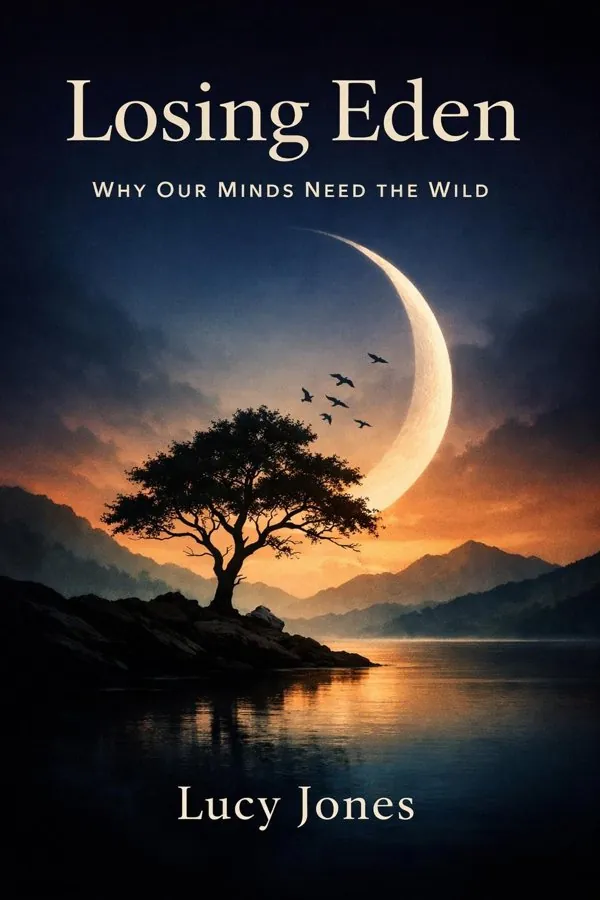
Losing Eden: Why Our Minds Need the Wild: Summary & Key Insights
by Lucy Jones
 10 min7 chaptersAudio available
What Is Losing Eden: Why Our Minds Need the Wild About?
Losing Eden: Why Our Minds Need the Wild by Lucy Jones is a environment book spanning 7 pages. Losing Eden: Why Our Minds Need the Wild is a compelling exploration of the vital connection between human mental health and the natural world. Drawing on scientific research, personal experience, and interviews with experts, Lucy Jones investigates how disconnection from nature contributes to anxiety, depression, and societal malaise, and how restoring that bond can heal both individuals and communities. Urgent and uplifting, the book serves as a rallying cry for a wilder way of life and a deeper relationship with the living world.
This FizzRead summary covers all 7 key chapters of Losing Eden: Why Our Minds Need the Wild in approximately 10 minutes, distilling the most important ideas, arguments, and takeaways from Lucy Jones's work. Also available as an audio summary and Key Quotes Podcast.
Losing Eden: Why Our Minds Need the Wild
Losing Eden: Why Our Minds Need the Wild is a compelling exploration of the vital connection between human mental health and the natural world. Drawing on scientific research, personal experience, and interviews with experts, Lucy Jones investigates how disconnection from nature contributes to anxiety, depression, and societal malaise, and how restoring that bond can heal both individuals and communities. Urgent and uplifting, the book serves as a rallying cry for a wilder way of life and a deeper relationship with the living world.
Who Should Read Losing Eden: Why Our Minds Need the Wild?
This book is perfect for anyone interested in environment and looking to gain actionable insights in a short read. Whether you're a student, professional, or lifelong learner, the key ideas from Losing Eden: Why Our Minds Need the Wild by Lucy Jones will help you think differently.
- ✓Readers who enjoy environment and want practical takeaways
- ✓Professionals looking to apply new ideas to their work and life
- ✓Anyone who wants the core insights of Losing Eden: Why Our Minds Need the Wild in just 10 minutes
Want the full summary?
Get instant access to this book summary and 100K+ more with Fizz Moment.
Get Free SummaryAvailable on App Store • Free to download
Key Chapters
It is easy to forget that for most of human history, the boundary between humanity and nature did not exist. Early humans didn’t see themselves as apart from their environment but as enmeshed within it. The forests, rivers, and skies were teachers and companions, repositories of food, danger, and meaning. Our dependence on natural cycles shaped our spirituality and our societies.
The Industrial Revolution brought both immense advances and profound dislocations. As people flooded into urban centers, the intimate connection to land eroded. Clean air, open land, and direct interaction with the nonhuman world became privileges instead of daily realities. By the twentieth century, industrial capitalism and urbanization had recast nature as resource and refuge, a place to visit rather than inhabit. With this redefinition came a psychological cost that few acknowledged at the time. We learned to think of mental distress as purely internal—chemical or cognitive—while overlooking the ecology of the mind.
I found it striking that many of our modern pathologies—anxiety disorders, depression, loneliness—grew in step with urban expansion. While correlation doesn’t prove causation, historical and epidemiological data began suggesting that something in the environment of the modern city—noise, pollution, sensory overload, loss of natural rhythms—might quietly undermine our mental equilibrium. Understanding how this rupture with nature emerged is crucial, for it reminds us that alienation from the wild is not inevitable but historically contingent, a story we have the power to rewrite.
My journey into the science of nature and mental health began with curiosity but soon deepened into astonishment. The research evidence is both rigorous and restorative. Across disciplines—from environmental psychology to psychiatry—scientists have observed correlations between natural exposure and improved well-being. People who regularly visit green spaces exhibit lower rates of stress, depression, and anxiety. Recovery times after surgery decrease when patients can see trees through hospital windows. Even short walks in woodlands reduce rumination, a key marker of mood disorders.
One pivotal framework is the Attention Restoration Theory proposed by Stephen and Rachel Kaplan, which suggests that the effortless fascination of natural settings replenishes the cognitive resources depleted by directed attention in urban environments. Similarly, Roger Ulrich’s Stress Reduction Theory demonstrates how observing natural scenes swiftly calms physiological stress responses.
These are not abstract concepts. They manifest in the lowered heart rate of a child climbing a tree, the slower breathing of someone sitting by the sea, or the renewed vitality of those who spend weekends hiking rather than scrolling. The more I spoke to neuroscientists and clinicians, the clearer the evidence became: our psychological architecture evolved in living landscapes, and we function best when we stay in contact with them.
The tragedy is that we rarely frame our mental health crisis as an ecological one. Yet this is precisely what the data invites us to do: to understand anxiety and depression not only as individual illnesses but as symptoms of collective disconnection from the environments that sustain us.
+ 5 more chapters — available in the FizzRead app
All Chapters in Losing Eden: Why Our Minds Need the Wild
About the Author
Lucy Jones is a British journalist and author known for her work on nature, science, and culture. Her writing has appeared in publications such as The Guardian and BBC Earth. She is also the author of 'Foxes Unearthed' and 'Matrescence'.
Get This Summary in Your Preferred Format
Read or listen to the Losing Eden: Why Our Minds Need the Wild summary by Lucy Jones anytime, anywhere. FizzRead offers multiple formats so you can learn on your terms — all free.
Available formats: App · Audio · PDF · EPUB — All included free with FizzRead
Download Losing Eden: Why Our Minds Need the Wild PDF and EPUB Summary
Key Quotes from Losing Eden: Why Our Minds Need the Wild
“It is easy to forget that for most of human history, the boundary between humanity and nature did not exist.”
“My journey into the science of nature and mental health began with curiosity but soon deepened into astonishment.”
Frequently Asked Questions about Losing Eden: Why Our Minds Need the Wild
Losing Eden: Why Our Minds Need the Wild by Lucy Jones is a environment book that explores key ideas across 7 chapters. Losing Eden: Why Our Minds Need the Wild is a compelling exploration of the vital connection between human mental health and the natural world. Drawing on scientific research, personal experience, and interviews with experts, Lucy Jones investigates how disconnection from nature contributes to anxiety, depression, and societal malaise, and how restoring that bond can heal both individuals and communities. Urgent and uplifting, the book serves as a rallying cry for a wilder way of life and a deeper relationship with the living world.
You Might Also Like

A Life on Our Planet: My Witness Statement and a Vision for the Future
David Attenborough
10 min
A Sky Full Of Birds
Matt Merritt
10 min
Carbon Zero: Imagining Cities That Can Save the Planet
Alex Steffen
10 min
Eaarth: Making a Life on a Tough New Planet
Bill McKibben
10 min
The Social Contract and Environmental Governance
Various Editors
10 min
The Wild Places
Robert Macfarlane
10 minBrowse by Category
Ready to read Losing Eden: Why Our Minds Need the Wild?
Get the full summary and 100K+ more books with Fizz Moment.