
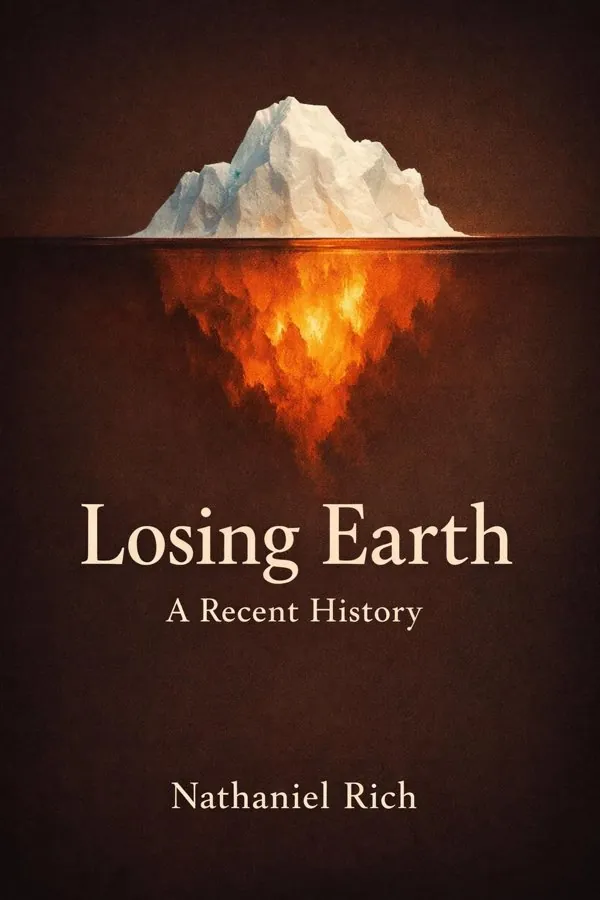
Losing Earth: A Recent History: Summary & Key Insights
 10 min7 chaptersAudio available
What Is Losing Earth: A Recent History About?
Losing Earth: A Recent History by Nathaniel Rich is a environment book spanning 7 pages. Losing Earth: A Recent History es un relato periodístico que explora la década crítica entre 1979 y 1989, cuando científicos, políticos y activistas tuvieron la oportunidad de detener el cambio climático antes de que se convirtiera en una crisis global. Nathaniel Rich reconstruye los eventos, debates y decisiones que definieron ese momento, mostrando cómo la humanidad comprendió el problema pero no actuó a tiempo.
This FizzRead summary covers all 7 key chapters of Losing Earth: A Recent History in approximately 10 minutes, distilling the most important ideas, arguments, and takeaways from Nathaniel Rich's work. Also available as an audio summary and Key Quotes Podcast.
Losing Earth: A Recent History
Losing Earth: A Recent History es un relato periodístico que explora la década crítica entre 1979 y 1989, cuando científicos, políticos y activistas tuvieron la oportunidad de detener el cambio climático antes de que se convirtiera en una crisis global. Nathaniel Rich reconstruye los eventos, debates y decisiones que definieron ese momento, mostrando cómo la humanidad comprendió el problema pero no actuó a tiempo.
Who Should Read Losing Earth: A Recent History?
This book is perfect for anyone interested in environment and looking to gain actionable insights in a short read. Whether you're a student, professional, or lifelong learner, the key ideas from Losing Earth: A Recent History by Nathaniel Rich will help you think differently.
- ✓Readers who enjoy environment and want practical takeaways
- ✓Professionals looking to apply new ideas to their work and life
- ✓Anyone who wants the core insights of Losing Earth: A Recent History in just 10 minutes
Want the full summary?
Get instant access to this book summary and 100K+ more with Fizz Moment.
Get Free SummaryAvailable on App Store • Free to download
Key Chapters
It begins in the heat of an American summer, not in a protest march or a campaign rally, but in a scientific meeting room. Jule Charney, one of the towering figures of meteorology, had assembled a team under the National Academy of Sciences to confront an unsettling question: What happens when humanity fills the atmosphere with carbon dioxide? The Charney Report, published in 1979, was the first comprehensive governmental document to establish the seriousness of global warming. It concluded, with sober precision, that doubling CO₂ levels would raise global temperatures by three degrees Celsius — a finding remarkably consistent with today’s science.
What’s crucial to grasp is the tone of that document. It wasn’t alarmist. It was the distilled voice of reason and evidence. Yet its implications were staggering. Charney’s team understood they were pointing at a kind of apocalypse slowly written into the fuel of our prosperity. The report circulated within the Carter administration, prompting quiet discussions among energy advisers and environmental officials. But the machinery of government was distracted: inflation, oil shocks, and Cold War priorities drowned the long-term warnings beneath immediate anxieties.
I recount this moment to show that the foundations of climate science were solidly in place decades ago. There was no mystery, no lack of understanding. The Charney Report could have been the blueprint for action. Instead, it became a historical artifact of what might have been. Science had done its job; policy had not. This gap — between comprehension and commitment — is the slow fracture through which history slipped out of our grasp.
Into this technically precise but politically inert landscape stepped two individuals whose determination would animate the decade: Rafe Pomerance and James Hansen. Pomerance, a policy-minded environmental lobbyist, encountered climate change almost by accident while working at Friends of the Earth. Reading scientific papers on carbon buildup, he felt a shock of moral urgency — an intuition that this was not another routine environmental concern but a planetary emergency.
He began knocking on doors. First scientists, then bureaucrats, then legislators. At every turn, he pushed the essential fact that the science was settled enough for action. His ally, James Hansen, was an astrophysicist turned climate modeler at NASA, developing early computer simulations that measured Earth’s energy balance. Hansen’s work translated the abstract physics into visual truth — projections of rising temperatures, maps of future drought. It was the first time anyone could see, with empirical clarity, the shape of a warming world.
Together, Pomerance and Hansen became the informal ambassadors of climate reality. They bridged two worlds that seldom spoke: the technical and the political. Hansen’s quiet precision combined with Pomerance’s advocacy created moments of genuine traction — briefings at the Environmental Protection Agency, hearings before congressional committees. Yet every step forward was met by the inertia of bureaucracy. Even sympathetic officials hesitated, constrained by institutional caution and economic orthodoxy.
I tell their stories not to romanticize them but to underline how much climate action depends on individual conscience within systemic indifference. They were not global celebrities; they were, instead, two voices shouting across a canyon of complexity, hoping the echo would reach power before it faded.
+ 5 more chapters — available in the FizzRead app
All Chapters in Losing Earth: A Recent History
About the Author
Nathaniel Rich es un escritor y periodista estadounidense nacido en 1980. Es autor de varias obras de ficción y no ficción, y sus ensayos han aparecido en The New York Times Magazine, donde también ha trabajado como editor. Su trabajo se centra en temas ambientales, culturales y sociales contemporáneos.
Get This Summary in Your Preferred Format
Read or listen to the Losing Earth: A Recent History summary by Nathaniel Rich anytime, anywhere. FizzRead offers multiple formats so you can learn on your terms — all free.
Available formats: App · Audio · PDF · EPUB — All included free with FizzRead
Download Losing Earth: A Recent History PDF and EPUB Summary
Key Quotes from Losing Earth: A Recent History
“It begins in the heat of an American summer, not in a protest march or a campaign rally, but in a scientific meeting room.”
“Into this technically precise but politically inert landscape stepped two individuals whose determination would animate the decade: Rafe Pomerance and James Hansen.”
Frequently Asked Questions about Losing Earth: A Recent History
Losing Earth: A Recent History by Nathaniel Rich is a environment book that explores key ideas across 7 chapters. Losing Earth: A Recent History es un relato periodístico que explora la década crítica entre 1979 y 1989, cuando científicos, políticos y activistas tuvieron la oportunidad de detener el cambio climático antes de que se convirtiera en una crisis global. Nathaniel Rich reconstruye los eventos, debates y decisiones que definieron ese momento, mostrando cómo la humanidad comprendió el problema pero no actuó a tiempo.
You Might Also Like

A Life on Our Planet: My Witness Statement and a Vision for the Future
David Attenborough
10 min
A Sky Full Of Birds
Matt Merritt
10 min
Carbon Zero: Imagining Cities That Can Save the Planet
Alex Steffen
10 min
Eaarth: Making a Life on a Tough New Planet
Bill McKibben
10 min
The Social Contract and Environmental Governance
Various Editors
10 min
The Wild Places
Robert Macfarlane
10 minBrowse by Category
Ready to read Losing Earth: A Recent History?
Get the full summary and 100K+ more books with Fizz Moment.