
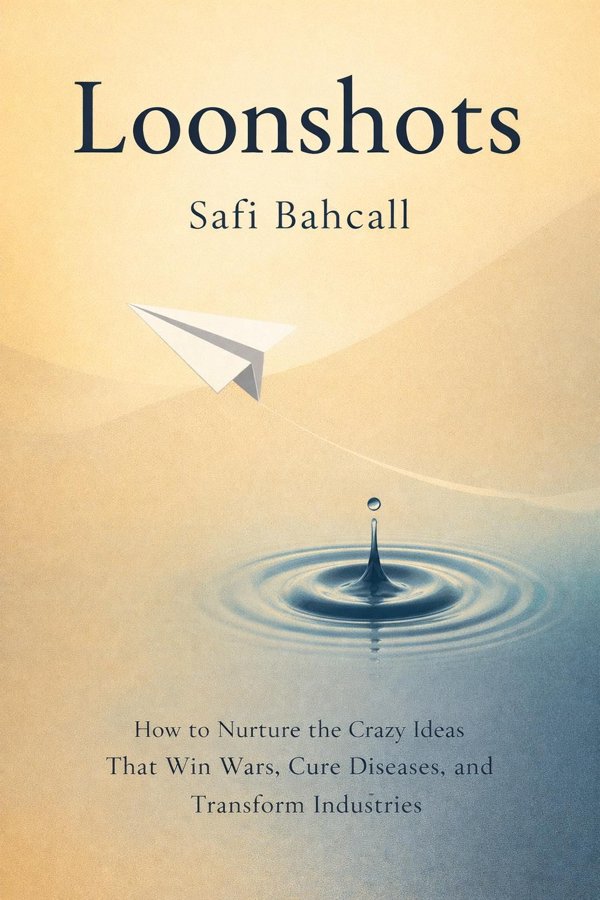
Loonshots: How to Nurture the Crazy Ideas That Win Wars, Cure Diseases, and Transform Industries: Summary & Key Insights
by Safi Bahcall
 10 min6 chaptersAudio available
What Is Loonshots: How to Nurture the Crazy Ideas That Win Wars, Cure Diseases, and Transform Industries About?
Loonshots: How to Nurture the Crazy Ideas That Win Wars, Cure Diseases, and Transform Industries by Safi Bahcall is a creativity book spanning 6 pages. Loonshots explores how nurturing seemingly crazy ideas can lead to groundbreaking innovations. Safi Bahcall, a physicist and entrepreneur, examines the patterns that allow organizations to balance between wild creativity and disciplined execution. Through historical examples—from radar development to biotech breakthroughs—Bahcall reveals how small shifts in structure, not culture, can unleash transformative progress.
This FizzRead summary covers all 6 key chapters of Loonshots: How to Nurture the Crazy Ideas That Win Wars, Cure Diseases, and Transform Industries in approximately 10 minutes, distilling the most important ideas, arguments, and takeaways from Safi Bahcall's work. Also available as an audio summary and Key Quotes Podcast.
Loonshots: How to Nurture the Crazy Ideas That Win Wars, Cure Diseases, and Transform Industries
Loonshots explores how nurturing seemingly crazy ideas can lead to groundbreaking innovations. Safi Bahcall, a physicist and entrepreneur, examines the patterns that allow organizations to balance between wild creativity and disciplined execution. Through historical examples—from radar development to biotech breakthroughs—Bahcall reveals how small shifts in structure, not culture, can unleash transformative progress.
Who Should Read Loonshots: How to Nurture the Crazy Ideas That Win Wars, Cure Diseases, and Transform Industries?
This book is perfect for anyone interested in creativity and looking to gain actionable insights in a short read. Whether you're a student, professional, or lifelong learner, the key ideas from Loonshots: How to Nurture the Crazy Ideas That Win Wars, Cure Diseases, and Transform Industries by Safi Bahcall will help you think differently.
- ✓Readers who enjoy creativity and want practical takeaways
- ✓Professionals looking to apply new ideas to their work and life
- ✓Anyone who wants the core insights of Loonshots: How to Nurture the Crazy Ideas That Win Wars, Cure Diseases, and Transform Industries in just 10 minutes
Want the full summary?
Get instant access to this book summary and 100K+ more with Fizz Moment.
Get Free SummaryAvailable on App Store • Free to download
Key Chapters
One of the first lessons I drew from both physics and business is that every organization lives in tension between two states—the franchise and the loonshot. The franchise represents the world of execution: the army of disciplined operators who refine, expand, and deliver proven ideas. The loonshot represents the world of invention: the explorers who chase dreams that may look absurd but hold revolutionary potential. Both are essential. Without the franchise, ideas remain dreams. Without the loonshot, success calcifies into bureaucracy.
In physics, a system’s particles can cooperate in one state or another depending on structural conditions—temperature, pressure, or density. Similarly, in organizations, group behavior changes depending on how we reward individuals. When careers depend strictly on collective performance, people naturally cling to safe bets. When individuals have room to advance based on the results of bold experiments, loonshots flourish. Organizations mistakenly try to fix this through cultural campaigns—'be more innovative!'—but the real lever is structure: incentives, group size, transparency of results. Adjust those, and behavior changes as predictably as water freezing or melting.
Consider Bell Labs in its prime under Mervin Kelly. He devised a structure where researchers and engineers could pursue high-risk ideas while production teams perfected existing technologies. The separation wasn’t absolute—it was porous enough to allow collaboration but distinct enough to protect loonshots from premature judgment. That balance powered decades of innovation: transistors, lasers, information theory—all emerged from this dual structure. Contrast that with organizations that fail to separate these states properly; they force innovators to compete directly with executors, and the wild ideas inevitably lose.
What I want every leader to see is that this duality isn’t conflict—it’s nature. Expect it, design for it, and you will harness it. The franchise generates stable growth; the loonshot opens new frontiers. Successful companies cycle their energy between the two. The tragedy is when leaders mistake execution excellence for innovation strength and suffocate their loonshots in the process.
World War II offers one of the most powerful examples of what happens when loonshots are protected rather than stifled. The development of radar was not the product of linear planning but of messy experimentation. Visionaries like Vannevar Bush and the scientists in the small research group at MIT’s Rad Lab faced bureaucratic resistance at every step. Military command preferred existing systems—it couldn’t see the value of an invisible technology. But by creating a protected enclave for these loonshots, with clear separation from operational pressures yet close enough to translate discoveries into the field, Bush and his team revolutionized warfare. Radar became the edge that helped win the war.
From this story comes a pattern: nurturing loonshots demands psychological safety and structural autonomy. Bush ensured researchers had freedom to experiment without distraction, while maintaining channels of communication with military liaisons who could help translate innovation into deployment. He built what I call the Bush-Vail model, an organizational design that separates and connects the two worlds at the same time. In that model, creative teams and operational teams are distinct but symbiotic. It is not isolation but dynamic equilibrium.
Most organizations misstep by either isolating innovators completely (creating disconnected R&D silos) or merging them too tightly with operations (burying creativity under execution metrics). The art lies in maintaining the right interface—loose enough for ideas to evolve, tight enough for practical translation. Radar’s development teaches us that a few structural safeguards—autonomous funding, protected leadership, and bridged communication—can turn a dismissed dream into life-saving reality.
+ 4 more chapters — available in the FizzRead app
All Chapters in Loonshots: How to Nurture the Crazy Ideas That Win Wars, Cure Diseases, and Transform Industries
About the Author
Safi Bahcall is an American physicist, entrepreneur, and author. He earned his Ph.D. in physics from Stanford University and worked as a consultant at McKinsey & Company before founding a biotechnology company. His work focuses on innovation, organizational dynamics, and the science of transformative ideas.
Get This Summary in Your Preferred Format
Read or listen to the Loonshots: How to Nurture the Crazy Ideas That Win Wars, Cure Diseases, and Transform Industries summary by Safi Bahcall anytime, anywhere. FizzRead offers multiple formats so you can learn on your terms — all free.
Available formats: App · Audio · PDF · EPUB — All included free with FizzRead
Download Loonshots: How to Nurture the Crazy Ideas That Win Wars, Cure Diseases, and Transform Industries PDF and EPUB Summary
Key Quotes from Loonshots: How to Nurture the Crazy Ideas That Win Wars, Cure Diseases, and Transform Industries
“One of the first lessons I drew from both physics and business is that every organization lives in tension between two states—the franchise and the loonshot.”
“World War II offers one of the most powerful examples of what happens when loonshots are protected rather than stifled.”
Frequently Asked Questions about Loonshots: How to Nurture the Crazy Ideas That Win Wars, Cure Diseases, and Transform Industries
Loonshots: How to Nurture the Crazy Ideas That Win Wars, Cure Diseases, and Transform Industries by Safi Bahcall is a creativity book that explores key ideas across 6 chapters. Loonshots explores how nurturing seemingly crazy ideas can lead to groundbreaking innovations. Safi Bahcall, a physicist and entrepreneur, examines the patterns that allow organizations to balance between wild creativity and disciplined execution. Through historical examples—from radar development to biotech breakthroughs—Bahcall reveals how small shifts in structure, not culture, can unleash transformative progress.
You Might Also Like

Dimensions Of Creativity
Margaret A. Boden
10 min
How to Fly a Horse: The Secret History of Creation, Invention, and Discovery
Kevin Ashton
10 min
Imagine: How Creativity Works
Jonah Lehrer
10 min
The Accidental Creative: How to Be Brilliant at a Moment's Notice
Todd Henry
10 min
The Origins of Creativity
Edward O. Wilson
10 min
Wired to Create: Unraveling the Mysteries of the Creative Mind
Scott Barry Kaufman, Carolyn Gregoire
10 minBrowse by Category
Ready to read Loonshots: How to Nurture the Crazy Ideas That Win Wars, Cure Diseases, and Transform Industries?
Get the full summary and 100K+ more books with Fizz Moment.