
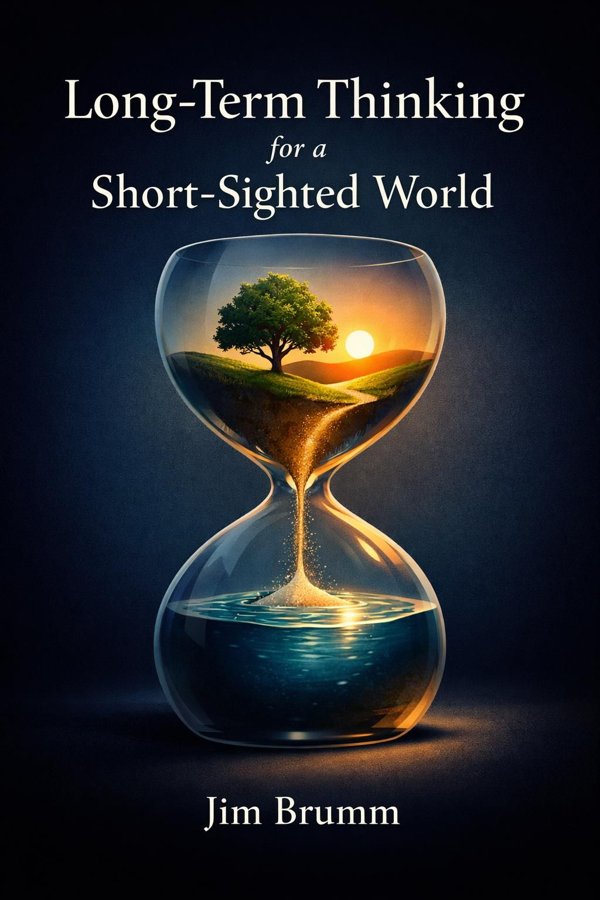
Long-Term Thinking for a Short-Sighted World: Restoring Happiness, Balance, and Sanity to Our Lives and Our Planet: Summary & Key Insights
by Jim Brumm
 10 min10 chaptersAudio available
What Is Long-Term Thinking for a Short-Sighted World: Restoring Happiness, Balance, and Sanity to Our Lives and Our Planet About?
Long-Term Thinking for a Short-Sighted World: Restoring Happiness, Balance, and Sanity to Our Lives and Our Planet by Jim Brumm is a environment book spanning 10 pages. This book by Jim Brumm examines how humanity’s obsession with short-term gains undermines our long-term well-being. Through examples from energy policy, debt management, and environmental stewardship, Brumm advocates for a shift toward sustainable, long-term thinking to restore balance and happiness to both our lives and the planet.
This FizzRead summary covers all 10 key chapters of Long-Term Thinking for a Short-Sighted World: Restoring Happiness, Balance, and Sanity to Our Lives and Our Planet in approximately 10 minutes, distilling the most important ideas, arguments, and takeaways from Jim Brumm's work. Also available as an audio summary and Key Quotes Podcast.
Long-Term Thinking for a Short-Sighted World: Restoring Happiness, Balance, and Sanity to Our Lives and Our Planet
This book by Jim Brumm examines how humanity’s obsession with short-term gains undermines our long-term well-being. Through examples from energy policy, debt management, and environmental stewardship, Brumm advocates for a shift toward sustainable, long-term thinking to restore balance and happiness to both our lives and the planet.
Who Should Read Long-Term Thinking for a Short-Sighted World: Restoring Happiness, Balance, and Sanity to Our Lives and Our Planet?
This book is perfect for anyone interested in environment and looking to gain actionable insights in a short read. Whether you're a student, professional, or lifelong learner, the key ideas from Long-Term Thinking for a Short-Sighted World: Restoring Happiness, Balance, and Sanity to Our Lives and Our Planet by Jim Brumm will help you think differently.
- ✓Readers who enjoy environment and want practical takeaways
- ✓Professionals looking to apply new ideas to their work and life
- ✓Anyone who wants the core insights of Long-Term Thinking for a Short-Sighted World: Restoring Happiness, Balance, and Sanity to Our Lives and Our Planet in just 10 minutes
Want the full summary?
Get instant access to this book summary and 100K+ more with Fizz Moment.
Get Free SummaryAvailable on App Store • Free to download
Key Chapters
When I speak of short-term thinking, I’m not condemning urgency itself, but the obsession with immediacy that has crept into every corner of modern life. Our economic systems reward quarterly profits, our political cycles hinge on immediate popularity, and our consumer culture equates satisfaction with acquisition. The term 'short-sighted' isn’t an insult—it’s a diagnosis. We’ve trained our institutions and even our emotions to focus on the next click, the next purchase, the next win.
This mentality is now woven into how we evaluate success. Politicians make decisions catering to an election ahead rather than a generation ahead. Corporations calculate value by this quarter’s numbers, not the stability of future markets. Individuals chase comfort through credit, consuming today and deferring tomorrow’s burden. What might have begun as adaptive responsiveness has turned pathological—a civilization that prizes speed over understanding.
I trace this pattern through examples that are painfully familiar: our appetite for consumer goods, the rise of disposable products, and the shrinking attention span induced by digital media. The logic that governs such behavior is deceptively simple: 'I must not lose today.' But each triumph of today taken in isolation plants the seed of tomorrow’s loss. The irony of our short-term victories is that they accumulate into long-term defeat. The cheap fuel becomes costly pollution; the easy debt becomes paralyzing obligation; the abundant food becomes ecological waste.
Recognizing this nature of short-termism is the first awakening. It helps us see that what we call progress may often be motion without direction, and that our current social systems are built not to sustain life but to sustain momentum. The goal of this book is to redirect that momentum toward meaning.
The price of short-term thinking is everywhere, though we seldom stop to total it. Our soil erodes, our climate destabilizes, our cities consume energy as if the supply were infinite. Economically, the same pattern repeats: individuals leverage the future for comfort in the present, governments defer structural reform, and companies externalize costs to environments and communities that will pay later.
I discuss how environmental degradation isn’t a mysterious accident—it’s the logical outcome of decisions optimized for the next fiscal benefit. When forests are seen only as lumber, oceans as sources of quick protein, and rivers as industrial utilities, we rob them of the time they need to regenerate. The same goes for our social ecosystems. A workforce treated as disposable eventually erodes trust and creativity; communities measured only by property values lose their moral cohesion.
These consequences deepen the crisis of happiness itself. Despite all our abundance, stress and mental illness proliferate because we are trapped in cycles of immediacy. We’re asked to respond, to produce, to consume—never to rest, never to integrate. When we forfeit the long view, we lose the ability to feel continuity. Everything feels transient, replaceable. The planet mirrors this state: fragmented habitats, disrupted seasons, and a diminishing sense of permanence.
Short-term thinking is not just environmentally unsustainable—it’s spiritually exhausting. Its consequence is a pervasive anxiety born of living without a horizon. The cost is both planetary and personal, reminding us that if our pace outstrips our purpose, we will inevitably collapse under the weight of our own acceleration.
+ 8 more chapters — available in the FizzRead app
All Chapters in Long-Term Thinking for a Short-Sighted World: Restoring Happiness, Balance, and Sanity to Our Lives and Our Planet
About the Author
Get This Summary in Your Preferred Format
Read or listen to the Long-Term Thinking for a Short-Sighted World: Restoring Happiness, Balance, and Sanity to Our Lives and Our Planet summary by Jim Brumm anytime, anywhere. FizzRead offers multiple formats so you can learn on your terms — all free.
Available formats: App · Audio · PDF · EPUB — All included free with FizzRead
Download Long-Term Thinking for a Short-Sighted World: Restoring Happiness, Balance, and Sanity to Our Lives and Our Planet PDF and EPUB Summary
Key Quotes from Long-Term Thinking for a Short-Sighted World: Restoring Happiness, Balance, and Sanity to Our Lives and Our Planet
“When I speak of short-term thinking, I’m not condemning urgency itself, but the obsession with immediacy that has crept into every corner of modern life.”
“The price of short-term thinking is everywhere, though we seldom stop to total it.”
Frequently Asked Questions about Long-Term Thinking for a Short-Sighted World: Restoring Happiness, Balance, and Sanity to Our Lives and Our Planet
Long-Term Thinking for a Short-Sighted World: Restoring Happiness, Balance, and Sanity to Our Lives and Our Planet by Jim Brumm is a environment book that explores key ideas across 10 chapters. This book by Jim Brumm examines how humanity’s obsession with short-term gains undermines our long-term well-being. Through examples from energy policy, debt management, and environmental stewardship, Brumm advocates for a shift toward sustainable, long-term thinking to restore balance and happiness to both our lives and the planet.
You Might Also Like

A Life on Our Planet: My Witness Statement and a Vision for the Future
David Attenborough
10 min
A Sky Full Of Birds
Matt Merritt
10 min
Carbon Zero: Imagining Cities That Can Save the Planet
Alex Steffen
10 min
Eaarth: Making a Life on a Tough New Planet
Bill McKibben
10 min
The Social Contract and Environmental Governance
Various Editors
10 min
The Wild Places
Robert Macfarlane
10 minBrowse by Category
Ready to read Long-Term Thinking for a Short-Sighted World: Restoring Happiness, Balance, and Sanity to Our Lives and Our Planet?
Get the full summary and 100K+ more books with Fizz Moment.