
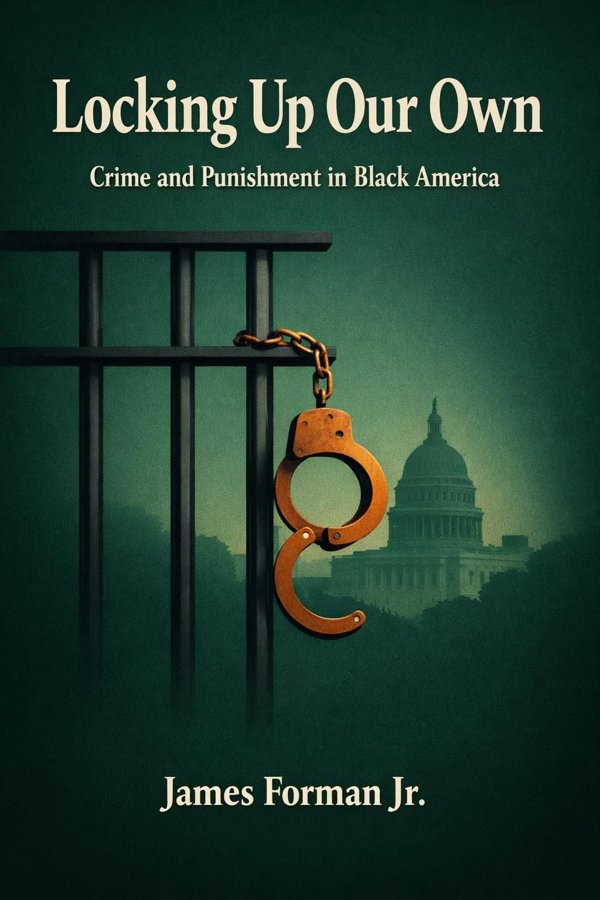
Locking Up Our Own: Crime and Punishment in Black America: Summary & Key Insights
 10 min9 chaptersAudio available
What Is Locking Up Our Own: Crime and Punishment in Black America About?
Locking Up Our Own: Crime and Punishment in Black America by James Forman Jr. is a law_crime book spanning 9 pages. In 'Locking Up Our Own', James Forman Jr. explores how decisions made by Black leaders in the 1970s and 1980s contributed to the rise of mass incarceration in the United States. Drawing on his experience as a public defender and extensive historical research, Forman examines the complex interplay of crime, race, and politics in Washington, D.C., showing how well-intentioned efforts to address violence and drugs inadvertently reinforced punitive policies that disproportionately harmed Black communities.
This FizzRead summary covers all 9 key chapters of Locking Up Our Own: Crime and Punishment in Black America in approximately 10 minutes, distilling the most important ideas, arguments, and takeaways from James Forman Jr.'s work. Also available as an audio summary and Key Quotes Podcast.
Locking Up Our Own: Crime and Punishment in Black America
In 'Locking Up Our Own', James Forman Jr. explores how decisions made by Black leaders in the 1970s and 1980s contributed to the rise of mass incarceration in the United States. Drawing on his experience as a public defender and extensive historical research, Forman examines the complex interplay of crime, race, and politics in Washington, D.C., showing how well-intentioned efforts to address violence and drugs inadvertently reinforced punitive policies that disproportionately harmed Black communities.
Who Should Read Locking Up Our Own: Crime and Punishment in Black America?
This book is perfect for anyone interested in law_crime and looking to gain actionable insights in a short read. Whether you're a student, professional, or lifelong learner, the key ideas from Locking Up Our Own: Crime and Punishment in Black America by James Forman Jr. will help you think differently.
- ✓Readers who enjoy law_crime and want practical takeaways
- ✓Professionals looking to apply new ideas to their work and life
- ✓Anyone who wants the core insights of Locking Up Our Own: Crime and Punishment in Black America in just 10 minutes
Want the full summary?
Get instant access to this book summary and 100K+ more with Fizz Moment.
Get Free SummaryAvailable on App Store • Free to download
Key Chapters
After the triumphs of the civil rights movement, Black Americans entered a new and bewildering era. In Washington, D.C.—a city that would soon gain its first Black mayor, Walter Washington, and later Marion Barry—many believed that political power would finally bring safety and justice. Yet by the mid-1970s, the optimism of self-governance collided with a mounting wave of urban violence and drug addiction.
Neighborhoods like Shaw and Anacostia were shrinking under the weight of unemployment and the collapse of opportunity. Factories closed, schools deteriorated, and drugs filled the void. The public discourse about crime shifted quickly; what had once been understood through the lens of social inequity became an urgent question of moral and physical survival within our own communities. Black leaders—deeply invested in their communities’ safety—faced anguishing choices: how much force should the state use to protect its own citizens, when those citizens were themselves the ones most frequently arrested and incarcerated?
In this crucible, the seeds of punitive policy were planted. D.C., often seen as a microcosm of the national landscape, became a testing ground for ideas about law and order. Forman recounts how Black elected officials and activists, influenced by both fear and responsibility, supported stronger policing efforts as a way to reclaim streets overwhelmed by violence. These decisions were not made out of ignorance or cruelty—they were responses to cries for help echoing from neighborhoods where parents feared for their children and elders demanded peace.
But as the book reveals, those very responses carried devastating consequences. A system designed to protect against external threats began punishing internal wounds. The history Forman reconstructs is one in which good intentions met structural injustice—where Black leadership, constrained by the political and economic realities of the time, inadvertently reinforced the very machinery of oppression that civil rights activism had sought to dismantle.
To understand the politics of gun control among Black leaders, we must begin with history—the memory of self-defense born in the Jim Crow South. Many Black Americans, especially those who had lived through the terror of white supremacy, regarded firearm ownership not merely as a right but as a necessity for survival. The civil rights movement itself had relied at times on armed protection—ordinary men and women who understood that the promise of nonviolence depended upon the possibility of self-defense.
Yet, as D.C. confronted the escalating wave of shootings in the 1970s, this tradition clashed with an intense demand for safety. Black residents and leaders found themselves asking: how do we balance the right to defend ourselves with the need to protect our children from gunfire? Forman describes how local Black politicians supported some of the strictest gun control laws in the nation, believing that fewer guns on the streets meant fewer funerals. The black-led initiative was a statement of community responsibility, a moral vow to change the narrative from victimhood to vigilance.
Still, the outcome was paradoxical. These laws, while intended to curb violence, ended up fueling patterns of over-policing. Arrests for gun possession soared, and young Black men became the main targets of enforcement. The image of the armed Black man transformed once again—from freedom fighter to criminal suspect. Forman’s analysis is clear-eyed and empathetic: leaders were responding to real suffering, but their tools were blunt. The tragedy, he insists, lies in how legitimate fears of violence were redirected into punitive strategies, deepening the divide between protection and punishment.
From the author’s perspective, these chapters reveal an emotional complexity behind policy debates often reduced to slogans. Gun control, in D.C.’s Black politics, was not an abstract issue—it was a question of survival and dignity. The choice to regulate weapons reflected genuine concern, yet it marked an early step toward accepting criminalization as a solution for social crisis.
+ 7 more chapters — available in the FizzRead app
All Chapters in Locking Up Our Own: Crime and Punishment in Black America
About the Author
James Forman Jr. is a professor at Yale Law School and a former public defender in Washington, D.C. His scholarship focuses on criminal justice reform, race, and education. 'Locking Up Our Own' won the 2018 Pulitzer Prize for General Nonfiction.
Get This Summary in Your Preferred Format
Read or listen to the Locking Up Our Own: Crime and Punishment in Black America summary by James Forman Jr. anytime, anywhere. FizzRead offers multiple formats so you can learn on your terms — all free.
Available formats: App · Audio · PDF · EPUB — All included free with FizzRead
Download Locking Up Our Own: Crime and Punishment in Black America PDF and EPUB Summary
Key Quotes from Locking Up Our Own: Crime and Punishment in Black America
“After the triumphs of the civil rights movement, Black Americans entered a new and bewildering era.”
“To understand the politics of gun control among Black leaders, we must begin with history—the memory of self-defense born in the Jim Crow South.”
Frequently Asked Questions about Locking Up Our Own: Crime and Punishment in Black America
Locking Up Our Own: Crime and Punishment in Black America by James Forman Jr. is a law_crime book that explores key ideas across 9 chapters. In 'Locking Up Our Own', James Forman Jr. explores how decisions made by Black leaders in the 1970s and 1980s contributed to the rise of mass incarceration in the United States. Drawing on his experience as a public defender and extensive historical research, Forman examines the complex interplay of crime, race, and politics in Washington, D.C., showing how well-intentioned efforts to address violence and drugs inadvertently reinforced punitive policies that disproportionately harmed Black communities.
You Might Also Like
Abortion and the Law in America: Roe v. Wade to the Present
Mary Ziegler
10 min
Black Edge: Inside Information, Dirty Money, and the Quest to Bring Down the Most Wanted Man on Wall Street
Sheelah Kolhatkar
10 min
Blood Feud: The Man Who Blew the Whistle on One of the Deadliest Prescription Drugs Ever
Kathleen Sharp
10 min
Catch and Kill: Lies, Spies, and a Conspiracy to Protect Predators
Ronan Farrow
10 min
Chaos: Charles Manson, the CIA, and the Secret History of the Sixties
Tom O'Neill with Dan Piepenbring
10 min
Code and Other Laws of Cyberspace
Lawrence Lessig
10 minBrowse by Category
Ready to read Locking Up Our Own: Crime and Punishment in Black America?
Get the full summary and 100K+ more books with Fizz Moment.