
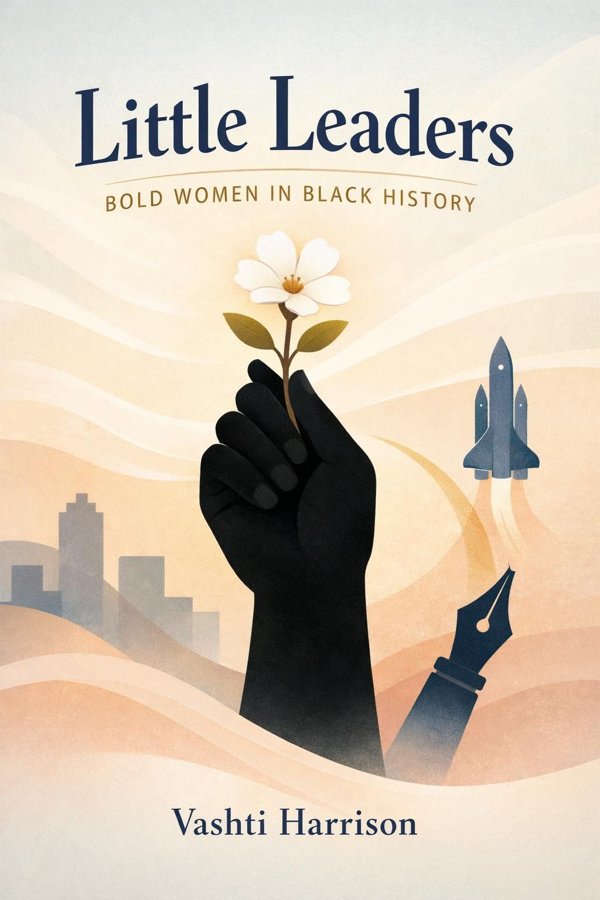
Little Leaders: Bold Women in Black History: Summary & Key Insights
 10 min9 chaptersAudio available
Key Takeaways from Little Leaders: Bold Women in Black History
A child cannot easily dream beyond what the world shows them is possible.
What we leave out of history shapes how we understand the world.
Many of the women in this book did not begin with power, approval, or access.
Not all leaders hold office, command crowds, or appear in headlines.
A brief story can open a lifelong pathway of discovery.
What Is Little Leaders: Bold Women in Black History About?
Little Leaders: Bold Women in Black History by Vashti Harrison is a biographies book. Little Leaders: Bold Women in Black History is a vibrant, inspiring collection of short biographies that introduces readers to forty groundbreaking Black women who shaped history through courage, intelligence, creativity, and perseverance. Written and illustrated by Vashti Harrison, the book brings together artists, activists, politicians, scientists, athletes, and pioneers whose lives are too often overlooked in traditional history books. Rather than treating Black history as a narrow subject or a single month of remembrance, Harrison presents it as an ongoing story of leadership, imagination, and world-changing impact. What makes this book especially powerful is its ability to speak to both children and adults. Young readers encounter role models who look like them or expand their understanding of who can lead, while older readers are reminded how incomplete mainstream historical narratives can be. Harrison’s authority comes not only from careful research, but from her gift as a storyteller and illustrator: she makes each woman feel vivid, human, and memorable. The result is more than a biographical collection. It is a corrective to erasure, a celebration of excellence, and an invitation to see history through a fuller, more truthful lens.
This FizzRead summary covers all 9 key chapters of Little Leaders: Bold Women in Black History in approximately 10 minutes, distilling the most important ideas, arguments, and takeaways from Vashti Harrison's work. Also available as an audio summary and Key Quotes Podcast.
Little Leaders: Bold Women in Black History
Little Leaders: Bold Women in Black History is a vibrant, inspiring collection of short biographies that introduces readers to forty groundbreaking Black women who shaped history through courage, intelligence, creativity, and perseverance. Written and illustrated by Vashti Harrison, the book brings together artists, activists, politicians, scientists, athletes, and pioneers whose lives are too often overlooked in traditional history books. Rather than treating Black history as a narrow subject or a single month of remembrance, Harrison presents it as an ongoing story of leadership, imagination, and world-changing impact.
What makes this book especially powerful is its ability to speak to both children and adults. Young readers encounter role models who look like them or expand their understanding of who can lead, while older readers are reminded how incomplete mainstream historical narratives can be. Harrison’s authority comes not only from careful research, but from her gift as a storyteller and illustrator: she makes each woman feel vivid, human, and memorable. The result is more than a biographical collection. It is a corrective to erasure, a celebration of excellence, and an invitation to see history through a fuller, more truthful lens.
Who Should Read Little Leaders: Bold Women in Black History?
This book is perfect for anyone interested in biographies and looking to gain actionable insights in a short read. Whether you're a student, professional, or lifelong learner, the key ideas from Little Leaders: Bold Women in Black History by Vashti Harrison will help you think differently.
- ✓Readers who enjoy biographies and want practical takeaways
- ✓Professionals looking to apply new ideas to their work and life
- ✓Anyone who wants the core insights of Little Leaders: Bold Women in Black History in just 10 minutes
Want the full summary?
Get instant access to this book summary and 100K+ more with Fizz Moment.
Get Free SummaryAvailable on App Store • Free to download
Key Chapters
A child cannot easily dream beyond what the world shows them is possible. One of the book’s deepest insights is that representation is not decorative; it is formative. By presenting Black women as inventors, pilots, dancers, judges, activists, and political leaders, Vashti Harrison expands the boundaries of possibility for young readers. She shows that leadership does not belong to one gender, one race, or one profession. It belongs to those who use their talents with courage and purpose.
This matters because many children grow up surrounded by incomplete stories. Traditional school lessons may highlight a small group of historical figures while leaving out many women, especially Black women, who made equally transformative contributions. Harrison corrects that imbalance by giving readers an accessible gallery of excellence. The message is powerful: greatness has many faces, and history is richer than the narrow version often presented in classrooms.
The book also demonstrates that representation works on multiple levels. For Black girls, it offers affirmation and belonging. For other readers, it builds empathy and broadens their understanding of achievement. A child who reads about Bessie Coleman, for example, sees aviation differently. A child who learns about Shirley Chisholm sees politics differently. These are not abstract lessons; they influence confidence, ambition, and respect.
In practical terms, parents and educators can use this idea by choosing books, lessons, and media that reflect a wide range of identities and contributions. Instead of waiting for special occasions, they can make diverse stories part of everyday reading. Conversations can follow simple questions: Who inspired you? What obstacles did she face? What did she change?
Actionable takeaway: Audit the stories in your home or classroom this week and intentionally add biographies that help children see a wider, more inclusive picture of who can lead.
What we leave out of history shapes how we understand the world. Little Leaders makes a compelling case that mainstream historical education is often incomplete, not because the achievements were absent, but because recognition was withheld. Harrison’s collection reminds readers that Black women have always been central to social progress, scientific innovation, artistic movements, and political change, even when institutions failed to record or celebrate their work adequately.
The book challenges the idea that history is a fixed set of famous names. Instead, it presents history as something curated, interpreted, and sometimes distorted. By gathering forty biographies in one accessible volume, Harrison reveals patterns of exclusion. Readers begin to notice that many of these women were “firsts” in their fields, not because Black women lacked talent before them, but because systems had long denied access and visibility. That realization changes how we read all of history. It encourages skepticism toward supposedly complete narratives.
This idea has practical value beyond the page. Students can apply it when researching historical topics by asking whose voices are missing. Teachers can redesign lessons to include overlooked contributors rather than treating them as side notes. Families can use the book as a starting point for deeper exploration, choosing one woman at a time to study further. This approach builds stronger historical literacy because it teaches readers not just facts, but how to think critically about whose stories get preserved.
The beauty of Harrison’s format is that it does not overwhelm. Each portrait is concise, inviting curiosity rather than closing discussion. Readers come away not with the illusion that they now know everything, but with a hunger to keep learning.
Actionable takeaway: The next time you encounter a historical topic, ask one guiding question: whose contributions might be missing, and where can I look to find them?
Many of the women in this book did not begin with power, approval, or access. They began with barriers. That is what makes their stories so resonant. Harrison shows that courage is rarely a dramatic trait people are born with; more often, it is a response to exclusion. These women faced racism, sexism, poverty, institutional bias, and cultural dismissal. Yet they turned those constraints into fuel for action.
This pattern appears across fields. Whether in politics, sports, science, or the arts, the women profiled often had to prove themselves in spaces designed to keep them out. Their achievements were not just personal victories. They forced institutions to expand. In that sense, courage in the book is not merely about persistence. It is about intervention. These women changed the rules by refusing to disappear.
For readers, this reframes hardship. Obstacles remain painful and unjust, but they do not automatically define the outcome. The book never suggests that discrimination is acceptable because someone overcame it. Instead, it honors the immense resilience required to move forward while exposing the systems that made such resilience necessary. That balance is important. It teaches children to admire perseverance without romanticizing oppression.
In everyday life, this idea can help readers think differently about rejection, unfair treatment, or discouragement. A student excluded from an opportunity can ask what new path might still be possible. An educator can use these stories to discuss both personal resilience and structural inequality. A leader can ask whether their institution creates unnecessary barriers for others.
The women in Little Leaders remind us that exclusion can become a turning point when someone refuses to accept the limits placed on them.
Actionable takeaway: Identify one barrier in your own environment and take one concrete step to challenge it rather than quietly adapting to it.
Not all leaders hold office, command crowds, or appear in headlines. One of the book’s most valuable lessons is that leadership is broader than conventional definitions. Harrison presents women who led through political action, scientific discovery, artistic brilliance, educational innovation, athletic excellence, and moral courage. This widens the reader’s understanding of what it means to make an impact.
Some of the women in the book changed policy. Others changed imagination. Some opened legal and institutional doors. Others created beauty that reshaped culture. A dancer can be a leader. A poet can be a leader. A mathematician can be a leader. By placing these lives side by side, Harrison rejects the narrow idea that leadership belongs only to visible authority figures. Leadership can also mean influence, originality, integrity, and the willingness to make space for those who follow.
This is especially important for children, who may assume that success counts only if it looks loud or public. The book teaches that every talent has social value. A child interested in art learns that creativity can change minds. A child interested in science learns that discovery can serve justice and progress. A child interested in speaking out learns that advocacy matters. This inclusive view supports healthier ambition because it allows young readers to connect purpose with their natural interests.
Practically, adults can reinforce this lesson by praising different kinds of contribution. Instead of celebrating only winners or top performers, they can also notice curiosity, collaboration, imagination, and service. Schools can broaden leadership programs beyond student government. Families can discuss how everyday actions, such as mentoring others or standing up for fairness, also count as leadership.
Actionable takeaway: Redefine leadership in your life this week by naming three ways someone can lead without having formal power or public recognition.
A brief story can open a lifelong pathway of discovery. Little Leaders proves that concise biographies are not simplistic; when done well, they are invitations. Harrison distills each woman’s life into a focused, memorable portrait that highlights key struggles, achievements, and significance. Rather than overwhelming readers with excessive detail, she gives them enough substance to understand why each figure matters and enough mystery to want to learn more.
This format is especially effective for young readers. Long historical accounts can feel distant or inaccessible, but short profiles make big ideas approachable. Each woman becomes a doorway into a larger world. A child who reads a page about a scientist may become curious about experiments. A page about an activist may lead to questions about voting rights or civil rights. A page about a performer may lead to interest in music, dance, or theater. The structure supports attention, retention, and exploration.
The book also models an important educational principle: depth often begins with clarity. By making information digestible, Harrison does not reduce complexity; she sequences it. First comes fascination, then further study. This makes the book useful not only for independent reading but also for classrooms, book clubs, and family discussions. Readers can choose one woman at a time and extend the learning through documentaries, museum visits, writing assignments, or creative projects.
In practical use, adults can turn each biography into a mini-lesson. Ask the reader to summarize the woman’s achievement, describe the challenge she faced, and connect her legacy to the present day. Those simple steps encourage comprehension, critical thinking, and personal reflection.
Actionable takeaway: Pick one profile from the book and spend 20 extra minutes researching that woman to turn curiosity into deeper understanding.
People remember what they feel, not just what they are told. One reason Little Leaders has such lasting impact is that Vashti Harrison is both writer and illustrator. Her artwork does more than decorate the page; it humanizes history. The portraits invite readers into a relationship with each figure, making the women feel present, dignified, and alive. This combination of visual storytelling and concise biography transforms history from a list of facts into an emotional encounter.
For children especially, illustration can bridge the gap between unfamiliar names and meaningful connection. A beautifully rendered portrait encourages attention before a single sentence is read. Once engaged, the child is more likely to retain the story. The images also reinforce a critical message: Black women deserve to be seen in ways that are celebratory, nuanced, and iconic. In a cultural environment where many historical depictions exclude or stereotype, that visual affirmation matters.
The book demonstrates how aesthetics can support education. Color, composition, and character design all contribute to memory and interest. This has practical implications for teaching and parenting. Historical learning does not need to be limited to lectures or dense text. Visual tools, including illustrations, timelines, posters, and creative response activities, can make complex subjects more accessible and enjoyable.
Adults can extend this idea by inviting children to draw their favorite leader, design a timeline, or create their own illustrated biography of a local hero. Such activities help readers process information actively rather than passively. They also communicate that history belongs not just in textbooks, but in imagination.
Actionable takeaway: Use art as a learning tool by pairing one historical biography with a creative activity that helps the story become vivid, personal, and easier to remember.
Children do not learn values only through rules; they learn them through examples. Little Leaders offers a gallery of role models whose lives embody courage, discipline, service, creativity, and conviction. Harrison does not present these women as flawless legends but as people who used their gifts to overcome adversity and improve the world around them. That distinction matters because it teaches readers that moral strength is expressed through action, not perfection.
The women in the book model many forms of character. Some show bravery by challenging injustice. Others demonstrate excellence through years of disciplined work. Some reveal compassion, while others model strategic thinking and public courage. Together, they help young readers build what might be called moral vision: an internal picture of the kind of person they might want to become. Instead of absorbing vague messages about success, children encounter concrete lives shaped by commitment and principle.
This is useful because values become more real when attached to stories. Saying “be brave” is abstract. Reading about someone who risked ridicule or danger to pursue justice makes bravery tangible. Saying “work hard” can sound repetitive. Learning about a woman who practiced tirelessly to break barriers gives effort meaning. Role models turn ideals into visible paths.
Parents and educators can apply this insight by discussing not only what each woman achieved, but how she achieved it. Ask questions such as: What personal qualities helped her succeed? What would you have done in her situation? Which trait do you want to practice this week? These conversations shift reading from admiration to imitation.
Actionable takeaway: Choose one woman from the book as a weekly role model and practice one specific character trait from her life in your daily routine.
Some books celebrate achievement. Others critique injustice. Little Leaders does both, and that balance is one of its greatest strengths. Harrison’s tone is uplifting and accessible, yet beneath the inspiration is a serious corrective project. She is not simply praising remarkable women; she is also challenging the historical systems that erased, minimized, or delayed recognition of their work. The book shows that celebration becomes more meaningful when it is paired with truth.
This dual approach is important because sanitized history can become misleading. If readers hear only triumphant endings, they may miss the structural obstacles that shaped these lives. If they hear only about oppression, they may miss joy, brilliance, and agency. Harrison avoids both extremes. She honors achievement while acknowledging context. The result is a fuller form of storytelling, one that respects both the difficulty of the struggle and the magnitude of the accomplishment.
For modern readers, this approach offers a useful model for discussing difficult subjects with children. It is possible to be honest about racism and sexism without making history feel hopeless. It is possible to celebrate resilience without pretending systems were fair. This balanced framing helps readers develop both admiration and critical awareness.
In practical settings, adults can follow the same pattern in conversation. When discussing a historical figure, include both the barrier and the breakthrough. When teaching about progress, ask what changed and what still needs to change. This encourages nuanced thinking rather than simplistic hero worship.
Actionable takeaway: When learning about any historical figure, name both one injustice she faced and one contribution she made so that celebration and truth stay connected.
Facts inform us, but stories transform us. Little Leaders succeeds because it turns historical figures into relatable human beings rather than distant monuments. Harrison’s storytelling invites readers to see each woman not just as a list of achievements, but as a person with dreams, obstacles, and determination. That shift from information to narrative is what makes the book memorable and emotionally resonant.
When history becomes personal, readers are more likely to care. A name attached only to a date may be forgotten quickly. A life story attached to struggle and triumph stays with us. Children especially respond to this form of learning because it mirrors how they naturally make sense of the world. They understand goals, setbacks, fear, persistence, and success. By framing history through those human experiences, Harrison makes the past feel connected to the present.
This also helps readers see themselves in history. Instead of viewing famous people as impossibly extraordinary, they begin to understand that major change often starts with ordinary human qualities: curiosity, discipline, bravery, and refusal to give up. The distance between reader and subject narrows. That is empowering.
In practical terms, this insight can improve how we teach and discuss history. Rather than memorizing names in isolation, readers can focus on story arcs: what did this person want, what stood in her way, and what difference did she make? Students can retell the biography in their own words, compare different life journeys, or write a letter to the historical figure. These methods strengthen comprehension and connection.
Actionable takeaway: The next time you study a historical figure, summarize her life as a story of challenge, choice, and impact rather than a list of disconnected facts.
All Chapters in Little Leaders: Bold Women in Black History
About the Author
Vashti Harrison is an acclaimed author, illustrator, and filmmaker whose work focuses on representation, identity, and overlooked stories from history. She is best known for creating children’s books that celebrate Black excellence and make important cultural narratives accessible to young readers. With a distinctive artistic style and a strong storytelling voice, Harrison has earned widespread recognition for combining visual beauty with educational depth. Little Leaders: Bold Women in Black History helped establish her as a major force in inclusive children’s publishing by introducing readers to Black women whose achievements were often ignored in traditional history books. Through her books and illustrations, Harrison continues to expand how children see themselves, their communities, and the possibilities of the world around them.
Get This Summary in Your Preferred Format
Read or listen to the Little Leaders: Bold Women in Black History summary by Vashti Harrison anytime, anywhere. FizzRead offers multiple formats so you can learn on your terms — all free.
Available formats: App · Audio · PDF · EPUB — All included free with FizzRead
Download Little Leaders: Bold Women in Black History PDF and EPUB Summary
Key Quotes from Little Leaders: Bold Women in Black History
“A child cannot easily dream beyond what the world shows them is possible.”
“What we leave out of history shapes how we understand the world.”
“Many of the women in this book did not begin with power, approval, or access.”
“Not all leaders hold office, command crowds, or appear in headlines.”
“A brief story can open a lifelong pathway of discovery.”
Frequently Asked Questions about Little Leaders: Bold Women in Black History
Little Leaders: Bold Women in Black History by Vashti Harrison is a biographies book that explores key ideas across 9 chapters. Little Leaders: Bold Women in Black History is a vibrant, inspiring collection of short biographies that introduces readers to forty groundbreaking Black women who shaped history through courage, intelligence, creativity, and perseverance. Written and illustrated by Vashti Harrison, the book brings together artists, activists, politicians, scientists, athletes, and pioneers whose lives are too often overlooked in traditional history books. Rather than treating Black history as a narrow subject or a single month of remembrance, Harrison presents it as an ongoing story of leadership, imagination, and world-changing impact. What makes this book especially powerful is its ability to speak to both children and adults. Young readers encounter role models who look like them or expand their understanding of who can lead, while older readers are reminded how incomplete mainstream historical narratives can be. Harrison’s authority comes not only from careful research, but from her gift as a storyteller and illustrator: she makes each woman feel vivid, human, and memorable. The result is more than a biographical collection. It is a corrective to erasure, a celebration of excellence, and an invitation to see history through a fuller, more truthful lens.
You Might Also Like
An American Marriage
Tayari Jones
10 min
Benjamin Franklin: An American Life
Walter Isaacson
10 min
I Know Why The Caged Bird Sings
Maya Angelou
10 min
Long Walk to Freedom
Nelson Mandela
10 min
Persepolis
Marjane Satrapi
10 min
Surely You're Joking, Mr. Feynman!
Richard P. Feynman
10 minBrowse by Category
Ready to read Little Leaders: Bold Women in Black History?
Get the full summary and 100K+ more books with Fizz Moment.