
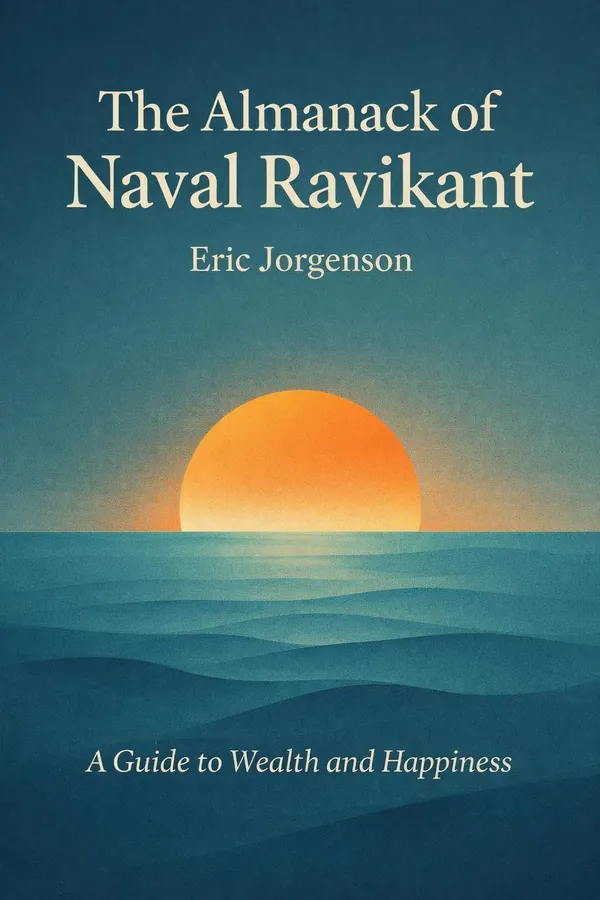
The Almanack of Naval Ravikant: Summary & Key Insights
 10 min9 chaptersAudio available
Key Takeaways from The Almanack of Naval Ravikant
Most people chase money when what they really want is control over their time.
Hard work is common; irreplaceable value is rare.
You do not get rich by trading time for money forever.
A single clear decision can outperform months of frantic effort.
In a changing world, the best skill is learning faster than your environment changes.
What Is The Almanack of Naval Ravikant About?
The Almanack of Naval Ravikant by Eric Jorgenson is a business book published in 2020 spanning 12 pages. The Almanack of Naval Ravikant is not a traditional business book with a single linear argument. Instead, it is a carefully curated collection of entrepreneur and investor Naval Ravikant’s most valuable ideas on wealth, leverage, judgment, happiness, freedom, and self-mastery, assembled by Eric Jorgenson. Drawn from years of podcasts, interviews, tweets, and essays, the book reads like a distilled operating system for modern life: how to build wealth without renting out your soul, how to think clearly in a noisy world, and how to pursue happiness without falling into endless striving. What makes the book matter is its unusual combination of practicality and philosophy. Naval does not separate money from meaning, or career success from peace of mind. He argues that true wealth is freedom, that leverage is the engine of outsized results, and that inner clarity is as important as external achievement. Jorgenson’s contribution is significant because he organizes scattered insights into a coherent, accessible guide. The result is a book that speaks to founders, investors, creators, and anyone trying to build a life that is both financially successful and deeply satisfying.
This FizzRead summary covers all 9 key chapters of The Almanack of Naval Ravikant in approximately 10 minutes, distilling the most important ideas, arguments, and takeaways from Eric Jorgenson's work. Also available as an audio summary and Key Quotes Podcast.
The Almanack of Naval Ravikant
The Almanack of Naval Ravikant is not a traditional business book with a single linear argument. Instead, it is a carefully curated collection of entrepreneur and investor Naval Ravikant’s most valuable ideas on wealth, leverage, judgment, happiness, freedom, and self-mastery, assembled by Eric Jorgenson. Drawn from years of podcasts, interviews, tweets, and essays, the book reads like a distilled operating system for modern life: how to build wealth without renting out your soul, how to think clearly in a noisy world, and how to pursue happiness without falling into endless striving.
What makes the book matter is its unusual combination of practicality and philosophy. Naval does not separate money from meaning, or career success from peace of mind. He argues that true wealth is freedom, that leverage is the engine of outsized results, and that inner clarity is as important as external achievement. Jorgenson’s contribution is significant because he organizes scattered insights into a coherent, accessible guide. The result is a book that speaks to founders, investors, creators, and anyone trying to build a life that is both financially successful and deeply satisfying.
Who Should Read The Almanack of Naval Ravikant?
This book is perfect for anyone interested in business and looking to gain actionable insights in a short read. Whether you're a student, professional, or lifelong learner, the key ideas from The Almanack of Naval Ravikant by Eric Jorgenson will help you think differently.
- ✓Readers who enjoy business and want practical takeaways
- ✓Professionals looking to apply new ideas to their work and life
- ✓Anyone who wants the core insights of The Almanack of Naval Ravikant in just 10 minutes
Want the full summary?
Get instant access to this book summary and 100K+ more with Fizz Moment.
Get Free SummaryAvailable on App Store • Free to download
Key Chapters
Most people chase money when what they really want is control over their time. One of Naval Ravikant’s most important distinctions is between wealth, money, and status. Money is a medium of exchange. Status is a social game built on comparison. Wealth, however, is having assets that earn while you sleep and the freedom to spend your life as you choose. This shift in definition matters because it changes the goal. If you define success as looking rich, you may optimize for appearances. If you define success as freedom, you optimize for ownership, savings, and long-term optionality.
This idea is especially useful in a world flooded with consumer signaling. A luxury car may project success, but if it comes with debt, dependence, and stress, it may reduce actual freedom. By contrast, a stake in a business, a software product, or a portfolio of investments can quietly increase your autonomy without being visible to anyone else. Naval pushes readers to stop admiring high-spending lifestyles and start admiring systems that generate independence.
In practice, this means asking better questions: Does this decision increase my future freedom? Am I buying an asset or maintaining an image? Am I building something that compounds, or consuming something that depreciates? Even career choices look different through this lens. A lower-status path that builds rare skills and ownership may create more long-term wealth than a prestigious job with no upside.
Actionable takeaway: Redefine your financial goals around freedom. Track the assets, skills, and choices that increase your independence, and spend less energy competing in games of status.
Hard work is common; irreplaceable value is rare. Naval argues that wealth is created not simply by effort, but by applying specific knowledge in ways that are difficult to replicate. Specific knowledge is the kind of expertise that feels natural to you but appears impressive or uniquely useful to others. It often sits at the intersection of your genuine curiosity, your lived experience, and your developed skills. Because it is highly personal, it cannot be easily trained into someone else through standard schooling.
This explains why following generic career advice often leads to crowded competition. If you pursue what everyone else is told to pursue, you become replaceable. But if you lean into what you are unusually good at, especially in a field with economic value, you can create disproportionate opportunities. One person may combine design taste with coding. Another may blend deep technical knowledge with storytelling. Another may pair community-building skills with market insight. These combinations become powerful because they are authentic and hard to copy.
Specific knowledge grows through play, obsession, and long-term immersion more than through forced discipline alone. Naval encourages people to notice what they do effortlessly, what they read about when no one tells them to, and what problems others regularly ask them to solve. From there, the task is to package that value into products, services, investments, or intellectual property.
Actionable takeaway: Identify the intersection of what feels like play to you, what others value, and what can scale. Double down on that combination instead of trying to win in a generic, crowded field.
You do not get rich by trading time for money forever. Naval repeatedly emphasizes leverage as the central mechanism behind modern wealth creation. Leverage allows your effort to produce results far beyond your individual hours. He highlights four broad forms: labor, capital, code, and media. Labor means organizing other people’s time. Capital means using money to earn more money. Code means software that works continuously at near-zero marginal cost. Media means content, audience, and communication that can scale to millions.
The most powerful forms today are permissionless leverage, especially code and media. Unlike raising large amounts of capital or managing big teams, an individual can write software, publish ideas, record videos, or build a digital product that reaches a global audience. This dramatically lowers the barriers to impact. A founder can build a tool once and serve thousands of customers. A writer can share a valuable insight once and continue benefiting from it for years. A teacher can turn expertise into a course, newsletter, or platform.
Leverage changes how you think about work. Instead of asking, “How can I work harder?” the better question becomes, “How can this effort continue producing value after I stop?” The answer might be documentation, automation, systems, licensing, investing, or creating reusable assets. This is why ownership matters so much to Naval: leverage without ownership may create value, but ownership determines whether you keep the upside.
Actionable takeaway: Audit your work and find one way to make it more scalable through systems, software, content, or equity so your effort compounds instead of resetting to zero every day.
A single clear decision can outperform months of frantic effort. Naval places extraordinary value on judgment, the ability to see reality accurately, think independently, and make high-quality decisions under uncertainty. In a leveraged world, judgment is a force multiplier. If your choices affect a team, a company, an investment portfolio, or a large audience, one sound call can create enormous returns. One poor decision can do the opposite.
Judgment is not the same as intelligence or information accumulation. It comes from calm observation, first-principles thinking, and learning to resist social pressure. Naval advises readers to become less reactive and more reflective. Many people borrow opinions from the crowd because it feels safe, but crowds are often late, emotional, or misaligned with your goals. Better judgment requires understanding incentives, separating signal from noise, and asking what is fundamentally true rather than what is currently popular.
Practically, judgment improves when you study timeless mental models, make fewer but more considered commitments, and learn from direct feedback. For example, an investor improves not by reading endless headlines but by understanding business quality, valuation, and psychology. An entrepreneur improves by observing customers closely, not by copying trends blindly. A person improves life decisions by knowing their own values rather than outsourcing them to family, peers, or social media.
Naval also links judgment to inner stillness. A cluttered, anxious mind tends to make impulsive decisions. A calmer mind can notice second-order effects and avoid self-deception.
Actionable takeaway: Slow down important decisions. Ask what incentives are driving the situation, what the first-principles truth is, and what outcome would still make sense if no one else approved.
In a changing world, the best skill is learning faster than your environment changes. Naval sees learning not as formal credential collection, but as the continuous upgrading of your mind. The internet has made knowledge abundant, but disciplined curiosity is still rare. People who can teach themselves, follow genuine interest, and synthesize ideas across domains gain a durable edge.
This matters because modern opportunity rarely stays inside one narrow lane. The most effective people often draw from multiple fields: economics, psychology, technology, philosophy, design, writing, and history. Naval encourages reading broadly because books allow you to absorb years of someone else’s hard-earned understanding in a matter of hours. He especially values timeless works over disposable news, because principles endure while headlines decay quickly.
Learning also becomes more powerful when it is active rather than passive. Taking notes, building projects, explaining ideas, and applying concepts in real decisions all deepen understanding. Someone learning sales by actually talking to customers will progress faster than someone consuming endless theory. Someone learning investing by studying businesses and tracking decisions will gain sharper instincts than someone memorizing slogans.
A crucial part of Naval’s view is that you should follow your curiosity. Obsession creates endurance. Endurance creates depth. Depth creates originality. This is why the best learners are often not the most obedient students but the people who cannot help exploring what fascinates them.
Actionable takeaway: Replace low-value information intake with deliberate learning. Read more timeless books, study across disciplines, and turn one area of curiosity into a practical project that builds real capability.
If wealth buys freedom, then time is what freedom is made of. Naval repeatedly returns to the idea that time is your most valuable nonrenewable asset. Money lost can often be regained. Time cannot. Yet many people spend their best years in exchange for social approval, obligations they never chose, or lifestyles they do not even enjoy. The result is a subtle tragedy: earning more while living less.
Seeing time clearly changes behavior. It makes you less willing to endure unnecessary meetings, draining relationships, performative work, or complex consumption habits that demand maintenance. It also raises the value of simplicity. A simpler life is often not a smaller life; it is a more intentional one. Naval’s idea of success is not being busy and important, but being free and at peace.
This perspective also alters how you think about career and money. Instead of maximizing short-term income at any cost, you might prioritize paths that build future autonomy. For example, joining a startup with meaningful equity, building a side business, or developing scalable digital skills may create more long-term time freedom than a high-paying but exhausting job. Likewise, controlling lifestyle inflation becomes a form of time preservation. The less your identity depends on expensive habits, the easier it is to make independent choices.
At a personal level, time freedom includes making space for rest, deep work, reflection, health, and relationships. These are not luxuries. They are the substance of a good life.
Actionable takeaway: Review your calendar and spending through the lens of freedom. Eliminate one recurring commitment that drains life energy and replace it with time that supports health, creativity, or meaningful work.
Achievement can solve some problems, but it cannot guarantee peace. Naval’s thinking on happiness is one of the book’s most distinctive contributions because he refuses the common assumption that happiness lies at the end of success. Instead, he suggests that happiness is a skill, a state of internal harmony, and a byproduct of accepting reality without constant mental resistance.
Much unhappiness comes from endless desire, comparison, and the inability to be present. The mind creates suffering by replaying the past, fearing the future, and arguing with what already is. Naval does not mean that ambition is bad, but that unchecked craving becomes a treadmill. You get what you wanted, adapt quickly, and want more. Without inner stability, external wins cannot satisfy for long.
He points toward practices that reduce internal turbulence: meditation, solitude, self-awareness, gratitude, and paying attention to the stories you tell yourself. If your identity depends on being admired, winning every contest, or controlling outcomes, you become fragile. But if you become less reactive and more observant, happiness becomes less conditional. Even difficult circumstances feel different when the mind is not compounding them with resentment and narrative.
This applies to work as well. A person who enjoys the craft, the learning, and the daily process is more resilient than someone motivated only by distant rewards. Happiness is not passivity; it is functioning from clarity rather than restlessness.
Actionable takeaway: Treat happiness as a practice, not a prize. Build a daily habit such as meditation, journaling, or gratitude that helps you observe your mind and reduce unnecessary internal conflict.
A life designed around someone else’s values will eventually feel like a trap. Naval argues that self-knowledge is a foundational advantage because it helps you choose the right games, the right goals, and the right people. Many forms of suffering come from self-betrayal: saying yes when you mean no, pursuing prestige when you want meaning, or copying paths that do not fit your temperament.
Knowing yourself requires honest observation. What kind of work gives you energy? How much social interaction do you truly enjoy? What environments make you thoughtful, anxious, disciplined, or distracted? What trade-offs are you actually willing to make? These are not abstract personality questions; they are practical design inputs for your life.
Naval also emphasizes that peace comes from reducing inner contradiction. If you claim to value health but constantly neglect sleep, your behavior generates friction. If you say you want freedom but keep increasing your fixed expenses, your actions fight your stated goals. Self-knowledge helps close this gap. The more your calendar, habits, work, and relationships align with your actual values, the less fragmented you feel.
This idea extends to relationships and decision-making. When you know your standards and priorities, you stop seeking universal approval. You can choose carefully, commit fully, and avoid many unnecessary conflicts. Self-awareness does not eliminate all pain, but it reduces confusion and wasted effort.
Actionable takeaway: Spend time identifying your real values, not your inherited ones. Write down the top three things you want your life to optimize for, then compare them honestly with how you currently spend your time and attention.
A successful life cannot be built on wealth alone. One of the quiet strengths of The Almanack of Naval Ravikant is that it widens the definition of returns. Relationships, health, and meaning also compound, and neglecting them can make financial success feel empty. Naval speaks often about choosing long-term people, creating peaceful environments, and treating your body and mind as the foundation of everything else.
In relationships, he favors honesty, mutual respect, and selectivity. The people closest to you affect your emotional baseline, your standards, and even the ambitions you believe are possible. Good relationships lower unnecessary drama and increase trust, growth, and joy. This includes romantic relationships, friendships, and professional partnerships. Choosing well matters more than managing chaos later.
Health is similarly non-negotiable. Clear thinking, energy, discipline, and emotional resilience all depend on physical well-being. Sleep, nutrition, exercise, sunlight, and recovery may sound basic, but their effects are profound. A tired, inflamed, overstimulated person will struggle to apply even the best philosophy consistently. Naval’s message is simple: if you sacrifice health for productivity, you often lose both over time.
Meaning emerges when your actions feel coherent. This may come from service, craftsmanship, family, creation, learning, or spiritual insight. The exact source differs by person, but the principle remains: life deepens when your efforts connect to something beyond ego and accumulation.
Actionable takeaway: Think in terms of life compounding. Invest regularly in your closest relationships, protect your health basics, and choose at least one meaningful pursuit that makes your life feel larger than mere achievement.
All Chapters in The Almanack of Naval Ravikant
About the Author
Eric Jorgenson is an entrepreneur, writer, and product strategist known for translating complex ideas into clear, accessible frameworks. He spent years working in startups, including leadership roles at companies such as Zaarly, where he focused on product, growth, and digital strategy. Jorgenson built a reputation as a thoughtful synthesizer of ideas in business, technology, leverage, and self-improvement. He is best known as the compiler and editor of The Almanack of Naval Ravikant, a project that organized Naval Ravikant’s widely scattered interviews, tweets, and essays into a single coherent volume. By curating those insights with structure and clarity, Jorgenson helped introduce Naval’s philosophy to a far broader audience. He continues to write and speak about entrepreneurship, media, investing, and building a life aligned with long-term value.
Get This Summary in Your Preferred Format
Read or listen to the The Almanack of Naval Ravikant summary by Eric Jorgenson anytime, anywhere. FizzRead offers multiple formats so you can learn on your terms — all free.
Available formats: App · Audio · PDF · EPUB — All included free with FizzRead
Download The Almanack of Naval Ravikant PDF and EPUB Summary
Key Quotes from The Almanack of Naval Ravikant
“Most people chase money when what they really want is control over their time.”
“Hard work is common; irreplaceable value is rare.”
“You do not get rich by trading time for money forever.”
“A single clear decision can outperform months of frantic effort.”
“In a changing world, the best skill is learning faster than your environment changes.”
Frequently Asked Questions about The Almanack of Naval Ravikant
The Almanack of Naval Ravikant by Eric Jorgenson is a business book that explores key ideas across 9 chapters. The Almanack of Naval Ravikant is not a traditional business book with a single linear argument. Instead, it is a carefully curated collection of entrepreneur and investor Naval Ravikant’s most valuable ideas on wealth, leverage, judgment, happiness, freedom, and self-mastery, assembled by Eric Jorgenson. Drawn from years of podcasts, interviews, tweets, and essays, the book reads like a distilled operating system for modern life: how to build wealth without renting out your soul, how to think clearly in a noisy world, and how to pursue happiness without falling into endless striving. What makes the book matter is its unusual combination of practicality and philosophy. Naval does not separate money from meaning, or career success from peace of mind. He argues that true wealth is freedom, that leverage is the engine of outsized results, and that inner clarity is as important as external achievement. Jorgenson’s contribution is significant because he organizes scattered insights into a coherent, accessible guide. The result is a book that speaks to founders, investors, creators, and anyone trying to build a life that is both financially successful and deeply satisfying.
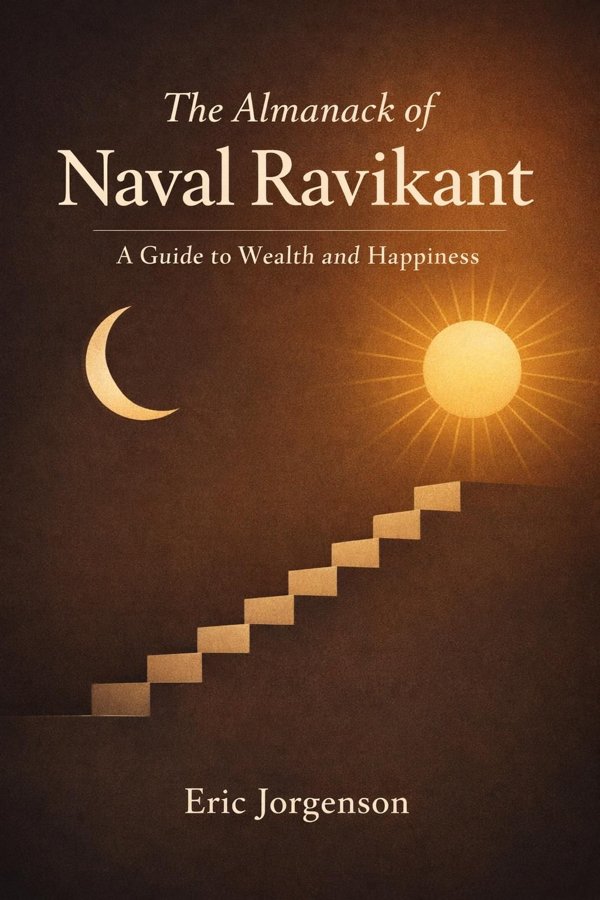
More by Eric Jorgenson
You Might Also Like




Featured In
Browse by Category
Ready to read The Almanack of Naval Ravikant?
Get the full summary and 100K+ more books with Fizz Moment.