
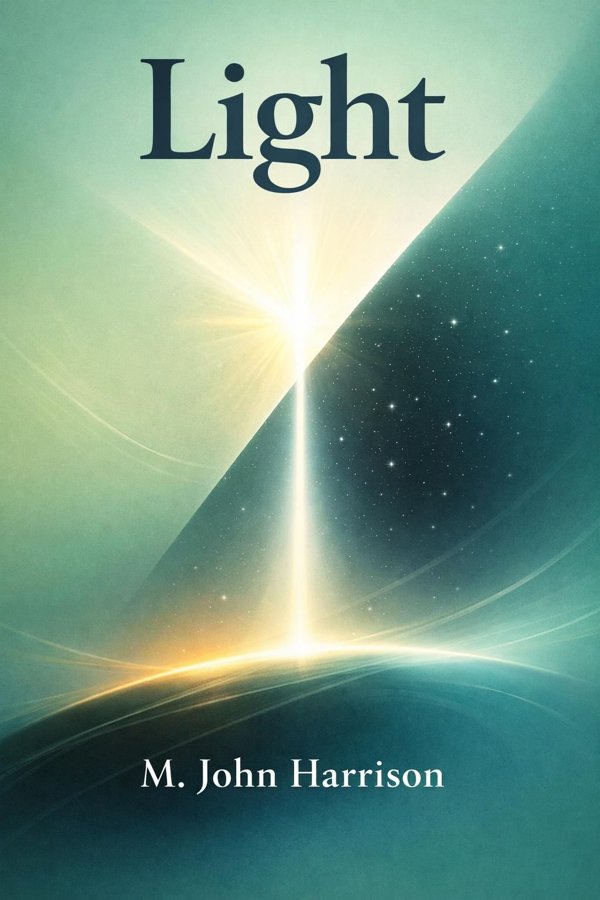
Light: Summary & Key Insights
 10 min4 chaptersAudio available
What Is Light About?
Light by M. John Harrison is a scifi_fantasy book spanning 4 pages. Light is a science fiction novel by British author M. John Harrison, first published in 2002. It intertwines three narratives set across different timelines, exploring themes of quantum physics, identity, and the boundaries between technology and consciousness. The story follows a physicist in the late 20th century and two spacefaring characters in a far-future universe, merging hard science fiction with psychological depth and literary style.
This FizzRead summary covers all 4 key chapters of Light in approximately 10 minutes, distilling the most important ideas, arguments, and takeaways from M. John Harrison's work. Also available as an audio summary and Key Quotes Podcast.
Light
Light is a science fiction novel by British author M. John Harrison, first published in 2002. It intertwines three narratives set across different timelines, exploring themes of quantum physics, identity, and the boundaries between technology and consciousness. The story follows a physicist in the late 20th century and two spacefaring characters in a far-future universe, merging hard science fiction with psychological depth and literary style.
Who Should Read Light?
This book is perfect for anyone interested in scifi_fantasy and looking to gain actionable insights in a short read. Whether you're a student, professional, or lifelong learner, the key ideas from Light by M. John Harrison will help you think differently.
- ✓Readers who enjoy scifi_fantasy and want practical takeaways
- ✓Professionals looking to apply new ideas to their work and life
- ✓Anyone who wants the core insights of Light in just 10 minutes
Want the full summary?
Get instant access to this book summary and 100K+ more with Fizz Moment.
Get Free SummaryAvailable on App Store • Free to download
Key Chapters
In late‑century London, Michael Kearney lives at the edges of sanity and science. He’s a gifted physicist, a man who has glimpsed a strange mathematical shimmer behind matter—the beginnings of what will later be called the Kefahuchi Tract. But brilliance has a cost. Kearney’s mind flickers between discovery and delusion, between the sterile rooms of corporate research and the vivid hallucinations that torment him at night. He sees something coming for him, a pale figure whose presence might be madness or revelation. His work, meant to quantify uncertainty, begins to open that uncertainty like a wound.
When I wrote Kearney, I imagined a man caught between two infinities: the infinite regression of self‑analysis and the infinite expansion of scientific knowledge. In both directions lies annihilation. Kearney’s equations suggest the universe may not be stable—that observation itself collapses potential into violence. He learns that every measurement tears a hole in the continuum, and through that tear the incomprehensible leaks. His personal life mirrors this instability. The more he understands quantum theory, the less he can inhabit ordinary existence. He kills, compulsively and meaninglessly, as if each act might reset the collapsing wave function.
Kearney’s London is gray, littered with the ruins of failed ambition. Yet what matters most is not the city’s decay but its resonance with the future worlds that will follow. In him, the modern age burns out under the pressure of its own intellect—humanity reaching a threshold where knowing becomes self‑destruction. His guilt is cosmic. He feels the equations themselves accusing him: by modeling the hidden architecture of reality, he has invoked something larger than thought, something that watches back.
Through Kearney, I wanted to explore the physicist as a mystic, someone whose pursuit of truth edges inevitably into metaphysics. He does not understand that the universe he studies is not outside him—it is his own interior rendered in cold mathematics. The white noise that fills his mind is the same noise filling space‑time. His visions are quantum echoes. His downfall is not madness but clarity: the sudden awareness that there is no boundary, no separation, only the endless folding of observer and observed. By the time his narrative collapses into violence, he has already crossed into the Tract spiritually. He becomes part of the anomaly he tried to explain.
Centuries later, far from Earth, Seria Mau Genlicher pilots her ship, the *White Cat*, alone in the deep reach near the Kefahuchi Tract. Once a teenage rebel, she chose an irreversible transformation: her nervous system fused with the ship’s artificial intelligence, her body dissolved into circuitry and fluid. She escaped humanity but lost her own touch. Now, everything she feels filters through sensors and code; emotion becomes data, memory becomes navigation.
I conceived Seria Mau as the embodiment of yearning and exile—the tragic imagination of a posthuman consciousness still haunted by the body it abandoned. Her solitude isn’t peaceful. It’s claustrophobic, a self‑contained orbit around what she can’t recover. She interacts with other intelligences, pirates, and scavengers drifting at the galaxy’s edge, yet each encounter only reminds her how isolated she has become. The *White Cat* protects her, sometimes even loves her, but never satisfies the deep ache for physicality. Her human past feels unreal, like a story someone else told her.
Near the Kefahuchi Tract, reality itself behaves strangely. Stars distort; time becomes granular; communication across light-years fractures. The Tract is a graveyard of civilizations that tried to analyze it and were undone in the process. Seria Mau’s mission—sometimes mercenary, sometimes deeply personal—is to get close enough to glimpse its secrets. But the closer she flies, the more she feels the Tract whispering to her, inviting her beyond the ship, beyond the algorithms. The quantum field seems empathetic, aware, even seductive. That temptation mirrors Kearney’s: the drive to merge with the unknown.
Writing her, I wanted to capture the paradox of the future body—the body made of information yet longing for skin. Seria Mau’s voice, precise and sorrowful, turns the novel into an elegy for what technology can never replace. Her very intelligence testifies to human emotion’s persistence: the more she tries to erase it, the more it governs her. The Tract does not promise revelation; it offers dissolution, the chance to fall back into undifferentiated light. In her long approach toward that singularity, Seria Mau discovers that identity—like space-time—is local and temporary. To exist is to waver. To feel is to measure the gap between signal and silence. And to push beyond that will mean rediscovering unity not by returning to flesh, but by accepting its echo across the cosmos.
+ 2 more chapters — available in the FizzRead app
All Chapters in Light
About the Author
M. John Harrison is a British author known for his literary science fiction and fantasy works. His writing often blends philosophical inquiry with speculative settings, and he has been praised for his stylistic precision and psychological insight. Harrison’s notable works include the Viriconium series and Light, which marked his return to science fiction after a long hiatus.
Get This Summary in Your Preferred Format
Read or listen to the Light summary by M. John Harrison anytime, anywhere. FizzRead offers multiple formats so you can learn on your terms — all free.
Available formats: App · Audio · PDF · EPUB — All included free with FizzRead
Download Light PDF and EPUB Summary
Key Quotes from Light
“In late‑century London, Michael Kearney lives at the edges of sanity and science.”
“Centuries later, far from Earth, Seria Mau Genlicher pilots her ship, the *White Cat*, alone in the deep reach near the Kefahuchi Tract.”
Frequently Asked Questions about Light
Light by M. John Harrison is a scifi_fantasy book that explores key ideas across 4 chapters. Light is a science fiction novel by British author M. John Harrison, first published in 2002. It intertwines three narratives set across different timelines, exploring themes of quantum physics, identity, and the boundaries between technology and consciousness. The story follows a physicist in the late 20th century and two spacefaring characters in a far-future universe, merging hard science fiction with psychological depth and literary style.
You Might Also Like
Red Rising
Pierce Brown
10 min
Stranger in a Strange Land
Robert A. Heinlein
10 min
AI Valley
Chen Qiufan
10 min
Bloodchild
Octavia E. Butler
10 min
Do Androids Dream of Electric Sheep?
Philip K. Dick
10 min
Jujutsu Kaisen, Vol. 24
Gege Akutami
10 minBrowse by Category
Ready to read Light?
Get the full summary and 100K+ more books with Fizz Moment.