
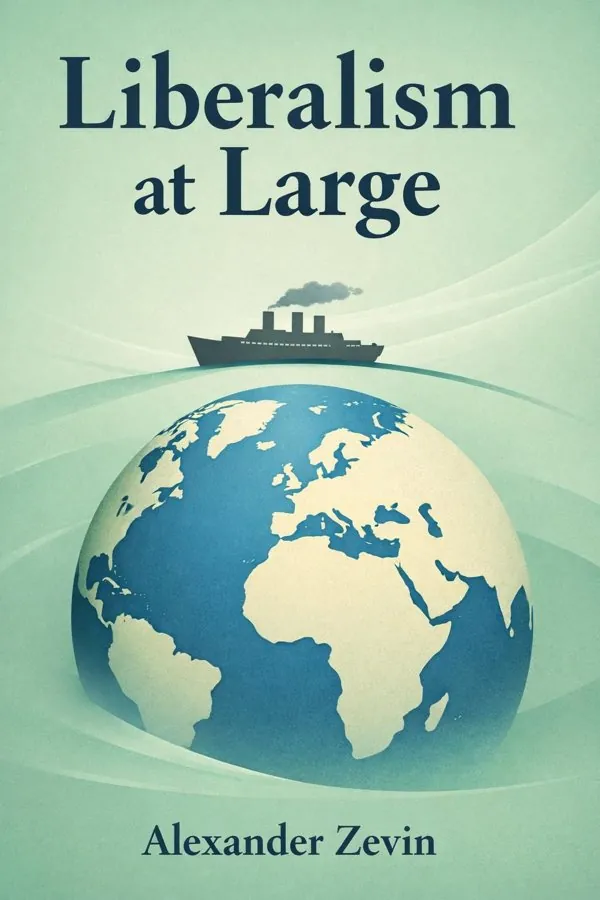
Liberalism at Large: The World According to the Economist: Summary & Key Insights
 10 min9 chaptersAudio available
Key Takeaways from Liberalism at Large: The World According to the Economist
Big ideologies often begin by presenting themselves as simple common sense.
A creed that speaks the language of freedom can still become an alibi for domination.
Media outlets do not float above economic life; they absorb the priorities of the world they interpret.
Powerful ideologies survive not because they never change, but because they change strategically.
An idea becomes globally influential when it stops looking local.
What Is Liberalism at Large: The World According to the Economist About?
Liberalism at Large: The World According to the Economist by Alexander Zevin is a politics book spanning 11 pages. What if one of the world’s most influential magazines could also serve as a history of modern liberalism itself? In Liberalism at Large, historian Alexander Zevin uses The Economist as a revealing archive of political ideas, economic dogma, imperial ambition, and elite common sense from the nineteenth century to today. Rather than treating the magazine as a neutral observer of world events, Zevin shows how it actively shaped debates about free trade, democracy, empire, capitalism, war, decolonization, and globalization. The book matters because liberalism is often described in abstract moral terms—freedom, tolerance, progress—while its real historical record is far more entangled with class power, colonial rule, and market expansion. By tracing how The Economist responded to crises across two centuries, Zevin uncovers the gap between liberal ideals and liberal practice. His approach is especially powerful because it combines intellectual history, media history, and political economy in one sharp narrative. Zevin writes with the authority of a trained historian and editor deeply familiar with European political thought. The result is a vivid, unsettling account of how elite journalism helped normalize a global order built on markets, hierarchy, and the language of reason.
This FizzRead summary covers all 9 key chapters of Liberalism at Large: The World According to the Economist in approximately 10 minutes, distilling the most important ideas, arguments, and takeaways from Alexander Zevin's work. Also available as an audio summary and Key Quotes Podcast.
Liberalism at Large: The World According to the Economist
What if one of the world’s most influential magazines could also serve as a history of modern liberalism itself? In Liberalism at Large, historian Alexander Zevin uses The Economist as a revealing archive of political ideas, economic dogma, imperial ambition, and elite common sense from the nineteenth century to today. Rather than treating the magazine as a neutral observer of world events, Zevin shows how it actively shaped debates about free trade, democracy, empire, capitalism, war, decolonization, and globalization.
The book matters because liberalism is often described in abstract moral terms—freedom, tolerance, progress—while its real historical record is far more entangled with class power, colonial rule, and market expansion. By tracing how The Economist responded to crises across two centuries, Zevin uncovers the gap between liberal ideals and liberal practice. His approach is especially powerful because it combines intellectual history, media history, and political economy in one sharp narrative.
Zevin writes with the authority of a trained historian and editor deeply familiar with European political thought. The result is a vivid, unsettling account of how elite journalism helped normalize a global order built on markets, hierarchy, and the language of reason.
Who Should Read Liberalism at Large: The World According to the Economist?
This book is perfect for anyone interested in politics and looking to gain actionable insights in a short read. Whether you're a student, professional, or lifelong learner, the key ideas from Liberalism at Large: The World According to the Economist by Alexander Zevin will help you think differently.
- ✓Readers who enjoy politics and want practical takeaways
- ✓Professionals looking to apply new ideas to their work and life
- ✓Anyone who wants the core insights of Liberalism at Large: The World According to the Economist in just 10 minutes
Want the full summary?
Get instant access to this book summary and 100K+ more with Fizz Moment.
Get Free SummaryAvailable on App Store • Free to download
Key Chapters
Big ideologies often begin by presenting themselves as simple common sense. Zevin shows that The Economist was founded in 1843 by James Wilson not merely as a business publication, but as a campaigning instrument in the battle against Britain’s Corn Laws. Wilson framed free trade as both economically rational and morally just: lower tariffs would reduce food prices, improve efficiency, and weaken aristocratic privilege. From the start, then, the magazine’s identity fused policy advocacy with moral certainty.
This origin matters because it reveals something essential about liberalism. It did not just argue that markets work; it argued that markets civilize. Trade was cast as the path to peace, prosperity, and social improvement. Yet the same language that challenged protectionist landowners also elevated commercial society as the standard by which politics should be judged. The market was not one institution among many. It became the measure of rational governance.
A practical example helps clarify the pattern. Today, many policy debates still frame deregulation or trade openness as if they were neutral technical solutions rather than political choices with winners and losers. Zevin’s account of Wilson reminds us that economic journalism often enters public debate already carrying a worldview, even when it claims only to report facts.
The larger lesson is to read media institutions historically. Their founding missions shape how they define problems, whose interests seem universal, and what kinds of solutions appear responsible. Actionable takeaway: whenever a publication claims to speak for reason alone, ask what moral and political commitments are hidden inside its definition of “common sense.”
A creed that speaks the language of freedom can still become an alibi for domination. One of Zevin’s most striking arguments is that The Economist’s nineteenth-century liberalism developed in step with British imperial expansion. The magazine treated empire less as a contradiction of liberal values than as a vehicle for spreading commerce, law, and supposedly civilized institutions across the world.
In this worldview, colonial rule could be justified if it opened markets, secured property rights, and integrated distant territories into global trade. Liberalism’s universal claims were therefore not applied universally. Colonized peoples were often judged unready for self-government, while British administration was presented as a temporary but necessary tutor. The gap between professed liberty and practiced hierarchy was not accidental; it was built into the way liberal elites imagined progress.
This history matters far beyond the Victorian period. It helps explain why interventions today are still sometimes defended in the language of modernization, institution building, or market reform, even when they reproduce unequal power relations. Zevin encourages readers to see continuity between classical imperial arguments and later forms of geopolitical management.
A useful application is to examine how contemporary commentary describes weaker states. Are they portrayed as partners, or as problems to be disciplined? Are market reforms presented as voluntary choices, or as conditions imposed from outside? Those patterns often echo the older imperial logic Zevin identifies.
The key insight is not that liberalism and empire were occasional companions, but that for many influential liberals they were mutually reinforcing projects. Actionable takeaway: when political rhetoric links freedom to external control, pause and ask who defines freedom, who exercises control, and who bears the cost.
Media outlets do not float above economic life; they absorb the priorities of the world they interpret. Zevin shows that as industrial capitalism matured, The Economist became more than a voice for free trade. It became a chronicler and defender of a society organized around investors, manufacturers, productivity, and financial stability. The publication’s authority grew because it spoke for a rising commercial order and translated its interests into universal principles.
The magazine covered labor unrest, business cycles, public finance, and industrial competition through assumptions that favored order, discipline, and profitability. Social conflict was often seen less as a contest over justice than as a disturbance to efficient economic functioning. Capital accumulation appeared dynamic and progressive, while demands from workers or democratic movements could seem irrational, disruptive, or dangerous when they threatened investment confidence.
This does not mean The Economist simply parroted business interests. Zevin’s point is subtler: the magazine helped construct a moral and intellectual world in which the health of markets stood in for the health of society. That framing still shapes business journalism today. Consider how recessions are often narrated through stock indices, inflation rates, or central bank credibility before they are described through wages, housing stress, or insecurity.
Readers can apply this insight by asking what metrics define success in economic reporting. If growth rises while inequality worsens, what story gets told? If productivity increases but workers lose bargaining power, whose perspective dominates?
Zevin’s analysis of industrial capitalism teaches that journalism can naturalize a particular social order by making its priorities appear objective. Actionable takeaway: whenever you read economic commentary, identify the underlying measure of well-being and ask whether it captures human flourishing or mainly the smooth operation of capital.
Powerful ideologies survive not because they never change, but because they change strategically. As the nineteenth century gave way to the twentieth, The Economist adjusted to major shifts: mass politics, stronger labor movements, new imperial rivalries, and the growing complexity of global finance. Zevin shows that the magazine did not remain frozen in an earlier laissez-faire purity. Instead, it recalibrated while preserving its central faith in markets, property, and elite stewardship.
This flexibility is a crucial part of liberalism’s durability. When circumstances demanded limited reforms, administrative modernization, or measured concessions to democracy, the magazine could accommodate them. But these adaptations typically aimed to stabilize the social order rather than transform it. Liberalism bent so that it would not break.
A practical analogy is the way institutions today often endorse limited reforms in response to public anger—more oversight after a financial crash, modest welfare expansion during hardship, or environmental targets alongside continued reliance on growth-led models. Such adjustments may be real, but they can also function as self-preservation strategies.
Zevin’s history helps readers distinguish between tactical reform and structural rethinking. The question is not only whether an institution has changed, but whether the hierarchy of values beneath that change remains intact. Are markets still treated as the default organizing principle? Are democratic demands accepted only when they do not threaten concentrated power?
The broader lesson is that moderation can be politically powerful because it presents continuity as pragmatism. Actionable takeaway: when evaluating reformist rhetoric, look beyond surface concessions and ask which assumptions remain nonnegotiable beneath the language of adaptation.
An idea becomes globally influential when it stops looking local. Zevin argues that The Economist helped transform a historically specific British liberal outlook into a supposedly universal language of world order. As trade networks widened and Britain’s international reach deepened, the magazine increasingly wrote as if the interests of commerce, finance, and stability reflected the interests of humanity as such.
This universalizing move was central to liberalism’s global prestige. Policies that favored open markets, creditor confidence, and commercial integration could be framed not as British priorities, or elite priorities, but as neutral standards of good governance. Nations that resisted were often portrayed as backward, emotional, or economically immature. The result was a politics of asymmetry dressed up as impartiality.
You can see a modern version of this dynamic whenever global institutions or influential commentators present one model of development as the inevitable path for all countries, regardless of local history, social structure, or democratic preference. Zevin’s account invites skepticism toward claims that there is only one responsible route to modernization.
This is particularly useful for understanding debates around austerity, privatization, and trade liberalization in postcolonial or developing states. Such measures are often sold in technical language, but they also carry embedded assumptions about sovereignty, class power, and acceptable policy choice.
The key contribution of this chapter in Zevin’s story is to show that global liberalism spread not only through armies and treaties, but through persuasive narratives that converted situated interests into universal norms. Actionable takeaway: when a policy is described as globally necessary, ask whose experience produced that standard and whether alternative models are being excluded before the debate even begins.
Ideas appear strongest just before events reveal their limits. The interwar period is where Zevin most clearly shows liberalism under pressure. World War I shattered confidence in inevitable progress, the global economy destabilized, empires weakened, and new ideological challengers emerged from the left and right. The Economist continued to defend liberal principles, but it did so in a world where the old assumptions no longer delivered stability.
Economic collapse, unemployment, social unrest, and the rise of fascism made it harder to insist that trade and financial orthodoxy alone would secure peace and prosperity. Liberalism now had to confront the possibility that unregulated capitalism could destroy the very social conditions on which liberal institutions depended. The magazine’s responses reveal both seriousness and limitation: it could diagnose disorder, but it often struggled to imagine remedies that departed too far from its inherited commitments.
This pattern has contemporary resonance. In moments of systemic strain, elite institutions often acknowledge crisis while proposing solutions calibrated to preserve the framework that produced it. After financial crashes or democratic breakdowns, we hear calls for restoration, confidence, and responsible management rather than deeper redistribution or institutional redesign.
For readers, the practical value lies in recognizing that crises are interpretive battles. The same event can be read as a temporary shock, a policy error, or a sign that the governing model itself is failing. Zevin shows how influential media help define which of those readings becomes legitimate.
His larger point is that liberalism’s crises are not aberrations external to it; they often emerge from tensions within it. Actionable takeaway: when institutions describe a crisis, ask whether they are treating symptoms, or whether they are willing to question the deeper rules of the system itself.
Liberalism did not emerge from World War II unchanged; it survived by speaking a new idiom. Zevin traces how, after the devastation of war and depression, The Economist adapted to a world of welfare states, managed economies, decolonization, American hegemony, and multilateral institutions. The magazine could no longer champion a simple return to nineteenth-century laissez-faire. Instead, it learned to work within a framework that accepted planning, social insurance, and state coordination—up to a point.
This period is important because it shows liberalism becoming more socially textured while retaining its core attachment to market society. The postwar order tempered capitalism without abandoning it. Governments took responsibility for employment, reconstruction, and public welfare, but private property, international trade, and commercial growth remained foundational. The Economist often supported this settlement pragmatically, even when it worried about overreach.
The lesson here is that liberalism can coexist with significant state activity, provided the state ultimately serves to secure a viable market order. That insight complicates simplistic contrasts between “free market” and “big government.” In practice, modern capitalism often relies on strong states to rescue banks, build infrastructure, train labor, and maintain social peace.
Readers can apply this framework when evaluating current policy debates. Calls for industrial strategy, green investment, or social protection do not automatically break with liberal orthodoxy. The decisive question is whether these tools democratize power or mainly stabilize existing arrangements.
Zevin’s postwar analysis reveals a liberalism skilled at absorbing lessons from catastrophe without surrendering command of the future. Actionable takeaway: when a political order claims to have reformed itself, examine whether it has redistributed power—or merely updated the methods by which the same system is preserved.
What looks like a new era is often an old doctrine with fresher packaging. Zevin argues that the late twentieth-century neoliberal turn did not represent a complete break with The Economist’s past. Rather, it reactivated longstanding commitments to market freedom, fiscal restraint, trade openness, and suspicion of mass democratic pressure, now expressed through the language of efficiency, competitiveness, and globalization.
As Keynesian arrangements faltered in the 1970s, The Economist became a leading advocate of deregulation, privatization, monetarism, and the discipline of global markets. It treated these developments as realistic corrections to state excess and national complacency. But Zevin shows that this “realism” carried a normative project: reducing the political capacity of labor, narrowing the range of acceptable economic policy, and deepening the authority of investors and transnational institutions.
This argument helps explain why globalization was so often presented as inevitable rather than chosen. If capital mobility, open trade, and flexible labor markets are framed as facts of nature, then democratic resistance appears futile or irrational. We still see this logic when governments claim their hands are tied by markets, ratings agencies, or international competitiveness.
A practical use of Zevin’s analysis is to interrogate inevitability claims. Whenever a reform is described as unavoidable, ask what political alternatives are being excluded. Could different tax structures, ownership models, labor protections, or trade arrangements exist? Usually yes.
The enduring power of neoliberalism lies partly in its ability to convert historically contingent policies into the language of necessity. Actionable takeaway: challenge any argument that treats market outcomes as destiny; behind every “inevitable” economic order is a set of political decisions that can be debated and changed.
The most influential publications do not merely report the world; they teach readers what kinds of world are thinkable. In Zevin’s final analysis, The Economist matters not only because of the positions it has taken, but because of the authority it has accumulated as a global interpreter of events. Its tone—urbane, witty, assured, technocratic—helps convert ideology into expertise. Readers are invited to trust judgment that appears measured, informed, and above partisan conflict.
That style is politically significant. It allows contested preferences to appear as reasonable consensus. Support for market integration, elite management, and incremental reform is presented not as one ideology among others, but as the mature center from which extremes can be judged. This is one reason liberalism remains powerful even in periods of visible failure: it continues to set the standards of seriousness.
The application to contemporary life is immediate. In a fragmented media environment, people often focus on explicit misinformation while overlooking the quieter force of agenda-setting institutions. Which problems get sustained attention? Which actors are treated as credible? Which proposals are dismissed as unrealistic before they are examined? These decisions shape politics as much as overt editorial endorsements.
Zevin encourages a form of media literacy grounded in history. To read elite journalism critically is not to reject expertise; it is to ask how expertise is produced, whom it serves, and what social horizons it normalizes.
His deepest contribution is to show that media power operates by narrowing possibility while seeming merely to clarify reality. Actionable takeaway: diversify the sources you trust, compare how different outlets frame the same issue, and notice not just what is argued, but what is made to seem unarguable.
All Chapters in Liberalism at Large: The World According to the Economist
About the Author
Alexander Zevin is a historian of modern Europe and a prominent intellectual voice on political history, media, and ideology. He teaches history at the City University of New York and has served as an editor at New Left Review, where he has written and edited widely on politics, culture, and international affairs. His scholarship focuses on how ideas travel through institutions and how seemingly neutral forms of expertise can shape public life. In Liberalism at Large, Zevin brings these interests together by studying The Economist as both a publication and a political actor. Known for combining archival depth with sharp contemporary relevance, he writes for readers who want to understand not just what powerful institutions say, but how they help define the limits of political common sense.
Get This Summary in Your Preferred Format
Read or listen to the Liberalism at Large: The World According to the Economist summary by Alexander Zevin anytime, anywhere. FizzRead offers multiple formats so you can learn on your terms — all free.
Available formats: App · Audio · PDF · EPUB — All included free with FizzRead
Download Liberalism at Large: The World According to the Economist PDF and EPUB Summary
Key Quotes from Liberalism at Large: The World According to the Economist
“Big ideologies often begin by presenting themselves as simple common sense.”
“A creed that speaks the language of freedom can still become an alibi for domination.”
“Media outlets do not float above economic life; they absorb the priorities of the world they interpret.”
“Powerful ideologies survive not because they never change, but because they change strategically.”
“An idea becomes globally influential when it stops looking local.”
Frequently Asked Questions about Liberalism at Large: The World According to the Economist
Liberalism at Large: The World According to the Economist by Alexander Zevin is a politics book that explores key ideas across 9 chapters. What if one of the world’s most influential magazines could also serve as a history of modern liberalism itself? In Liberalism at Large, historian Alexander Zevin uses The Economist as a revealing archive of political ideas, economic dogma, imperial ambition, and elite common sense from the nineteenth century to today. Rather than treating the magazine as a neutral observer of world events, Zevin shows how it actively shaped debates about free trade, democracy, empire, capitalism, war, decolonization, and globalization. The book matters because liberalism is often described in abstract moral terms—freedom, tolerance, progress—while its real historical record is far more entangled with class power, colonial rule, and market expansion. By tracing how The Economist responded to crises across two centuries, Zevin uncovers the gap between liberal ideals and liberal practice. His approach is especially powerful because it combines intellectual history, media history, and political economy in one sharp narrative. Zevin writes with the authority of a trained historian and editor deeply familiar with European political thought. The result is a vivid, unsettling account of how elite journalism helped normalize a global order built on markets, hierarchy, and the language of reason.
You Might Also Like
Antifa: The Anti-Fascist Handbook
Mark Bray
10 min
Attack from Within: How Disinformation Is Sabotaging America
Barbara McQuade
10 min
Coercion, Capital, and European States, AD 990–1992
Charles Tilly
10 min
Digital Democracy: Concepts, Methodologies, Tools, and Applications
Various Authors
10 min
Fascism
Stanley G. Payne
10 min
Fire And Fury: Inside The Trump White House
Michael Wolff
10 minBrowse by Category
Ready to read Liberalism at Large: The World According to the Economist?
Get the full summary and 100K+ more books with Fizz Moment.