
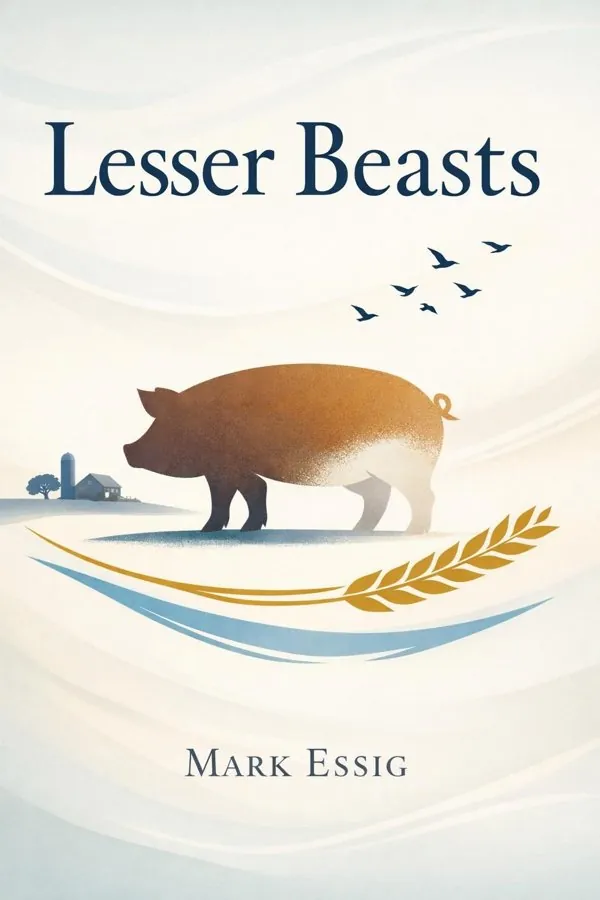
Lesser Beasts: A Snout-to-Tail History of the Humble Pig: Summary & Key Insights
by Mark Essig
 10 min10 chaptersAudio available
What Is Lesser Beasts: A Snout-to-Tail History of the Humble Pig About?
Lesser Beasts: A Snout-to-Tail History of the Humble Pig by Mark Essig is a world_history book spanning 10 pages. Lesser Beasts: A Snout-to-Tail History of the Humble Pig explores the intertwined history of humans and pigs, tracing how this animal shaped agriculture, religion, and culture from ancient times to modern industrial farming. Mark Essig examines the pig’s role in civilization, its symbolic meanings, and its transformation through domestication and technology, offering a rich narrative that connects food, ethics, and human progress.
This FizzRead summary covers all 10 key chapters of Lesser Beasts: A Snout-to-Tail History of the Humble Pig in approximately 10 minutes, distilling the most important ideas, arguments, and takeaways from Mark Essig's work. Also available as an audio summary and Key Quotes Podcast.
Lesser Beasts: A Snout-to-Tail History of the Humble Pig
Lesser Beasts: A Snout-to-Tail History of the Humble Pig explores the intertwined history of humans and pigs, tracing how this animal shaped agriculture, religion, and culture from ancient times to modern industrial farming. Mark Essig examines the pig’s role in civilization, its symbolic meanings, and its transformation through domestication and technology, offering a rich narrative that connects food, ethics, and human progress.
Who Should Read Lesser Beasts: A Snout-to-Tail History of the Humble Pig?
This book is perfect for anyone interested in world_history and looking to gain actionable insights in a short read. Whether you're a student, professional, or lifelong learner, the key ideas from Lesser Beasts: A Snout-to-Tail History of the Humble Pig by Mark Essig will help you think differently.
- ✓Readers who enjoy world_history and want practical takeaways
- ✓Professionals looking to apply new ideas to their work and life
- ✓Anyone who wants the core insights of Lesser Beasts: A Snout-to-Tail History of the Humble Pig in just 10 minutes
Want the full summary?
Get instant access to this book summary and 100K+ more with Fizz Moment.
Get Free SummaryAvailable on App Store • Free to download
Key Chapters
The story begins over ten millennia ago, in the Neolithic world, when human hands first reshaped nature for survival. Pigs were among the earliest animals we brought into our domestic orbit, and their domestication unfolded in several regions: the Fertile Crescent, China, and parts of Southeast Asia. Archaeological and genetic evidence reveals a fascinating truth—not a single domestication event, but multiple ones, as humans across continents discovered the same possibilities hidden in the wild boar.
In those early villages, pigs were convenient partners. They thrived on scraps, converted waste into meat, and reproduced quickly. Unlike cattle or sheep, they demanded little pasture; they prospered near human settlements, feeding on the margins of our existence. It was a symbiosis grounded in practicality: we offered protection, they offered sustenance.
What struck me as I delved into this stage of history was how the pig’s very proximity to us defined its destiny. Where other livestock grazed the open plains, pigs lived amid our refuse, sharing our boundaries and, in a sense, our identity. The intimacy was both natural and uneasy—pigs were familiar, almost familial, yet their omnivorous habits and uncanny intelligence made them unsettling mirrors of ourselves.
This early stage set the pattern that would endure: pigs flourished wherever humans did, adapting to their masters’ habits, diets, and ecologies. And in their adaptability lay both their blessing and their curse. They were creatures of civilization, but they could never quite escape the shadow of their wild origins.
As agriculture expanded into empires, pigs took on multiple meanings—economic, ritual, and moral. In Mesopotamia, pigs were both valued and reviled. Cuneiform tablets record them as sources of food for laborers and soldiers, yet also as animals considered unclean, associated with filth and contagion. In Egypt, their image fluctuated even more dramatically: while commoners raised pigs for meat, priests and elites sometimes regarded them as impure, even demonic, linking them to Seth, god of chaos.
Meanwhile, in ancient China, the pig was inseparable from the very notion of domestic life. The Chinese character for 'home' (家) literally depicts a pig beneath a roof, an emblem of household harmony. The animal represented wealth and fertility, and in early Chinese ritual, its sacrifice held deep symbolic power—blood offered to ancestors, flesh shared in feasts that bound community and lineage.
Across these early civilizations, pigs embodied an ambivalence that would persist through time: they were vital to sustenance but morally suspect, essential yet tainted. Their flesh could sanctify a ritual or violate a taboo, depending on who you asked. And behind these contrasts lay a universal human tension—how to reconcile the practical necessity of eating with the spiritual aspiration toward purity.
+ 8 more chapters — available in the FizzRead app
All Chapters in Lesser Beasts: A Snout-to-Tail History of the Humble Pig
About the Author
Mark Essig is an American historian and writer known for his works on food history and culture. He has contributed to various publications and focuses on the intersection of science, history, and everyday life.
Get This Summary in Your Preferred Format
Read or listen to the Lesser Beasts: A Snout-to-Tail History of the Humble Pig summary by Mark Essig anytime, anywhere. FizzRead offers multiple formats so you can learn on your terms — all free.
Available formats: App · Audio · PDF · EPUB — All included free with FizzRead
Download Lesser Beasts: A Snout-to-Tail History of the Humble Pig PDF and EPUB Summary
Key Quotes from Lesser Beasts: A Snout-to-Tail History of the Humble Pig
“The story begins over ten millennia ago, in the Neolithic world, when human hands first reshaped nature for survival.”
“As agriculture expanded into empires, pigs took on multiple meanings—economic, ritual, and moral.”
Frequently Asked Questions about Lesser Beasts: A Snout-to-Tail History of the Humble Pig
Lesser Beasts: A Snout-to-Tail History of the Humble Pig by Mark Essig is a world_history book that explores key ideas across 10 chapters. Lesser Beasts: A Snout-to-Tail History of the Humble Pig explores the intertwined history of humans and pigs, tracing how this animal shaped agriculture, religion, and culture from ancient times to modern industrial farming. Mark Essig examines the pig’s role in civilization, its symbolic meanings, and its transformation through domestication and technology, offering a rich narrative that connects food, ethics, and human progress.
You Might Also Like
The Age of Capital
Eric Hobsbawm
10 min
The Gulag Archipelago
Aleksandr Solzhenitsyn
10 min
Jerusalem: The Biography
Simon Sebag Montefiore
10 min
The Anglo-Saxons
James Campbell
10 min
The Boer War
Thomas Pakenham
10 min
The Industrial Revolutionaries: The Making of the Modern World 1776–1914
Gavin Weightman
10 minBrowse by Category
Ready to read Lesser Beasts: A Snout-to-Tail History of the Humble Pig?
Get the full summary and 100K+ more books with Fizz Moment.