
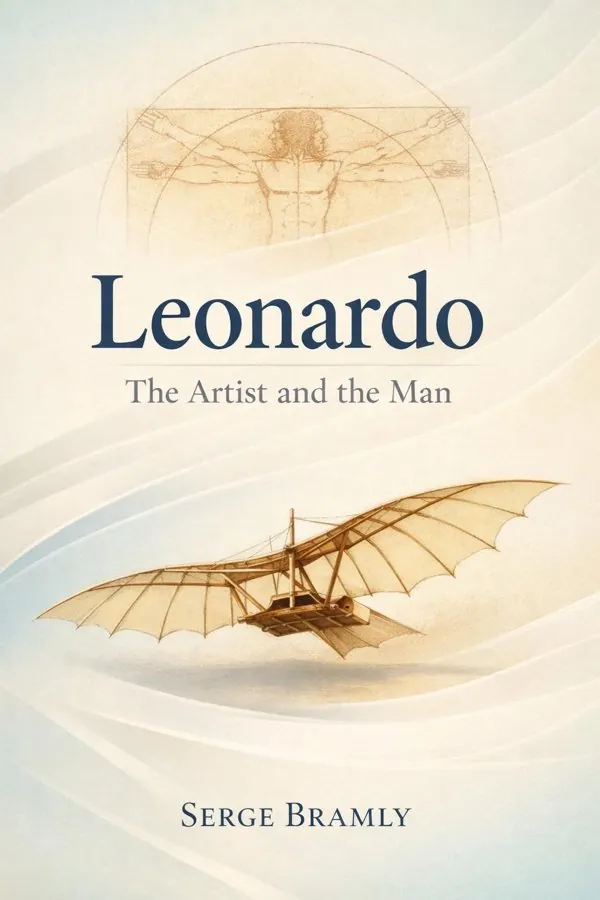
Leonardo: The Artist and the Man: Summary & Key Insights
by Serge Bramly
 10 min9 chaptersAudio available
What Is Leonardo: The Artist and the Man About?
Leonardo: The Artist and the Man by Serge Bramly is a biographies book spanning 9 pages. This book is a detailed biography of Leonardo da Vinci, exploring his life, artistic and scientific work, and his influence on the Renaissance. Serge Bramly presents a comprehensive portrait of the man behind the genius, drawing on historical sources and in-depth analyses of his creations and notebooks.
This FizzRead summary covers all 9 key chapters of Leonardo: The Artist and the Man in approximately 10 minutes, distilling the most important ideas, arguments, and takeaways from Serge Bramly's work. Also available as an audio summary and Key Quotes Podcast.
Leonardo: The Artist and the Man
This book is a detailed biography of Leonardo da Vinci, exploring his life, artistic and scientific work, and his influence on the Renaissance. Serge Bramly presents a comprehensive portrait of the man behind the genius, drawing on historical sources and in-depth analyses of his creations and notebooks.
Who Should Read Leonardo: The Artist and the Man?
This book is perfect for anyone interested in biographies and looking to gain actionable insights in a short read. Whether you're a student, professional, or lifelong learner, the key ideas from Leonardo: The Artist and the Man by Serge Bramly will help you think differently.
- ✓Readers who enjoy biographies and want practical takeaways
- ✓Professionals looking to apply new ideas to their work and life
- ✓Anyone who wants the core insights of Leonardo: The Artist and the Man in just 10 minutes
Want the full summary?
Get instant access to this book summary and 100K+ more with Fizz Moment.
Get Free SummaryAvailable on App Store • Free to download
Key Chapters
Leonardo’s story begins amid the rolling Tuscan hills of Vinci, a village steeped in rustic simplicity and practical wisdom. Born illegitimate to Ser Piero da Vinci and a peasant woman, Caterina, he carried from his earliest days both the privileges of education and the instinctive intimacy with nature that would define his imagination. Childhood in Vinci meant a front-row seat to the rhythms of the earth—the flight of insects, the flow of streams, the geometry of leaves and rock formations. These were not idle perceptions; for Leonardo they were questions waiting to be solved.
In reconstructing those years, I envisioned a boy whose curiosity was insatiable. When others might see a cloud as nothing more than mist, Leonardo perceived its movement, its structure, its relationship to the wind. His grandfather’s notebooks offered him examples of neat writing and accounting, yet Leonardo’s sketches always drifted toward the margins—spirals, faces, flowing lines of water and wind. It was in those margins that the artistic seed was first planted.
The world around Vinci taught him the language of practical labor—the craft of building, the observation of machines, the patience of measurement. This early exposure to workmanship would later make him the most technical artist of his generation. Yet there was more to it: from the natural sceneries, he began to grasp that observation could be a form of worship. In nature, he saw evidence of divine order, a reflection of what art ought to capture. These Tuscan beginnings gave Leonardo both grounding and longing—a sense of belonging to the world and a yearning to understand it fully.
When Leonardo entered the workshop of Andrea del Verrocchio, Florence was the beating heart of creativity. Verrocchio’s studio was a laboratory of invention, a place where sculpture, painting, metallurgy, and geometry intertwined. Under his master’s patient guidance, Leonardo learned the discipline of technique: how anatomy informs gesture, how light models form, how precision becomes grace.
In the workshop, he distinguished himself instantly. His hands were steady, but it was his eyes—their penetrating curiosity—that marked him as different. Leonardo absorbed not only Verrocchio’s methods but also the intellectual currents sweeping Florence: Humanism, the rediscovery of Greek ideals, and the ambition to harmonize science with art. He began sketching everything—faces, animals, machines—each drawing charged with motion and affection.
It was here that Leonardo’s independence first manifested. He rarely finished what others considered adequate; he would retouch endlessly, striving for a truth beyond imitation. This perfectionism carried both brilliance and burden. The angel he painted in Verrocchio’s ‘Baptism of Christ’ shone with unprecedented subtlety; according to legend, Verrocchio, humbled by that angel’s beauty, declared he would never paint again. Whether true or not, it expresses the transformation occurring in Florence: a new art guided not merely by skill but by scientific observation.
Leonardo’s exploration of optics and anatomy began in this period. He dissected animals, studied the fall of light on different surfaces, and questioned the principles that made a painting lifelike. To him, art was not a mystery but a natural equation, and artists were not mere decorators but interpreters of creation.
+ 7 more chapters — available in the FizzRead app
All Chapters in Leonardo: The Artist and the Man
About the Author
Serge Bramly is a French writer and art historian, born in 1949. He is known for his works on photography, art, and iconic figures of Western culture. His writing combines scholarly rigor with literary sensitivity, offering insightful narratives about art and history.
Get This Summary in Your Preferred Format
Read or listen to the Leonardo: The Artist and the Man summary by Serge Bramly anytime, anywhere. FizzRead offers multiple formats so you can learn on your terms — all free.
Available formats: App · Audio · PDF · EPUB — All included free with FizzRead
Download Leonardo: The Artist and the Man PDF and EPUB Summary
Key Quotes from Leonardo: The Artist and the Man
“Leonardo’s story begins amid the rolling Tuscan hills of Vinci, a village steeped in rustic simplicity and practical wisdom.”
“When Leonardo entered the workshop of Andrea del Verrocchio, Florence was the beating heart of creativity.”
Frequently Asked Questions about Leonardo: The Artist and the Man
Leonardo: The Artist and the Man by Serge Bramly is a biographies book that explores key ideas across 9 chapters. This book is a detailed biography of Leonardo da Vinci, exploring his life, artistic and scientific work, and his influence on the Renaissance. Serge Bramly presents a comprehensive portrait of the man behind the genius, drawing on historical sources and in-depth analyses of his creations and notebooks.
You Might Also Like

An American Marriage
Tayari Jones
10 min
Benjamin Franklin: An American Life
Walter Isaacson
10 min
I Know Why The Caged Bird Sings
Maya Angelou
10 min
Long Walk to Freedom
Nelson Mandela
10 min
Persepolis
Marjane Satrapi
10 min
Surely You're Joking, Mr. Feynman!
Richard P. Feynman
10 minBrowse by Category
Ready to read Leonardo: The Artist and the Man?
Get the full summary and 100K+ more books with Fizz Moment.