
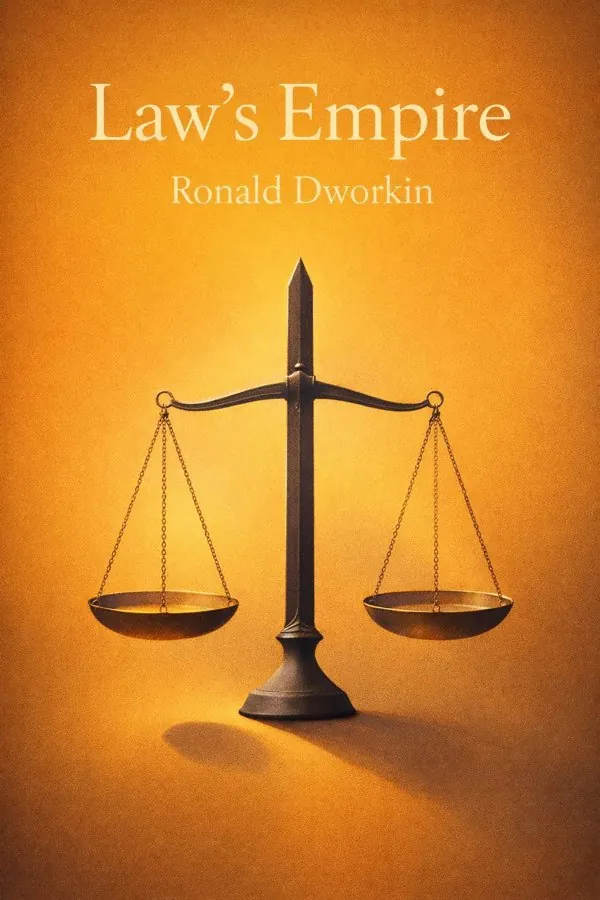
Law’s Empire: Summary & Key Insights
 10 min6 chaptersAudio available
What Is Law’s Empire About?
Law’s Empire by Ronald Dworkin is a law_crime book spanning 6 pages. In this influential work, Ronald Dworkin develops a comprehensive theory of law that challenges both legal positivism and natural law traditions. He argues that law is best understood as an interpretive practice grounded in moral principles, not merely as a system of rules. Dworkin introduces the concept of 'law as integrity,' asserting that judges should interpret legal materials in the best moral light possible, ensuring coherence and justice within the legal system.
This FizzRead summary covers all 6 key chapters of Law’s Empire in approximately 10 minutes, distilling the most important ideas, arguments, and takeaways from Ronald Dworkin's work. Also available as an audio summary and Key Quotes Podcast.
Law’s Empire
In this influential work, Ronald Dworkin develops a comprehensive theory of law that challenges both legal positivism and natural law traditions. He argues that law is best understood as an interpretive practice grounded in moral principles, not merely as a system of rules. Dworkin introduces the concept of 'law as integrity,' asserting that judges should interpret legal materials in the best moral light possible, ensuring coherence and justice within the legal system.
Who Should Read Law’s Empire?
This book is perfect for anyone interested in law_crime and looking to gain actionable insights in a short read. Whether you're a student, professional, or lifelong learner, the key ideas from Law’s Empire by Ronald Dworkin will help you think differently.
- ✓Readers who enjoy law_crime and want practical takeaways
- ✓Professionals looking to apply new ideas to their work and life
- ✓Anyone who wants the core insights of Law’s Empire in just 10 minutes
Want the full summary?
Get instant access to this book summary and 100K+ more with Fizz Moment.
Get Free SummaryAvailable on App Store • Free to download
Key Chapters
To begin, I must confront the most influential modern theory of law: H.L.A. Hart’s legal positivism. Hart’s model holds that a legal system is composed of primary rules (duties and obligations) and secondary rules (rules about how laws are created, recognized, and enforced). For positivists, what counts as “law” is determined by social sources—official acts like legislation or judicial decisions—not by moral reasoning. The validity of a rule depends on its pedigree, not its merit.
At first glance, this seems appealing. It grants law clarity and authority by rooting it in identifiable social facts. But upon closer examination, Hart’s model explains too little about what lawyers and judges actually do. When judges confront hard cases—those where no clear rule applies—they do not flip a coin or wait for Parliament to speak. They reason through principles that underlie and justify existing law. In other words, legal practice reveals that morality is already inside law, not outside it.
The positivist’s claim that law and morality are separate realms fails to honor our actual interpretive conduct. Law is not just a system of commands; it is an exercise in justification. When a judge decides a case, she interprets past legal decisions in their best moral light, explaining why they deserve continuing allegiance. That process—of interpreting, not merely applying—shows us what law truly is: an inherently moral enterprise, embedded in the ongoing story of a community trying to govern itself under principles of justice and fairness.
In *The Model of Rules* essays, I first introduced a distinction crucial to my later argument: the difference between rules and principles. Rules function in an all-or-nothing fashion. If the rule applies, it dictates a result. Principles, by contrast, have a dimension of weight—they express moral standards that guide judgment, even when no rule provides a clear answer.
This distinction matters because real legal reasoning often depends on principles that judges must balance and interpret. For instance, when courts invoke fairness, equality, or due process, they are not applying statutes verbatim. They are appealing to principles embedded within legal tradition. Such principles do not derive their authority from legislative enactment but from their moral power to justify the law as a whole.
By recognizing the role of principles, we can see that legal reasoning cannot be adequately explained by positivist models. Law extends beyond the mere sum of enacted rules; it includes the moral commitments that give those rules meaning. Understanding this interplay between principles and rules is the key to seeing legal reasoning as an interpretive process rather than a mechanical one.
+ 4 more chapters — available in the FizzRead app
All Chapters in Law’s Empire
About the Author
Ronald Dworkin (1931–2013) was an American legal philosopher and scholar of constitutional law. He served as Professor of Jurisprudence at University College London and as Frank Henry Sommer Professor of Law and Philosophy at New York University. Dworkin is widely regarded as one of the most important legal theorists of the 20th century, known for his works on legal interpretation, rights, and moral philosophy.
Get This Summary in Your Preferred Format
Read or listen to the Law’s Empire summary by Ronald Dworkin anytime, anywhere. FizzRead offers multiple formats so you can learn on your terms — all free.
Available formats: App · Audio · PDF · EPUB — All included free with FizzRead
Download Law’s Empire PDF and EPUB Summary
Key Quotes from Law’s Empire
“To begin, I must confront the most influential modern theory of law: H.”
“In *The Model of Rules* essays, I first introduced a distinction crucial to my later argument: the difference between rules and principles.”
Frequently Asked Questions about Law’s Empire
Law’s Empire by Ronald Dworkin is a law_crime book that explores key ideas across 6 chapters. In this influential work, Ronald Dworkin develops a comprehensive theory of law that challenges both legal positivism and natural law traditions. He argues that law is best understood as an interpretive practice grounded in moral principles, not merely as a system of rules. Dworkin introduces the concept of 'law as integrity,' asserting that judges should interpret legal materials in the best moral light possible, ensuring coherence and justice within the legal system.
You Might Also Like
Abortion and the Law in America: Roe v. Wade to the Present
Mary Ziegler
10 min
Black Edge: Inside Information, Dirty Money, and the Quest to Bring Down the Most Wanted Man on Wall Street
Sheelah Kolhatkar
10 min
Blood Feud: The Man Who Blew the Whistle on One of the Deadliest Prescription Drugs Ever
Kathleen Sharp
10 min
Catch and Kill: Lies, Spies, and a Conspiracy to Protect Predators
Ronan Farrow
10 min
Chaos: Charles Manson, the CIA, and the Secret History of the Sixties
Tom O'Neill with Dan Piepenbring
10 min
Code and Other Laws of Cyberspace
Lawrence Lessig
10 minBrowse by Category
Ready to read Law’s Empire?
Get the full summary and 100K+ more books with Fizz Moment.