
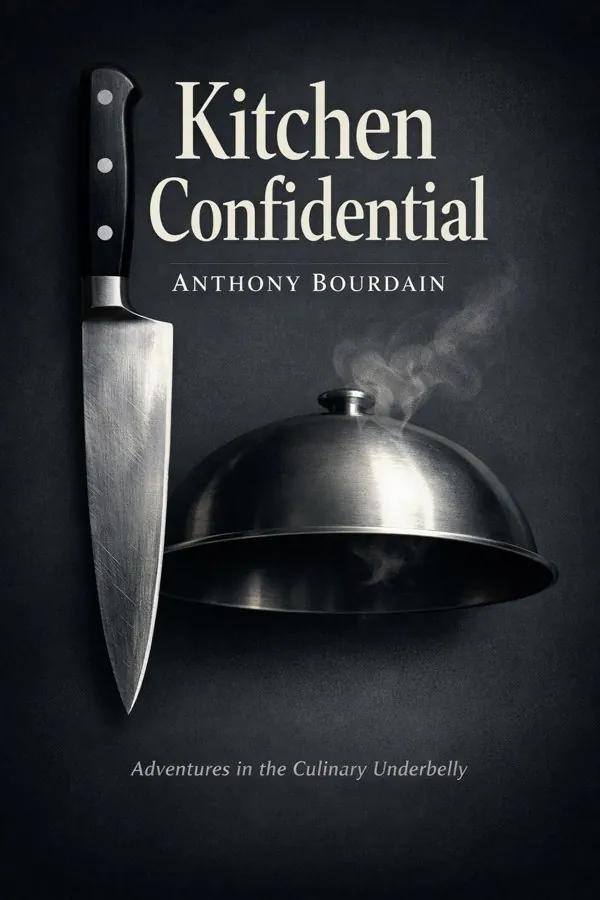
Kitchen Confidential: Adventures in the Culinary Underbelly: Summary & Key Insights
 10 min8 chaptersAudio available
Key Takeaways from Kitchen Confidential: Adventures in the Culinary Underbelly
A restaurant kitchen looks glamorous from the dining room, but from the inside it is closer to controlled warfare.
Pleasure on the plate often rests on pain behind the scenes.
Some of the most functional teams are made of people who look dysfunctional from the outside.
In Bourdain’s world, image is cheap and craft is everything.
The kitchen can feed ambition, but it can also feed self-destruction.
What Is Kitchen Confidential: Adventures in the Culinary Underbelly About?
Kitchen Confidential: Adventures in the Culinary Underbelly by Anthony Bourdain is a biographies book. Kitchen Confidential: Adventures in the Culinary Underbelly is Anthony Bourdain’s explosive memoir of restaurant life, a book that strips away the polished fantasy of fine dining and reveals the sweat, chaos, addiction, ambition, and dark humor behind the kitchen door. Part autobiography, part industry exposé, and part love letter to cooks, it takes readers deep into the world of professional kitchens, where long hours, razor-sharp hierarchies, and fierce camaraderie shape both the food and the people making it. Bourdain writes with the authority of someone who lived every layer of that life: from struggling line cook to executive chef, from reckless young addict to seasoned kitchen veteran. His storytelling is fast, brutal, funny, and startlingly honest, making the book as entertaining as it is revealing. More than a behind-the-scenes account of restaurants, Kitchen Confidential is a study of craft, obsession, identity, and survival. It matters because it changed how readers see chefs, food culture, and the hidden labor behind every plate placed on a table.
This FizzRead summary covers all 8 key chapters of Kitchen Confidential: Adventures in the Culinary Underbelly in approximately 10 minutes, distilling the most important ideas, arguments, and takeaways from Anthony Bourdain's work. Also available as an audio summary and Key Quotes Podcast.
Kitchen Confidential: Adventures in the Culinary Underbelly
Kitchen Confidential: Adventures in the Culinary Underbelly is Anthony Bourdain’s explosive memoir of restaurant life, a book that strips away the polished fantasy of fine dining and reveals the sweat, chaos, addiction, ambition, and dark humor behind the kitchen door. Part autobiography, part industry exposé, and part love letter to cooks, it takes readers deep into the world of professional kitchens, where long hours, razor-sharp hierarchies, and fierce camaraderie shape both the food and the people making it. Bourdain writes with the authority of someone who lived every layer of that life: from struggling line cook to executive chef, from reckless young addict to seasoned kitchen veteran. His storytelling is fast, brutal, funny, and startlingly honest, making the book as entertaining as it is revealing. More than a behind-the-scenes account of restaurants, Kitchen Confidential is a study of craft, obsession, identity, and survival. It matters because it changed how readers see chefs, food culture, and the hidden labor behind every plate placed on a table.
Who Should Read Kitchen Confidential: Adventures in the Culinary Underbelly?
This book is perfect for anyone interested in biographies and looking to gain actionable insights in a short read. Whether you're a student, professional, or lifelong learner, the key ideas from Kitchen Confidential: Adventures in the Culinary Underbelly by Anthony Bourdain will help you think differently.
- ✓Readers who enjoy biographies and want practical takeaways
- ✓Professionals looking to apply new ideas to their work and life
- ✓Anyone who wants the core insights of Kitchen Confidential: Adventures in the Culinary Underbelly in just 10 minutes
Want the full summary?
Get instant access to this book summary and 100K+ more with Fizz Moment.
Get Free SummaryAvailable on App Store • Free to download
Key Chapters
A restaurant kitchen looks glamorous from the dining room, but from the inside it is closer to controlled warfare. One of Bourdain’s most powerful insights is that great food often emerges from environments defined by pressure, heat, noise, urgency, and relentless discipline. Kitchens are not serene creative studios; they are systems built to produce excellence under impossible constraints. Every station, every prep list, every shouted command exists for a reason. If one person fails, the entire service can collapse.
Bourdain shows how the kitchen operates as a brutal meritocracy. Talent matters, but consistency matters more. A flashy cook who breaks under pressure is less valuable than a disciplined one who can execute perfectly on the busiest night of the week. This idea extends beyond cooking. In any high-stakes field, success depends on repeatable processes, teamwork, and calm under stress, not just inspiration.
He also explains why kitchen culture often appears harsh to outsiders. The speed of service leaves little room for politeness or hesitation. Communication must be clear and immediate. In that environment, respect is earned through reliability, stamina, and competence. The lesson is not that abuse is admirable, but that high-performance systems demand structure and accountability.
For readers, this insight changes how restaurants are perceived. The plate arriving at a table is the visible result of an invisible machine made of timing, hierarchy, and sacrifice. Understanding that can deepen appreciation for any skilled profession where the final product hides the complexity behind it.
Actionable takeaway: In your own work, identify where chaos is hurting performance and replace it with clearer roles, stronger routines, and dependable execution under pressure.
Pleasure on the plate often rests on pain behind the scenes. Bourdain makes clear that the restaurant industry depends on exhausting labor that diners rarely see: punishing shifts, burned hands, aching backs, missed holidays, emotional strain, and razor-thin margins. The glamour associated with chefs is deeply misleading. Before culinary celebrity culture, most cooks were anonymous workers driven by endurance as much as artistry.
What makes this observation so compelling is Bourdain’s refusal to romanticize suffering while still acknowledging the pride that comes with surviving it. The kitchen becomes a place where people discover what they can withstand. There is meaning in showing up, preparing relentlessly, and delivering under pressure, even when the work is physically and mentally brutal.
This idea has practical relevance beyond restaurants. Many industries mask the labor behind consumer convenience. We admire outcomes while ignoring the systems and people required to create them. Bourdain invites readers to look beyond polished surfaces and ask: who is doing the hard work, under what conditions, and at what cost?
He also helps readers understand why kitchen workers often form unusually tight bonds. Shared hardship creates loyalty. People who survive dinner service together develop trust the way soldiers, athletes, or emergency teams might. That camaraderie is part of what keeps people in a difficult profession.
For diners, the insight encourages more respect for restaurant workers. For professionals in any field, it is a reminder that mastery usually includes a long period of invisible toil. Success is often built in the hours no one applauds.
Actionable takeaway: The next time you admire an excellent result, pause to recognize the hidden labor behind it and bring more gratitude, fairness, and realism into how you value work.
Some of the most functional teams are made of people who look dysfunctional from the outside. Bourdain celebrates the kitchen as a refuge for outsiders: immigrants, addicts in recovery, drifters, rebels, eccentrics, and people who never fit conventional expectations. In the kitchen, social polish matters less than usefulness. If you can cook, move fast, stay focused, and hold your station, you belong.
This is one of the book’s most humane ideas. Bourdain does not present kitchens merely as hard workplaces but as communities where broken, difficult, or unconventional people can find purpose. The line cook with a rough past may still be a genius on sauté. The tattooed dishwasher who barely speaks may become indispensable. In this world, competence becomes a path to dignity.
There is a broader leadership lesson here. Strong teams are not always built from people with perfect résumés or smooth personalities. They are built from people whose strengths fit the mission. Great managers learn to recognize ability in unexpected forms. They create systems where contribution matters more than appearance.
Bourdain also reveals that diversity in kitchens is practical, not abstract. Different backgrounds bring resilience, techniques, speed, humor, and perspective. What unites the team is not similarity but shared standards and mutual dependence.
For readers, this insight challenges narrow ideas of professionalism. It suggests that workplaces become stronger when they focus on reliability, skill, and commitment rather than superficial conformity. Belonging should be earned through contribution, not style.
Actionable takeaway: Look more carefully at the overlooked people in your environment; talent often hides in unconventional packaging, and inclusive standards can unlock exceptional performance.
In Bourdain’s world, image is cheap and craft is everything. Long before food media turned chefs into celebrities, he understood that the real measure of a cook is not charisma, branding, or trendiness but execution. Can you butcher fish properly? Can you make stock correctly? Can you organize a station, rescue a bad service, and send out consistent plates all night? Technique, not performance, earns respect in the kitchen.
This idea gives the book lasting value. Bourdain exposes how easy it is for industries to confuse appearance with competence. In restaurants, stylish menus, elegant dining rooms, and polished public personas can hide weak fundamentals. The same is true in business, art, and leadership. The person who looks impressive is not always the person who can actually do the work.
He repeatedly returns to the importance of repetition. Great cooking is not just creativity; it is the mastery of basics until they become instinctive. Sharpening knives, breaking down ingredients, controlling heat, timing courses, tasting constantly, and cleaning thoroughly are not glamorous tasks, but they are what produce excellence.
For aspiring cooks, this is practical advice: learn the fundamentals before chasing originality. For everyone else, it is a warning against being seduced by surface-level sophistication. Real expertise usually looks less dramatic than people expect.
Bourdain’s respect for craftsmen also gives dignity to manual skill. In a culture that often overvalues abstract strategy and undervalues physical expertise, Kitchen Confidential reminds readers that skilled labor is intellectual, artistic, and disciplined.
Actionable takeaway: Whatever your field, invest in the boring fundamentals first; durable credibility comes from repeated competence, not from looking impressive.
The kitchen can feed ambition, but it can also feed self-destruction. One of the darkest and most honest themes in Kitchen Confidential is Bourdain’s account of addiction, excess, ego, and the seductive danger of living at full throttle. Drugs, alcohol, adrenaline, and late-night intensity become woven into the culture of many restaurants, especially in the eras Bourdain describes. The same environment that rewards stamina and fearlessness can normalize recklessness.
What makes this theme important is Bourdain’s refusal to glamorize it, even when he writes with swagger and humor. He understands the appeal of excess because he lived it, but he also shows the cost: damaged health, unstable relationships, wasted talent, and careers derailed by chaos. Passion without boundaries can become self-sabotage.
This lesson reaches far beyond food. Many competitive professions reward people for overextending themselves. Workaholism, substance dependence, ego inflation, and burnout often masquerade as commitment. People celebrate intensity until it begins to destroy judgment, consistency, and character.
Bourdain’s story suggests that survival requires maturation. At some point, raw appetite must give way to discipline. Talent alone is not enough; longevity depends on knowing when to stop, what to refuse, and how to separate identity from self-destruction.
For readers, this is both cautionary and compassionate. Ambitious people often believe they must live recklessly to create extraordinary work. Bourdain shows that while excess may feel exciting, it rarely builds a sustainable life.
Actionable takeaway: Audit the habits your environment rewards and ask which ones truly support excellence versus which ones quietly erode your health, relationships, and long-term potential.
Once you know how the kitchen works, you can never dine in the same way again. A major contribution of Bourdain’s book is its raw honesty about restaurant practices, ingredient quality, staffing realities, and the gap between dining-room illusion and kitchen reality. He made readers more aware consumers by telling them what insiders know: which menu items are often risky, how freshness can be misrepresented, and why certain days or dishes should inspire caution.
This is not just gossip. It is an argument for informed consumption. Bourdain believed diners should understand what they are paying for and how the system actually functions. Transparency creates better choices. Readers become more alert to quality, labor, sourcing, and credibility. They learn to distinguish between genuine care and empty presentation.
The broader lesson is powerful. In every industry, consumers benefit when insiders tell the truth. Whether the topic is food, finance, education, or technology, honest information reduces manipulation and raises standards. Systems improve when their hidden assumptions are exposed.
At the same time, Bourdain avoids turning awareness into snobbery. The goal is not to make readers paranoid or superior; it is to make them attentive. Better diners ask smarter questions, appreciate expertise, and reward places that take pride in doing things well.
This insight also reinforces the value of firsthand knowledge. Bourdain writes not as a theorist but as a practitioner, and that credibility changes the impact of his advice. Truth resonates more deeply when it comes from lived experience.
Actionable takeaway: Be a more informed consumer by asking how products are made, who makes them, and what hidden realities might sit behind polished marketing.
Wanting to be great is not enough; you must also learn what greatness requires. Bourdain’s memoir tracks his journey from young ego and restless appetite toward a more seasoned understanding of work, leadership, and self-respect. Early ambition can be theatrical. It imagines glory, rebellion, and mastery without fully grasping the discipline involved. Over time, Bourdain learns that competence is quieter, leadership is more demanding, and authority must be earned daily.
This maturation arc gives the book emotional depth. Kitchen Confidential is not simply a string of wild stories. It is also the account of a person coming to terms with his profession and with himself. Bourdain gradually recognizes that being a chef means more than cooking well. It means building systems, managing personalities, taking responsibility, and maintaining standards when no one is watching.
That evolution offers a practical model for readers in many fields. Early career ambition often focuses on identity: I want to be seen as talented, important, original. Mature ambition focuses on service: Can I deliver? Can I improve a team? Can I create something dependable and meaningful? Humility makes that transition possible because it allows a person to keep learning.
Bourdain never becomes sentimental about professionalism, but he does become more honest about what it costs and what it demands. He learns to respect consistency over fantasy and responsibility over pose.
For anyone pursuing mastery, this idea is essential. Big dreams matter, but dreams without humility produce frustration. Growth begins when ambition stops performing and starts practicing.
Actionable takeaway: Reframe your goals from being recognized as excellent to becoming useful, reliable, and continuously teachable in the work you do.
A meal is never just a meal. Beneath Bourdain’s profanity, wit, and kitchen gossip lies a deeper understanding: food expresses culture, status, desire, memory, and personal identity. In Kitchen Confidential, cooking is not only labor or art but also a language through which people reveal what they value. Restaurant choices signal aspiration. Kitchen traditions preserve old worlds. The meals people crave often connect them to childhood, longing, or belonging.
Bourdain’s own life reflects this. His obsession with food becomes a way of constructing selfhood. The kitchen gives him purpose, tribe, and narrative. It tells him who he is when other parts of life feel unstable. That helps explain the emotional intensity of restaurant work. For cooks, food is not just product; it is personal.
This insight broadens the book beyond memoir. It helps readers understand why dining can feel so charged. A restaurant experience involves taste, but also trust, identity, and fantasy. People are not simply buying calories. They are buying atmosphere, memory, status, comfort, and meaning.
The practical application is to treat food with more attention and less triviality. The meals we cook, buy, and share shape relationships and habits. They reveal priorities. Families build rituals around food. Businesses build brands around it. Communities preserve identity through it.
Bourdain’s deeper gift is showing that the world of food deserves serious attention because it touches nearly every dimension of life: economics, art, migration, class, pleasure, and labor.
Actionable takeaway: Pay closer attention to your own food choices and rituals; they may reveal more about your values, identity, and emotional life than you realize.
All Chapters in Kitchen Confidential: Adventures in the Culinary Underbelly
About the Author
Anthony Bourdain was an American chef, memoirist, and television host whose work transformed how millions of people think about food, travel, and culture. Born in New York City in 1956, he trained at the Culinary Institute of America and spent years working in demanding restaurant kitchens, eventually becoming executive chef at Brasserie Les Halles in Manhattan. His breakout memoir, Kitchen Confidential, brought him international recognition for its fearless honesty, dark humor, and insider perspective on the culinary world. Bourdain later became a celebrated storyteller on television through programs such as No Reservations and Parts Unknown, where he explored global cultures through meals and conversation. He was widely admired for his curiosity, empathy, and ability to connect food with history, politics, and everyday human life.
Get This Summary in Your Preferred Format
Read or listen to the Kitchen Confidential: Adventures in the Culinary Underbelly summary by Anthony Bourdain anytime, anywhere. FizzRead offers multiple formats so you can learn on your terms — all free.
Available formats: App · Audio · PDF · EPUB — All included free with FizzRead
Download Kitchen Confidential: Adventures in the Culinary Underbelly PDF and EPUB Summary
Key Quotes from Kitchen Confidential: Adventures in the Culinary Underbelly
“A restaurant kitchen looks glamorous from the dining room, but from the inside it is closer to controlled warfare.”
“Pleasure on the plate often rests on pain behind the scenes.”
“Some of the most functional teams are made of people who look dysfunctional from the outside.”
“In Bourdain’s world, image is cheap and craft is everything.”
“The kitchen can feed ambition, but it can also feed self-destruction.”
Frequently Asked Questions about Kitchen Confidential: Adventures in the Culinary Underbelly
Kitchen Confidential: Adventures in the Culinary Underbelly by Anthony Bourdain is a biographies book that explores key ideas across 8 chapters. Kitchen Confidential: Adventures in the Culinary Underbelly is Anthony Bourdain’s explosive memoir of restaurant life, a book that strips away the polished fantasy of fine dining and reveals the sweat, chaos, addiction, ambition, and dark humor behind the kitchen door. Part autobiography, part industry exposé, and part love letter to cooks, it takes readers deep into the world of professional kitchens, where long hours, razor-sharp hierarchies, and fierce camaraderie shape both the food and the people making it. Bourdain writes with the authority of someone who lived every layer of that life: from struggling line cook to executive chef, from reckless young addict to seasoned kitchen veteran. His storytelling is fast, brutal, funny, and startlingly honest, making the book as entertaining as it is revealing. More than a behind-the-scenes account of restaurants, Kitchen Confidential is a study of craft, obsession, identity, and survival. It matters because it changed how readers see chefs, food culture, and the hidden labor behind every plate placed on a table.
You Might Also Like

An American Marriage
Tayari Jones
10 min
Benjamin Franklin: An American Life
Walter Isaacson
10 min
I Know Why The Caged Bird Sings
Maya Angelou
10 min
Long Walk to Freedom
Nelson Mandela
10 min
Persepolis
Marjane Satrapi
10 min
Surely You're Joking, Mr. Feynman!
Richard P. Feynman
10 minBrowse by Category
Ready to read Kitchen Confidential: Adventures in the Culinary Underbelly?
Get the full summary and 100K+ more books with Fizz Moment.