
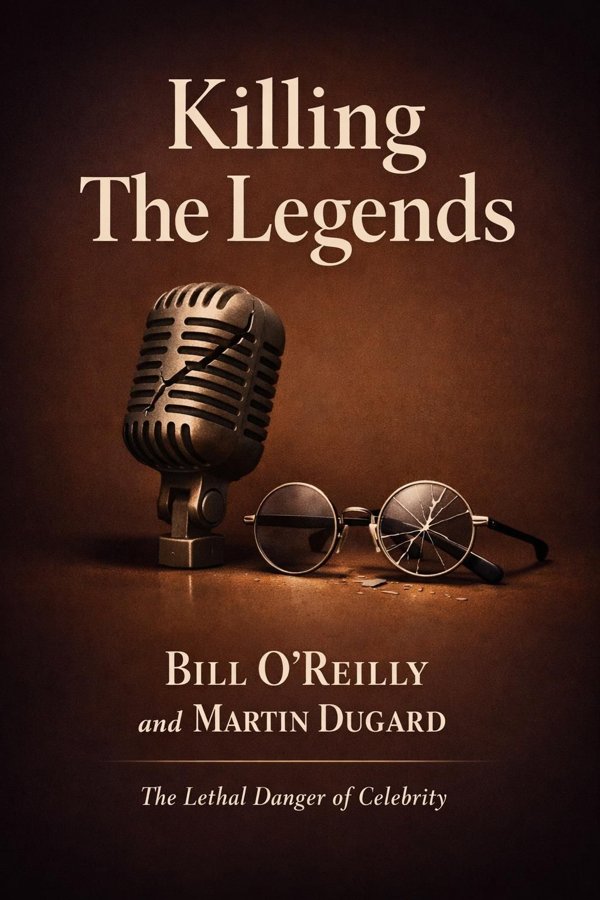
Killing The Legends: The Lethal Danger of Celebrity: Summary & Key Insights
by Bill O'Reilly, Martin Dugard
 10 min4 chaptersAudio available
What Is Killing The Legends: The Lethal Danger of Celebrity About?
Killing The Legends: The Lethal Danger of Celebrity by Bill O'Reilly and Martin Dugard is a biographies book spanning 4 pages. In this installment of the bestselling Killing series, Bill O'Reilly and Martin Dugard explore the tragic fates of three cultural icons—Elvis Presley, John Lennon, and Muhammad Ali—whose fame brought both glory and destruction. The book examines how the pressures of celebrity and public adoration contributed to their downfall, offering a compelling narrative of fame, isolation, and mortality.
This FizzRead summary covers all 4 key chapters of Killing The Legends: The Lethal Danger of Celebrity in approximately 10 minutes, distilling the most important ideas, arguments, and takeaways from Bill O'Reilly and Martin Dugard's work. Also available as an audio summary and Key Quotes Podcast.
Killing The Legends: The Lethal Danger of Celebrity
In this installment of the bestselling Killing series, Bill O'Reilly and Martin Dugard explore the tragic fates of three cultural icons—Elvis Presley, John Lennon, and Muhammad Ali—whose fame brought both glory and destruction. The book examines how the pressures of celebrity and public adoration contributed to their downfall, offering a compelling narrative of fame, isolation, and mortality.
Who Should Read Killing The Legends: The Lethal Danger of Celebrity?
This book is perfect for anyone interested in biographies and looking to gain actionable insights in a short read. Whether you're a student, professional, or lifelong learner, the key ideas from Killing The Legends: The Lethal Danger of Celebrity by Bill O'Reilly and Martin Dugard will help you think differently.
- ✓Readers who enjoy biographies and want practical takeaways
- ✓Professionals looking to apply new ideas to their work and life
- ✓Anyone who wants the core insights of Killing The Legends: The Lethal Danger of Celebrity in just 10 minutes
Want the full summary?
Get instant access to this book summary and 100K+ more with Fizz Moment.
Get Free SummaryAvailable on App Store • Free to download
Key Chapters
Elvis Presley’s story begins with a dream that seemed to embody all the promise of American ambition. A poor boy from Tupelo, Mississippi, he grew up surrounded by gospel music and poverty, a gentle spirit raised by a devoted mother and a father who did his best to keep the family afloat. His voice and stage presence were electrifying, not just for their technical brilliance but for the emotional rawness they carried. When Elvis exploded onto the music scene in the 1950s, he bridged racial and cultural divides, bringing rhythm and blues to a mainstream audience that had never truly heard it before.
Yet, in that extraordinary ascent, the foundation was laid for his eventual isolation. Fame arrived like a tidal wave. The cameras, fans, and handlers created a kingdom around him, but one in which Elvis was less a ruler than a captive. As Martin Dugard and I chronicle, the people who surrounded Elvis were not always friends—they were caretakers of the money machine. Colonel Tom Parker, his manager, controlled every move, every appearance, every business decision, until Presley became a product, a brand, not a man. The King of Rock ’n’ Roll found himself locked inside Graceland, insulated from reality and clinging to the myth others had built around him.
We describe how Elvis’s creative spirit began to suffocate under commercial pressure. Hollywood demanded lighthearted musicals instead of the edgy music that first ignited his passion. His dangerous sex appeal was slowly sanitized for mass audiences, and with every compromise, his self-worth eroded. The drugs came next—first stimulants to handle grueling schedules, then narcotics to escape the emptiness of celebrity. The Graceland mansion became both sanctuary and prison, filled with entourage members who enabled his decline rather than resisting it.
By the time of his death in 1977, Elvis was a man broken not by lack of success but by overexposure. The legend demanded perpetual performance, even when there was nothing left to give. His bloated figure, dulled expression, and failing health were visible signs of what happens when the human behind the myth is lost. In the end, the King died not from a single mistake but from a system designed to consume him. His story reminds us that the higher fame lifts a man, the more devastating the fall when he cannot escape its gravity.
John Lennon’s life, as we narrate it, was the story of a visionary forever wrestling with the burden of his own influence. From his beginnings in Liverpool—a rebellious youth with a sharp wit and deep insecurities—Lennon sought meaning through music. When The Beatles formed, he found creative completion in partnership with Paul McCartney, generating art that reshaped global culture. Their songs weren’t just melodies but movements—expressions of youth’s desire to overturn the status quo.
But fame has its corrosion. The Beatles became not simply musicians but cultural deities. Lennon, sharp-tongued and introspective, began to feel swallowed by the identity others projected onto him. Even before the band’s breakup, he sensed the weight of artificial adoration pressing against his individuality. His famous remark that The Beatles were “more popular than Jesus” captured both his discomfort and his insight into public obsession. The backlash was fierce, yet it exposed something vital: Lennon understood that celebrity distorts faith—it replaces spirituality with spectacle.
After The Beatles disbanded, Lennon seemed intent on reclaiming his humanity. His partnership with Yoko Ono was an attempt at rebirth, turning his life into art and activism. He became a global symbol for peace and defiance, speaking out against war and conformity. But even as he tried to retreat, the world refused to let go. The New York years were paradoxical—moments of renewal shadowed by paranoia and longing. Fame had become a cage he could never fully dismantle.
As we write in the book, Lennon's tragedy was that the world admired his authenticity but wouldn’t allow him privacy. Every attempt at normal life was met with intrusion—from tabloids, fanatics, and the mythic expectations of millions. His assassination in 1980 outside the Dakota building was not merely an act of madness; it symbolized the fatal intimacy between icon and audience. The man who preached peace was killed by one who claimed to love him. The danger of celebrity here reached its purest form: when adoration turns to possession, when the fan believes he owns the legend.
Lennon’s story stands as a haunting mirror to modern fame. He had tried to redefine it, to use celebrity as a platform for truth, but the machinery was too powerful. His legacy endures, yet his death reminds us that public fascination can destroy even the most self-aware visionary. The lethal danger of celebrity is not only exploitation—it is obsession, the inability of society to separate admiration from ownership.
+ 2 more chapters — available in the FizzRead app
All Chapters in Killing The Legends: The Lethal Danger of Celebrity
About the Authors
Bill O'Reilly is an American journalist, television host, and author known for his political commentary and the bestselling Killing series. Martin Dugard is an American historian and author who has collaborated with O'Reilly on multiple historical works.
Get This Summary in Your Preferred Format
Read or listen to the Killing The Legends: The Lethal Danger of Celebrity summary by Bill O'Reilly and Martin Dugard anytime, anywhere. FizzRead offers multiple formats so you can learn on your terms — all free.
Available formats: App · Audio · PDF · EPUB — All included free with FizzRead
Download Killing The Legends: The Lethal Danger of Celebrity PDF and EPUB Summary
Key Quotes from Killing The Legends: The Lethal Danger of Celebrity
“Elvis Presley’s story begins with a dream that seemed to embody all the promise of American ambition.”
“John Lennon’s life, as we narrate it, was the story of a visionary forever wrestling with the burden of his own influence.”
Frequently Asked Questions about Killing The Legends: The Lethal Danger of Celebrity
Killing The Legends: The Lethal Danger of Celebrity by Bill O'Reilly and Martin Dugard is a biographies book that explores key ideas across 4 chapters. In this installment of the bestselling Killing series, Bill O'Reilly and Martin Dugard explore the tragic fates of three cultural icons—Elvis Presley, John Lennon, and Muhammad Ali—whose fame brought both glory and destruction. The book examines how the pressures of celebrity and public adoration contributed to their downfall, offering a compelling narrative of fame, isolation, and mortality.
You Might Also Like

An American Marriage
Tayari Jones
10 min
Benjamin Franklin: An American Life
Walter Isaacson
10 min
I Know Why The Caged Bird Sings
Maya Angelou
10 min
Long Walk to Freedom
Nelson Mandela
10 min
Persepolis
Marjane Satrapi
10 min
Surely You're Joking, Mr. Feynman!
Richard P. Feynman
10 minBrowse by Category
Ready to read Killing The Legends: The Lethal Danger of Celebrity?
Get the full summary and 100K+ more books with Fizz Moment.