
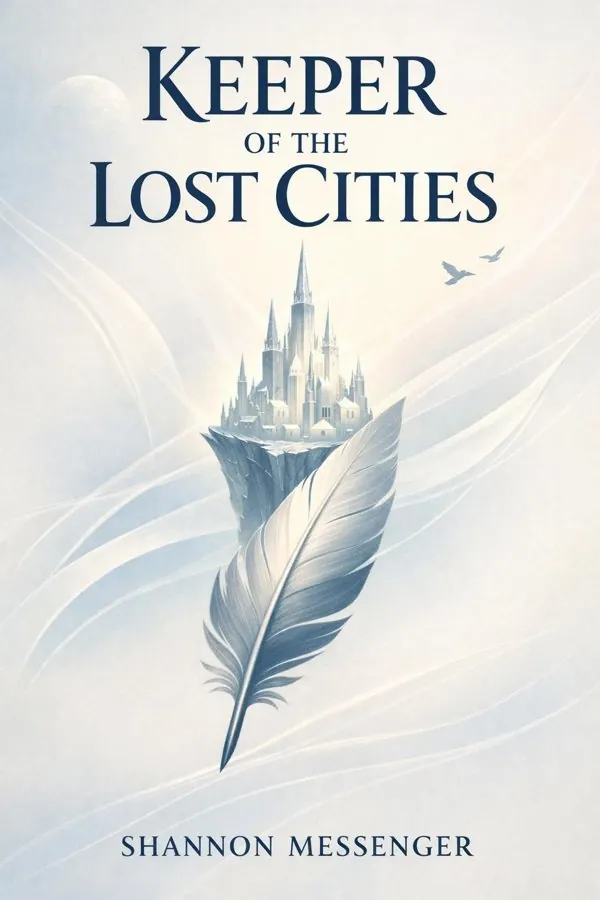
Keeper of the Lost Cities: Summary & Key Insights
 10 min8 chaptersAudio available
Key Takeaways from Keeper of the Lost Cities
The traits that make us feel most isolated are often the first clues to who we really are.
Beautiful worlds in fantasy often hide difficult truths, and that tension makes them feel real.
What we cannot remember can shape us as strongly as what we know.
Destiny may open a door, but character is revealed by what someone does after walking through it.
In the best fantasy stories, friendship is not a side benefit of adventure; it is the reason the adventure can be survived at all.
What Is Keeper of the Lost Cities About?
Keeper of the Lost Cities by Shannon Messenger is a scifi_fantasy book spanning 4 pages. What if the thing that makes you feel most alone is actually proof that you belong somewhere extraordinary? In Keeper of the Lost Cities, Shannon Messenger begins with that powerful question and turns it into a fast-moving fantasy adventure about identity, belonging, and hidden power. The novel follows Sophie Foster, a twelve-year-old prodigy who has never fit neatly into the human world. Her secret ability to hear other people’s thoughts has made ordinary life exhausting, confusing, and isolating. Then she meets Fitz, a mysterious boy who reveals that Sophie is not human at all, but an elf from a secret world hidden beyond human sight. Swept into the dazzling Lost Cities, Sophie must adapt to a new life filled with telepathy, advanced magic-like technology, dangerous secrets, and the unsettling truth that her past has been deliberately concealed. Messenger, best known for creating one of modern middle-grade fantasy’s most beloved series, combines emotional realism with imaginative worldbuilding. The result is a story that matters not only because it is exciting and inventive, but because it captures the universal fear of being different and transforms it into a celebration of courage, friendship, and self-discovery.
This FizzRead summary covers all 8 key chapters of Keeper of the Lost Cities in approximately 10 minutes, distilling the most important ideas, arguments, and takeaways from Shannon Messenger's work. Also available as an audio summary and Key Quotes Podcast.
Keeper of the Lost Cities
What if the thing that makes you feel most alone is actually proof that you belong somewhere extraordinary? In Keeper of the Lost Cities, Shannon Messenger begins with that powerful question and turns it into a fast-moving fantasy adventure about identity, belonging, and hidden power. The novel follows Sophie Foster, a twelve-year-old prodigy who has never fit neatly into the human world. Her secret ability to hear other people’s thoughts has made ordinary life exhausting, confusing, and isolating. Then she meets Fitz, a mysterious boy who reveals that Sophie is not human at all, but an elf from a secret world hidden beyond human sight. Swept into the dazzling Lost Cities, Sophie must adapt to a new life filled with telepathy, advanced magic-like technology, dangerous secrets, and the unsettling truth that her past has been deliberately concealed. Messenger, best known for creating one of modern middle-grade fantasy’s most beloved series, combines emotional realism with imaginative worldbuilding. The result is a story that matters not only because it is exciting and inventive, but because it captures the universal fear of being different and transforms it into a celebration of courage, friendship, and self-discovery.
Who Should Read Keeper of the Lost Cities?
This book is perfect for anyone interested in scifi_fantasy and looking to gain actionable insights in a short read. Whether you're a student, professional, or lifelong learner, the key ideas from Keeper of the Lost Cities by Shannon Messenger will help you think differently.
- ✓Readers who enjoy scifi_fantasy and want practical takeaways
- ✓Professionals looking to apply new ideas to their work and life
- ✓Anyone who wants the core insights of Keeper of the Lost Cities in just 10 minutes
Want the full summary?
Get instant access to this book summary and 100K+ more with Fizz Moment.
Get Free SummaryAvailable on App Store • Free to download
Key Chapters
The traits that make us feel most isolated are often the first clues to who we really are. That idea sits at the heart of Sophie Foster’s introduction. At twelve, Sophie already appears unusual: she is academically advanced, skipped grades, and understands the world at a level far beyond her peers. But her real burden is telepathy. She can hear the thoughts of everyone around her, and instead of feeling gifted, she feels trapped by noise, secrecy, and constant overstimulation. Her life in the human world is not simply awkward; it is emotionally exhausting because she has no framework for understanding herself.
This is what gives the opening of Keeper of the Lost Cities its emotional force. Messenger does not present Sophie’s talent as instantly empowering. First, it is a source of alienation. Sophie cannot fully trust normal appearances because she hears what people really think. She cannot fully relax because she is always processing more information than anyone else. Her difference creates distance between herself and her family, classmates, and teachers, even when they care about her.
That makes Fitz’s arrival so important. He does not merely reveal a magical secret; he reframes Sophie’s entire identity. What she thought was a flaw is evidence that she belongs to another world. In practical terms, this mirrors a common human experience: many people spend years believing their sensitivity, intensity, intelligence, or unconventional perspective is a problem before discovering it has meaning and value in the right environment.
Readers can apply this insight by reexamining what feels "wrong" about them. Instead of asking, "Why don’t I fit here?" it can be more useful to ask, "What kind of place, work, friendship, or purpose would make this trait an advantage?" Sophie’s first lesson is not that she must change to belong, but that she must find the truth about herself. Actionable takeaway: identify one trait you usually treat as a weakness and write down two situations where it could become a strength.
Beautiful worlds in fantasy often hide difficult truths, and that tension makes them feel real. When Sophie enters the Lost Cities, she does not simply step into a prettier version of life. She enters a carefully designed civilization of breathtaking landscapes, advanced abilities, and elegant order. There are crystal cities, hidden pathways, luminous architecture, and a culture that seems far more sophisticated than the human world she left behind. At first glance, it looks like a dream fulfilled.
But Messenger is too thoughtful a storyteller to leave it there. The Lost Cities quickly reveal that perfection can be intimidating, exclusionary, and morally complicated. Sophie does not instantly feel at home. She faces unfamiliar rules, social expectations, and standards she never had the chance to prepare for. Her new world values talent and lineage, but it also judges difference. The setting becomes more than a magical backdrop; it becomes a test of whether apparent utopia is truly kind.
This idea matters because many transitions in real life work the same way. A prestigious school, a new city, a dream job, or an admired community may look ideal from the outside, but entering it often exposes hidden pressures. Sophie’s experience reminds readers that belonging is not guaranteed by beauty or status. A dazzling environment can still make someone feel uncertain and small.
Messenger also uses the Lost Cities to expand the imagination of younger readers. Fantasy here is not random spectacle. It is structured, sensory, and socially meaningful. Every marvel comes with a question: who benefits from this system, and who gets left out? That is what gives the world depth.
The practical application is simple but powerful: whenever you encounter an environment that seems perfect, look past appearances and ask what values hold it together. Actionable takeaway: think of a school, workplace, or group you admire, and list both its visible strengths and its possible hidden costs before deciding it represents the whole truth.
What we cannot remember can shape us as strongly as what we know. One of the most compelling threads in Keeper of the Lost Cities is the mystery surrounding Sophie’s past. She learns that crucial parts of her life were engineered, hidden, or altered, and that the people connected to her origins may have acted out of protection, strategy, or something more ambiguous. The result is a story where memory is not just personal history; it is a battleground over identity and control.
The Black Swan, the secretive group linked to Sophie’s past, introduces moral complexity into the novel. They are not easy villains or obvious heroes. Instead, they represent the uncomfortable reality that people sometimes make enormous decisions for others while claiming it is necessary for a greater good. Sophie’s confusion becomes the reader’s confusion: if someone hides the truth to protect you, is that care, manipulation, or both?
This theme resonates beyond fantasy. Families, institutions, and societies all shape the stories people tell about themselves. Sometimes key facts are withheld because adults think children are not ready. Sometimes organizations keep information secret in the name of order. Sometimes people edit their own memories to survive. Messenger translates these dynamics into an accessible fantasy mystery for younger readers.
Sophie’s struggle also reveals an important developmental truth: growing up often means reclaiming authorship of your own story. She cannot move forward until she starts asking difficult questions about why her life was designed the way it was. Rather than passively accepting what others say is best, she begins testing motives, gathering evidence, and trusting her own judgment.
Readers can apply this idea by noticing where their identity has been defined for them by others. Which beliefs about yourself come from direct experience, and which were handed to you? Actionable takeaway: choose one assumption you hold about your past or personality and ask where it came from, whether it is fully true, and what new evidence might reshape it.
Destiny may open a door, but character is revealed by what someone does after walking through it. Sophie’s journey is not meaningful simply because she is special. Many fantasy stories begin with a hidden chosen one, but Keeper of the Lost Cities gains its emotional depth from showing that extraordinary ability does not automatically create wisdom or courage. Sophie becomes significant because she keeps choosing to engage, to care, and to act even when she is frightened or uncertain.
The idea of becoming a "keeper" is larger than any title. It suggests responsibility: keeping secrets, keeping faith, keeping others safe, and keeping hold of oneself when the world becomes disorienting. Sophie does not have all the answers. She makes mistakes, reacts emotionally, and struggles with trust. Yet she repeatedly moves toward the truth instead of away from it. That forward motion is what makes her admirable.
This matters because readers, especially younger ones, often receive mixed messages about greatness. They may think they must already know who they are before they can be brave, or that confidence must come before action. Messenger suggests the opposite. Sophie grows because she acts before she feels fully ready. She asks questions, forms alliances, learns new skills, and risks embarrassment or failure in order to protect what matters.
In everyday life, this is how growth usually works. Students become leaders by volunteering before they feel polished. Friends become dependable by showing up in difficult moments. People build self-respect not by waiting to feel certain, but by practicing courage in small decisions.
The novel therefore reframes identity as something built through choice. Sophie’s future is influenced by secrets around her, but it is not completely defined by them. Actionable takeaway: pick one area where you feel unprepared and take a small concrete step anyway, because confidence often follows commitment rather than preceding it.
In the best fantasy stories, friendship is not a side benefit of adventure; it is the reason the adventure can be survived at all. Sophie’s transition into the elvin world would be unbearable without the relationships she begins to form there. Characters like Fitz and Dex do more than add humor, warmth, or intrigue. They help Sophie interpret a confusing society, test her assumptions, and endure moments of fear and humiliation. Friendship becomes a form of orientation.
Messenger portrays this especially well because Sophie does not enter the Lost Cities as an instantly beloved hero. She is new, unusual, and surrounded by people who know the rules she does not. That imbalance creates vulnerability. In that context, even small acts of kindness matter. A person who explains a custom, offers support after embarrassment, or believes you when you are doubted can radically alter your ability to keep going.
This idea has practical power beyond the novel. During any major transition, people often focus on mastering systems: understanding the schedule, learning the material, figuring out expectations. But emotional survival often depends just as much on finding trustworthy allies. A new school, workplace, neighborhood, or life stage becomes manageable when someone says, in effect, "You are not facing this alone."
The book also reminds readers that friendship is not effortless sameness. Sophie’s bonds are shaped by difference, misunderstanding, and gradual trust. Real friendships work that way too. They deepen through shared uncertainty, not just shared fun.
For younger readers, this is an especially valuable message. It teaches that asking for help is not weakness and that being the person who offers help can be quietly heroic. Actionable takeaway: during your next stressful transition, identify one person you can reach out to for guidance and one person you can encourage in return, because strong communities are built through mutual support.
A gift becomes dangerous when no one asks how it should be used. Keeper of the Lost Cities is full of impressive abilities, especially telepathy, but Messenger wisely refuses to treat power as simple wish fulfillment. Sophie’s mind-reading skill gives her access to knowledge other people cannot reach, yet that access raises immediate ethical problems. What does privacy mean when thoughts can be heard? How do trust, consent, and honesty function when one person can know more than others realize?
These questions help elevate the book beyond a straightforward magical adventure. Sophie’s telepathy is thrilling, but it is also intrusive, destabilizing, and morally complicated. She must learn restraint as much as technique. The same applies to the wider elvin world, where extraordinary talents are common and social systems depend on how responsibly those talents are managed.
This theme mirrors real life more closely than it may first appear. Modern forms of power often involve information rather than magic. Technology, social media, surveillance, academic knowledge, or leadership positions all give people access and influence. The important question is not merely whether someone can do something, but whether they should, when, and under what boundaries.
Messenger’s treatment of power offers younger readers an accessible ethical framework. Ability is not the same as maturity. Talent without empathy can become domination. Knowledge without humility can become harm. Sophie’s path requires her to develop conscience alongside capability.
That makes the novel especially useful for readers navigating achievement and responsibility. Being smart, gifted, or unusually perceptive does not exempt a person from respecting others. In fact, it increases that obligation.
Actionable takeaway: if you hold any advantage, such as insight, skill, authority, or access to information, ask three questions before using it: does this help, is it fair, and would I still do it if the other person fully understood what I know?
Being told where you come from does not automatically answer where you belong. Sophie’s discovery that she is an elf seems, at first, like the solution to her lifelong alienation. Finally, there is a reason she has always felt different. Finally, there is a place where her telepathy makes sense. Yet Messenger complicates this comforting fantasy by showing that ancestry alone cannot guarantee acceptance, safety, or identity.
In the Lost Cities, Sophie is still an outsider. She lacks the upbringing, assumptions, and confidence of those who were raised there. Her origins are mysterious, and that mystery makes other people curious, suspicious, or dismissive. In other words, even after finding her "true" world, she still must build a life within it. This is a sharp and mature insight for a middle-grade novel.
The book suggests that belonging is relational and lived, not merely inherited. Family, culture, and background matter, but they do not eliminate the need for trust, contribution, and mutual recognition. Many readers will recognize this from their own lives. Someone can share your background and still not understand you. Conversely, people with very different histories can become your deepest sense of home.
This idea is especially meaningful for children and teens who feel between worlds: gifted students, adoptees, immigrants, third-culture kids, or anyone whose environment does not fully reflect their inner experience. Messenger validates the longing for origin while also warning against simplistic answers.
Belonging, the novel argues, is something we discover and create at the same time. Sophie’s journey is not complete when she learns the truth of her species. It continues as she chooses whom to trust, what values to defend, and what kind of person she will be in this new society.
Actionable takeaway: define belonging for yourself using three categories—people, values, and places—so you can build a sense of home that depends on more than labels or background.
Not all bravery is loud; sometimes it is the refusal to stop asking questions. Sophie is not fearless, and that is one reason she feels convincing. She is overwhelmed, unsure, and often emotionally exposed. Yet she keeps investigating. She wants to understand her powers, her past, the Black Swan, and the motives of those around her. In doing so, she demonstrates a form of courage that many readers can actually practice: curiosity under pressure.
This is an important contribution of Keeper of the Lost Cities. Rather than presenting heroism only as combat or dramatic sacrifice, the novel shows that courage also lives in attention, inquiry, and persistence. Sophie does not protect herself by becoming numb. She protects herself by trying to see more clearly. Even when the answers are painful, she prefers truth to comforting illusion.
That lesson matters in school, relationships, and personal growth. People often avoid difficult questions because the answers may disrupt familiar routines. A student may avoid feedback that could improve their work. A friend may ignore signs that something is wrong. A family may leave old tensions unnamed. Curiosity can feel risky because it may require change. Yet without it, confusion hardens into helplessness.
Messenger’s story frames questioning as a positive moral act. Sophie’s curiosity is not mere nosiness; it is a commitment to reality. She senses that hidden systems are shaping her life, and she refuses to remain passive within them. That posture helps her grow from a bewildered child into an active participant in her own story.
Readers can use this idea immediately. When something feels confusing or unfair, the first brave move may be to gather better information instead of retreating into assumption. Actionable takeaway: choose one uncertainty you have been avoiding and write down the next honest question you need to ask, because clarity usually begins with a single act of curiosity.
All Chapters in Keeper of the Lost Cities
About the Author
Shannon Messenger is an American author best known for the bestselling Keeper of the Lost Cities series, a major work in contemporary middle-grade fantasy. She also wrote the young adult Sky Fall trilogy. Messenger studied art and film at the University of Southern California, and her background in visual storytelling is reflected in the vivid settings, cinematic pacing, and emotionally expressive scenes that define her fiction. Her books are especially admired for combining imaginative worldbuilding with themes that resonate strongly with younger readers, including identity, friendship, belonging, and courage. Over the years, Keeper of the Lost Cities has developed a passionate fan base and become a favorite among readers, teachers, librarians, and families looking for immersive fantasy adventures with heart, mystery, and memorable characters.
Get This Summary in Your Preferred Format
Read or listen to the Keeper of the Lost Cities summary by Shannon Messenger anytime, anywhere. FizzRead offers multiple formats so you can learn on your terms — all free.
Available formats: App · Audio · PDF · EPUB — All included free with FizzRead
Download Keeper of the Lost Cities PDF and EPUB Summary
Key Quotes from Keeper of the Lost Cities
“The traits that make us feel most isolated are often the first clues to who we really are.”
“Beautiful worlds in fantasy often hide difficult truths, and that tension makes them feel real.”
“What we cannot remember can shape us as strongly as what we know.”
“Destiny may open a door, but character is revealed by what someone does after walking through it.”
“In the best fantasy stories, friendship is not a side benefit of adventure; it is the reason the adventure can be survived at all.”
Frequently Asked Questions about Keeper of the Lost Cities
Keeper of the Lost Cities by Shannon Messenger is a scifi_fantasy book that explores key ideas across 8 chapters. What if the thing that makes you feel most alone is actually proof that you belong somewhere extraordinary? In Keeper of the Lost Cities, Shannon Messenger begins with that powerful question and turns it into a fast-moving fantasy adventure about identity, belonging, and hidden power. The novel follows Sophie Foster, a twelve-year-old prodigy who has never fit neatly into the human world. Her secret ability to hear other people’s thoughts has made ordinary life exhausting, confusing, and isolating. Then she meets Fitz, a mysterious boy who reveals that Sophie is not human at all, but an elf from a secret world hidden beyond human sight. Swept into the dazzling Lost Cities, Sophie must adapt to a new life filled with telepathy, advanced magic-like technology, dangerous secrets, and the unsettling truth that her past has been deliberately concealed. Messenger, best known for creating one of modern middle-grade fantasy’s most beloved series, combines emotional realism with imaginative worldbuilding. The result is a story that matters not only because it is exciting and inventive, but because it captures the universal fear of being different and transforms it into a celebration of courage, friendship, and self-discovery.
You Might Also Like
Red Rising
Pierce Brown
10 min
Stranger in a Strange Land
Robert A. Heinlein
10 min
AI Valley
Chen Qiufan
10 min
Bloodchild
Octavia E. Butler
10 min
Do Androids Dream of Electric Sheep?
Philip K. Dick
10 min
Jujutsu Kaisen, Vol. 24
Gege Akutami
10 minBrowse by Category
Ready to read Keeper of the Lost Cities?
Get the full summary and 100K+ more books with Fizz Moment.