
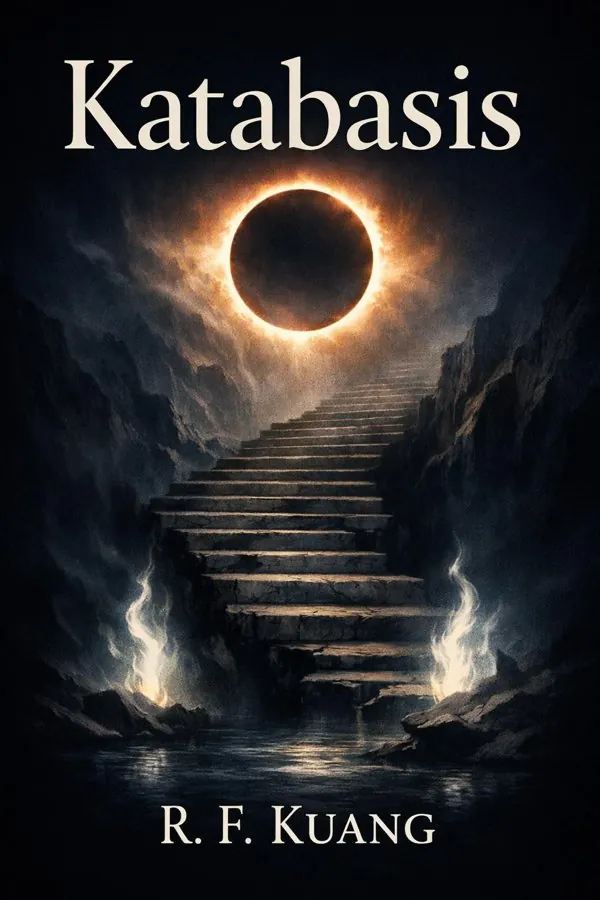
Katabasis: Summary & Key Insights
by R. F. Kuang
 10 min9 chaptersAudio available
Key Takeaways from Katabasis
The most revealing journeys are often downward, not upward.
The hunger to excel can be as dangerous as any curse.
Some of the deepest bonds are formed not through affection, but through competition.
Intelligence is not the same thing as wisdom, and expertise does not guarantee conscience.
People do not enter elite systems unchanged; they are trained to want differently.
What Is Katabasis About?
Katabasis by R. F. Kuang is a scifi_fantasy book spanning 5 pages. Katabasis signals a striking new direction in R. F. Kuang’s fiction: a dark academic fantasy centered on descent, ambition, and the terrifying cost of knowledge. Rather than continuing The Poppy War saga, this novel stands on its own, drawing on the ancient idea of katabasis—a journey into the underworld—to explore what happens when intellectual hunger becomes a moral trial. Kuang has built her reputation on novels that combine propulsive storytelling with fierce engagement in history, empire, language, and institutional power. In Babel, she dissected colonialism through translation and academia; in The Poppy War, she mapped war, trauma, and political ruthlessness onto epic fantasy. Katabasis appears poised to bring those strengths into an even more intimate register, using speculative fiction to ask what scholars, students, and rivals are willing to sacrifice in pursuit of mastery, recognition, and survival. What makes the book matter is not just its premise, but Kuang’s proven ability to turn genre conventions into sharp meditations on class, meritocracy, violence, and desire. This is fantasy with philosophical pressure: thrilling on the surface, unsettling underneath, and deeply relevant to anyone who has ever been shaped by institutions that demand excellence at any cost.
This FizzRead summary covers all 9 key chapters of Katabasis in approximately 10 minutes, distilling the most important ideas, arguments, and takeaways from R. F. Kuang's work. Also available as an audio summary and Key Quotes Podcast.
Katabasis
Katabasis signals a striking new direction in R. F. Kuang’s fiction: a dark academic fantasy centered on descent, ambition, and the terrifying cost of knowledge. Rather than continuing The Poppy War saga, this novel stands on its own, drawing on the ancient idea of katabasis—a journey into the underworld—to explore what happens when intellectual hunger becomes a moral trial. Kuang has built her reputation on novels that combine propulsive storytelling with fierce engagement in history, empire, language, and institutional power. In Babel, she dissected colonialism through translation and academia; in The Poppy War, she mapped war, trauma, and political ruthlessness onto epic fantasy. Katabasis appears poised to bring those strengths into an even more intimate register, using speculative fiction to ask what scholars, students, and rivals are willing to sacrifice in pursuit of mastery, recognition, and survival. What makes the book matter is not just its premise, but Kuang’s proven ability to turn genre conventions into sharp meditations on class, meritocracy, violence, and desire. This is fantasy with philosophical pressure: thrilling on the surface, unsettling underneath, and deeply relevant to anyone who has ever been shaped by institutions that demand excellence at any cost.
Who Should Read Katabasis?
This book is perfect for anyone interested in scifi_fantasy and looking to gain actionable insights in a short read. Whether you're a student, professional, or lifelong learner, the key ideas from Katabasis by R. F. Kuang will help you think differently.
- ✓Readers who enjoy scifi_fantasy and want practical takeaways
- ✓Professionals looking to apply new ideas to their work and life
- ✓Anyone who wants the core insights of Katabasis in just 10 minutes
Want the full summary?
Get instant access to this book summary and 100K+ more with Fizz Moment.
Get Free SummaryAvailable on App Store • Free to download
Key Chapters
The most revealing journeys are often downward, not upward. The core idea behind Katabasis is embedded in its title: a katabasis is a descent into the underworld, but in literature it is rarely just a change of setting. It is a stripping-away process. Characters descend not merely to retrieve something lost, but to confront what they have hidden from themselves. In Kuang’s work, external systems of power and internal fractures are usually inseparable, so an underworld journey is likely to function as both plot engine and psychological exposure.
This matters because descent narratives invert the usual fantasy logic of heroic ascent. Instead of gaining power through progress, the protagonist must pass through shame, memory, grief, compromise, and moral uncertainty. The underworld becomes a place where ordinary identities fail: the gifted student, the brilliant scholar, the ambitious rival, the loyal friend. What remains is the more uncomfortable question of character. What do you become when prestige no longer protects you? What values survive when the institutions that trained you are no longer watching?
In practical terms, this is one reason descent stories resonate so strongly with modern readers. They mirror burnout, grief, depression, academic pressure, and periods of life when success stops feeling meaningful. A reader does not need literal demons to understand the sensation of moving through a space shaped by old failures and unfinished guilt. Kuang’s likely brilliance here is in making that inner terrain feel mythic without making it abstract.
Actionable takeaway: Read Katabasis not only as a fantasy adventure, but as a study in what pressure reveals. Ask, scene by scene, what each descent strips away from the characters and what truth it leaves behind.
The hunger to excel can be as dangerous as any curse. One of the most compelling ideas surrounding Katabasis is that the novel appears to center on high-achieving intellectuals whose drive for mastery may trap them in an ethical and emotional underworld long before any literal descent begins. Kuang has repeatedly shown that institutions reward brilliance while quietly normalizing exploitation, competition, and dehumanization. In that context, ambition is never innocent.
Ambition often begins as aspiration: the desire to learn, to matter, to transcend one’s circumstances. But in elite environments, it can mutate into self-erasure. A student stops asking whether a goal is good and focuses only on whether it is difficult, prestigious, or winnable. Rivals become mirrors. Mentors become judges or gatekeepers. Every achievement raises the stakes for the next one. A descent narrative is perfect for dramatizing this process because it asks what happens when the pursuit itself has already become hell.
This idea extends beyond academia. In workplaces, creative industries, and professional cultures, many people learn to measure themselves by output, recognition, and scarcity. They sacrifice sleep, friendship, ethics, and joy in exchange for distinction. The tragedy is not simply that they suffer. It is that suffering begins to feel meaningful because it proves seriousness. Kuang’s fiction is particularly good at exposing that warped logic.
Readers can apply this lens to their own lives. When does excellence sharpen you, and when does it hollow you out? When are you pursuing something because it matters, and when because you fear irrelevance? Katabasis promises to make those questions visceral through story rather than lecture.
Actionable takeaway: Use the novel as a prompt to audit your own ambitions. Identify one goal you are pursuing and ask what it is costing you in integrity, relationships, or peace of mind.
Some of the deepest bonds are formed not through affection, but through competition. A likely emotional engine of Katabasis is rivalry: the charged relationship between people who need to outdo one another and, in doing so, become uniquely capable of understanding each other. Kuang excels at writing relationships structured by power, dependency, admiration, and resentment all at once. Rivalry allows all of these to coexist.
Why is rivalry so narratively potent? Because it collapses distance. Rivals track each other obsessively. They notice subtleties others miss. They interpret every achievement, hesitation, and failure as meaningful. In a high-stakes academic or magical setting, that intensity can resemble friendship, love, hatred, and self-projection simultaneously. A rival is not just an obstacle; they are a possible version of the self. That is why rivalry stories often feel so emotionally volatile. To lose to a rival is not merely to be defeated. It is to have one’s identity challenged.
In an underworld framework, rivalry becomes even more revealing. Shared danger can turn competition into collaboration, but not necessarily into trust. Every act of help may carry calculation. Every moment of vulnerability may become leverage. The descent forces rivals to decide whether they are trying to save each other, surpass each other, or use each other. That instability gives the story both tension and emotional sophistication.
This dynamic appears everywhere in real life: classmates chasing the same opportunities, coworkers competing for promotion, artists measuring themselves against peers. Rivalry can motivate growth, but it can also corrode judgment if winning becomes more important than truth or care.
Actionable takeaway: As you read, track how competition creates closeness. Then reflect on one rivalry in your own life and ask whether it is making you better, smaller, or merely more anxious.
Intelligence is not the same thing as wisdom, and expertise does not guarantee conscience. If Katabasis continues Kuang’s long-running interest in institutions of learning, then one of its central concerns will likely be the moral instability of knowledge divorced from ethical responsibility. Kuang’s fiction repeatedly asks who gets to define legitimate knowledge, who benefits from its use, and what violence is concealed beneath supposedly noble pursuits.
Fantasy often romanticizes learning: ancient texts, secret languages, forbidden archives, arcane systems. Kuang tends to complicate that romance. Knowledge can empower, but it can also authorize domination. Once a person learns to manipulate language, spirits, magic, or theory, they may begin to think mastery itself confers righteousness. That is the dangerous leap. The more technically competent a system becomes, the easier it is for participants to ignore the human consequences of what they do.
In a story built around descent, this idea becomes especially sharp. The underworld may function as the ultimate research site, a place of hidden truths or impossible recoveries. But the question is never only whether the characters can obtain knowledge. It is whether they should, and what kind of people they become while trying. The book’s likely force lies in refusing easy distinctions between curiosity and exploitation.
This has clear real-world applications. Universities, labs, corporations, and governments all frame discovery as progress, yet history shows how often progress serves power rather than justice. Readers familiar with academic pressure may recognize the temptation to prize brilliance over accountability.
Actionable takeaway: While reading, separate the thrill of discovery from the ethics of its use. In your own life, ask not just “Can this be done?” but “Who is harmed, erased, or controlled if it is?”
People do not enter elite systems unchanged; they are trained to want differently. A defining strength of Kuang’s fiction is her ability to portray institutions not simply as backdrops, but as machines that manufacture values, fears, and forms of selfhood. Katabasis appears poised to continue this inquiry through an academic-fantasy lens, showing how schools, departments, mentors, and hierarchies transform intellectual desire into social competition.
Institutions teach explicit lessons, but their hidden curriculum is often more powerful. Students learn what kinds of brilliance are rewarded, what kinds of suffering are normalized, and which compromises are framed as maturity. They internalize ranking systems. They begin to equate worth with productivity or exceptionalism. In that sense, the underworld may not be a break from the institution at all, but its truest expression: a place where the values of ambition, scarcity, and obedience are revealed in concentrated form.
This framework helps explain why Kuang’s stories feel so contemporary even when they use fantastical settings. Many readers know what it means to be sorted, assessed, and compared until identity becomes inseparable from performance. The institution then lives inside you. Even when you leave the classroom or workplace, its logic continues to govern how you evaluate yourself.
A novel like Katabasis can make this process newly visible. Why do characters want what they want? Which desires are truly theirs, and which have been engineered by mentorship, prestige, or fear of failure? That question deepens both characterization and theme.
Outside fiction, this insight is useful for anyone navigating ambitious environments. Before assuming your goals are entirely self-chosen, it is worth asking who taught you to want them and why.
Actionable takeaway: Notice how the novel links personal desire to institutional conditioning. Then write down one standard you hold for yourself and examine whether it comes from conviction, imitation, or pressure.
What if the landscape of a story behaves like memory? One of the richest possibilities in Katabasis is that its descent is not only mythic or academic, but deeply shaped by trauma and grief. Kuang’s fiction consistently portrays violence as something that lingers in bodies, language, and relationships. Rather than treating suffering as backstory, she often makes it structurally central. An underworld setting offers the perfect imaginative space for that approach.
In many literary traditions, the underworld is where the dead, the lost, and the unfinished remain present. It is a geography of unresolved attachment. For that reason, it can serve as an external model of traumatized consciousness: recursive, haunted, difficult to navigate, and resistant to linear closure. Characters descend into a place where what they fear, regret, or mourn cannot be avoided. The journey becomes less about defeating monsters than about enduring recognition.
This concept matters because it resists simplistic narratives of healing. Trauma is not solved by insight alone. Grief does not disappear because it has been named. A strong descent narrative honors this by allowing confrontation without promising neat repair. Kuang is especially well positioned to handle this tension because her work is unafraid of aftermath. She understands that survival can carry its own burden.
Readers may find this dimension especially resonant if they have experienced periods when ordinary life feels overrun by old losses. Fantasy can provide a form for emotions that are otherwise hard to articulate. A haunted corridor, impossible return, or repeating trial can feel truer than realism precisely because trauma often feels unreal.
Actionable takeaway: Read the underworld symbolically as well as literally. Ask what memories, losses, or injuries the landscape is making visible, and consider what in your own life remains unresolved but unacknowledged.
Some of the newest fears become clearest when told through the oldest stories. Katabasis draws on an ancient narrative pattern—the journey to the underworld—but Kuang’s likely achievement is to use myth not as decorative allusion, but as a structure for contemporary anxiety. Academic precarity, class insecurity, obsessive achievement, and moral compromise may be modern experiences in their current form, yet myth gives them scale, ritual, and inevitability.
Why does this matter? Because myth translates personal pressure into shared human drama. A student terrified of failure may feel uniquely broken, but in mythic terms that panic resembles a trial of the soul, a confrontation with judgment, temptation, and the possibility of return transformed or destroyed. Myth does not solve anxiety, but it reframes it. It suggests that what feels isolating may also be archetypal.
Kuang has shown before that she can fuse intellectual argument with narrative momentum. In Katabasis, myth may help her bind private emotion to larger questions of history, knowledge, and power. The underworld is never just one person’s nightmare. It is also a civilizational space, a record of what a culture fears, values, and refuses to bury. That makes the novel potentially rich in symbolism without losing emotional immediacy.
This has practical value for readers and thinkers alike. Mythic framing can help people interpret difficult experiences not as random personal failures, but as encounters with larger systems and recurring human patterns. It can also sharpen reading itself: symbols, thresholds, guides, bargains, and returns all become interpretive clues.
Actionable takeaway: As you read, identify the mythic elements and ask what modern problem each one illuminates. Then try reframing one personal struggle through a larger story pattern to gain perspective.
The real cost of power is often paid long before triumph arrives. Across Kuang’s body of work, power is never simply empowering. It extracts. It narrows empathy, distorts judgment, and can make violence feel necessary, even elegant. Katabasis is likely to continue this moral interrogation by asking what characters are willing to surrender—ethically, emotionally, spiritually—to gain the knowledge or authority they seek.
Fantasy often centers on acquisition: new abilities, hidden truths, superior command. Kuang, by contrast, is interested in degradation alongside empowerment. The key question is not only what power enables, but what it trains people to stop valuing. A brilliant scholar may gain access to extraordinary methods yet lose the ability to distinguish devotion from obsession. A rival may learn to survive every trial yet become incapable of intimacy. Victory then appears hollow not because it fails, but because it succeeds on terms that destroy the self that wanted it.
This is one reason Kuang’s stories linger. They do not let readers celebrate capability without considering moral residue. In an underworld narrative, every bargain can crystallize this idea. To go farther, know more, or return alive, what must be abandoned? The answer is rarely abstract. It may be trust, innocence, compassion, memory, or the possibility of ordinary life.
The lesson applies far beyond fantasy. Promotions, public recognition, and elite credentials can all come with invisible prices if they depend on chronic self-betrayal. Not every sacrifice is meaningful simply because it is painful.
Actionable takeaway: Pay attention to what each character gives up before the story names it as loss. Then consider one success you desire and define in advance which lines you refuse to cross to achieve it.
A journey into darkness only becomes meaningful if it changes how one lives afterward. The final and perhaps most important idea in Katabasis is that descent is only half the story. In classical and modern underworld narratives alike, the crucial question is not whether characters can go down, but whether they can return—and what return even means after irreversible knowledge. A katabasis without transformation is spectacle. A katabasis with transformation becomes philosophy.
Return is difficult because the self that enters the underworld cannot remain intact. Once characters have seen hidden truths, confronted guilt, or crossed moral thresholds, ordinary life becomes unstable. They may survive physically while failing to reintegrate emotionally or ethically. That tension is fertile ground for Kuang, whose fiction often focuses on aftermath rather than neat closure. She understands that revelation can be damaging, and that insight does not automatically produce wisdom.
This idea elevates the novel from an atmospheric fantasy premise to a meditation on growth. Real change is not proven in extremity alone, but in how one acts once the crisis has passed. Does the character become gentler, harder, freer, more honest, more compromised? Do they reject the values that sent them downward, or carry those values back with greater force? The meaning of the descent depends on the answer.
Readers can draw an immediate parallel to real life. Many people survive intense experiences—grief, burnout, illness, failure, success itself—only to discover that endurance is not the same as integration. The harder work begins afterward.
Actionable takeaway: As you finish the book, judge the descent by the return. Ask not what the characters endured, but what they now believe, what they refuse, and what kind of life their knowledge makes possible.
All Chapters in Katabasis
About the Author
R. F. Kuang is a Chinese-American author and scholar whose fiction is known for combining speculative storytelling with rigorous engagement in history, empire, translation, violence, and institutional power. She rose to prominence with The Poppy War trilogy, a fantasy series praised for its ambitious scope and unsparing treatment of war and trauma. She later published Babel, a bestselling dark academic novel that explored language, colonialism, and the politics of knowledge. Kuang studied at Georgetown University, earned a master’s degree at Cambridge, and pursued doctoral work at Yale, and her academic training strongly shapes the intellectual texture of her novels. Across her work, she has built a reputation for writing fantasy that is both emotionally intense and analytically sharp, challenging readers to think deeply about ambition, morality, and the systems that govern human life.
Get This Summary in Your Preferred Format
Read or listen to the Katabasis summary by R. F. Kuang anytime, anywhere. FizzRead offers multiple formats so you can learn on your terms — all free.
Available formats: App · Audio · PDF · EPUB — All included free with FizzRead
Download Katabasis PDF and EPUB Summary
Key Quotes from Katabasis
“The most revealing journeys are often downward, not upward.”
“The hunger to excel can be as dangerous as any curse.”
“Some of the deepest bonds are formed not through affection, but through competition.”
“Intelligence is not the same thing as wisdom, and expertise does not guarantee conscience.”
“People do not enter elite systems unchanged; they are trained to want differently.”
Frequently Asked Questions about Katabasis
Katabasis by R. F. Kuang is a scifi_fantasy book that explores key ideas across 9 chapters. Katabasis signals a striking new direction in R. F. Kuang’s fiction: a dark academic fantasy centered on descent, ambition, and the terrifying cost of knowledge. Rather than continuing The Poppy War saga, this novel stands on its own, drawing on the ancient idea of katabasis—a journey into the underworld—to explore what happens when intellectual hunger becomes a moral trial. Kuang has built her reputation on novels that combine propulsive storytelling with fierce engagement in history, empire, language, and institutional power. In Babel, she dissected colonialism through translation and academia; in The Poppy War, she mapped war, trauma, and political ruthlessness onto epic fantasy. Katabasis appears poised to bring those strengths into an even more intimate register, using speculative fiction to ask what scholars, students, and rivals are willing to sacrifice in pursuit of mastery, recognition, and survival. What makes the book matter is not just its premise, but Kuang’s proven ability to turn genre conventions into sharp meditations on class, meritocracy, violence, and desire. This is fantasy with philosophical pressure: thrilling on the surface, unsettling underneath, and deeply relevant to anyone who has ever been shaped by institutions that demand excellence at any cost.
You Might Also Like
Red Rising
Pierce Brown
10 min
Stranger in a Strange Land
Robert A. Heinlein
10 min
AI Valley
Chen Qiufan
10 min
Bloodchild
Octavia E. Butler
10 min
Do Androids Dream of Electric Sheep?
Philip K. Dick
10 min
Jujutsu Kaisen, Vol. 24
Gege Akutami
10 minBrowse by Category
Ready to read Katabasis?
Get the full summary and 100K+ more books with Fizz Moment.