
Kaputt: Summary & Key Insights
 10 min9 chaptersAudio available
Key Takeaways from Kaputt
One of the most unforgettable truths in Kaputt is that war destroys not only people, but the very idea of natural life.
A society reveals its deepest truth in the way it treats the defenseless.
War deforms the meaning of loyalty.
Decay rarely arrives with dramatic fanfare; more often, it spreads quietly, like vermin in the walls.
Neutrality can protect a nation, but it cannot fully protect a conscience.
What Is Kaputt About?
Kaputt by Curzio Malaparte is a war_military book spanning 9 pages. Kaputt is Curzio Malaparte’s unforgettable account of Europe’s moral collapse during the Second World War. First published in 1944, the book blends memoir, reportage, fiction, allegory, and nightmare into a single unsettling vision. Drawing on his experiences as an Italian journalist and war correspondent attached to Axis forces on the Eastern Front and across occupied Europe, Malaparte takes readers from the frozen landscapes near Leningrad to the Warsaw Ghetto, from aristocratic drawing rooms to battlefields soaked in blood and delusion. What makes the book remarkable is not simply what it describes, but how it describes it: with lyrical, hallucinatory prose that turns war into a theater of cruelty, absurdity, beauty, and decay. Malaparte writes with the authority of someone who saw power from the inside yet refused to reduce events to slogans or patriotic myth. Kaputt matters because it is not only a chronicle of wartime horror; it is a diagnosis of civilization in breakdown. It shows how cultured societies can normalize barbarism, and why witnessing honestly is itself an act of resistance.
This FizzRead summary covers all 9 key chapters of Kaputt in approximately 10 minutes, distilling the most important ideas, arguments, and takeaways from Curzio Malaparte's work. Also available as an audio summary and Key Quotes Podcast.
Kaputt
Kaputt is Curzio Malaparte’s unforgettable account of Europe’s moral collapse during the Second World War. First published in 1944, the book blends memoir, reportage, fiction, allegory, and nightmare into a single unsettling vision. Drawing on his experiences as an Italian journalist and war correspondent attached to Axis forces on the Eastern Front and across occupied Europe, Malaparte takes readers from the frozen landscapes near Leningrad to the Warsaw Ghetto, from aristocratic drawing rooms to battlefields soaked in blood and delusion. What makes the book remarkable is not simply what it describes, but how it describes it: with lyrical, hallucinatory prose that turns war into a theater of cruelty, absurdity, beauty, and decay. Malaparte writes with the authority of someone who saw power from the inside yet refused to reduce events to slogans or patriotic myth. Kaputt matters because it is not only a chronicle of wartime horror; it is a diagnosis of civilization in breakdown. It shows how cultured societies can normalize barbarism, and why witnessing honestly is itself an act of resistance.
Who Should Read Kaputt?
This book is perfect for anyone interested in war_military and looking to gain actionable insights in a short read. Whether you're a student, professional, or lifelong learner, the key ideas from Kaputt by Curzio Malaparte will help you think differently.
- ✓Readers who enjoy war_military and want practical takeaways
- ✓Professionals looking to apply new ideas to their work and life
- ✓Anyone who wants the core insights of Kaputt in just 10 minutes
Want the full summary?
Get instant access to this book summary and 100K+ more with Fizz Moment.
Get Free SummaryAvailable on App Store • Free to download
Key Chapters
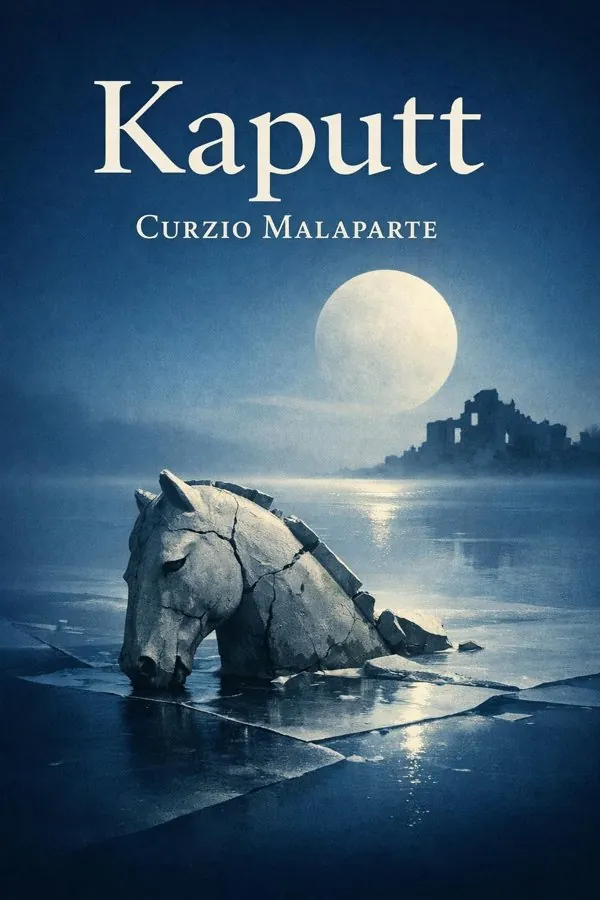
One of the most unforgettable truths in Kaputt is that war destroys not only people, but the very idea of natural life. Malaparte’s vision of horses trapped beneath the ice near Leningrad captures this with eerie precision. Their bodies appear suspended in motion, as if still galloping under the frozen surface, transformed into a kind of monument to suffering. The scene is not just descriptive; it is symbolic. The horses embody Europe itself: alive with force and tradition one moment, immobilized by violence the next. They are noble creatures reduced to mute evidence of catastrophe.
Malaparte uses such images to show that war is never limited to strategy, borders, or armies. It spreads into the landscape, into animals, into weather, into memory. The frozen horses also reveal his method. He does not explain events in a dry political style. Instead, he creates images that force readers to feel the unnaturalness of war. A military campaign becomes a frozen apocalypse. The image lingers because it says something facts alone cannot say: that civilization can die while still appearing to move.
In practical terms, this section teaches readers to pay attention to symbols in historical writing. The most powerful accounts of catastrophe often work through images, not arguments. In modern life, we can apply this insight by noticing how systems of violence leave traces in ordinary scenes, whether in ruined cities, damaged ecosystems, or traumatized communities. Statistics matter, but moral understanding often begins with a single unforgettable picture.
Actionable takeaway: when reading about conflict or crisis, ask not only what happened, but what image best reveals its human cost.
A society reveals its deepest truth in the way it treats the defenseless. Malaparte’s account of the Jews of Warsaw is among the most devastating parts of Kaputt because it strips away every illusion of European refinement. In the ghetto, he sees hunger, fear, humiliation, and abandonment concentrated into a closed world. The people he encounters do not appear merely as victims in a political narrative; they emerge as evidence of what happens when cruelty becomes administrative, legal, and routine.
What gives this section its power is the contrast between the ghetto and the rest of occupied Europe. Outside, officials dine, converse, negotiate, and speak the language of order and culture. Inside, human beings are reduced to bare survival. Malaparte exposes the obscene coexistence of elegance and brutality. The lesson is not only about Nazi atrocity, though it is certainly that. It is also about how civilized societies compartmentalize evil. People continue with ceremonies, etiquette, and bureaucratic normality while unspeakable suffering is happening nearby.
This idea remains relevant well beyond the historical setting of the book. Modern readers can recognize similar mechanisms whenever institutions sanitize harm through procedure, distance, or euphemism. Whether the issue is war, displacement, racism, or poverty, the danger lies in treating suffering as background information. Malaparte forces readers to confront proximity: horror is not elsewhere. It exists next door to comfort.
Actionable takeaway: whenever you encounter systems that produce suffering, look beyond official language and ask who is being excluded, hidden, or made invisible.
War deforms the meaning of loyalty. In Malaparte’s treatment of the dogs of Finland, animals become mirrors for human conduct under extreme pressure. Dogs usually symbolize faithfulness, companionship, and instinctive trust. But in Kaputt, even these familiar creatures are drawn into the distortion of wartime life. Their presence highlights a central irony: in a world governed by ideology, fear, and opportunism, the simplest forms of loyalty may survive more clearly in animals than in human beings.
Malaparte often uses animals to reveal truths that people work hard to conceal. Human beings can justify betrayal, disguise ambition as patriotism, and call cruelty necessity. Animals cannot participate in such moral language games. Because of that, they become a kind of silent standard against which human corruption is measured. The Finnish setting also matters. Finland appears in the book as both physically beautiful and strategically precarious, a place where cold landscapes intensify questions of endurance, alliance, and identity.
For readers, this chapter suggests that war is not only a clash of armies but a test of character. Who remains faithful to conscience? Who adapts to power? Who survives by hardening emotionally? These questions extend into ordinary life. In workplaces, politics, and personal relationships, loyalty can become distorted when fear or self-interest dominates. Malaparte reminds us that loyalty without humanity becomes servility, while loyalty to moral truth may require standing apart from the group.
Actionable takeaway: examine the loyalties that guide your choices and ask whether they are rooted in fear, convenience, or genuine ethical commitment.
Decay rarely arrives with dramatic fanfare; more often, it spreads quietly, like vermin in the walls. In Kaputt, the rats of the Balkans serve as a grotesque emblem of war’s hidden contagion. Rats thrive in ruin, feed on neglect, and multiply where systems collapse. Malaparte uses them not just as physical details of wartime misery but as symbols of the moral and political decomposition consuming Europe. They suggest that corruption is not accidental to war. It is one of war’s natural ecosystems.
The Balkans in the book appear as a region where old hatreds, occupation, nationalism, and opportunism have created conditions of deep instability. Rats become the perfect image for that atmosphere. They are not grand or tragic like the frozen horses. They are invasive, persistent, and hard to eradicate. Through them, Malaparte shows that barbarism does not always wear a uniform or make speeches. It also takes the form of petty cruelty, black-market instinct, fear-driven compliance, and the breakdown of trust.
This has clear modern applications. In any institution under strain, corruption often emerges first in small tolerated behaviors: dishonesty, scapegoating, indifference, and normalization of abuse. By the time the crisis looks obvious, the rot has already spread. Malaparte teaches readers to notice the secondary signs of collapse, not just the headline events. A society may still function externally while internally becoming unlivable.
Actionable takeaway: do not ignore the small signs of moral decay in organizations or communities; address minor corruption early before it becomes the environment everyone must live in.
Neutrality can protect a nation, but it cannot fully protect a conscience. In Malaparte’s reflections on the Swedes, wartime Scandinavia becomes a lens through which to examine detachment, safety, and the illusion of standing outside history. Sweden appears comparatively sheltered from the devastation engulfing Europe, yet that very distance raises difficult questions. What does it mean to remain civilized while others are being destroyed? Is neutrality wisdom, privilege, prudence, or evasion?
Malaparte does not offer a simple condemnation. Instead, he exposes a recurring human temptation: to believe that because one is not directly participating in evil, one is untouched by it. The salons, conversations, and composed manners associated with safer spaces can become morally ambiguous when they exist alongside mass suffering elsewhere. The Swedes in Kaputt represent the uneasy position of observers who are close enough to know, but distant enough to continue living well.
This insight matters today in an interconnected world. Many readers inhabit forms of protected distance from wars, exploitation, or humanitarian crises. We may consume information about tragedy while remaining materially insulated from its consequences. Malaparte’s point is not that everyone is equally guilty, but that distance does not erase responsibility. Awareness creates ethical demands, even when direct intervention is limited.
In personal terms, the chapter encourages readers to think critically about comfort. A comfortable position may be fortunate, but it can also tempt us into moral passivity. The challenge is to convert awareness into solidarity, generosity, and truthful speech rather than cultivated indifference.
Actionable takeaway: if you are insulated from a crisis, ask what meaningful form of attention, support, or witness your position allows.
One of Kaputt’s harshest insights is that education, refinement, and artistic taste do not guarantee moral decency. Malaparte’s portrayal of the Germans is deeply unsettling because it repeatedly shows cultured people participating in or accommodating barbarism. Officers appreciate music, discuss literature, host elegant dinners, and display impeccable manners, all while serving a machinery of destruction. This contradiction is central to the book’s argument: civilization can coexist with cruelty more easily than we like to imagine.
Malaparte is not making a narrow national stereotype. He is exposing a broader European failure. The German case matters because it destroys the comforting belief that barbarism belongs only to the uncultured or irrational. In Kaputt, horror is administered by people who understand ceremony, philosophy, architecture, and order. That makes the violence more frightening, not less. It suggests that culture can be used decoratively, as a veil over domination, unless it is joined to humility and ethical courage.
This is a vital lesson for contemporary readers. We often assume that intelligence, sophistication, or institutional prestige are signs of moral reliability. But history shows otherwise. Highly educated individuals can rationalize injustice with extraordinary skill. The question is not whether a person or society is cultivated, but whether it can recognize the humanity of others when power is at stake.
In practical life, this means resisting surface impressions. A polished leader, eloquent expert, or respectable institution should not be trusted merely because it appears refined. Character must be tested by conduct, especially toward the vulnerable.
Actionable takeaway: judge people and institutions less by polish and rhetoric than by what they permit, justify, and do.
When systems become absurd, people often survive by performing roles. Malaparte’s treatment of the Italians reveals a world of improvisation, vanity, flexibility, charm, and moral ambiguity. Italy in Kaputt is neither innocent nor ideologically rigid in the way Nazi Germany is portrayed. Instead, it often appears theatrical: full of gestures, masks, accommodations, and maneuvers designed to endure shifting realities. This theatricality can seem humane compared with fanatical brutality, but Malaparte shows that it also carries its own dangers.
The Italian response to war in the book often involves style as a form of evasion. Wit, elegance, and adaptability become tools for navigating chaos. Yet survival through performance can drift into irresponsibility. If everything is treated as a role, then conviction weakens, accountability dissolves, and complicity becomes easier to excuse. Malaparte, as an Italian observer implicated in the world he describes, is especially sharp on this point. He sees both the resilience and the hollowness in a culture that can turn disaster into spectacle.
This idea remains recognizable today. In politics, media, and professional life, image management often replaces substance. People learn to signal concern without accepting cost, to appear principled while staying safe. Malaparte warns that theatrical intelligence may help individuals survive, but it does not rebuild moral order.
For readers, this chapter asks a difficult question: when do flexibility and diplomacy become excuses for avoiding truth? Adaptability is valuable, but not when it empties out conscience.
Actionable takeaway: notice where you may be relying on performance or irony to avoid taking a clear ethical stand.
If Europe in Kaputt often appears decadent, the Russians are presented with a different kind of force: endurance stripped of sentimentality. Malaparte’s encounters with Russia reveal a people marked by immense suffering, physical hardship, and historical depth. Unlike the polished elites elsewhere in the book, the Russians often seem closer to elemental realities: cold, hunger, sacrifice, land, death, and persistence. This does not make them morally pure, but it gives them a terrifying resilience.
Malaparte is fascinated by the Russian capacity to absorb devastation without the same illusions that sustain the West. Where others cling to etiquette, rhetoric, or self-image, Russia often appears in harsher, more primitive terms. There is brutality here too, but also a resistance to decorative falseness. This contrast helps explain why the Eastern Front in Kaputt feels so apocalyptic. It is not only a military struggle; it is a collision between exhausted European sophistication and a harder endurance forged by suffering.
Modern readers can take from this a broader insight about resilience. Real endurance is rarely glamorous. It is built through contact with limits, pain, and necessity. In personal and collective crises, people often discover that what survives is not ideology or image, but habits of persistence and a willingness to face reality without adornment.
At the same time, Malaparte does not romanticize hardship. Endurance can preserve life, but it can also normalize suffering. The challenge is to cultivate resilience without becoming numb.
Actionable takeaway: build resilience by confronting reality honestly, but pair toughness with compassion so survival does not become emotional deadness.
The deepest argument of Kaputt is that Europe’s crisis was not merely military defeat or political instability, but the breakdown of an entire moral imagination. By the time Malaparte reaches his broader vision of the end of Europe, the book has assembled enough scenes of grotesque beauty and cruelty to make one conclusion unavoidable: a civilization can preserve its symbols while losing its soul. The Europe of Kaputt still has churches, palaces, officers, diplomats, artworks, uniforms, and rituals. What it lacks is the ethical center that once made those things meaningful.
This is why the book remains powerful long after World War II. Malaparte is not simply describing one historical disaster. He is asking how a civilization famous for philosophy, Christianity, law, art, and humanism became capable of industrialized cruelty and widespread moral anesthesia. His answer is not neat, but it is clear: refinement without conscience collapses from within. Once domination, racial contempt, vanity, and fear become normal, the outer shell of culture cannot save a society.
Readers today can apply this insight beyond Europe or war. Any institution, nation, or community can suffer a similar fracture when ideals are celebrated publicly but betrayed in practice. The warning is timeless: decline begins long before formal collapse, in habits of dishonesty, indifference, and dehumanization.
Actionable takeaway: measure the health of any culture not by its prestige or achievements, but by whether it protects human dignity when doing so becomes costly.
All Chapters in Kaputt
About the Author
Curzio Malaparte, born Kurt Erich Suckert in 1898, was an Italian novelist, journalist, diplomat, and one of the most distinctive literary voices of the twentieth century. He served in World War I and later became involved with fascist circles before distancing himself from the regime, a shift that shaped his reputation as both controversial and fiercely independent. As a war correspondent during World War II, he traveled widely through Eastern and Central Europe, experiences that informed his most famous books, Kaputt and The Skin. Malaparte’s writing blends reportage, satire, autobiography, and surreal imagery to explore cruelty, power, and the collapse of civilization. He died in 1957, leaving behind a body of work admired for its stylistic brilliance and moral provocation.
Get This Summary in Your Preferred Format
Read or listen to the Kaputt summary by Curzio Malaparte anytime, anywhere. FizzRead offers multiple formats so you can learn on your terms — all free.
Available formats: App · Audio · PDF · EPUB — All included free with FizzRead
Download Kaputt PDF and EPUB Summary
Key Quotes from Kaputt
“One of the most unforgettable truths in Kaputt is that war destroys not only people, but the very idea of natural life.”
“A society reveals its deepest truth in the way it treats the defenseless.”
“In Malaparte’s treatment of the dogs of Finland, animals become mirrors for human conduct under extreme pressure.”
“Decay rarely arrives with dramatic fanfare; more often, it spreads quietly, like vermin in the walls.”
“Neutrality can protect a nation, but it cannot fully protect a conscience.”
Frequently Asked Questions about Kaputt
Kaputt by Curzio Malaparte is a war_military book that explores key ideas across 9 chapters. Kaputt is Curzio Malaparte’s unforgettable account of Europe’s moral collapse during the Second World War. First published in 1944, the book blends memoir, reportage, fiction, allegory, and nightmare into a single unsettling vision. Drawing on his experiences as an Italian journalist and war correspondent attached to Axis forces on the Eastern Front and across occupied Europe, Malaparte takes readers from the frozen landscapes near Leningrad to the Warsaw Ghetto, from aristocratic drawing rooms to battlefields soaked in blood and delusion. What makes the book remarkable is not simply what it describes, but how it describes it: with lyrical, hallucinatory prose that turns war into a theater of cruelty, absurdity, beauty, and decay. Malaparte writes with the authority of someone who saw power from the inside yet refused to reduce events to slogans or patriotic myth. Kaputt matters because it is not only a chronicle of wartime horror; it is a diagnosis of civilization in breakdown. It shows how cultured societies can normalize barbarism, and why witnessing honestly is itself an act of resistance.
You Might Also Like

Patriot
Andrew Britton
10 min
War
John Hersey
10 min
An Army at Dawn: The War in North Africa, 1942–1943
Rick Atkinson
10 min
Brave New War: The Next Stage of Terrorism and the End of Globalization
John Robb
10 min
Catch-22
Joseph Heller
10 min
Command and Control: Nuclear Weapons, the Damascus Accident, and the Illusion of Safety
Eric Schlosser
10 minBrowse by Category
Ready to read Kaputt?
Get the full summary and 100K+ more books with Fizz Moment.