
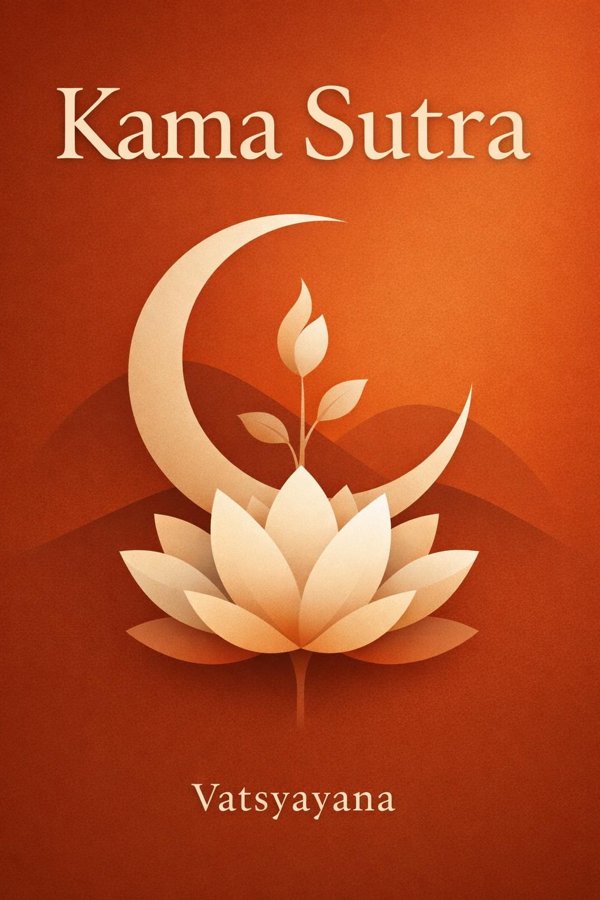
Kama Sutra: Summary & Key Insights
by Vatsyayana
 10 min7 chaptersAudio available
What Is Kama Sutra About?
Kama Sutra by Vatsyayana is a eastern_wisdom book spanning 7 pages. The Kama Sutra is an ancient Indian text composed by Vatsyayana that explores human sexual behavior, love, and social relationships. Written in Sanskrit, it is considered one of the foundational works on the philosophy of desire (kama) within Indian thought. The text discusses various aspects of love, marriage, and the art of living a pleasurable life.
This FizzRead summary covers all 7 key chapters of Kama Sutra in approximately 10 minutes, distilling the most important ideas, arguments, and takeaways from Vatsyayana's work. Also available as an audio summary and Key Quotes Podcast.
Kama Sutra
The Kama Sutra is an ancient Indian text composed by Vatsyayana that explores human sexual behavior, love, and social relationships. Written in Sanskrit, it is considered one of the foundational works on the philosophy of desire (kama) within Indian thought. The text discusses various aspects of love, marriage, and the art of living a pleasurable life.
Who Should Read Kama Sutra?
This book is perfect for anyone interested in eastern_wisdom and looking to gain actionable insights in a short read. Whether you're a student, professional, or lifelong learner, the key ideas from Kama Sutra by Vatsyayana will help you think differently.
- ✓Readers who enjoy eastern_wisdom and want practical takeaways
- ✓Professionals looking to apply new ideas to their work and life
- ✓Anyone who wants the core insights of Kama Sutra in just 10 minutes
Want the full summary?
Get instant access to this book summary and 100K+ more with Fizz Moment.
Get Free SummaryAvailable on App Store • Free to download
Key Chapters
In the first part of my treatise, I explain the foundation upon which all that follows is built: the three aims of life, *dharma*, *artha*, and *kama*. No human existence can be noble without understanding how these three interrelate. *Dharma* sustains society and moral order; *artha* enables one to maintain comfort and independence; *kama* brings joy and fulfillment to daily living. Neglecting any one leads to imbalance—pursuing pleasure without virtue leads to ruin, but denying pleasure breeds hard-heartedness and hypocrisy.
I remind the reader that *kama* should be pursued after establishing *dharma* and *artha*. Pleasure built upon poverty or dishonor is fleeting. But when a person, already grounded in right conduct and secure in livelihood, learns the ways of love, *kama* becomes an adornment to life rather than its master.
I then turn to the ideal education of one who would understand love. Such a person should study poetry, music, hairdressing, perfume-making, and all the arts that unite sensual delight with intelligence. The cultivation of the senses—sight, sound, scent, touch—is part of refinement, not indulgence. Through these accomplishments, a person becomes graceful and expressive, capable of giving and receiving affection.
The first book also reminds us that pleasure is not the same for everyone. Age, temperament, and circumstance shape how people experience desire. Therefore, to learn the science of *kama* is to learn about human nature itself. Just as the physician studies the body, the lover studies the heart. Through this study, we come to know ourselves and others, which is the beginning of harmony.
Here I begin to describe the art that most readers seek with greatest curiosity: the art of approach, attraction, and union. But again, the body is only one part of this art; the heart and mind are equally involved. I divide this section to explore how lovers initiate intimacy—through glances, gestures, poetry, and conversation—and how physical union arises from emotional connection.
I describe the various temperaments of men and women—how some are easily kindled, others slow to respond—and how matching temperaments leads to the most satisfying relationships. Just as in music, harmony comes from complement, not uniformity. To understand the partner’s disposition is a moral as well as an erotic duty: it shows respect for their experience and personhood.
From gentle teasing to embrace and eventual union, every act of love has a rhythm and purpose. The goal is not conquest but communion, a deep enjoyment born from attentiveness. I caution against ignorance and haste, for these destroy pleasure. Skill arises from mindfulness, in which desire is infused with understanding. Thus, when the body responds, the spirit participates too.
This part of my book also classifies the forms of physical union, not to encourage excess but to show how diversity of expression can be part of mutual exploration. Pleasure shared with tenderness is sacred, for it reflects the divine creativity that sustains the world.
+ 5 more chapters — available in the FizzRead app
All Chapters in Kama Sutra
About the Author
Vatsyayana Mallanaga was an ancient Indian philosopher and author, best known as the compiler of the Kama Sutra. He is believed to have lived between the 3rd and 5th centuries CE and wrote extensively on the concept of kama, one of the four aims of human life in Hindu philosophy.
Get This Summary in Your Preferred Format
Read or listen to the Kama Sutra summary by Vatsyayana anytime, anywhere. FizzRead offers multiple formats so you can learn on your terms — all free.
Available formats: App · Audio · PDF · EPUB — All included free with FizzRead
Download Kama Sutra PDF and EPUB Summary
Key Quotes from Kama Sutra
“In the first part of my treatise, I explain the foundation upon which all that follows is built: the three aims of life, *dharma*, *artha*, and *kama*.”
“Here I begin to describe the art that most readers seek with greatest curiosity: the art of approach, attraction, and union.”
Frequently Asked Questions about Kama Sutra
Kama Sutra by Vatsyayana is a eastern_wisdom book that explores key ideas across 7 chapters. The Kama Sutra is an ancient Indian text composed by Vatsyayana that explores human sexual behavior, love, and social relationships. Written in Sanskrit, it is considered one of the foundational works on the philosophy of desire (kama) within Indian thought. The text discusses various aspects of love, marriage, and the art of living a pleasurable life.
You Might Also Like
A New Earth
Eckhart Tolle
10 min
The Daily Stoic
Ryan Holiday, Stephen Hanselman
10 min
Buddhism: Plain and Simple
Steve Hagen
10 min
Enchiridion
Epictetus
10 min
The Book of Tea
Kakuzō Okakura
10 min
The Light We Give: How Sikh Wisdom Can Transform Your Life
Simran Jeet Singh
10 minBrowse by Category
Ready to read Kama Sutra?
Get the full summary and 100K+ more books with Fizz Moment.