
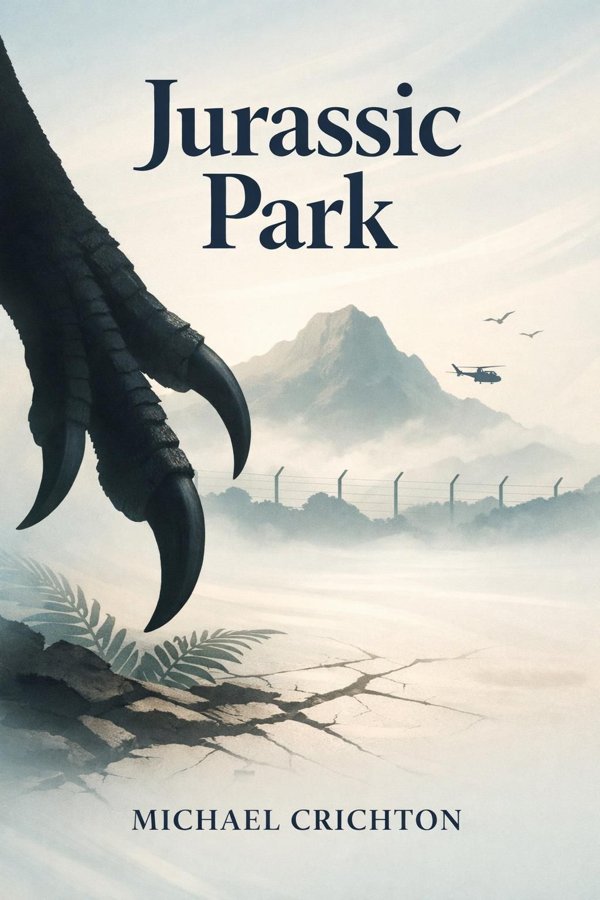
Jurassic Park: Summary & Key Insights
 10 min9 chaptersAudio available
Key Takeaways from Jurassic Park
A civilization changes the moment it can reverse extinction.
The most dangerous systems often begin as beautiful visions.
Awe is powerful, but expertise asks harder questions.
The more complex a system becomes, the less it behaves like a machine and the more it behaves like weather.
Disaster rarely needs a single villain when a system is already brittle.
What Is Jurassic Park About?
Jurassic Park by Michael Crichton is a scifi_fantasy book spanning 8 pages. Jurassic Park is far more than a dinosaur thriller. Michael Crichton uses the irresistible premise of cloning extinct creatures from preserved DNA to build a sharp, suspenseful novel about scientific ambition, corporate secrecy, and the dangerous belief that nature can be fully controlled. Set on a private island off Costa Rica, the story begins as a showcase of human ingenuity: a billionaire entrepreneur has turned cutting-edge genetics into a theme park populated by living dinosaurs. But as experts arrive to inspect the park, admiration quickly gives way to dread. Systems fail, assumptions collapse, and the carefully managed illusion of safety is stripped away. What remains is a brutal lesson about complexity, risk, and the limits of human foresight. Crichton, trained as a physician and famous for blending real science with high-stakes fiction, writes with unusual authority about technology’s promises and blind spots. That is why Jurassic Park still matters. It is an entertaining adventure, but also a warning: when power grows faster than wisdom, catastrophe is never far behind.
This FizzRead summary covers all 9 key chapters of Jurassic Park in approximately 10 minutes, distilling the most important ideas, arguments, and takeaways from Michael Crichton's work. Also available as an audio summary and Key Quotes Podcast.
Jurassic Park
Jurassic Park is far more than a dinosaur thriller. Michael Crichton uses the irresistible premise of cloning extinct creatures from preserved DNA to build a sharp, suspenseful novel about scientific ambition, corporate secrecy, and the dangerous belief that nature can be fully controlled. Set on a private island off Costa Rica, the story begins as a showcase of human ingenuity: a billionaire entrepreneur has turned cutting-edge genetics into a theme park populated by living dinosaurs. But as experts arrive to inspect the park, admiration quickly gives way to dread. Systems fail, assumptions collapse, and the carefully managed illusion of safety is stripped away. What remains is a brutal lesson about complexity, risk, and the limits of human foresight. Crichton, trained as a physician and famous for blending real science with high-stakes fiction, writes with unusual authority about technology’s promises and blind spots. That is why Jurassic Park still matters. It is an entertaining adventure, but also a warning: when power grows faster than wisdom, catastrophe is never far behind.
Who Should Read Jurassic Park?
This book is perfect for anyone interested in scifi_fantasy and looking to gain actionable insights in a short read. Whether you're a student, professional, or lifelong learner, the key ideas from Jurassic Park by Michael Crichton will help you think differently.
- ✓Readers who enjoy scifi_fantasy and want practical takeaways
- ✓Professionals looking to apply new ideas to their work and life
- ✓Anyone who wants the core insights of Jurassic Park in just 10 minutes
Want the full summary?
Get instant access to this book summary and 100K+ more with Fizz Moment.
Get Free SummaryAvailable on App Store • Free to download
Key Chapters
A civilization changes the moment it can reverse extinction. Jurassic Park begins with one of the most captivating scientific ideas in modern fiction: extracting dinosaur DNA from the blood inside prehistoric mosquitoes preserved in amber, then using genetic engineering to fill the missing gaps and produce living animals. Crichton presents this breakthrough not as pure fantasy, but as the logical extension of humanity’s growing confidence in biotechnology. The excitement is understandable. If science can bring back a lost world, it seems to prove that human knowledge has conquered time itself.
But the novel quickly reframes that wonder as a moral burden. Bringing dinosaurs back is not the same as understanding them, controlling them, or creating an environment in which they can exist safely. The scientists and investors treat resurrection as a technical challenge, yet every technical solution creates new uncertainties. DNA is incomplete, behavior is unpredictable, and ecological consequences are impossible to model fully. The book asks a crucial question: just because we can do something extraordinary, does that mean we are prepared to live with the results?
This idea extends far beyond dinosaurs. In the real world, emerging fields such as gene editing, synthetic biology, and AI-driven bioengineering raise similar issues. A lab may achieve something revolutionary, but society still needs rules, humility, and long-term thinking before deploying it at scale.
The practical lesson is simple: celebrate innovation, but never confuse capability with readiness. Before launching any powerful new technology, ask not only whether it works, but what responsibilities it creates. Actionable takeaway: whenever you evaluate a breakthrough, pair curiosity with a second question—what new risks, duties, and unknowns come with this success?
The most dangerous systems often begin as beautiful visions. John Hammond, the creator of Jurassic Park, is charismatic, persuasive, and deeply convinced that his dream is a gift to the world. He imagines a scientific Disneyland where extinct creatures inspire wonder, profit, and prestige. To him, the park’s complexity is proof of genius. Every fence, monitor, automated tour, and laboratory process reinforces his belief that enough money and intelligence can tame any force.
Crichton uses Hammond to show how ambition can turn into self-deception. Hammond does not merely build a park; he builds a story about the park, and then mistakes that story for reality. He dismisses warnings, minimizes uncertainty, and treats dissent as negativity rather than useful criticism. This is one of the novel’s sharpest insights: leaders are often most vulnerable when they fall in love with their own narrative of success. The illusion of control can be more seductive than control itself.
You can see this pattern in startups that scale too quickly, executives who ignore operational warnings, or organizations that prioritize investor confidence over structural safety. A polished presentation can hide fragile systems. A bold mission can silence important objections. Hammond’s failure is not that he dreams big; it is that he believes vision alone can overrule complexity.
The practical lesson applies in business, leadership, and personal planning. Confidence is useful, but confidence without friction becomes fantasy. Strong systems require outside review, red-team thinking, and respect for bad news. Actionable takeaway: whenever a project seems too elegant to fail, actively seek the evidence that would prove you wrong before reality does it for you.
Awe is powerful, but expertise asks harder questions. When the invited experts arrive at Jurassic Park, they represent different ways of seeing the same achievement. Paleontologist Alan Grant is fascinated by the dinosaurs as living remnants of deep time. Paleobotanist Ellie Sattler notices environmental details others overlook. Mathematician Ian Malcolm focuses on systems, instability, and hidden failure points. Lawyer Donald Gennaro, often underestimated, asks whether the park is actually safe enough to operate. Their combined presence reveals one of the novel’s central truths: major decisions are better when multiple forms of expertise are allowed to challenge one another.
Crichton carefully stages the visitors’ reactions to show how easily spectacle can suppress skepticism. Seeing a living dinosaur can make even intelligent people emotionally vulnerable. Yet the experts gradually move from amazement to concern because they observe what the park’s creators have normalized. They notice design assumptions, incomplete data, overreliance on automation, and the gap between demonstration and reality. The park works as a presentation long before it works as a resilient system.
This applies directly to modern organizations. Teams often confuse technical achievement with operational readiness. A product demo may impress investors, but engineers may still know the infrastructure is brittle. A hospital may have world-class equipment and still suffer from weak procedures. Expertise matters not because experts are infallible, but because they ask different questions from different angles.
The practical lesson is to build decision-making environments where specialists are heard before a crisis, not after one. Cross-functional review is not bureaucracy; it is a defense against blindness. Actionable takeaway: before trusting any complex project, ask what each expert in the room is worried about—and pay special attention to the concerns that do not fit the optimistic script.
The more complex a system becomes, the less it behaves like a machine and the more it behaves like weather. Through Ian Malcolm and his discussions of chaos theory, Jurassic Park argues that tightly linked systems cannot be fully predicted, even when they are designed by brilliant people. Small changes can have outsized consequences. Hidden variables can multiply. Stability may be temporary rather than real. The park’s creators rely on models, counts, fences, and computerized oversight, but Malcolm insists that complexity eventually slips beyond calculation.
This is not a rejection of science; it is a warning against simplistic confidence in scientific management. Malcolm understands that living systems are dynamic. Dinosaurs breed when they are not supposed to. Animals move in ways not anticipated by planners. Human operators make mistakes. Software assumptions fail under pressure. Each individual component may appear reasonable, yet the total system becomes impossible to command with certainty.
The insight has enormous modern relevance. Financial markets, supply chains, power grids, social media ecosystems, and AI systems all show how nonlinear behavior can emerge from interconnected parts. Problems are rarely caused by one dramatic flaw alone. More often, they arise when multiple small vulnerabilities interact in ways no one fully anticipated.
The practical application is to move from a mindset of perfect prediction to one of resilient preparation. Build buffers. Expect failure modes. Monitor reality instead of trusting static models. Design for graceful degradation rather than total confidence. Actionable takeaway: when dealing with any complex system, stop asking, “How do we guarantee control?” and start asking, “How do we remain safe when control inevitably weakens?”
When systems fail, survival belongs not to the most powerful but to the most adaptable. Once Jurassic Park descends into chaos, the story shifts from technological spectacle to a primal struggle for life. Characters such as Grant, Sattler, and the children must navigate a landscape where rules have vanished. They cannot rely on schedules, control rooms, or official reassurances. They survive by observing carefully, learning quickly, and responding to immediate reality rather than to old plans.
Crichton contrasts this practical adaptability with institutional paralysis. The park was built on assumptions of containment and predictability, yet the survivors succeed only when they abandon those assumptions. Grant uses his paleontological understanding to interpret animal behavior. Sattler combines scientific observation with courage and decisiveness. Even the children, initially dependent on adults and systems, become more resourceful under pressure. The novel suggests that intelligence is not just specialized knowledge; it is the ability to revise your model of the world when the world changes.
This applies to crises of all kinds. In emergencies, market shocks, career disruptions, or health challenges, rigid plans often fail first. People who adapt well pay attention, stay calm enough to process new information, and act on what is true now rather than what was supposed to be true.
The practical lesson is to cultivate flexible competence. Learn transferable skills, prepare mentally for disruption, and practice making decisions under imperfect conditions. Resilience is not confidence that nothing will go wrong. It is the capacity to function when many things do.
Actionable takeaway: in any uncertain situation, pause and ask, “What has changed, what remains true, and what is my next useful move?” That mindset is often more valuable than any original plan.
One of the novel’s deepest insights is that living things do not exist as cleanly managed exhibits. Jurassic Park tries to turn nature into a product: categorized, fenced, counted, and sold. Dinosaurs are treated as attractions, almost like animated assets. But once alive, they are not museum pieces. They are animals with instincts, territorial drives, social behaviors, and capacities the humans around them do not fully understand. Nature, Crichton insists, resists simplification.
This matters because many human failures begin with reduction. We turn ecosystems into spreadsheets, people into user metrics, and biological life into manageable units. That reduction can be useful for analysis, but dangerous when mistaken for the whole truth. In the park, the creators know how to clone dinosaurs and feed them, yet still fail to grasp how these creatures behave in a living environment. The result is not just technical malfunction, but ecological arrogance.
The real-world parallel is visible in conservation, agriculture, urban planning, and medicine. When decision-makers focus only on isolated variables, they often create larger problems elsewhere. Introducing one species, changing one chemical input, or optimizing one metric can destabilize an entire system.
The practical lesson is to approach living systems with humility. Observation must continue after implementation. Models must be updated by reality. Management of complex life requires respect for relationships, not just components.
Actionable takeaway: whenever you work with people, ecosystems, institutions, or any living process, avoid assuming that what is measurable is all that matters. Build time to observe unintended effects and adjust before they become irreversible.
The true villain of Jurassic Park is not any one dinosaur, but human hubris. Crichton shows how extraordinary achievement can become self-destructive when it is accompanied by overconfidence, denial, and moral impatience. Hammond wants recognition, wonder, and commercial triumph, and he believes those goals justify moving forward before all the uncertainties are understood. His downfall is tragic because his dream contains genuine brilliance. Yet brilliance without humility becomes dangerous.
Hubris in the novel takes several forms. It appears as scientific pride, corporate secrecy, dismissal of critics, belief in total control, and confidence that consequences can be handled after the fact. Each form is familiar in modern life. Companies launch products before safety is proven. Governments embrace technologies before regulation catches up. Individuals make major choices believing they can manage complications later. The pattern is the same: success in one domain creates exaggerated belief in competence everywhere else.
Crichton’s warning is not anti-ambition. It is anti-arrogance. The book admires knowledge, courage, and discovery, but insists that power must be matched by restraint. A wise creator asks what should be limited, delayed, or left undone. That question is often harder than invention itself.
The practical lesson is to treat criticism as a survival tool rather than a personal attack. The greater the stakes, the more humility is required. If a project gives you the power to alter life, society, or human behavior at scale, then caution is not weakness; it is maturity.
Actionable takeaway: whenever you feel most certain that your intelligence or success makes failure unlikely, deliberately slow down and invite strong opposition. That is often the moment you need humility most.
The ending of Jurassic Park makes one point unmistakable: disasters do not stay contained simply because humans want them to. Even after the park is effectively destroyed, questions remain about escaped animals, biological spread, government secrecy, and the long afterlife of technological mistakes. Crichton refuses to offer a neat reset. Once a powerful creation enters the world, its consequences ripple outward in ways that can be delayed, hidden, or misread, but not fully erased.
This final perspective elevates the novel from a thrilling survival story to a broader warning about modern civilization. Many technologies are introduced with assurances that problems will remain local and manageable. Yet environmental contamination, invasive species, software vulnerabilities, and engineered systems often have long tails. The first crisis is only the visible beginning. The harder challenge is dealing with aftereffects, accountability, and the temptation to repeat the same mistakes under a new name.
The book also suggests that institutions prefer comforting narratives after failure. People want to believe the danger has ended, the incident was exceptional, and normal progress can resume unchanged. But real learning requires something more painful: admitting that the system itself invited disaster.
The practical lesson is that prevention matters more than cleanup when consequences can spread. If a mistake could be difficult to reverse, early caution is worth more than late heroics. Leaders, policymakers, and citizens should all ask how far a failure might travel beyond its original setting.
Actionable takeaway: when evaluating any risky innovation, do not stop at immediate outcomes. Ask what happens if the problem escapes its boundaries, who will be affected next, and whether recovery would be possible at all.
All Chapters in Jurassic Park
About the Author
Michael Crichton (1942–2008) was an American novelist, screenwriter, director, and producer best known for turning scientific ideas into gripping popular fiction. Educated at Harvard College and Harvard Medical School, he brought a rare combination of technical knowledge and narrative flair to his work. Crichton specialized in techno-thrillers that explored the risks of innovation, often focusing on genetics, medicine, artificial intelligence, and complex systems. His bestselling novels include The Andromeda Strain, Congo, Sphere, Timeline, and Jurassic Park, many of which were adapted for film. He also created the influential television series ER. Crichton’s work stands out for its ability to make advanced science accessible while raising urgent ethical and social questions. He remains one of the defining authors of modern science-based suspense fiction.
Get This Summary in Your Preferred Format
Read or listen to the Jurassic Park summary by Michael Crichton anytime, anywhere. FizzRead offers multiple formats so you can learn on your terms — all free.
Available formats: App · Audio · PDF · EPUB — All included free with FizzRead
Download Jurassic Park PDF and EPUB Summary
Key Quotes from Jurassic Park
“A civilization changes the moment it can reverse extinction.”
“The most dangerous systems often begin as beautiful visions.”
“Awe is powerful, but expertise asks harder questions.”
“The more complex a system becomes, the less it behaves like a machine and the more it behaves like weather.”
“Disaster rarely needs a single villain when a system is already brittle.”
Frequently Asked Questions about Jurassic Park
Jurassic Park by Michael Crichton is a scifi_fantasy book that explores key ideas across 9 chapters. Jurassic Park is far more than a dinosaur thriller. Michael Crichton uses the irresistible premise of cloning extinct creatures from preserved DNA to build a sharp, suspenseful novel about scientific ambition, corporate secrecy, and the dangerous belief that nature can be fully controlled. Set on a private island off Costa Rica, the story begins as a showcase of human ingenuity: a billionaire entrepreneur has turned cutting-edge genetics into a theme park populated by living dinosaurs. But as experts arrive to inspect the park, admiration quickly gives way to dread. Systems fail, assumptions collapse, and the carefully managed illusion of safety is stripped away. What remains is a brutal lesson about complexity, risk, and the limits of human foresight. Crichton, trained as a physician and famous for blending real science with high-stakes fiction, writes with unusual authority about technology’s promises and blind spots. That is why Jurassic Park still matters. It is an entertaining adventure, but also a warning: when power grows faster than wisdom, catastrophe is never far behind.
You Might Also Like
Red Rising
Pierce Brown
10 min
Stranger in a Strange Land
Robert A. Heinlein
10 min
AI Valley
Chen Qiufan
10 min
Bloodchild
Octavia E. Butler
10 min
Do Androids Dream of Electric Sheep?
Philip K. Dick
10 min
Jujutsu Kaisen, Vol. 24
Gege Akutami
10 minBrowse by Category
Ready to read Jurassic Park?
Get the full summary and 100K+ more books with Fizz Moment.