
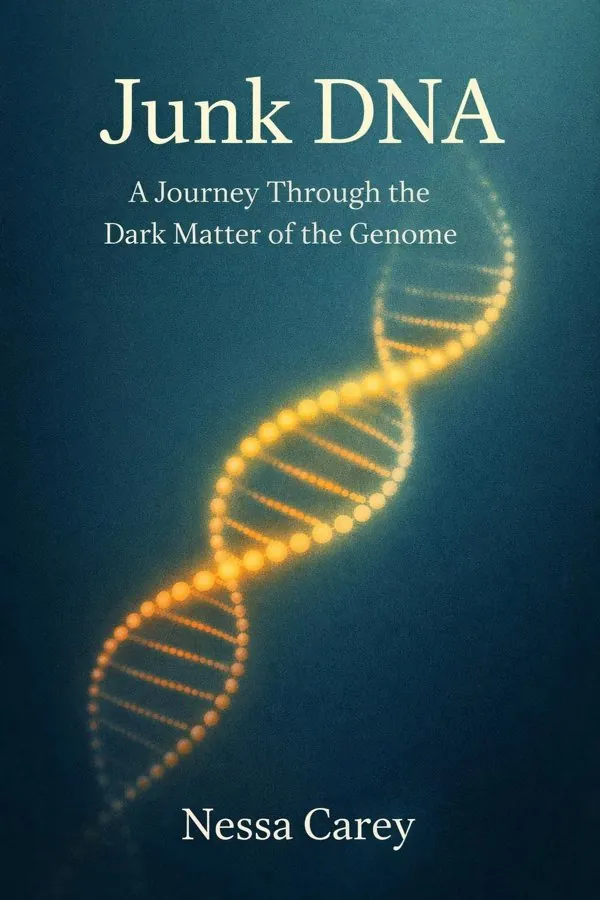
Junk DNA: A Journey Through the Dark Matter of the Genome: Summary & Key Insights
by Nessa Carey
 10 min10 chaptersAudio available
What Is Junk DNA: A Journey Through the Dark Matter of the Genome About?
Junk DNA: A Journey Through the Dark Matter of the Genome by Nessa Carey is a life_science book spanning 10 pages. This book explores the vast stretches of the human genome once dismissed as 'junk DNA' and reveals their crucial roles in gene regulation, disease, and evolution. Nessa Carey explains how these non-coding regions influence everything from development to aging, offering a compelling narrative about the hidden complexity of our genetic code.
This FizzRead summary covers all 10 key chapters of Junk DNA: A Journey Through the Dark Matter of the Genome in approximately 10 minutes, distilling the most important ideas, arguments, and takeaways from Nessa Carey's work. Also available as an audio summary and Key Quotes Podcast.
Junk DNA: A Journey Through the Dark Matter of the Genome
This book explores the vast stretches of the human genome once dismissed as 'junk DNA' and reveals their crucial roles in gene regulation, disease, and evolution. Nessa Carey explains how these non-coding regions influence everything from development to aging, offering a compelling narrative about the hidden complexity of our genetic code.
Who Should Read Junk DNA: A Journey Through the Dark Matter of the Genome?
This book is perfect for anyone interested in life_science and looking to gain actionable insights in a short read. Whether you're a student, professional, or lifelong learner, the key ideas from Junk DNA: A Journey Through the Dark Matter of the Genome by Nessa Carey will help you think differently.
- ✓Readers who enjoy life_science and want practical takeaways
- ✓Professionals looking to apply new ideas to their work and life
- ✓Anyone who wants the core insights of Junk DNA: A Journey Through the Dark Matter of the Genome in just 10 minutes
Want the full summary?
Get instant access to this book summary and 100K+ more with Fizz Moment.
Get Free SummaryAvailable on App Store • Free to download
Key Chapters
If genes are the content of the book of life, enhancers, silencers, and promoters are its punctuation and rhythm. These elements determine not just what is said, but when, how loudly, and in what context. For decades, molecular biologists focused on coding sequences as the locus of function. But in the late twentieth century, experiments with gene expression began to reveal something subtle: identical genes produced different outcomes depending on their regulatory environments.
Promoters act as gateways for transcription — the moment when DNA information is transcribed into RNA. Enhancers amplify the action of promoters, sometimes over astonishing distances, looping through three-dimensional space to reach their targets. Silencers, by contrast, dampen expression, ensuring that genes are activated only when needed. These elements are crafted from non-coding DNA, yet they define the character of a cell. The liver, brain, and skin cells of any one person share the same genome, but differ because distinct sets of enhancers and silencers sculpt their identities.
Throughout this exploration, it becomes clear that these regulatory regions embody biological nuance. Mutations within them can produce disease even when the coding region of a gene remains perfectly intact. Many cancers, autoimmune disorders, and developmental abnormalities arise not from faulty proteins but from misdirected regulation — a misplaced switch or a missing amplifier. These hidden sequences determine timing, coordination, and balance.
To appreciate enhancers and silencers is to grasp that genetic information is never static; it is interpretive, context-dependent, and relational. Nature’s genius lies not just in writing the script but in designing the stage directions. The genome is not a linear text but a living performance — and those regions once thought to be junk are the unseen directors keeping the play coherent.
+ 8 more chapters — available in the FizzRead app
All Chapters in Junk DNA: A Journey Through the Dark Matter of the Genome
About the Author
Nessa Carey is a British molecular biologist and science writer. She has worked in both academia and the biotechnology industry and is known for her accessible books on genetics and epigenetics, including 'The Epigenetics Revolution' and 'Junk DNA'.
Get This Summary in Your Preferred Format
Read or listen to the Junk DNA: A Journey Through the Dark Matter of the Genome summary by Nessa Carey anytime, anywhere. FizzRead offers multiple formats so you can learn on your terms — all free.
Available formats: App · Audio · PDF · EPUB — All included free with FizzRead
Download Junk DNA: A Journey Through the Dark Matter of the Genome PDF and EPUB Summary
Key Quotes from Junk DNA: A Journey Through the Dark Matter of the Genome
“In the early days of genomics, it seemed reasonable to believe that genes alone were the main actors in biology.”
“If genes are the content of the book of life, enhancers, silencers, and promoters are its punctuation and rhythm.”
Frequently Asked Questions about Junk DNA: A Journey Through the Dark Matter of the Genome
Junk DNA: A Journey Through the Dark Matter of the Genome by Nessa Carey is a life_science book that explores key ideas across 10 chapters. This book explores the vast stretches of the human genome once dismissed as 'junk DNA' and reveals their crucial roles in gene regulation, disease, and evolution. Nessa Carey explains how these non-coding regions influence everything from development to aging, offering a compelling narrative about the hidden complexity of our genetic code.
More by Nessa Carey
You Might Also Like
The Selfish Gene
Richard Dawkins
10 min
Awakenings
Oliver Sacks
10 min
Parasite Rex: Inside the Bizarre World of Nature's Most Dangerous Creatures
Carl Zimmer
10 min
The Atlas of Life on Earth
Various
10 min
The Book of Humans: The Story of How We Became Us
Adam Rutherford
10 min
The Horse
Wendy Williams
10 minBrowse by Category
Ready to read Junk DNA: A Journey Through the Dark Matter of the Genome?
Get the full summary and 100K+ more books with Fizz Moment.