
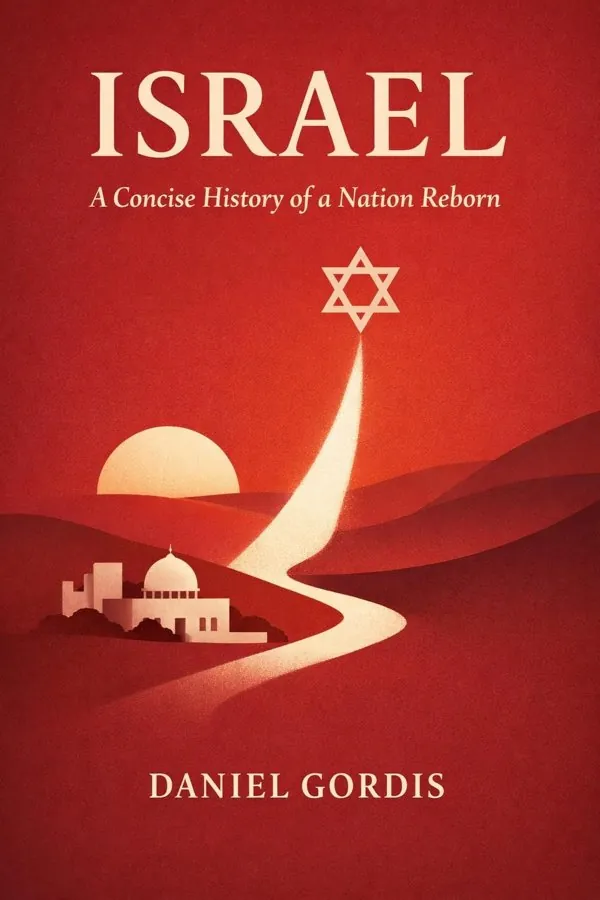
Israel: A Concise History of a Nation Reborn: Summary & Key Insights
 10 min11 chaptersAudio available
What Is Israel: A Concise History of a Nation Reborn About?
Israel: A Concise History of a Nation Reborn by Daniel Gordis is a world_history book spanning 11 pages. A comprehensive and accessible history of the State of Israel, tracing its origins from the Zionist movement through its founding in 1948 to its modern challenges and achievements. Gordis presents the political, cultural, and moral dilemmas that have shaped Israel’s identity and survival.
This FizzRead summary covers all 11 key chapters of Israel: A Concise History of a Nation Reborn in approximately 10 minutes, distilling the most important ideas, arguments, and takeaways from Daniel Gordis's work. Also available as an audio summary and Key Quotes Podcast.
Israel: A Concise History of a Nation Reborn
A comprehensive and accessible history of the State of Israel, tracing its origins from the Zionist movement through its founding in 1948 to its modern challenges and achievements. Gordis presents the political, cultural, and moral dilemmas that have shaped Israel’s identity and survival.
Who Should Read Israel: A Concise History of a Nation Reborn?
This book is perfect for anyone interested in world_history and looking to gain actionable insights in a short read. Whether you're a student, professional, or lifelong learner, the key ideas from Israel: A Concise History of a Nation Reborn by Daniel Gordis will help you think differently.
- ✓Readers who enjoy world_history and want practical takeaways
- ✓Professionals looking to apply new ideas to their work and life
- ✓Anyone who wants the core insights of Israel: A Concise History of a Nation Reborn in just 10 minutes
Want the full summary?
Get instant access to this book summary and 100K+ more with Fizz Moment.
Get Free SummaryAvailable on App Store • Free to download
Key Chapters
To understand Israel’s rebirth, one must begin with the moment Jewish history changed course—from passive endurance to active self-determination. The late nineteenth century witnessed the dawn of Zionism, born in the cafés and congresses of Europe amid a rising tide of nationalism and virulent anti-Semitism. Theodor Herzl, an assimilated Viennese journalist, emerged as the unlikely prophet who crystallized centuries of yearning into a political movement. His vision was both pragmatic and romantic: a sovereign Jewish homeland that would normalize Jewish life and redeem its dignity.
Herzl’s *Der Judenstaat* was not simply a proposal for refuge but a declaration that Jewish history need not remain a story written by others. Yet Zionism’s power lay not only in Herzl’s diplomacy but in the way it spoke to a dispersed people’s spiritual hunger. For the Jews of Eastern Europe, Zionism offered an escape from pogroms and humiliation; for secular intellectuals, it offered renewal through nationhood. The ideological diversity that would later define Israeli politics was already taking shape—religious, socialist, cultural, and revisionist Zionisms all contending to shape the contours of the new Jewish identity.
This was not an easy awakening. Many Jews, especially in the West, rejected Zionism as a betrayal of their integration into European life. But history’s cruelty would soon vindicate Herzl’s intuition. As empires crumbled and new nationalisms rose, Jewish vulnerability became untenable. The Zionist idea, radical at first, grew into an undeniable moral claim: that the survival of the Jewish people demanded a return to political sovereignty in their ancestral homeland.
The early immigrants—those of the First and Second Aliyot—were not arriving in a land waiting passively to welcome them. Ottoman Palestine was a place of neglected fields, recurring malaria, and deep poverty. Yet what those immigrants brought was not material wealth but willpower. They drained swamps, built agricultural settlements, and began reviving Hebrew as a living language. In their hands, Hebrew transformed from the tongue of ancient prophets to the speech of newborn children.
These pioneers were dreamers with shovels. They established kibbutzim and moshavim not merely as farms but as social laboratories, where equality and community replaced hierarchy and exile. Their achievements were fragile but formative; the collective spirit born in the settlements became the moral DNA of the future state. It was in these early decades that the ethos of self-reliance, service, and sacrifice took hold—values that would sustain Israelis through the wars and hardships to come.
Yet coexistence was never simple. Arab opposition to Jewish immigration grew with every wave, laying the groundwork for future conflict. Even so, the Jewish community, still small and scattered, persisted in believing that coexistence and nationhood could coexist. It was a fragile hope, but it was enough to keep faith alive.
+ 9 more chapters — available in the FizzRead app
All Chapters in Israel: A Concise History of a Nation Reborn
About the Author
Daniel Gordis is an American-born Israeli author and scholar, known for his works on Jewish thought, Israel, and Zionism. He is a senior vice president and Koret Distinguished Fellow at Shalem College in Jerusalem.
Get This Summary in Your Preferred Format
Read or listen to the Israel: A Concise History of a Nation Reborn summary by Daniel Gordis anytime, anywhere. FizzRead offers multiple formats so you can learn on your terms — all free.
Available formats: App · Audio · PDF · EPUB — All included free with FizzRead
Download Israel: A Concise History of a Nation Reborn PDF and EPUB Summary
Key Quotes from Israel: A Concise History of a Nation Reborn
“To understand Israel’s rebirth, one must begin with the moment Jewish history changed course—from passive endurance to active self-determination.”
“The early immigrants—those of the First and Second Aliyot—were not arriving in a land waiting passively to welcome them.”
Frequently Asked Questions about Israel: A Concise History of a Nation Reborn
Israel: A Concise History of a Nation Reborn by Daniel Gordis is a world_history book that explores key ideas across 11 chapters. A comprehensive and accessible history of the State of Israel, tracing its origins from the Zionist movement through its founding in 1948 to its modern challenges and achievements. Gordis presents the political, cultural, and moral dilemmas that have shaped Israel’s identity and survival.
You Might Also Like
The Age of Capital
Eric Hobsbawm
10 min
The Gulag Archipelago
Aleksandr Solzhenitsyn
10 min
Jerusalem: The Biography
Simon Sebag Montefiore
10 min
The Anglo-Saxons
James Campbell
10 min
The Boer War
Thomas Pakenham
10 min
The Industrial Revolutionaries: The Making of the Modern World 1776–1914
Gavin Weightman
10 minBrowse by Category
Ready to read Israel: A Concise History of a Nation Reborn?
Get the full summary and 100K+ more books with Fizz Moment.