
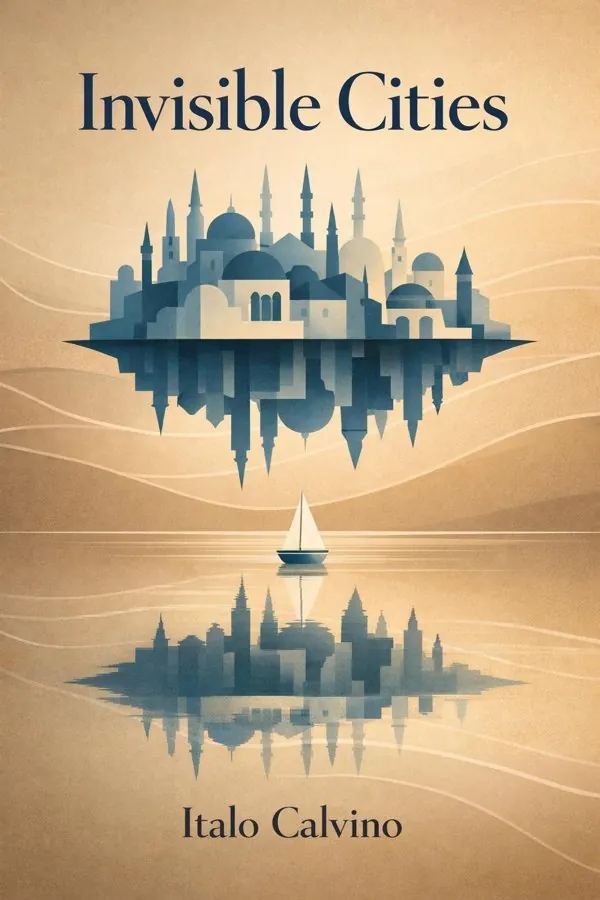
Invisible Cities: Summary & Key Insights
 10 min9 chaptersAudio available
Key Takeaways from Invisible Cities
A city is never only what stands before our eyes; it is also what survives in recollection.
Human beings do not merely live in cities; they project their longings into them.
We never encounter a city innocently; we interpret it through signs.
Some of Calvino’s most memorable cities are defined by thinness, suspension, delicacy, and improbable balance.
A city of trade is never only a marketplace for goods; it is a meeting ground for values, stories, habits, and identities.
What Is Invisible Cities About?
Invisible Cities by Italo Calvino is a classics book spanning 12 pages. Invisible Cities is one of those rare books that feels both weightless and profound. First published in 1972, Italo Calvino’s novel imagines a series of conversations between the aging emperor Kublai Khan and the Venetian traveler Marco Polo. Polo describes city after city, yet these are not ordinary travel reports. Each place becomes a meditation on memory, desire, death, language, signs, trade, time, and the fragile patterns by which human beings give meaning to life. As the book unfolds, the reader begins to sense that these cities may all be versions of one city, one mind, or even one civilization trying to understand itself. That is what makes the book so enduring: it transforms urban life into philosophy and storytelling into a way of thinking. Calvino, one of the 20th century’s most inventive literary minds, writes with extraordinary precision and imagination, blending fable, structural elegance, and emotional depth. Invisible Cities matters because it teaches us to read places differently—not as fixed maps, but as living networks of longing, memory, and interpretation.
This FizzRead summary covers all 9 key chapters of Invisible Cities in approximately 10 minutes, distilling the most important ideas, arguments, and takeaways from Italo Calvino's work. Also available as an audio summary and Key Quotes Podcast.
Invisible Cities
Invisible Cities is one of those rare books that feels both weightless and profound. First published in 1972, Italo Calvino’s novel imagines a series of conversations between the aging emperor Kublai Khan and the Venetian traveler Marco Polo. Polo describes city after city, yet these are not ordinary travel reports. Each place becomes a meditation on memory, desire, death, language, signs, trade, time, and the fragile patterns by which human beings give meaning to life. As the book unfolds, the reader begins to sense that these cities may all be versions of one city, one mind, or even one civilization trying to understand itself. That is what makes the book so enduring: it transforms urban life into philosophy and storytelling into a way of thinking. Calvino, one of the 20th century’s most inventive literary minds, writes with extraordinary precision and imagination, blending fable, structural elegance, and emotional depth. Invisible Cities matters because it teaches us to read places differently—not as fixed maps, but as living networks of longing, memory, and interpretation.
Who Should Read Invisible Cities?
This book is perfect for anyone interested in classics and looking to gain actionable insights in a short read. Whether you're a student, professional, or lifelong learner, the key ideas from Invisible Cities by Italo Calvino will help you think differently.
- ✓Readers who enjoy classics and want practical takeaways
- ✓Professionals looking to apply new ideas to their work and life
- ✓Anyone who wants the core insights of Invisible Cities in just 10 minutes
Want the full summary?
Get instant access to this book summary and 100K+ more with Fizz Moment.
Get Free SummaryAvailable on App Store • Free to download
Key Chapters
A city is never only what stands before our eyes; it is also what survives in recollection. In Invisible Cities, the cities of memory reveal that places are built as much from remembered experiences as from streets, walls, and monuments. Marco Polo’s descriptions suggest that architecture becomes meaningful only when it is charged with stories, absences, and traces of former lives. A staircase matters because someone once waited there. A square matters because generations have crossed it with hope, fear, or grief. Memory does not preserve a city perfectly; it reshapes it. What we remember is selective, emotional, and unstable, which means every city is constantly being rewritten in the minds of those who inhabit it.
This idea helps explain why two people can experience the same place so differently. One sees beauty, another loss. One sees opportunity, another exile. Calvino’s insight applies well beyond literature. Think of a childhood home revisited in adulthood: the rooms seem smaller, but emotionally they may feel larger than ever. Or consider historic districts in modern cities. Their value is not only visual; it lies in the accumulated meanings people attach to them.
In practical terms, this encourages a more reflective way of engaging with our surroundings. Journaling about places, recording family stories tied to neighborhoods, or preserving local histories can deepen our sense of belonging. Even in workplaces or schools, shared memory shapes culture more than official design does.
Actionable takeaway: Choose one place you know well and write down three memories attached to it. Notice how those memories change what the place means to you.
Human beings do not merely live in cities; they project their longings into them. In Calvino’s cities of desire, every avenue, tower, market, and balcony seems shaped by what people hope to find but can never fully possess. Desire creates movement. It sends us toward distant neighborhoods, imagined futures, better lives, and more satisfying versions of ourselves. Yet Calvino also shows that desire is double-edged: it generates beauty and energy, but it can also produce disappointment, illusion, and endless dissatisfaction.
These imagined cities reflect a familiar psychological truth. We often confuse a destination with a fulfillment. We assume that a new job, a new apartment, a more glamorous city, or a different relationship will resolve our unrest. But once we arrive, desire simply reorganizes itself around something else. Calvino captures this cycle with elegance. The city becomes a mirror of the mind, revealing that longing is not only about objects; it is a structure of attention.
This idea has practical relevance in modern life, especially in consumer culture and career ambition. Urban branding, lifestyle marketing, and digital media all sell images of desirable lives attached to places. A city neighborhood may be marketed as freedom, sophistication, or authenticity. But Calvino asks us to look deeper: what are we really seeking when we are drawn to a place?
Actionable takeaway: The next time you strongly want a new place, role, or lifestyle, ask yourself what feeling you expect it to provide. Name the underlying desire before chasing the surface image.
We never encounter a city innocently; we interpret it through signs. In Invisible Cities, signs include symbols, gestures, names, rituals, advertisements, layouts, and social signals. A city tells us how to move, what to value, whom to fear, and where to look. But signs do not simply clarify reality. They can also mislead, overwhelm, or detach us from direct experience. Calvino’s cities of signs expose a world in which meaning is always mediated. What we believe about a place may come less from the place itself than from the codes through which we have learned to read it.
This insight feels strikingly contemporary. Modern life is saturated with signage in every sense: brand identities, online ratings, neighborhood reputations, maps, headlines, and algorithms. Often we decide what a place is before we have actually experienced it. A district becomes "dangerous," "trendy," or "up-and-coming" because of repeated labels. In organizations, the same thing happens with titles, dress codes, and office design. Symbols create expectations, and expectations shape behavior.
Calvino invites readers to become more attentive interpreters. Rather than accepting appearances at face value, we can ask how meaning is being constructed. Is a luxury storefront expressing quality, or simply status? Is an institution projecting openness while enforcing exclusion? Is a person’s confidence a sign of competence, or just performance?
This perspective is useful in leadership, education, marketing, and daily social life. Good readers of signs are harder to manipulate and better able to perceive hidden structures.
Actionable takeaway: When entering a new environment, identify five visible signs that shape your impression of it, then ask which of those signs reveal reality and which merely stage it.
Some of Calvino’s most memorable cities are defined by thinness, suspension, delicacy, and improbable balance. These are not weak places; they are places that expose how little support is sometimes needed to hold an entire world together. The cities of thinness suggest that systems, relationships, and identities may appear solid while actually depending on fragile threads. Yet Calvino does not present fragility only as danger. Thinness can also mean elegance, economy, and freedom from unnecessary weight.
This idea runs through Calvino’s wider literary philosophy. He prized lightness not as superficiality, but as a disciplined way of resisting heaviness. In Invisible Cities, the image of a city stretched over voids or held aloft by slender structures encourages us to think about all the invisible supports beneath ordinary life: trust, routine, language, infrastructure, shared belief. Remove these, and the whole system trembles.
In practical life, this insight matters whenever we confuse visibility with strength. A successful company may look robust but depend on one key relationship. A family may seem stable but rely on unspoken sacrifices. A busy schedule may feel productive while hanging by a thread. Recognizing hidden supports allows for wiser maintenance.
It also suggests the value of simplification. Not every structure needs bulk; some become more resilient when stripped of excess. Designers, managers, and individuals can all ask whether they are carrying too much weight.
Actionable takeaway: Identify one area of your life that feels overly heavy or complicated, and remove one unnecessary layer. Lightness can be a form of clarity.
A city of trade is never only a marketplace for goods; it is a meeting ground for values, stories, habits, and identities. In Calvino’s trading cities, exchange becomes a broader human principle. People barter objects, but they also exchange glances, expectations, myths, customs, and misunderstandings. Trade builds cities because it creates circulation, and circulation generates transformation. Nothing that enters a city leaves it unchanged, and the city itself is altered by every transaction.
This idea broadens our understanding of economic life. Commerce is often treated as material and impersonal, yet Calvino shows that trade always has a cultural dimension. A market is a stage where social relations are negotiated. A port changes because of what passes through it. Even in today’s digital economies, platforms do more than distribute products; they transmit ways of speaking, valuing, and belonging.
On a personal level, this applies to everyday relationships. Conversations are a kind of exchange. So are collaborations, friendships, and conflicts. Every interaction leaves residues. In workplaces, teams do not only share information; they create norms. In neighborhoods, local businesses often become repositories of community identity precisely because exchange there includes recognition and trust.
Calvino’s lesson is that we should pay attention not only to what we acquire, but to what modes of life our exchanges reinforce. Are our transactions building mutuality, exploitation, efficiency, or isolation?
Actionable takeaway: In one recurring exchange—at work, online, or in your community—ask not just what is being traded, but what kind of relationship that exchange is creating.
No city is fully alive without also containing the presence of the dead. In Invisible Cities, Calvino’s reflections on death are not morbid interruptions but essential reminders that every human settlement is layered with endings. Cemeteries, ruins, memorials, inherited customs, and even street names testify that cities are inhabited by those who came before. The living move through arrangements partly designed by the dead, often without noticing it. This means that urban life is always a conversation across time.
Calvino suggests that how a city relates to death reveals its deepest values. Some cities hide mortality behind surfaces of novelty and expansion. Others ritualize remembrance and give the dead a clear place in civic life. In either case, death structures the imagination. It shapes what people build to endure, what they fear losing, and what they hope to transmit.
This insight speaks strongly to modern cultures that often avoid thinking about mortality. Yet meaningful planning—whether personal or collective—requires exactly that awareness. Families preserve stories because life is finite. Institutions archive records because memory fades. Cities protect landmarks because erasure is always possible. Even personal priorities become clearer when viewed against limited time.
Rather than darkening life, Calvino’s perspective deepens it. When we recognize that all human arrangements are temporary, we may care for them more intentionally. We may also become less seduced by the illusion of permanence.
Actionable takeaway: Visit or reflect on a place that connects your present life to those who came before you. Ask what inheritance you are receiving there—and what trace you hope to leave.
The dialogue between Marco Polo and Kublai Khan shows that description is never neutral. Language does not simply report cities; it constructs them. As Polo speaks, the emperor begins to inhabit places he has never seen. The city emerges in words, images, metaphors, and patterns of comparison. But language is also limited. No description can fully capture a place, and every act of naming excludes other possibilities. This tension gives Invisible Cities much of its philosophical power.
Calvino is deeply interested in how words mediate knowledge. The emperor seeks mastery, but Polo offers stories. Governance wants maps; imagination supplies fragments. Through this contrast, the book suggests that language is both a bridge and a barrier. It allows us to share inner worlds, but it also reveals how much remains unsaid. Misunderstanding is not an accident of communication; it is built into the effort itself.
This has practical implications wherever explanation matters: teaching, leadership, design, politics, and relationships. The words used to frame a problem often determine what solutions seem possible. Call a challenge a crisis, and people react one way. Call it a transition, and they react another. In personal life, the stories we tell about ourselves can either trap us or open alternatives.
Calvino encourages precision, imagination, and humility in communication. We should choose language carefully, but we should also remember that no description is final.
Actionable takeaway: Rewrite one situation in your life using different language. Notice how changing the words changes the meaning, and possibly the options you can see.
Modern culture often treats expansion as proof of vitality, but Calvino’s cities of continuous growth question that assumption. A city that keeps extending outward, multiplying structures, and accumulating activity may seem prosperous, yet it can also lose coherence, beauty, and livability. Growth without reflection becomes sprawl. Addition becomes burden. The city grows larger while becoming less habitable for the people inside it.
This is one of the book’s most quietly prophetic themes. Long before today’s debates about overdevelopment, congestion, and unsustainable systems, Calvino grasped that endless accumulation can hollow out meaning. A city may become crowded with objects, data, ambitions, and functions while leaving less room for attention, community, or contemplation. The same is true of personal life. More tasks, more possessions, more commitments, and more digital input can create the appearance of a full life while producing exhaustion and fragmentation.
In organizations, relentless scaling can erode culture. In technology, constant feature expansion can reduce usability. In cities, development that ignores human rhythm can produce alienation rather than flourishing. Calvino’s challenge is not to reject growth altogether, but to distinguish organic growth from compulsive enlargement.
The key question becomes: growth toward what? If expansion no longer serves human experience, it may be a disguised form of decay.
Actionable takeaway: Review one area of growth in your life or work and ask whether it is improving quality or merely increasing quantity. If it is the latter, pause before adding more.
All Chapters in Invisible Cities
About the Author
Italo Calvino (1923–1985) was one of the most inventive and influential writers of the 20th century. Born in Santiago de Las Vegas, Cuba, to Italian parents and raised in Sanremo, Italy, he developed a literary style known for its clarity, precision, wit, and imagination. After participating in the Italian Resistance during World War II, he began publishing fiction that moved from neorealism toward fable, fantasy, and formal experimentation. His major works include The Baron in the Trees, The Cloven Viscount, The Nonexistent Knight, Cosmicomics, Invisible Cities, and If on a Winter’s Night a Traveler. Calvino’s writing often explores language, structure, perception, and the relationship between imagination and reality. He remains widely read for his rare ability to unite philosophical depth with elegance and play.
Get This Summary in Your Preferred Format
Read or listen to the Invisible Cities summary by Italo Calvino anytime, anywhere. FizzRead offers multiple formats so you can learn on your terms — all free.
Available formats: App · Audio · PDF · EPUB — All included free with FizzRead
Download Invisible Cities PDF and EPUB Summary
Key Quotes from Invisible Cities
“A city is never only what stands before our eyes; it is also what survives in recollection.”
“Human beings do not merely live in cities; they project their longings into them.”
“We never encounter a city innocently; we interpret it through signs.”
“Some of Calvino’s most memorable cities are defined by thinness, suspension, delicacy, and improbable balance.”
“A city of trade is never only a marketplace for goods; it is a meeting ground for values, stories, habits, and identities.”
Frequently Asked Questions about Invisible Cities
Invisible Cities by Italo Calvino is a classics book that explores key ideas across 9 chapters. Invisible Cities is one of those rare books that feels both weightless and profound. First published in 1972, Italo Calvino’s novel imagines a series of conversations between the aging emperor Kublai Khan and the Venetian traveler Marco Polo. Polo describes city after city, yet these are not ordinary travel reports. Each place becomes a meditation on memory, desire, death, language, signs, trade, time, and the fragile patterns by which human beings give meaning to life. As the book unfolds, the reader begins to sense that these cities may all be versions of one city, one mind, or even one civilization trying to understand itself. That is what makes the book so enduring: it transforms urban life into philosophy and storytelling into a way of thinking. Calvino, one of the 20th century’s most inventive literary minds, writes with extraordinary precision and imagination, blending fable, structural elegance, and emotional depth. Invisible Cities matters because it teaches us to read places differently—not as fixed maps, but as living networks of longing, memory, and interpretation.
More by Italo Calvino

You Might Also Like




Browse by Category
Ready to read Invisible Cities?
Get the full summary and 100K+ more books with Fizz Moment.