
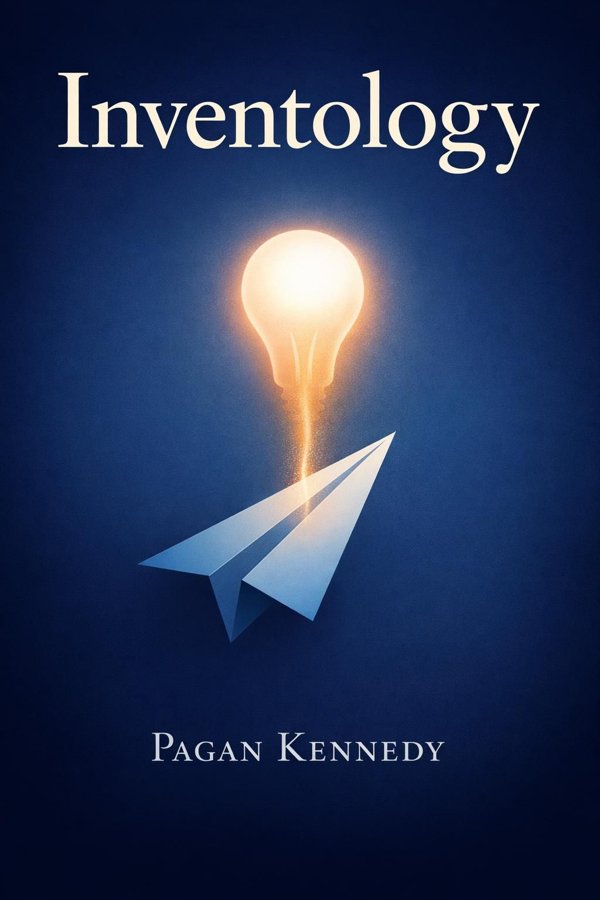
Inventology: How We Dream Up Things That Change the World: Summary & Key Insights
 10 min10 chaptersAudio available
Key Takeaways from Inventology: How We Dream Up Things That Change the World
Some of the most important inventions begin where certainty ends.
Knowing less can sometimes help you see more.
Great inventors are often better at spotting problems than solving them quickly.
Freedom sounds ideal, but unlimited freedom often produces vague thinking.
A lone spark may start an invention, but sustained innovation usually depends on other people.
What Is Inventology: How We Dream Up Things That Change the World About?
Inventology: How We Dream Up Things That Change the World by Pagan Kennedy is a creativity book spanning 10 pages. Inventology is a lively, idea-rich exploration of how inventions actually happen. Rather than treating innovation as the work of isolated geniuses struck by lightning, Pagan Kennedy shows that invention is a process shaped by curiosity, observation, frustration, collaboration, and repeated experimentation. Drawing on stories from science, technology, medicine, and everyday life, she examines how new ideas emerge when people notice unmet needs, combine existing knowledge in unusual ways, and stay open to surprise. The book matters because it demystifies creativity. It argues that invention is not a rare gift reserved for a few exceptional minds, but a set of habits and conditions that many people can cultivate. Kennedy is especially persuasive because she writes as a journalist and cultural observer deeply interested in the human side of discovery. With reporting, historical examples, and psychological insight, she reveals the hidden patterns behind breakthrough thinking. For readers interested in creativity, entrepreneurship, design, or problem-solving, Inventology offers both inspiration and a practical framework for generating ideas that can genuinely improve the world.
This FizzRead summary covers all 10 key chapters of Inventology: How We Dream Up Things That Change the World in approximately 10 minutes, distilling the most important ideas, arguments, and takeaways from Pagan Kennedy's work. Also available as an audio summary and Key Quotes Podcast.
Inventology: How We Dream Up Things That Change the World
Inventology is a lively, idea-rich exploration of how inventions actually happen. Rather than treating innovation as the work of isolated geniuses struck by lightning, Pagan Kennedy shows that invention is a process shaped by curiosity, observation, frustration, collaboration, and repeated experimentation. Drawing on stories from science, technology, medicine, and everyday life, she examines how new ideas emerge when people notice unmet needs, combine existing knowledge in unusual ways, and stay open to surprise. The book matters because it demystifies creativity. It argues that invention is not a rare gift reserved for a few exceptional minds, but a set of habits and conditions that many people can cultivate. Kennedy is especially persuasive because she writes as a journalist and cultural observer deeply interested in the human side of discovery. With reporting, historical examples, and psychological insight, she reveals the hidden patterns behind breakthrough thinking. For readers interested in creativity, entrepreneurship, design, or problem-solving, Inventology offers both inspiration and a practical framework for generating ideas that can genuinely improve the world.
Who Should Read Inventology: How We Dream Up Things That Change the World?
This book is perfect for anyone interested in creativity and looking to gain actionable insights in a short read. Whether you're a student, professional, or lifelong learner, the key ideas from Inventology: How We Dream Up Things That Change the World by Pagan Kennedy will help you think differently.
- ✓Readers who enjoy creativity and want practical takeaways
- ✓Professionals looking to apply new ideas to their work and life
- ✓Anyone who wants the core insights of Inventology: How We Dream Up Things That Change the World in just 10 minutes
Want the full summary?
Get instant access to this book summary and 100K+ more with Fizz Moment.
Get Free SummaryAvailable on App Store • Free to download
Key Chapters
Some of the most important inventions begin where certainty ends. One of Pagan Kennedy’s central insights is that invention often grows out of accidents, missteps, and unexpected observations. We tend to imagine inventors as people who know exactly what they are building from the start, but history shows something messier and more interesting: many breakthroughs happen when someone notices that a mistake has created a possibility. Serendipity, in this view, is not pure luck. It is luck noticed, interpreted, and pursued by a prepared mind.
Kennedy shows that accidental invention depends on attention. A failed experiment, an odd result, or a surprising use case can become valuable only if someone is curious enough to ask why it happened. This separates productive inventors from passive observers. Instead of dismissing anomalies, they treat them as signals. They understand that novelty often appears before it makes sense.
This idea applies far beyond laboratories. In business, a product may succeed with a customer group the creators never expected. In daily life, a workaround for an inconvenience can reveal a larger market need. A teacher improvising a classroom tool, a nurse modifying a routine process, or a hobbyist repurposing materials may all be doing early-stage invention.
The practical lesson is to stop treating mistakes as dead ends. Keep records of what failed, what behaved strangely, and what users did differently than expected. Review those moments regularly. The next time something goes wrong, ask a better question: what hidden opportunity is this accident revealing?
Knowing less can sometimes help you see more. Kennedy highlights a powerful paradox: experts have deep knowledge, but that same knowledge can trap them inside accepted assumptions. Outsiders, by contrast, are not yet loyal to the standard way of doing things. Because they have fewer intellectual habits to defend, they are more likely to ask basic questions, challenge conventions, and combine ideas from unrelated fields.
This does not mean expertise is useless. It means innovation often happens at the edge of expertise, where fresh perspective meets enough knowledge to act. Outsiders can notice problems insiders have normalized. They are often the people who ask, “Why must it work this way?” and refuse to accept “because it always has” as a satisfying answer.
Kennedy’s broader point is that invention frequently comes from cross-pollination. A person trained in one discipline may carry methods, metaphors, or tools into another. A designer entering healthcare may rethink patient experience. A biologist collaborating with an engineer may frame a problem in a radically different way. Newness often appears when one domain’s obvious answer becomes another domain’s breakthrough.
For readers, this is liberating. You do not need perfect credentials to contribute ideas. If you are entering a new field, your naivete may be an asset if paired with humility and research. Study enough to understand the real constraints, but preserve your beginner’s eye. Actionable takeaway: deliberately expose yourself to unfamiliar disciplines and ask simple, even uncomfortable questions. Innovation often begins with a perspective experts have forgotten to consider.
Great inventors are often better at spotting problems than solving them quickly. Kennedy argues that invention does not begin with brilliance in the abstract; it begins with noticing friction, unmet needs, and overlooked frustrations. Before a breakthrough can exist, someone has to recognize that something is broken, inefficient, inaccessible, dangerous, or unnecessarily complicated.
This shifts the focus from idea generation to problem discovery. Many people chase solutions before identifying what truly matters. Inventors work differently. They observe behavior closely. They pay attention to workarounds, complaints, delays, and recurring inconveniences. A workaround is especially revealing because it shows that users are already trying to patch a gap the system has failed to address.
Problem finding is also an empathetic act. It requires seeing the world from another person’s point of view. A useful invention often emerges not from technical obsession alone, but from careful attention to how people actually live. A tool that seems elegant to its creator may fail if it does not solve a real pain point. By contrast, even a simple, low-tech improvement can be transformative if it removes a persistent burden.
In practice, this means spending more time watching than brainstorming. Interview users. Shadow people in real environments. List annoyances that recur in your own routines. Ask where time, effort, money, or attention is being wasted. The best opportunities are often hidden in plain sight, disguised as ordinary irritation. Actionable takeaway: keep a “problem notebook” for two weeks and record every repeated inconvenience you encounter or observe. Start your next creative project by choosing one problem worth understanding deeply.
Freedom sounds ideal, but unlimited freedom often produces vague thinking. Kennedy shows that constraints are not the enemy of invention; they are frequently its engine. Limits of time, money, materials, space, or technical capability force people to make sharper choices. When inventors cannot do everything, they must focus on what matters most. That pressure can unlock elegant, unconventional solutions.
Constraints remove the illusion that innovation depends on endless resources. In many cases, scarcity increases ingenuity because it demands adaptation. A designer working with cheap materials may discover a simpler structure. A medical innovator serving low-income communities may create a device that is more portable, affordable, and practical than expensive alternatives. When the question changes from “What would be perfect?” to “What can work under real conditions?” invention becomes grounded and often more useful.
Kennedy also suggests that self-imposed constraints can be productive. Rules such as reducing steps, cutting cost by half, or designing for a novice user create creative tension. They narrow the problem in a way that invites originality. This is why some of the best products and systems are not the most feature-rich but the most thoughtfully simplified.
For everyday creators, the implication is powerful. Do not wait for ideal circumstances. Instead, use your limits as design prompts. Ask what a solution would look like if it had to be smaller, faster, cheaper, more durable, or easier to learn. Actionable takeaway: choose one project and impose three meaningful constraints on it. Then redesign from scratch. Often the version shaped by limits will be clearer, leaner, and more inventive than the original.
A lone spark may start an invention, but sustained innovation usually depends on other people. Kennedy emphasizes that breakthroughs are rarely the product of isolated genius alone. Inventors need collaborators, critics, users, mentors, and networks that supply feedback, skills, and unexpected connections. New ideas become stronger when they are tested against different minds.
This matters because invention is multidimensional. One person may identify the problem, another may understand the science, a third may refine the design, and a fourth may see how to bring the idea into the world. Networks accelerate this process by exposing inventors to information and perspectives they would not find on their own. Informal conversations, interdisciplinary communities, and chance introductions often play a larger role than formal plans.
Kennedy’s broader insight is that collaboration is not just about teamwork; it is about intellectual diversity. Productive networks contain people who do not think alike. They ask different questions, challenge assumptions, and point out blind spots. This can be uncomfortable, but it is precisely what helps weak ideas improve and promising ideas survive contact with reality.
Readers can apply this by treating creativity as a social process. Share unfinished concepts earlier. Seek feedback from people outside your field. Build relationships with practitioners who understand adjacent parts of the problem. Instead of protecting ideas too tightly, expose them to constructive stress. Actionable takeaway: identify three people with different expertise and ask each to critique the same idea from their own perspective. Their combined feedback will likely reveal a more innovative path than solitary thinking can produce.
Inventors are not a separate species. One of Kennedy’s most encouraging themes is that the psychology of invention can be cultivated. While some people may be naturally more curious or more tolerant of ambiguity, the habits behind creative breakthroughs are learnable: paying attention, asking unusual questions, persisting through failure, and remaining flexible when reality contradicts your plan.
This mindset includes a willingness to live with uncertainty. Inventors often work without guarantees that an idea will succeed, that others will understand it, or that the path forward is clear. Instead of needing immediate validation, they keep exploring. They are also willing to revise their identity. If the evidence changes, they change with it. That adaptability matters because invention is rarely linear.
Kennedy also points to emotional resilience. Creative work involves rejection, dead ends, and long periods of confusion. The inventor’s advantage is not constant inspiration but the ability to keep learning from frustration. A failed prototype is data. A skeptical response is information. What looks like discouragement can become direction if interpreted productively.
For readers, this reframes creativity from talent to practice. You can become more inventive by strengthening the mental habits that support exploration. Build routines that reward observation, experimentation, and reflection rather than perfection. Notice when you dismiss an idea too quickly because it is awkward or incomplete. Actionable takeaway: once a week, choose one assumption you hold about your work, tools, or routines and deliberately question it. The habit of interrogating the obvious is one of the most practical ways to train an inventor’s mind.
An idea becomes real when it meets resistance. Kennedy underscores the importance of prototyping and experimentation because invention does not advance through speculation alone. A concept may sound brilliant in conversation, but only when it is modeled, built, tested, or used does its true value become visible. Prototypes turn imagination into evidence.
This is crucial because early versions are supposed to be incomplete. Many people avoid prototyping because they fear embarrassment or imperfection. Inventors understand the opposite: rough versions are efficient learning tools. A quick mock-up can reveal flaws in usability, cost, durability, or logic far earlier than endless planning ever could. The point of a prototype is not to impress. It is to generate feedback.
Kennedy’s stories suggest that experimentation also changes the inventor. When people build things, they notice details they could not have predicted. Materials behave differently than expected. Users misunderstand instructions. Hidden opportunities emerge during interaction. Each test creates new information, and that information reshapes the next version.
This lesson applies to startups, creative projects, teaching methods, and process improvements. You do not need a fully polished solution to begin learning. You need the simplest version that allows reality to answer your assumptions. Actionable takeaway: for your next idea, define the smallest testable form it can take within one week. Build that version, put it in front of real users or stakeholders, and gather specific observations. Progress comes faster when feedback arrives before perfectionism takes over.
We invent with our minds, but also with our tools. Kennedy explores how technologies, instruments, and materials do more than help execute ideas; they expand the range of ideas people can even conceive. When a new tool appears, it changes what feels possible. It lets inventors observe previously invisible phenomena, manipulate matter in new ways, or reduce the cost of testing unusual concepts.
This means innovation is partly historical. Different eras produce different kinds of invention because the available tools change the creative landscape. A scientific instrument can reveal a new problem. A manufacturing method can make an old idea practical. A communication platform can connect scattered collaborators who would never have met before. Tools do not replace ingenuity, but they amplify and redirect it.
Kennedy’s deeper implication is that creators should pay attention not only to ideas but to infrastructure. If you want to become more inventive, upgrading your toolkit may matter as much as increasing motivation. Better tools can shorten experimentation cycles, improve visibility into problems, and lower the risk of trying unconventional approaches.
This also applies to mental tools: diagrams, models, simulation software, notebooks, and collaborative platforms can all help externalize thought. Often an invention appears only after an idea is represented differently. Actionable takeaway: audit the tools you use to think, design, and test. Identify one outdated or limiting tool and replace it with something that increases speed, visibility, or flexibility. Sometimes the fastest route to better ideas is building a better environment for ideas to emerge.
Tomorrow’s inventions will likely come from people who can connect worlds that used to stay separate. Kennedy points toward a future of invention shaped by interdisciplinarity, rapid technological change, and complex global problems. As challenges become more interconnected, the most valuable innovators will be those who can blend science with design, data with ethics, and technical skill with deep human understanding.
This future rewards synthesis over specialization alone. Specialized knowledge remains essential, but it is increasingly not enough. Climate, health, education, urban life, and digital systems all involve overlapping technical and social dimensions. Inventors who can move between domains, communicate across expertise, and understand systems rather than isolated parts will be better equipped to create solutions that endure.
Kennedy’s vision is hopeful because it expands who gets to participate. You do not need to fit an old stereotype of the lone mechanical genius. The future inventor may be a translator, connector, organizer, researcher, designer, coder, or community builder. In many cases, invention will look less like a single eureka moment and more like the careful integration of many insights into something newly useful.
For readers, the practical implication is to build a portfolio of perspectives. Learn to collaborate across fields. Strengthen both analytical and empathetic skills. Stay curious about technology, but also about the people and systems technology affects. Actionable takeaway: choose one area outside your expertise that intersects with your work and study it seriously for the next month. Hybrid understanding is becoming one of the strongest foundations for future innovation.
All Chapters in Inventology: How We Dream Up Things That Change the World
About the Author
Pagan Kennedy is an American author, journalist, and cultural observer whose work often explores innovation, science, creativity, and the hidden stories behind major ideas. She has written for prominent publications, including The New York Times Magazine, and is known for making complex subjects approachable through narrative-driven reporting. Kennedy’s writing frequently focuses on the human side of discovery, showing how inventors, thinkers, and outsiders shape culture and technology in unexpected ways. In Inventology, she combines journalistic curiosity with historical research and psychological insight to examine how inventions are actually born. Her work stands out for its ability to connect big intellectual questions with everyday experience, making her a compelling guide for readers interested in how ideas emerge and change the world.
Get This Summary in Your Preferred Format
Read or listen to the Inventology: How We Dream Up Things That Change the World summary by Pagan Kennedy anytime, anywhere. FizzRead offers multiple formats so you can learn on your terms — all free.
Available formats: App · Audio · PDF · EPUB — All included free with FizzRead
Download Inventology: How We Dream Up Things That Change the World PDF and EPUB Summary
Key Quotes from Inventology: How We Dream Up Things That Change the World
“Some of the most important inventions begin where certainty ends.”
“Knowing less can sometimes help you see more.”
“Great inventors are often better at spotting problems than solving them quickly.”
“Freedom sounds ideal, but unlimited freedom often produces vague thinking.”
“A lone spark may start an invention, but sustained innovation usually depends on other people.”
Frequently Asked Questions about Inventology: How We Dream Up Things That Change the World
Inventology: How We Dream Up Things That Change the World by Pagan Kennedy is a creativity book that explores key ideas across 10 chapters. Inventology is a lively, idea-rich exploration of how inventions actually happen. Rather than treating innovation as the work of isolated geniuses struck by lightning, Pagan Kennedy shows that invention is a process shaped by curiosity, observation, frustration, collaboration, and repeated experimentation. Drawing on stories from science, technology, medicine, and everyday life, she examines how new ideas emerge when people notice unmet needs, combine existing knowledge in unusual ways, and stay open to surprise. The book matters because it demystifies creativity. It argues that invention is not a rare gift reserved for a few exceptional minds, but a set of habits and conditions that many people can cultivate. Kennedy is especially persuasive because she writes as a journalist and cultural observer deeply interested in the human side of discovery. With reporting, historical examples, and psychological insight, she reveals the hidden patterns behind breakthrough thinking. For readers interested in creativity, entrepreneurship, design, or problem-solving, Inventology offers both inspiration and a practical framework for generating ideas that can genuinely improve the world.
You Might Also Like
Dimensions Of Creativity
Margaret A. Boden
10 min
How to Fly a Horse: The Secret History of Creation, Invention, and Discovery
Kevin Ashton
10 min
Imagine: How Creativity Works
Jonah Lehrer
10 min
The Accidental Creative: How to Be Brilliant at a Moment's Notice
Todd Henry
10 min
The Origins of Creativity
Edward O. Wilson
10 min
Wired to Create: Unraveling the Mysteries of the Creative Mind
Scott Barry Kaufman, Carolyn Gregoire
10 minBrowse by Category
Ready to read Inventology: How We Dream Up Things That Change the World?
Get the full summary and 100K+ more books with Fizz Moment.