
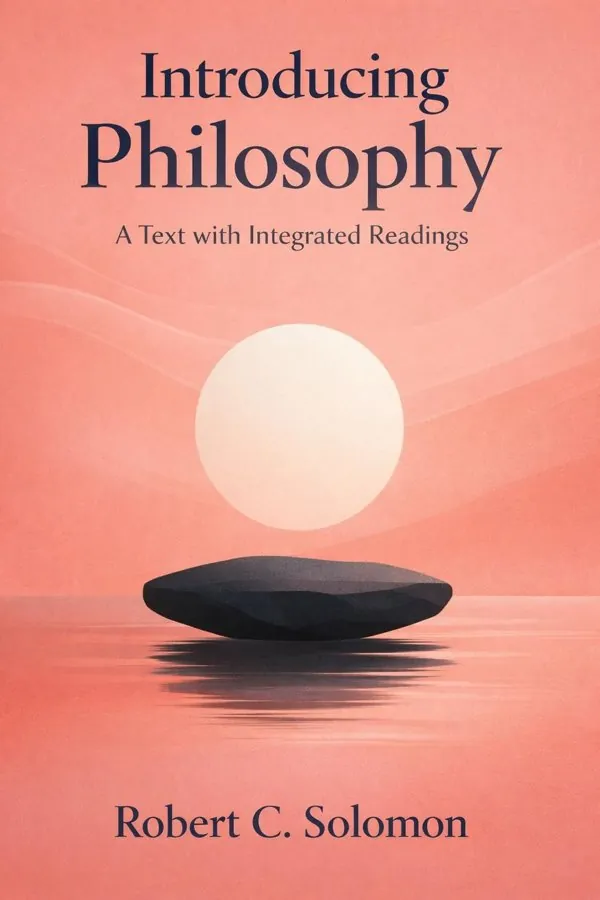
Introducing Philosophy: A Text with Integrated Readings: Summary & Key Insights
 10 min6 chaptersAudio available
What Is Introducing Philosophy: A Text with Integrated Readings About?
Introducing Philosophy: A Text with Integrated Readings by Robert C. Solomon is a western_phil book spanning 6 pages. Introducing Philosophy: A Text with Integrated Readings is a comprehensive introduction to Western philosophy that combines classic and contemporary readings with the author’s own commentary. It covers major philosophical questions about existence, knowledge, ethics, and the meaning of life, presenting them in an accessible and engaging way for students and general readers alike.
This FizzRead summary covers all 6 key chapters of Introducing Philosophy: A Text with Integrated Readings in approximately 10 minutes, distilling the most important ideas, arguments, and takeaways from Robert C. Solomon's work. Also available as an audio summary and Key Quotes Podcast.
Introducing Philosophy: A Text with Integrated Readings
Introducing Philosophy: A Text with Integrated Readings is a comprehensive introduction to Western philosophy that combines classic and contemporary readings with the author’s own commentary. It covers major philosophical questions about existence, knowledge, ethics, and the meaning of life, presenting them in an accessible and engaging way for students and general readers alike.
Who Should Read Introducing Philosophy: A Text with Integrated Readings?
This book is perfect for anyone interested in western_phil and looking to gain actionable insights in a short read. Whether you're a student, professional, or lifelong learner, the key ideas from Introducing Philosophy: A Text with Integrated Readings by Robert C. Solomon will help you think differently.
- ✓Readers who enjoy western_phil and want practical takeaways
- ✓Professionals looking to apply new ideas to their work and life
- ✓Anyone who wants the core insights of Introducing Philosophy: A Text with Integrated Readings in just 10 minutes
Want the full summary?
Get instant access to this book summary and 100K+ more with Fizz Moment.
Get Free SummaryAvailable on App Store • Free to download
Key Chapters
When we ask, 'What is real?', we confront the oldest and perhaps the most puzzling problem in philosophy—metaphysics. From Plato’s distinction between the world of changing appearances and the realm of unchanging Forms, to Aristotle’s grounded sense of substance as what truly exists, the quest to understand being itself defines the philosophical journey. Appearance and reality may coincide or diverge; our senses delight us and deceive us in equal measure.
In the modern period, Descartes sought certainty by doubting everything until only the clear and distinct truth of his own thinking self remained. His 'Cogito, ergo sum'—I think, therefore I am—becomes the pivot on which modern metaphysics turns. Yet centuries later, the existentialists would challenge his abstraction, reminding us that existence precedes essence—that to be real is not merely to think but to live, act, and choose.
I wish the reader to see metaphysics not as an ivory-tower exercise but as an inquiry into our daily encounter with reality. When you walk in a forest, when you look at a digital screen, when you contemplate whether artificial intelligence possesses consciousness, you are implicitly making metaphysical judgments. You are deciding what counts as real, what counts as illusion, and how much your mind participates in shaping that reality.
Throughout this section, you will see how thinkers from Hindu Vedantic philosophy to Heidegger’s phenomenology attempt to dissolve the rigid line between 'mind' and 'world.' Reality is not a static collection of things but an ongoing field of relationships. The question is not only 'What is?' but 'How do we live within being?'—a question that resonates through every philosophical system and every moment of awareness.
Who are you, really? That question, simple to ask yet infinitely complex to answer, lies at the center of philosophy’s exploration of the self. When Locke argued that personal identity resides in memory—the continuity of consciousness over time—he was offering a psychological rather than a metaphysical explanation of selfhood. Hume, skeptical of even that, declared that the self is nothing but a bundle of perceptions, a fleeting sequence without an underlying essence.
The modern existentialists took that insight to heart. Sartre insisted that there is no pre-given nature or essence to any human being. We exist first; we make ourselves afterward through choices. The self, in other words, is not found—it is created. The freedom this realization grants us is immense, but so is the burden. If there is no given self, no destiny mapped out in advance, then every decision is a declaration of who we are.
Neuroscience, psychology, and artificial intelligence now join philosophy in wrestling with these ancient puzzles. Is consciousness merely a function of brain activity? Or is there an irreducible 'subjective' dimension that escapes physical explanation? My position is not to settle these debates but to encourage you to appreciate their depth. Every time you feel regret, nostalgia, or hope, you are witnessing the self’s temporal fabric—its capacity to remember, to project, and to evaluate.
The self is, finally, a story—never complete, always in revision. And philosophy provides the language and structure by which that story can be examined with honesty and compassion.
+ 4 more chapters — available in the FizzRead app
All Chapters in Introducing Philosophy: A Text with Integrated Readings
About the Author
Robert C. Solomon (1942–2007) was an American philosopher known for his work in existentialism, ethics, and the philosophy of emotions. He taught at the University of Texas at Austin and authored numerous influential books that made philosophy accessible to a broad audience.
Get This Summary in Your Preferred Format
Read or listen to the Introducing Philosophy: A Text with Integrated Readings summary by Robert C. Solomon anytime, anywhere. FizzRead offers multiple formats so you can learn on your terms — all free.
Available formats: App · Audio · PDF · EPUB — All included free with FizzRead
Download Introducing Philosophy: A Text with Integrated Readings PDF and EPUB Summary
Key Quotes from Introducing Philosophy: A Text with Integrated Readings
“', we confront the oldest and perhaps the most puzzling problem in philosophy—metaphysics.”
“That question, simple to ask yet infinitely complex to answer, lies at the center of philosophy’s exploration of the self.”
Frequently Asked Questions about Introducing Philosophy: A Text with Integrated Readings
Introducing Philosophy: A Text with Integrated Readings by Robert C. Solomon is a western_phil book that explores key ideas across 6 chapters. Introducing Philosophy: A Text with Integrated Readings is a comprehensive introduction to Western philosophy that combines classic and contemporary readings with the author’s own commentary. It covers major philosophical questions about existence, knowledge, ethics, and the meaning of life, presenting them in an accessible and engaging way for students and general readers alike.
More by Robert C. Solomon
You Might Also Like
A Little History of Philosophy
Nigel Warburton
10 min
Areopagitica
John Milton
10 min
How To Think Like A Philosopher: Essential Principles For Clear Thinking
Peter Cave
10 min
Language, Truth and Logic
A. J. Ayer
10 min
The Age of Reason
Thomas Paine
10 min
The Essays
Michel De Montaigne
10 minBrowse by Category
Ready to read Introducing Philosophy: A Text with Integrated Readings?
Get the full summary and 100K+ more books with Fizz Moment.