
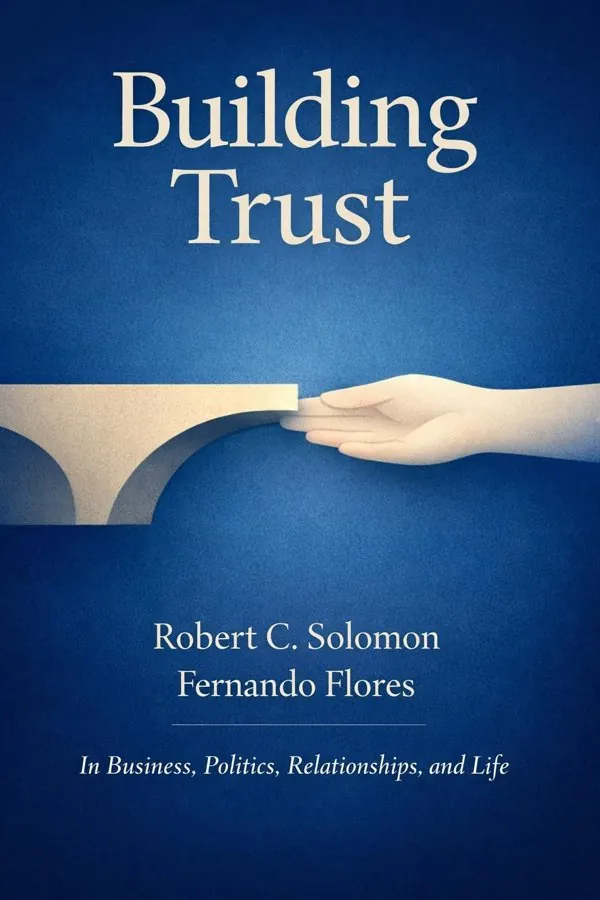
Building Trust: In Business, Politics, Relationships, and Life: Summary & Key Insights
by Robert C. Solomon, Fernando Flores
 10 min9 chaptersAudio available
What Is Building Trust: In Business, Politics, Relationships, and Life About?
Building Trust: In Business, Politics, Relationships, and Life by Robert C. Solomon, Fernando Flores is a leadership book spanning 9 pages. Este libro explora la naturaleza de la confianza como una habilidad emocional esencial en la vida personal y profesional. Los autores, un filósofo y un ejecutivo, argumentan que la confianza no es simplemente un estado que existe o se pierde, sino una práctica activa que se construye, mantiene y restaura mediante la comunicación, la empatía y la responsabilidad compartida.
This FizzRead summary covers all 9 key chapters of Building Trust: In Business, Politics, Relationships, and Life in approximately 10 minutes, distilling the most important ideas, arguments, and takeaways from Robert C. Solomon, Fernando Flores's work. Also available as an audio summary and Key Quotes Podcast.
Building Trust: In Business, Politics, Relationships, and Life
Este libro explora la naturaleza de la confianza como una habilidad emocional esencial en la vida personal y profesional. Los autores, un filósofo y un ejecutivo, argumentan que la confianza no es simplemente un estado que existe o se pierde, sino una práctica activa que se construye, mantiene y restaura mediante la comunicación, la empatía y la responsabilidad compartida.
Who Should Read Building Trust: In Business, Politics, Relationships, and Life?
This book is perfect for anyone interested in leadership and looking to gain actionable insights in a short read. Whether you're a student, professional, or lifelong learner, the key ideas from Building Trust: In Business, Politics, Relationships, and Life by Robert C. Solomon, Fernando Flores will help you think differently.
- ✓Readers who enjoy leadership and want practical takeaways
- ✓Professionals looking to apply new ideas to their work and life
- ✓Anyone who wants the core insights of Building Trust: In Business, Politics, Relationships, and Life in just 10 minutes
Want the full summary?
Get instant access to this book summary and 100K+ more with Fizz Moment.
Get Free SummaryAvailable on App Store • Free to download
Key Chapters
To understand trust, we must abandon the notion that it is a simple question of belief or probability. Trust is not rational calculation; it is interpretation and commitment. It involves reading another person’s intentions, judging their character, and deciding to depend upon them—knowing that disappointment is always possible. This is what makes trust so distinctly human: it involves emotion and choice together.
When I speak of trust as a dynamic process, I mean that trust unfolds through interaction. Each promise we make, each response we give, each silence we offer, contributes to this ongoing construction. It is not something that exists independently of our actions; it is created through those actions. Consider two colleagues who must collaborate on a project. Trust between them is not defined by contracts or formal agreements, but by how they interpret one another’s commitments, how they respond to mistakes, and how they acknowledge one another’s efforts. In that sense, trust is a kind of conversation—a continuous negotiation of meaning.
This perspective allows us to see that trust thrives not in certainty, but in honest engagement. One cannot control or force it; but one can evoke it by acting with integrity and openness. To engage in trust means to take an emotional risk, to allow oneself to be vulnerable to another person’s freedom. Such vulnerability is not weakness—it is a form of moral and emotional courage. When we build trust, we bind ourselves to others in ways that reveal our shared humanity.
If trust were merely rational, it would be much easier to manage, predict, or repair. But trust is rooted in our emotional lives. It arises from empathy, vulnerability, and the need for recognition. Every act of trust is an emotional gesture that says, 'I believe in you; I depend on you; I open myself to you.'
This emotional openness makes trust powerful—and precarious. To trust is to expose oneself to uncertainty, and to acknowledge that others matter deeply to our well-being. Empathy allows us to see them not as abstract agents, but as people with hopes and frailties similar to ours. Authenticity, therefore, becomes the emotional core of trust. Without it, interactions become manipulative and shallow.
In professional contexts, emotions are often marginalized, treated as interference. But Flores and I insist that they are central. A team that ignores its emotional atmosphere cannot build genuine trust. Leaders must be able to read the moods of their organizations, to understand fear, resentment, enthusiasm, and pride as shared emotional realities. It is only by addressing those emotions honestly that collective trust can emerge. When emotion and integrity come together, trust becomes possible—not because people are perfect, but because they are fully recognized.
+ 7 more chapters — available in the FizzRead app
All Chapters in Building Trust: In Business, Politics, Relationships, and Life
About the Authors
Robert C. Solomon fue un filósofo estadounidense especializado en ética y emociones, conocido por su trabajo sobre la autenticidad y la filosofía existencial. Fernando Flores es un empresario y pensador chileno, reconocido por sus aportes en liderazgo, comunicación y teoría organizacional.
Get This Summary in Your Preferred Format
Read or listen to the Building Trust: In Business, Politics, Relationships, and Life summary by Robert C. Solomon, Fernando Flores anytime, anywhere. FizzRead offers multiple formats so you can learn on your terms — all free.
Available formats: App · Audio · PDF · EPUB — All included free with FizzRead
Download Building Trust: In Business, Politics, Relationships, and Life PDF and EPUB Summary
Key Quotes from Building Trust: In Business, Politics, Relationships, and Life
“To understand trust, we must abandon the notion that it is a simple question of belief or probability.”
“If trust were merely rational, it would be much easier to manage, predict, or repair.”
Frequently Asked Questions about Building Trust: In Business, Politics, Relationships, and Life
Building Trust: In Business, Politics, Relationships, and Life by Robert C. Solomon, Fernando Flores is a leadership book that explores key ideas across 9 chapters. Este libro explora la naturaleza de la confianza como una habilidad emocional esencial en la vida personal y profesional. Los autores, un filósofo y un ejecutivo, argumentan que la confianza no es simplemente un estado que existe o se pierde, sino una práctica activa que se construye, mantiene y restaura mediante la comunicación, la empatía y la responsabilidad compartida.
You Might Also Like

Extreme Ownership
Jocko Willink
10 min
Dare to Lead
Brene Brown
10 min
Leaders Eat Last
Simon Sinek
10 min
The 21 Irrefutable Laws of Leadership
John Maxwell
10 min
Start With Why
Simon Sinek
10 min
How to Lead When You're Not in Charge
Clay Scroggins
10 minBrowse by Category
Ready to read Building Trust: In Business, Politics, Relationships, and Life?
Get the full summary and 100K+ more books with Fizz Moment.