
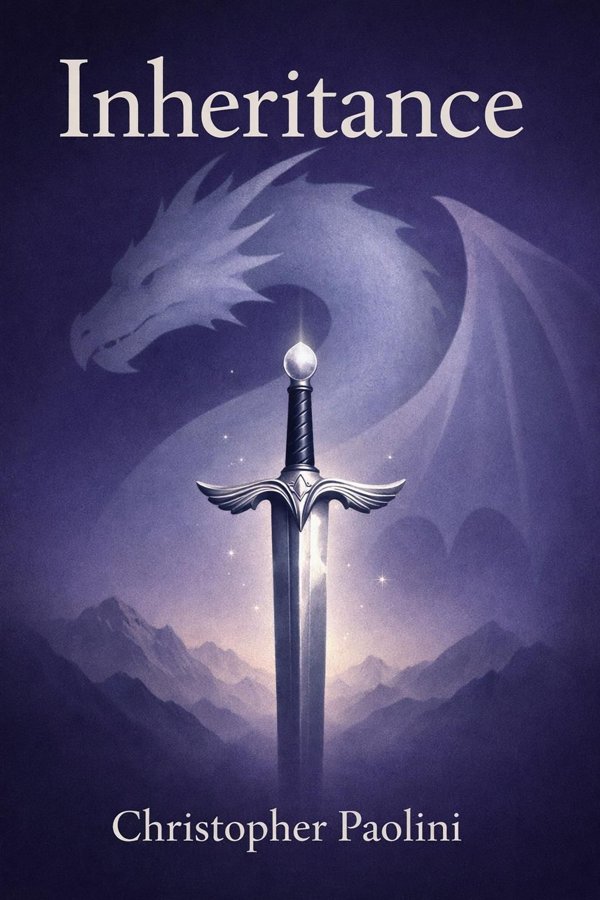
Inheritance: Summary & Key Insights
 10 min9 chaptersAudio available
Key Takeaways from Inheritance
The most decisive battles are often won long before the first blow is struck.
Leadership becomes real when every decision carries a human cost.
No one defeats a vast tyranny alone, and Inheritance makes that truth impossible to ignore.
Heroism is often less about extraordinary destiny than about refusing to stop when ordinary people would break.
Sometimes the answer to an impossible problem lies not in greater force, but in forgotten inheritance.
What Is Inheritance About?
Inheritance by Christopher Paolini is a scifi_fantasy book spanning 8 pages. Inheritance is the sweeping conclusion to Christopher Paolini’s Inheritance Cycle, a modern epic fantasy series built on dragons, war, prophecy, and the difficult transition from youth to responsibility. In this final installment, Eragon and his dragon Saphira move toward their inevitable confrontation with Galbatorix, the king whose near-absolute power has bent Alagaësia into fear and obedience. But the novel is more than a grand battle between hero and tyrant. It is a story about what it costs to overthrow oppression, how leaders carry the burden of hope, and why victory often demands moral clarity as much as strength. Paolini brings together the threads of politics, magic, ancient history, and personal loyalty that have defined the series, delivering a finale that is both emotionally resonant and strategically intricate. As the creator of one of contemporary fantasy’s most popular dragon-centered worlds, Paolini writes with deep familiarity with the genre’s traditions while giving them an earnest, character-driven intensity. Inheritance matters because it asks not only how evil is defeated, but what kind of world must be built afterward.
This FizzRead summary covers all 9 key chapters of Inheritance in approximately 10 minutes, distilling the most important ideas, arguments, and takeaways from Christopher Paolini's work. Also available as an audio summary and Key Quotes Podcast.
Inheritance
Inheritance is the sweeping conclusion to Christopher Paolini’s Inheritance Cycle, a modern epic fantasy series built on dragons, war, prophecy, and the difficult transition from youth to responsibility. In this final installment, Eragon and his dragon Saphira move toward their inevitable confrontation with Galbatorix, the king whose near-absolute power has bent Alagaësia into fear and obedience. But the novel is more than a grand battle between hero and tyrant. It is a story about what it costs to overthrow oppression, how leaders carry the burden of hope, and why victory often demands moral clarity as much as strength. Paolini brings together the threads of politics, magic, ancient history, and personal loyalty that have defined the series, delivering a finale that is both emotionally resonant and strategically intricate. As the creator of one of contemporary fantasy’s most popular dragon-centered worlds, Paolini writes with deep familiarity with the genre’s traditions while giving them an earnest, character-driven intensity. Inheritance matters because it asks not only how evil is defeated, but what kind of world must be built afterward.
Who Should Read Inheritance?
This book is perfect for anyone interested in scifi_fantasy and looking to gain actionable insights in a short read. Whether you're a student, professional, or lifelong learner, the key ideas from Inheritance by Christopher Paolini will help you think differently.
- ✓Readers who enjoy scifi_fantasy and want practical takeaways
- ✓Professionals looking to apply new ideas to their work and life
- ✓Anyone who wants the core insights of Inheritance in just 10 minutes
Want the full summary?
Get instant access to this book summary and 100K+ more with Fizz Moment.
Get Free SummaryAvailable on App Store • Free to download
Key Chapters
The most decisive battles are often won long before the first blow is struck. At the start of Inheritance, Eragon and Saphira are not simply marching toward Galbatorix; they are wrestling with the enormous gap between what they are and what they must become. Their enemy is not merely stronger in brute force. He is entrenched, cunning, and armed with generations of stolen power. That imbalance creates the central tension of the novel: how do courage and justice prevail when they seem insufficient on their own?
Paolini uses this stage of the story to show that preparation is more than gathering weapons or troops. Eragon must refine his judgment, discipline his emotions, and learn how to think beyond direct confrontation. Saphira, too, embodies the need to balance pride with patience. They have survived earlier trials, but survival is different from readiness. The coming conflict requires them to absorb hard truths: skill does not erase fear, noble intentions do not guarantee success, and destiny still demands labor.
This idea has clear relevance beyond fantasy. People often imagine major turning points—a career change, public challenge, family crisis, or difficult decision—as moments of spontaneous bravery. In reality, outcomes are shaped by preparation: studying the landscape, understanding weaknesses, and building emotional stamina. Like Eragon, we may need to admit that wanting to win is not the same as being ready to face what winning requires.
Paolini also reminds readers that preparation includes accepting uncertainty. Eragon cannot know every step ahead, but he can train, ask better questions, and remain open to unexpected help. That mindset turns fear into focus.
Actionable takeaway: Before facing any major challenge, pause and ask three questions: What do I still not understand, where am I overconfident, and what inner discipline must I build before the real test begins?
Leadership becomes real when every decision carries a human cost. Through the Varden’s campaign, Inheritance portrays war not as a series of heroic set pieces, but as an exhausting chain of sacrifices held together by trust in those at the top. Nasuada stands at the heart of this theme. Her leadership is not glamorous; it is administrative, moral, political, and deeply personal. She must keep diverse factions aligned, maintain morale, ration strength, and project confidence even while surrounded by uncertainty.
What makes Nasuada compelling is that her authority comes less from magical power than from discipline and conviction. In a world populated by dragons, elves, and ancient riders, she proves that endurance and clarity can rival supernatural force. Her choices are constantly constrained. Every victory costs lives. Every alliance requires compromise. Every delay risks losing momentum. Paolini uses her to show that leadership is often the art of carrying unbearable ambiguity without passing panic downward.
This applies strongly to modern forms of responsibility. Whether someone leads a team, a household, a classroom, or a community group, the same tension appears: people look to leaders not for perfection but for steadiness. Nasuada demonstrates that credibility is built when actions align with principles, especially under pressure. She listens, delegates, adapts, and refuses to detach from consequences.
The Varden’s campaign also emphasizes that institutions matter. Great causes collapse without logistics, communication, and shared purpose. Paolini resists romanticizing rebellion; he shows that freeing a nation requires administration as much as valor.
Actionable takeaway: If you are leading others through a difficult period, focus on three essentials: communicate honestly, make values-based decisions, and create systems that help people endure the strain instead of relying on inspiration alone.
No one defeats a vast tyranny alone, and Inheritance makes that truth impossible to ignore. One of the novel’s most important ideas is that alliances are not side details to the plot; they are the engine of resistance. The coalition opposing Galbatorix includes humans, elves, dwarves, urgals, and others shaped by different histories, grievances, and expectations. Their unity is fragile, and Paolini explores how difficult it is to turn shared opposition into genuine cooperation.
Diplomacy in the novel is not presented as weakness or delay. It is a form of courage. Characters must negotiate across prejudice, ancient wounds, and competing interests. Eragon, in particular, grows by learning that heroism is not only slaying enemies but also listening well enough to earn trust. The larger conflict can only be won if old assumptions are challenged. This is especially meaningful in a fantasy world where racial and cultural identities are deeply embedded in tradition.
Readers can easily connect this to real life. Families, organizations, and societies all depend on cooperation among people who do not think alike. Shared goals are often undermined by ego, poor communication, or unexamined bias. Inheritance suggests that progress comes when participants stop asking, “Who deserves control?” and begin asking, “What structure makes mutual survival possible?”
Paolini also underscores that alliances need maintenance. Goodwill is not self-sustaining. It must be renewed through fairness, transparency, and visible respect. Temporary coalitions break apart when one side feels used. Lasting unity is built when each group sees itself as a stakeholder rather than a tool.
Actionable takeaway: In any partnership, identify one assumption you hold about the other side, test it through honest conversation, and look for one practical way to create shared ownership instead of one-sided dependence.
Heroism is often less about extraordinary destiny than about refusing to stop when ordinary people would break. Roran’s storyline in Inheritance captures this principle with unusual force. Unlike Eragon, he is not a dragon rider, and he lacks access to the mythic stature that surrounds the series’ central magical figures. Yet again and again, he proves essential because he combines fierce determination with practical ingenuity. He leads through action, accepts risk others avoid, and inspires confidence by sharing hardship rather than standing above it.
Paolini uses Roran to ground the novel. In a story filled with ancient prophecies and immense magical power, Roran represents the strength of the human will under pressure. His battlefield successes are not the product of destiny but of adaptability, stubbornness, and a refusal to surrender responsibility. He thinks tactically, reacts quickly, and commits completely. That makes him one of the clearest examples in the book of earned authority.
This theme resonates because many readers are far more likely to face Roran-like challenges than Eragon-like ones. Most people do not have unusual gifts that automatically command attention. They have obligations, fear, limited resources, and difficult decisions. Roran shows that leadership can arise from reliability. People follow those who solve problems, stay present, and act decisively when circumstances are chaotic.
His story also highlights the double edge of courage. Boldness can save lives, but it can also exact emotional and physical costs. Paolini does not present resilience as painless. Instead, he shows that endurance often means carrying scars while continuing to serve.
Actionable takeaway: When facing a difficult situation, do not wait to feel exceptional. Identify the most urgent problem, take the next concrete step, and build credibility through useful action rather than dramatic declarations.
Power often reveals itself most clearly in what it tries to break. Nasuada’s captivity under Galbatorix is one of Inheritance’s most psychologically intense threads, and it deepens the novel’s exploration of tyranny. Here Paolini shifts the battlefield inward. Instead of armies and open combat, the struggle becomes one of endurance, self-command, and identity under coercion. Galbatorix does not merely seek obedience; he wants submission that appears voluntary. That distinction matters because tyranny aims not only to control actions but to colonize the soul.
Nasuada’s resistance is remarkable precisely because it is disciplined rather than explosive. She endures manipulation, temptation, intimidation, and pain without relinquishing her core self. In doing so, she demonstrates a crucial idea: inner freedom can survive even when external freedom is taken away. This does not romanticize suffering. Paolini is careful to show its brutality. But he also insists that moral resolve is a real form of power, one that can deny legitimacy to oppression.
The broader application is significant. People may never face a tyrant-king, but many encounter pressures that attempt to reshape their values—hostile workplaces, manipulative relationships, corrupt institutions, or social climates that reward silence. Nasuada’s example suggests that resistance sometimes means preserving clarity when confusion is being imposed on you. It means refusing to call wrong right simply because doing so would be easier.
Her captivity also teaches that resilience is not the absence of fear or pain. It is the refusal to let pain define your principles. In that sense, her struggle is as central to the novel’s victory as any military advance.
Actionable takeaway: In moments of pressure, name the value you refuse to surrender—integrity, honesty, dignity, loyalty—and let that explicit commitment guide your decisions when circumstances are trying to wear you down.
The climax of Inheritance offers a powerful challenge to the usual fantasy assumption that the strongest force wins. Eragon’s confrontation with Galbatorix is not solved by outmatching the tyrant in conventional terms. In fact, one of the book’s boldest ideas is that absolute power can become vulnerable in ways brute strength cannot anticipate. Galbatorix has spent his reign accumulating domination, believing mastery over others is the highest expression of order. Eragon ultimately reaches for something the king cannot comprehend: empathy as a weapon of truth.
This resolution matters because it reframes the moral structure of the series. Evil is not merely a quantity of violence. It is a failure of understanding, a radical severance from the reality of others’ suffering. By forcing Galbatorix to confront the pain he has inflicted, the novel exposes the emptiness at the core of tyrannical self-justification. Paolini suggests that some victories occur not when an enemy is simply overpowered, but when illusion is stripped away.
This concept has relevance outside fiction. In conflict, people often assume persuasion is naive and force is practical. Yet many destructive systems endure because they are protected by narratives—stories that excuse harm, deny accountability, or frame domination as necessity. Challenging those narratives can be transformative. That does not eliminate the need for firm action, but it broadens our sense of what meaningful resistance looks like.
The climax also reinforces that wisdom is strategic. Eragon succeeds because he is willing to think differently, to use insight where others expect only aggression. That is growth.
Actionable takeaway: When confronting a difficult person or system, do not ask only, “How do I overpower this?” Also ask, “What false story is sustaining this, and how can I expose it with clarity, evidence, and moral focus?”
Ending a war is not the same as healing the damage it leaves behind. After the fall of Galbatorix, Inheritance turns toward one of the most mature themes in the book: what comes after liberation. Paolini refuses to let triumph function as a simple closing note. The defeat of a tyrant creates possibility, but possibility immediately becomes responsibility. Political power must be redistributed, social wounds addressed, and institutions rebuilt in a way that does not reproduce old patterns.
This transition is especially important because the novel has spent so much time exploring the costs of oppression. A believable ending must therefore consider succession, legitimacy, and the future of groups that were previously marginalized or weaponized. The fate of the dragon eggs, the reorganization of leadership, and the reconsideration of alliances all reflect a broader truth: freedom survives only when it is structured, protected, and renewed.
Readers can apply this idea to any major turning point. Solving a crisis—leaving a bad job, ending a destructive habit, resolving a conflict, completing a difficult project—is often followed by a quieter but equally important phase: building the conditions that prevent relapse. Without reconstruction, people drift back into familiar dysfunction. Paolini’s ending recognizes that restoration is a creative task, not an automatic reward.
There is also emotional realism here. Victory can bring grief, uncertainty, and displacement. People who have spent years fighting may struggle to imagine peace. The future they wanted arrives, but it asks them to become new kinds of people.
Actionable takeaway: After any major success, create a rebuilding plan. Ask what structures, habits, relationships, and boundaries must be established now so that the gains you fought for can endure over time.
Some endings are victories precisely because they are painful. One of the deepest emotional currents in Inheritance is the recognition that fulfillment does not always look like staying where one began. Eragon’s journey concludes not with uncomplicated belonging, but with separation, transition, and the acceptance that his role in the world has changed permanently. This gives the novel its final layer of maturity. Growth is not only about acquiring strength; it is about becoming capable of leaving behind the life that once defined you.
Paolini treats this parting with seriousness. Bonds forged through war, friendship, loyalty, and love cannot remain untouched by transformation. Eragon’s future involves duty to dragons, riders, and generations yet to come. That future has meaning, but it also carries loss. The novel therefore argues that destiny is not a prize handed to the chosen; it is often a calling that rearranges personal happiness.
This theme resonates because many real-life transitions work the same way. Graduation, parenthood, migration, leadership, recovery, and personal reinvention all involve grief as well as opportunity. We may gain purpose while losing proximity to familiar people, places, or identities. Inheritance does not suggest that such losses should be dismissed. Instead, it frames them as evidence that change is real.
The result is a more honest kind of hope. The future is not painless, but it can still be worthy. Eragon’s departure underscores that protecting what one loves sometimes means stepping away to serve it more fully.
Actionable takeaway: When entering a new chapter, acknowledge both what you are gaining and what you must release. Naming the loss honestly can make it easier to embrace the responsibility and meaning of what comes next.
All Chapters in Inheritance
About the Author
Christopher Paolini is an American author best known for The Inheritance Cycle, the bestselling fantasy series that began with Eragon. He started writing the first book as a teenager, and its success quickly established him as a major voice in contemporary epic fantasy. Paolini’s fiction is known for immersive world-building, dragon lore, invented languages, and sweeping narratives shaped by themes of destiny, power, loyalty, and personal growth. His work draws on classic fantasy traditions while maintaining a direct, emotionally sincere storytelling style that has appealed to both young adult and adult readers. Beyond the original cycle, Paolini has continued expanding his imaginative universe and exploring new speculative fiction projects, but he remains most closely associated with the world of Alagaësia and the enduring journey of Eragon and Saphira.
Get This Summary in Your Preferred Format
Read or listen to the Inheritance summary by Christopher Paolini anytime, anywhere. FizzRead offers multiple formats so you can learn on your terms — all free.
Available formats: App · Audio · PDF · EPUB — All included free with FizzRead
Download Inheritance PDF and EPUB Summary
Key Quotes from Inheritance
“The most decisive battles are often won long before the first blow is struck.”
“Leadership becomes real when every decision carries a human cost.”
“No one defeats a vast tyranny alone, and Inheritance makes that truth impossible to ignore.”
“Heroism is often less about extraordinary destiny than about refusing to stop when ordinary people would break.”
“Sometimes the answer to an impossible problem lies not in greater force, but in forgotten inheritance.”
Frequently Asked Questions about Inheritance
Inheritance by Christopher Paolini is a scifi_fantasy book that explores key ideas across 9 chapters. Inheritance is the sweeping conclusion to Christopher Paolini’s Inheritance Cycle, a modern epic fantasy series built on dragons, war, prophecy, and the difficult transition from youth to responsibility. In this final installment, Eragon and his dragon Saphira move toward their inevitable confrontation with Galbatorix, the king whose near-absolute power has bent Alagaësia into fear and obedience. But the novel is more than a grand battle between hero and tyrant. It is a story about what it costs to overthrow oppression, how leaders carry the burden of hope, and why victory often demands moral clarity as much as strength. Paolini brings together the threads of politics, magic, ancient history, and personal loyalty that have defined the series, delivering a finale that is both emotionally resonant and strategically intricate. As the creator of one of contemporary fantasy’s most popular dragon-centered worlds, Paolini writes with deep familiarity with the genre’s traditions while giving them an earnest, character-driven intensity. Inheritance matters because it asks not only how evil is defeated, but what kind of world must be built afterward.
More by Christopher Paolini
You Might Also Like
Red Rising
Pierce Brown
10 min
Stranger in a Strange Land
Robert A. Heinlein
10 min
AI Valley
Chen Qiufan
10 min
Bloodchild
Octavia E. Butler
10 min
Do Androids Dream of Electric Sheep?
Philip K. Dick
10 min
Jujutsu Kaisen, Vol. 24
Gege Akutami
10 minBrowse by Category
Ready to read Inheritance?
Get the full summary and 100K+ more books with Fizz Moment.