
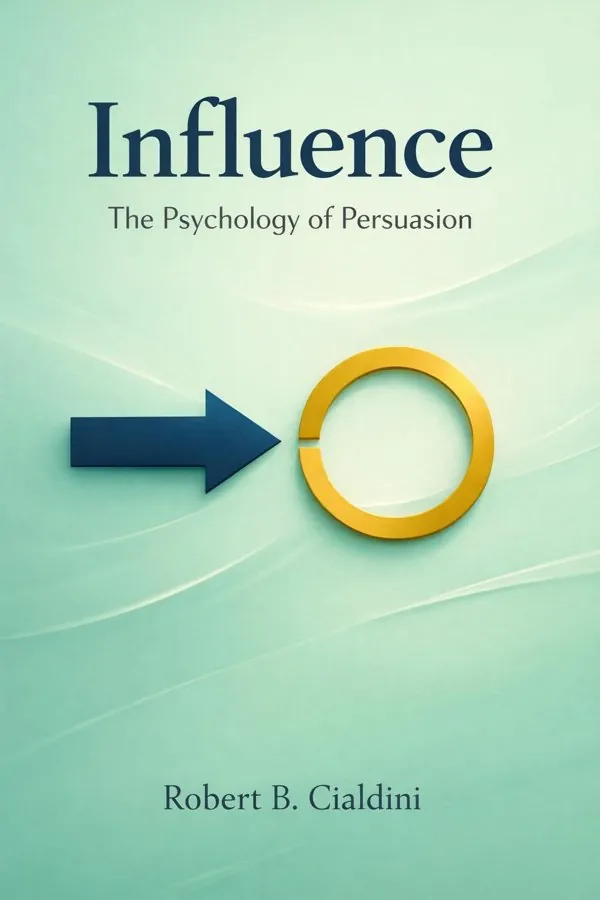
Influence: The Psychology of Persuasion: Summary & Key Insights
 10 min9 chaptersAudio available
Key Takeaways from Influence: The Psychology of Persuasion
The most persuasive moments in life often happen when we are not thinking deeply at all.
A small favor can produce a surprisingly large debt in the mind.
A person’s smallest yes can become the foundation for much larger decisions.
When we do not know what to do, we look for clues in other people.
We prefer to say yes to people we like, even when liking has little to do with the actual request.
What Is Influence: The Psychology of Persuasion About?
Influence: The Psychology of Persuasion by Robert B. Cialdini is a psychology book spanning 9 pages. Why do people say yes when, moments earlier, they were unsure? In Influence: The Psychology of Persuasion, Robert B. Cialdini answers that question by revealing the hidden psychological triggers that shape everyday decisions. Drawing on decades of research in social psychology, along with firsthand observation of sales organizations, charities, and compliance professionals, Cialdini shows that persuasion often works not through lengthy argument but through a small set of predictable mental shortcuts. He identifies six core principles—reciprocity, commitment and consistency, social proof, liking, authority, and scarcity—and explains why they are so powerful in business, marketing, negotiation, and personal relationships. What makes this book enduring is its dual purpose: it teaches readers how influence works, and it helps them recognize when those same techniques are being used on them. Cialdini, a respected psychologist and professor emeritus at Arizona State University, combines scientific rigor with vivid real-world examples. The result is a practical, eye-opening guide to understanding persuasion, protecting yourself from manipulation, and communicating more ethically and effectively.
This FizzRead summary covers all 9 key chapters of Influence: The Psychology of Persuasion in approximately 10 minutes, distilling the most important ideas, arguments, and takeaways from Robert B. Cialdini's work. Also available as an audio summary and Key Quotes Podcast.
Influence: The Psychology of Persuasion
Why do people say yes when, moments earlier, they were unsure? In Influence: The Psychology of Persuasion, Robert B. Cialdini answers that question by revealing the hidden psychological triggers that shape everyday decisions. Drawing on decades of research in social psychology, along with firsthand observation of sales organizations, charities, and compliance professionals, Cialdini shows that persuasion often works not through lengthy argument but through a small set of predictable mental shortcuts. He identifies six core principles—reciprocity, commitment and consistency, social proof, liking, authority, and scarcity—and explains why they are so powerful in business, marketing, negotiation, and personal relationships. What makes this book enduring is its dual purpose: it teaches readers how influence works, and it helps them recognize when those same techniques are being used on them. Cialdini, a respected psychologist and professor emeritus at Arizona State University, combines scientific rigor with vivid real-world examples. The result is a practical, eye-opening guide to understanding persuasion, protecting yourself from manipulation, and communicating more ethically and effectively.
Who Should Read Influence: The Psychology of Persuasion?
This book is perfect for anyone interested in psychology and looking to gain actionable insights in a short read. Whether you're a student, professional, or lifelong learner, the key ideas from Influence: The Psychology of Persuasion by Robert B. Cialdini will help you think differently.
- ✓Readers who enjoy psychology and want practical takeaways
- ✓Professionals looking to apply new ideas to their work and life
- ✓Anyone who wants the core insights of Influence: The Psychology of Persuasion in just 10 minutes
Want the full summary?
Get instant access to this book summary and 100K+ more with Fizz Moment.
Get Free SummaryAvailable on App Store • Free to download
Key Chapters
The most persuasive moments in life often happen when we are not thinking deeply at all. Cialdini begins with a simple but unsettling insight: human beings rely heavily on mental shortcuts because careful analysis of every decision would be exhausting. These shortcuts, or automatic responses, are usually helpful. If an item is expensive, we often assume it is high quality. If many people approve of something, we infer it is worth considering. In a world full of complexity, these quick rules allow us to move efficiently.
The problem is that shortcuts can be triggered artificially. Skilled persuaders do not always change our minds with logic; they activate cues that lead us to comply automatically. A retailer can raise the price of jewelry and increase sales because customers equate higher price with higher value. A fundraiser may increase donations by first offering a small gift, not because the gift is valuable, but because it activates a feeling of obligation. In both cases, the response is fast, familiar, and often unconscious.
Cialdini’s central warning is not that automatic behavior is bad, but that it can be exploited when we fail to notice the trigger being used. The same mental habits that make life manageable also make us vulnerable to manipulation. That is why understanding influence begins with understanding ourselves: we are not persuaded only by arguments; we are persuaded by conditions.
Actionable takeaway: when you feel an immediate urge to say yes, pause and ask, “Am I responding to the actual merits of this request, or to a psychological cue?”
A small favor can produce a surprisingly large debt in the mind. The rule of reciprocity is one of the oldest and most universal principles of social life: when someone gives us something, helps us, or makes a concession, we feel pressure to return it. This norm supports cooperation and trust, but it also gives persuaders a potent tool. People often comply not because they genuinely want to, but because refusing feels rude, ungrateful, or socially improper.
Cialdini shows how this principle operates in everyday settings. Charities may send free address labels or greeting cards before asking for donations. Store employees offer samples, hoping the act of receiving will increase purchases. In negotiation, a person may make an initial concession so the other side feels compelled to compromise in return. Even unsolicited favors can trigger the reciprocity response; we often feel indebted whether we asked for the gift or not.
One especially important variation is the “rejection-then-retreat” technique. A requester starts with a large ask that is likely to be refused, then follows with a smaller request. Because the second ask seems like a concession, the target feels pressure to reciprocate by agreeing. This can be highly effective in sales, fundraising, and personal requests.
Reciprocity is not inherently manipulative. Used ethically, it strengthens relationships and encourages generosity. Problems arise when favors are strategic traps designed to create compliance rather than goodwill.
Actionable takeaway: appreciate genuine generosity, but before agreeing to a request, ask yourself whether you truly want to say yes or merely feel obligated because someone gave first.
A person’s smallest yes can become the foundation for much larger decisions. Cialdini explains that once people make a choice, take a stand, or publicly commit to something, they feel pressure to behave consistently with that position. Consistency is socially valued; it signals reliability, discipline, and integrity. But the same desire to appear consistent can lock us into actions we would not have chosen if each decision were evaluated fresh.
This is why small commitments matter so much. A customer who agrees to answer a few questions becomes more likely to consider a purchase. A citizen who signs a petition may later be more willing to volunteer time or money. The famous “foot-in-the-door” effect works because agreeing to a minor request changes self-perception: “I am the kind of person who supports this cause.” Once that identity is established, later requests feel more natural.
Written, public, and effortful commitments are especially strong. If someone writes down a goal, announces it publicly, or works hard to achieve a position, they are more likely to stay aligned with it. Businesses use this in loyalty programs, trial offers, and enrollment processes. Relationships and habits also follow this pattern: small repeated actions build an internal story about who we are.
Cialdini’s deeper point is that consistency can be a strength when guided by conscious values, but a weakness when triggered by manipulation. We should not keep saying yes simply to avoid contradicting our earlier selves.
Actionable takeaway: make small commitments carefully, because they shape identity; before following through, ask whether consistency is serving your values or merely preserving your image.
We prefer to say yes to people we like, even when liking has little to do with the actual request. This principle sounds obvious, but Cialdini shows how systematically it shapes persuasion. Attractive people are often judged as more competent and trustworthy. Familiarity breeds comfort. Similarity creates rapport. Compliments lower resistance. Cooperation builds goodwill. When these forces combine, requests feel less like pressure and more like natural extensions of a positive relationship.
Sales professionals often use liking strategically. They search for shared interests, background similarities, or flattering points of connection. A salesperson who notices your hobbies, praises your taste, or mentions mutual acquaintances is not merely making conversation; they may be increasing the chance of compliance. Even associative liking matters: if a person or product is linked to enjoyable experiences, admired celebrities, or positive emotions, that warmth can transfer.
This principle has broad applications beyond selling. Managers gain more cooperation when they build sincere rapport. Teachers become more influential when students feel seen and respected. Negotiators often improve outcomes by establishing human connection before discussing terms. Yet liking can also cloud judgment. We may overlook weak arguments, unfair deals, or hidden costs because the messenger feels pleasant and familiar.
The lesson is not to distrust warmth, but to separate your feelings about the person from the merits of the proposal. Ethical persuasion strengthens relationships while respecting autonomy; manipulative persuasion uses charm to bypass scrutiny.
Actionable takeaway: build genuine rapport when you want to influence ethically, but when evaluating an offer, ask, “Would I agree to this if I did not particularly like the person presenting it?”
What seems limited often feels more desirable. Scarcity works because people assign greater value to opportunities that are rare, dwindling, exclusive, or about to disappear. A product labeled “limited edition” feels more special. A sale that ends tonight feels more urgent. A chance that may be lost can become more emotionally compelling than one that remains available. Scarcity does not only affect what we want; it intensifies how badly we want it.
Cialdini explains that scarcity influences us for two reasons. First, rare things are often genuinely valuable, so scarcity can serve as a useful shortcut. Second, and more psychologically powerful, limited availability threatens freedom of choice. When access is restricted, people experience reactance: a motivational push to reclaim what seems to be slipping away. This is why banned books can become more interesting, unavailable products more attractive, and hard-to-get people more captivating.
Marketers use scarcity constantly through countdown timers, low-stock alerts, exclusive memberships, and invite-only offers. Some of these signals reflect reality. Others are exaggerated or engineered to create pressure. Scarcity becomes even stronger when competition is implied: not only is the opportunity limited, but others may take it first.
The danger is that urgency narrows attention. Under time pressure, people focus on not missing out rather than on evaluating quality. Scarcity can make us buy the wrong thing, pay too much, or commit too quickly. The right response is not to ignore scarcity, but to slow down enough to judge whether what is scarce is also truly worthwhile.
Actionable takeaway: when urgency spikes your desire, pause and ask, “If this were fully available tomorrow, would I still want it just as much?”
Many acts of persuasion succeed because they trigger patterned behavior faster than conscious thought can intervene. Cialdini highlights how certain words, cues, and contexts can produce near-instant compliance. A famous example is the phrase “because.” When people hear a request supported by a reason—even a weak one—they become more likely to cooperate, because the structure resembles a legitimate explanation. Much of daily interaction runs on these scripts.
This insight connects the six principles into a broader view of human behavior. We live by learned routines: return favors, honor commitments, follow the crowd, trust liked people, defer to experts, grab rare opportunities. Most of the time these patterns are adaptive. They reduce friction and enable social coordination. But because they are automatic, they can be activated without our full awareness. That is why influence often feels invisible while it is happening.
Instant influence is especially common in busy, distracted environments. When inboxes are full, meetings are rushed, and attention is fragmented, people rely even more on shortcuts. Digital platforms amplify this dynamic through one-click purchases, push notifications, and interface designs built around speed and impulse. A request framed at the right moment, with the right cue, can bypass deeper evaluation.
The practical lesson is not to become suspicious of every interaction, but to recognize high-risk situations: fatigue, emotional arousal, social pressure, and time scarcity all increase automaticity. The more overloaded we are, the easier we are to steer.
Actionable takeaway: create pause points in important decisions—sleep on major purchases, delay responses under pressure, and build habits that force reflection when a request feels easy, urgent, or strangely compelling.
The difference between persuasion and manipulation is not effectiveness but integrity. Cialdini closes with an ethical challenge: the principles of influence are powerful precisely because they tap genuine features of human psychology. That means they can be used to help people make good decisions, strengthen trust, and communicate value clearly—or they can be used to exploit predictable vulnerabilities. Understanding influence therefore creates responsibility.
Ethical influence respects the interests of the other person. It presents truthful information, uses persuasion to clarify rather than deceive, and seeks mutually beneficial outcomes. A manager who builds consensus, a nonprofit that highlights authentic social proof, or a business that uses scarcity only when inventory is truly limited can all influence ethically. The techniques are not the problem; the intention and honesty behind them matter.
Cialdini also emphasizes self-defense. Once you can recognize influence triggers, you are less likely to respond blindly. If a request makes you feel indebted, rushed, flattered, or reluctant to appear inconsistent, those feelings can serve as warning signals. The goal is not emotional numbness. It is awareness. Manipulation loses power when its mechanism becomes visible.
This makes the book valuable for both persuaders and targets of persuasion. Leaders, marketers, teachers, and negotiators can communicate more effectively; consumers, employees, and citizens can protect their autonomy. The most mature use of influence combines skill with conscience.
Actionable takeaway: before using any persuasion technique, ask two questions: “Is this true?” and “Would I consider this fair if someone used it on me?”
All Chapters in Influence: The Psychology of Persuasion
About the Author
Robert B. Cialdini is a renowned American psychologist and professor emeritus of psychology and marketing at Arizona State University. He is best known for his groundbreaking research on persuasion, compliance, and the psychology of influence. Trained as a social psychologist, Cialdini combined academic rigor with unusual fieldwork, studying real-world tactics used by salespeople, fundraisers, advertisers, and other compliance professionals. This blend of science and observation gave his work unusual practical power. His book Influence: The Psychology of Persuasion became a global classic and has shaped thinking in business, marketing, negotiation, leadership, and behavioral science. Widely respected for making complex psychological ideas clear and actionable, Cialdini remains one of the most influential voices in understanding how and why people say yes.
Get This Summary in Your Preferred Format
Read or listen to the Influence: The Psychology of Persuasion summary by Robert B. Cialdini anytime, anywhere. FizzRead offers multiple formats so you can learn on your terms — all free.
Available formats: App · Audio · PDF · EPUB — All included free with FizzRead
Download Influence: The Psychology of Persuasion PDF and EPUB Summary
Key Quotes from Influence: The Psychology of Persuasion
“The most persuasive moments in life often happen when we are not thinking deeply at all.”
“A small favor can produce a surprisingly large debt in the mind.”
“A person’s smallest yes can become the foundation for much larger decisions.”
“When we do not know what to do, we look for clues in other people.”
“We prefer to say yes to people we like, even when liking has little to do with the actual request.”
Frequently Asked Questions about Influence: The Psychology of Persuasion
Influence: The Psychology of Persuasion by Robert B. Cialdini is a psychology book that explores key ideas across 9 chapters. Why do people say yes when, moments earlier, they were unsure? In Influence: The Psychology of Persuasion, Robert B. Cialdini answers that question by revealing the hidden psychological triggers that shape everyday decisions. Drawing on decades of research in social psychology, along with firsthand observation of sales organizations, charities, and compliance professionals, Cialdini shows that persuasion often works not through lengthy argument but through a small set of predictable mental shortcuts. He identifies six core principles—reciprocity, commitment and consistency, social proof, liking, authority, and scarcity—and explains why they are so powerful in business, marketing, negotiation, and personal relationships. What makes this book enduring is its dual purpose: it teaches readers how influence works, and it helps them recognize when those same techniques are being used on them. Cialdini, a respected psychologist and professor emeritus at Arizona State University, combines scientific rigor with vivid real-world examples. The result is a practical, eye-opening guide to understanding persuasion, protecting yourself from manipulation, and communicating more ethically and effectively.
More by Robert B. Cialdini
You Might Also Like
The Body Keeps the Score
Bessel van der Kolk
10 min
Surrounded by Idiots
Thomas Erikson
10 min
Emotional Intelligence
Daniel Goleman
10 min
Attached
Amir Levine
10 min
Why Does He Do That
Lundy Bancroft
10 min
Women Who Run with the Wolves
Clarissa Pinkola Estés
10 minBrowse by Category
Ready to read Influence: The Psychology of Persuasion?
Get the full summary and 100K+ more books with Fizz Moment.