
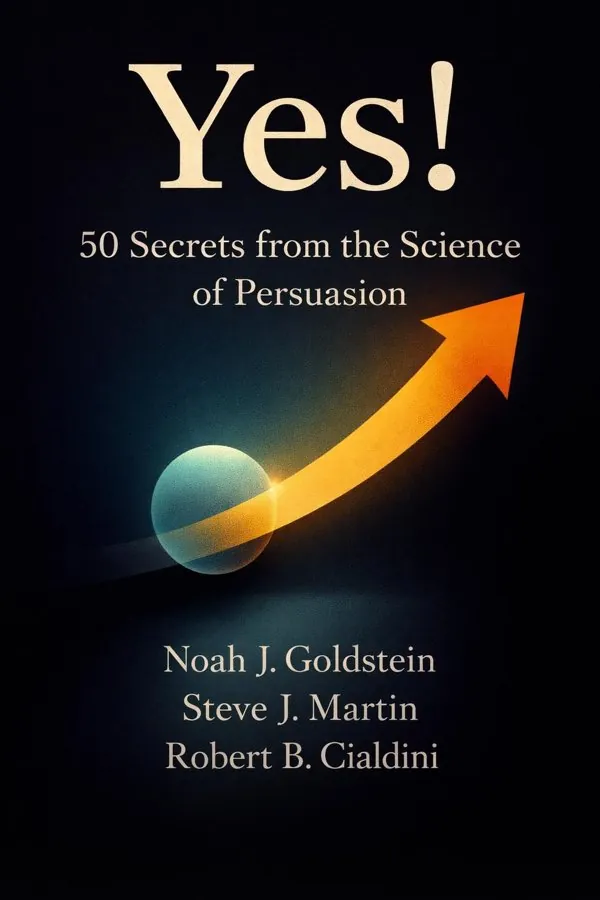
Yes! 50 Secrets from the Science of Persuasion: Summary & Key Insights
by Noah J. Goldstein, Steve J. Martin, Robert B. Cialdini
 10 min10 chaptersAudio available
Key Takeaways from Yes! 50 Secrets from the Science of Persuasion
A surprisingly small favor can open a much larger door.
The smallest yes can become the seed of a much bigger yes.
When people are unsure what to do, they look sideways before they look inward.
People do not simply evaluate messages; they also evaluate messengers.
Expertise often persuades before the argument even begins.
What Is Yes! 50 Secrets from the Science of Persuasion About?
Yes! 50 Secrets from the Science of Persuasion by Noah J. Goldstein, Steve J. Martin, Robert B. Cialdini is a communication book spanning 10 pages. Persuasion is often misunderstood as pressure, spin, or manipulation. In reality, the best persuasion works by aligning a message with how people naturally think, decide, and respond to social situations. In Yes! 50 Secrets from the Science of Persuasion, Noah J. Goldstein, Steve J. Martin, and Robert B. Cialdini distill decades of behavioral science into practical strategies that can help anyone become more effective in communication, leadership, sales, negotiation, and everyday influence. Rather than relying on intuition alone, the book shows how small, evidence-based adjustments in timing, wording, framing, and social context can dramatically change outcomes. Its power lies in its accessibility: each idea is rooted in real experiments and translated into practical lessons for daily life. The authors bring exceptional authority to the subject. Goldstein is a professor of management and psychology, Martin is a behavioral scientist specializing in influence, and Cialdini is one of the world’s most respected social psychologists. Together, they offer an ethical, research-backed guide to earning agreement, building trust, and inspiring action without coercion.
This FizzRead summary covers all 10 key chapters of Yes! 50 Secrets from the Science of Persuasion in approximately 10 minutes, distilling the most important ideas, arguments, and takeaways from Noah J. Goldstein, Steve J. Martin, Robert B. Cialdini's work. Also available as an audio summary and Key Quotes Podcast.
Yes! 50 Secrets from the Science of Persuasion
Persuasion is often misunderstood as pressure, spin, or manipulation. In reality, the best persuasion works by aligning a message with how people naturally think, decide, and respond to social situations. In Yes! 50 Secrets from the Science of Persuasion, Noah J. Goldstein, Steve J. Martin, and Robert B. Cialdini distill decades of behavioral science into practical strategies that can help anyone become more effective in communication, leadership, sales, negotiation, and everyday influence. Rather than relying on intuition alone, the book shows how small, evidence-based adjustments in timing, wording, framing, and social context can dramatically change outcomes. Its power lies in its accessibility: each idea is rooted in real experiments and translated into practical lessons for daily life. The authors bring exceptional authority to the subject. Goldstein is a professor of management and psychology, Martin is a behavioral scientist specializing in influence, and Cialdini is one of the world’s most respected social psychologists. Together, they offer an ethical, research-backed guide to earning agreement, building trust, and inspiring action without coercion.
Who Should Read Yes! 50 Secrets from the Science of Persuasion?
This book is perfect for anyone interested in communication and looking to gain actionable insights in a short read. Whether you're a student, professional, or lifelong learner, the key ideas from Yes! 50 Secrets from the Science of Persuasion by Noah J. Goldstein, Steve J. Martin, Robert B. Cialdini will help you think differently.
- ✓Readers who enjoy communication and want practical takeaways
- ✓Professionals looking to apply new ideas to their work and life
- ✓Anyone who wants the core insights of Yes! 50 Secrets from the Science of Persuasion in just 10 minutes
Want the full summary?
Get instant access to this book summary and 100K+ more with Fizz Moment.
Get Free SummaryAvailable on App Store • Free to download
Key Chapters
A surprisingly small favor can open a much larger door. One of the most powerful principles in persuasion is reciprocity: when people receive something meaningful, they often feel a natural urge to give something back. This response is deeply social and largely automatic. It helps explain why generosity, thoughtful gestures, and unexpected help can be far more persuasive than hard selling or repeated demands.
The key insight is that what you offer must feel personal, relevant, and sincere. A generic freebie may be ignored, but a helpful introduction, a tailored recommendation, or a genuine compliment can create a sense of obligation and goodwill. In professional settings, reciprocity appears when a manager gives employees flexibility and receives stronger commitment in return, or when a business shares useful information before asking for a sale. In personal life, it can be as simple as listening carefully, offering assistance first, or showing appreciation before making a request.
The authors emphasize that reciprocity works best when it is not manipulative. People can sense when a gift is really a disguised demand. Ethical persuasion means leading with authentic value rather than using favors as bait. When the other person feels respected, reciprocity becomes a foundation for lasting relationships rather than a one-time tactic.
Actionable takeaway: Before asking for support, provide something genuinely useful first—advice, time, insight, recognition, or assistance—and make sure it is tailored to the person you hope to influence.
The smallest yes can become the seed of a much bigger yes. Human beings like to see themselves as consistent. Once we publicly make a choice, take a position, or agree to a small step, we are more likely to behave in ways that match that earlier commitment. This is why persuasion often succeeds not by demanding immediate big actions, but by first securing small, voluntary ones.
A manager who asks a team member, “Will you try this for one week?” may have more success than one who insists on permanent change. A charity that invites someone to sign a petition before making a donation request can increase follow-through. A salesperson who asks customers to identify their needs in writing may make later agreement feel more self-directed and natural. The reason is simple: people want their actions to match their self-image.
The most effective commitments are active, public, and chosen freely. If someone writes down a goal, says it aloud, or shares it with others, the psychological pull toward consistency grows stronger. But forced commitment can backfire. People resist when they feel trapped, pressured, or deceived. The goal is not to corner them; it is to help them take ownership of a choice they already value.
Actionable takeaway: When seeking agreement, start with a small, voluntary commitment that reflects the person’s values, then connect your larger request to that earlier decision.
People do not simply evaluate messages; they also evaluate messengers. We are far more likely to say yes to someone we like, and we tend to like people who feel familiar, similar, respectful, and warm. This makes liking one of the most underestimated tools of persuasion. It is not about charm in the superficial sense. It is about connection.
Similarity can be surprisingly influential. Shared interests, common backgrounds, mutual experiences, or even small points of resemblance can increase trust and reduce resistance. In business, a salesperson who notices and sincerely acknowledges a customer’s priorities creates a stronger bond than one who launches straight into features and pricing. In leadership, managers who communicate as allies rather than distant authorities often gain greater cooperation. In everyday conversations, asking thoughtful questions and finding authentic common ground can change the tone of an interaction entirely.
Compliments also matter, but only when they are credible. Flattery that feels exaggerated damages trust, while specific appreciation builds rapport. So does collaboration: people tend to like those who work with them toward shared goals rather than those who seem to be pushing an agenda.
Actionable takeaway: Before making a persuasive case, invest time in building rapport—identify genuine common ground, show sincere interest, and communicate in a way that makes the other person feel understood rather than handled.
We notice what might disappear. Scarcity increases desire because people tend to assign greater value to opportunities, resources, or choices that are limited in quantity, time, or availability. When something may soon be unavailable, hesitation starts to feel risky. This is why limited offers, expiring deadlines, and exclusive access can move people to act.
But scarcity works best when it is meaningful, specific, and believable. A vague “limited-time offer” repeated endlessly loses its power. By contrast, a clear statement such as “registration closes Friday” or “only three spots remain” can create urgency because it gives the audience a concrete reason to decide. Scarcity also becomes stronger when tied to uniqueness. People do not only want what is rare; they want what they may uniquely miss.
In workplaces, scarcity can highlight the cost of delay: a proposal window is closing, a market opportunity is narrowing, or top talent may not remain available. In personal life, scarcity can remind us that attention, time, and energy are also limited, making present action more meaningful than endless postponement.
Still, false urgency damages credibility. Manufactured scarcity may produce a quick response once, but it weakens future influence. The ethical use of scarcity is to reveal genuine limits, not invent them.
Actionable takeaway: When asking for action, honestly highlight what could be lost through delay—time, access, choice, or opportunity—and make the constraint specific rather than dramatic.
The facts may stay the same, yet the decision changes. That is the power of framing. People do not respond only to objective information; they respond to how that information is presented. Word choice, comparisons, sequencing, and context all shape interpretation. A proposal can look appealing or unappealing depending on the frame around it.
One important tool is contrast. An option often seems more or less attractive depending on what it is compared with. A premium service may feel expensive in isolation but reasonable next to a more costly alternative. A request may feel difficult until it is contrasted with a larger burden. Another key element is gain versus loss framing. People often react differently to “90% success” than to “10% failure,” even though both describe the same outcome.
The authors show that smart framing is not deception. It is about presenting information in a way that helps people understand its significance. In leadership, framing a change initiative as an opportunity to improve performance may inspire more engagement than framing it as a correction of failure. In negotiations, setting an anchor can shape what seems fair. In personal communication, emphasizing benefits that matter to the listener makes agreement easier.
Actionable takeaway: Before making your case, ask how your audience is likely to interpret the choice, then frame your message around the comparison, language, and outcome that most clearly highlights its genuine value.
People rarely decide on logic alone. Even when decisions appear rational, emotion often determines what gets attention, what feels meaningful, and what ultimately moves someone to act. Persuasion becomes stronger when it acknowledges the emotional realities behind choices: fear, hope, pride, belonging, relief, and trust.
Empathy is central here. When people feel understood, they become less defensive and more open to influence. A manager who recognizes an employee’s stress before requesting extra effort is likely to get a better response than one who focuses only on deadlines. A negotiator who acknowledges the other side’s concerns creates a more cooperative tone. A marketer who speaks to a customer’s aspirations rather than just product features creates stronger resonance.
Stories are especially effective because they carry information through emotion. Statistics may prove a point, but a vivid example makes it memorable. That said, emotional persuasion should never become emotional exploitation. Fear-based pressure, guilt, or manipulation may generate short-term compliance but often at the cost of trust and relationship quality.
The most effective influence blends evidence with human understanding. Logic explains why something makes sense; empathy explains why it matters. Together, they make action feel both reasonable and emotionally acceptable.
Actionable takeaway: When making a persuasive appeal, address not only the practical facts but also the feelings involved—show that you understand the other person’s concerns, motivations, and emotional stakes.
People resist persuasion less when they do not feel they are being pushed. One of the most counterintuitive findings in the science of influence is that honesty about limitations can increase credibility. When communicators openly acknowledge a weakness, a constraint, or a less-than-perfect aspect of their offer, audiences often trust the rest of the message more.
This works because transparency signals confidence and fairness. If a business says, “This option is not the cheapest, but it lasts longer and requires less maintenance,” customers may see the claim as more believable than a one-sided pitch. If a leader admits that a change will be difficult before explaining its benefits, employees may be more willing to engage. A small concession can make a larger argument feel more trustworthy.
Trust also grows when intentions are clear. Hidden agendas trigger suspicion, while openness lowers defensiveness. People are more likely to cooperate when they feel informed rather than managed. This is particularly important in long-term relationships, where credibility compounds over time.
The authors present persuasion as something that works best in the open. Ethical influence is not weakened by candor; it is strengthened by it. In many cases, the shortest route to agreement is not a more polished message, but a more honest one.
Actionable takeaway: Increase credibility by acknowledging a real limitation or trade-off upfront, then explain clearly why your recommendation still offers the best overall value.
Persuasion is most effective when it is not treated as a single trick. The greatest strength of Yes! is its demonstration that influence comes from combining small, ethical adjustments that align with how people naturally decide. Reciprocity, social proof, liking, authority, scarcity, commitment, framing, and trust are not isolated tools; they reinforce one another when used thoughtfully.
Imagine a manager introducing a new initiative. Instead of issuing an order, she could begin by acknowledging employees’ concerns, share evidence from respected experts, highlight that similar teams have already succeeded with the approach, invite a small initial commitment, and explain the limited window for acting on the opportunity. None of these elements alone guarantees success, but together they create a persuasive environment that feels credible, relevant, and motivating.
The same is true in sales, parenting, customer service, fundraising, and negotiation. Better persuasion often depends less on pressure and more on design: choosing the right messenger, setting the right sequence, using the right comparison, and making the desired action easy to accept. The book’s broader message is that influence is not reserved for charismatic people. It is a learnable skill grounded in evidence.
Actionable takeaway: Before an important conversation, build a persuasion plan—ask which principles best fit the situation, then combine two or three ethically rather than relying on force, repetition, or instinct alone.
All Chapters in Yes! 50 Secrets from the Science of Persuasion
About the Authors
Noah J. Goldstein is a professor of management and psychology at UCLA whose research focuses on social influence, decision-making, and behavioral change. Steve J. Martin is a behavioral scientist and the director of Influence at Work in the UK, where he has helped organizations apply persuasion science in practical settings. Robert B. Cialdini is one of the world’s leading social psychologists and the bestselling author of Influence: The Psychology of Persuasion, a foundational work in the field. Together, these authors combine academic depth, real-world consulting experience, and decades of experimental research. Their collaboration in Yes! brings scientific credibility and practical clarity to one of the most important subjects in communication: how to influence others ethically and effectively.
Get This Summary in Your Preferred Format
Read or listen to the Yes! 50 Secrets from the Science of Persuasion summary by Noah J. Goldstein, Steve J. Martin, Robert B. Cialdini anytime, anywhere. FizzRead offers multiple formats so you can learn on your terms — all free.
Available formats: App · Audio · PDF · EPUB — All included free with FizzRead
Download Yes! 50 Secrets from the Science of Persuasion PDF and EPUB Summary
Key Quotes from Yes! 50 Secrets from the Science of Persuasion
“A surprisingly small favor can open a much larger door.”
“The smallest yes can become the seed of a much bigger yes.”
“When people are unsure what to do, they look sideways before they look inward.”
“People do not simply evaluate messages; they also evaluate messengers.”
“Expertise often persuades before the argument even begins.”
Frequently Asked Questions about Yes! 50 Secrets from the Science of Persuasion
Yes! 50 Secrets from the Science of Persuasion by Noah J. Goldstein, Steve J. Martin, Robert B. Cialdini is a communication book that explores key ideas across 10 chapters. Persuasion is often misunderstood as pressure, spin, or manipulation. In reality, the best persuasion works by aligning a message with how people naturally think, decide, and respond to social situations. In Yes! 50 Secrets from the Science of Persuasion, Noah J. Goldstein, Steve J. Martin, and Robert B. Cialdini distill decades of behavioral science into practical strategies that can help anyone become more effective in communication, leadership, sales, negotiation, and everyday influence. Rather than relying on intuition alone, the book shows how small, evidence-based adjustments in timing, wording, framing, and social context can dramatically change outcomes. Its power lies in its accessibility: each idea is rooted in real experiments and translated into practical lessons for daily life. The authors bring exceptional authority to the subject. Goldstein is a professor of management and psychology, Martin is a behavioral scientist specializing in influence, and Cialdini is one of the world’s most respected social psychologists. Together, they offer an ethical, research-backed guide to earning agreement, building trust, and inspiring action without coercion.
You Might Also Like

Magic Words: The Science and Secrets Behind Seven Words That Motivate, Engage, and Influence
Tim David
10 min
Talking Across The Divide: How to Communicate with People You Disagree with and Maybe Even Change the World
Justin Lee
10 min
The Exceptional Presenter: A Proven Formula to Open Up! and Own the Room
Timothy J. Koegel
10 min
4 Essential Keys to Effective Communication in Love, Life, Work--Anywhere!: Including the 12-Day Communication Challenge!
Bento C. Leal III
10 min
Active Listening Techniques: 30 Practical Tools to Hone Your Communication Skills
Nisha Gupta
10 min
Bargaining for Advantage: Negotiation Strategies for Reasonable People
G. Richard Shell
10 minBrowse by Category
Ready to read Yes! 50 Secrets from the Science of Persuasion?
Get the full summary and 100K+ more books with Fizz Moment.