
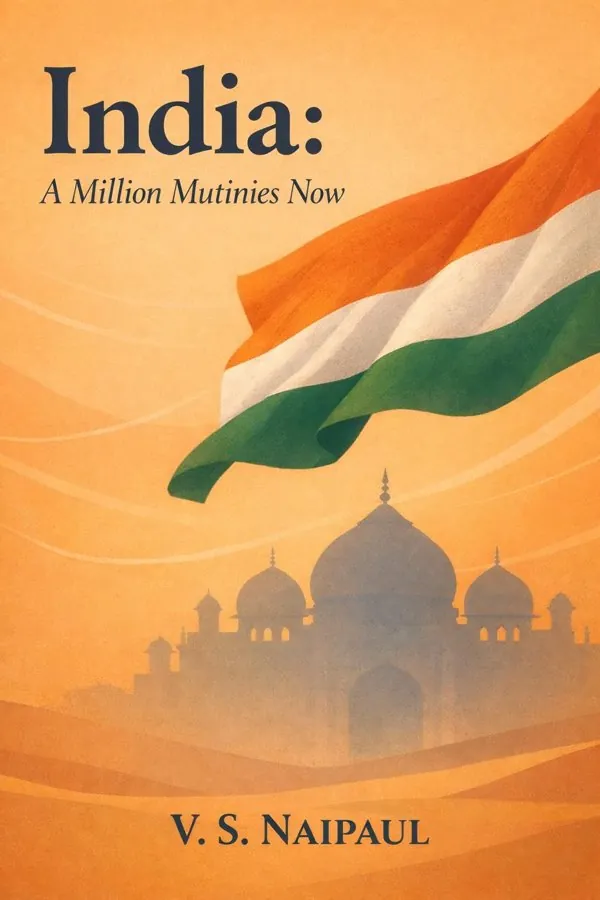
India: A Million Mutinies Now: Summary & Key Insights
 10 min7 chaptersAudio available
What Is India: A Million Mutinies Now About?
India: A Million Mutinies Now by V. S. Naipaul is a world_history book spanning 7 pages. In this nonfiction work, Nobel laureate V. S. Naipaul travels through India in the late 1980s, exploring the country’s social, political, and cultural transformations. Through interviews and observations, he portrays a nation in flux—where individuals and communities are asserting new identities and freedoms after centuries of colonial and hierarchical constraints. The book captures the complexity of modern India, marked by both progress and persistent divisions.
This FizzRead summary covers all 7 key chapters of India: A Million Mutinies Now in approximately 10 minutes, distilling the most important ideas, arguments, and takeaways from V. S. Naipaul's work. Also available as an audio summary and Key Quotes Podcast.
India: A Million Mutinies Now
In this nonfiction work, Nobel laureate V. S. Naipaul travels through India in the late 1980s, exploring the country’s social, political, and cultural transformations. Through interviews and observations, he portrays a nation in flux—where individuals and communities are asserting new identities and freedoms after centuries of colonial and hierarchical constraints. The book captures the complexity of modern India, marked by both progress and persistent divisions.
Who Should Read India: A Million Mutinies Now?
This book is perfect for anyone interested in world_history and looking to gain actionable insights in a short read. Whether you're a student, professional, or lifelong learner, the key ideas from India: A Million Mutinies Now by V. S. Naipaul will help you think differently.
- ✓Readers who enjoy world_history and want practical takeaways
- ✓Professionals looking to apply new ideas to their work and life
- ✓Anyone who wants the core insights of India: A Million Mutinies Now in just 10 minutes
Want the full summary?
Get instant access to this book summary and 100K+ more with Fizz Moment.
Get Free SummaryAvailable on App Store • Free to download
Key Chapters
I began the journey in Bombay, that paradoxical city where ambition and deprivation coexist almost within a single breath. Bombay was not the India of rustic fatalism I had encountered before; it was a place of movement, a magnet for people seeking escape from constraining traditions. Yet beneath the glitter of commerce and film, the contradictions were raw. Skyscrapers rose beside slums, and the migrant became both citizen and outsider. Here I met businessmen who had risen from nothing, women carving places for themselves in an urban order still ruled by men, and laborers who lived with one foot in the village and one in a city that would never fully claim them.
Through these encounters, I sensed Bombay’s deeper meaning: it was India’s frontier of self-invention. The merchant who recounted his early days selling textiles from a handcart was not merely a success story; he represented the will to break caste, family, and language barriers in pursuit of individual recognition. Yet for many, the cost of this pursuit was alienation—displacement from community, and the loneliness of competing dreams. Bombay thus embodied the restless energy of modern India: a theater of possibility and contradiction where people tested what freedom might feel like after centuries of obedience.
From Bombay I turned south, into a region long marked by orthodoxy and ritual, but now stirring with new social currents. In Tamil Nadu and Andhra, the rigid hierarchies of caste were being challenged by those once condemned to servitude. I found movements of education among lower castes, new political voices rising from the margins, and young men and women who no longer accepted the sanctity of inherited status. A teacher in Madurai told me that learning English for her was not about colonial aspiration but emancipation: a language of access rather than subjection.
Yet rebellion was no idyll. Many found themselves torn between reverence for their ancestral identity and the awareness that progress demanded rupture. The Self-Respect Movement, the Dravidian assertion—it all revealed India’s deeper transformation, the shift from collective acceptance to personal definition. In these southern landscapes, once regarded as peripheral, I discovered the core of India’s modernization: the insistence that dignity can no longer be granted from above but must be claimed from within.
+ 5 more chapters — available in the FizzRead app
All Chapters in India: A Million Mutinies Now
About the Author
Vidiadhar Surajprasad Naipaul (1932–2018) was a Trinidad-born British writer of Indian descent. Known for his incisive prose and exploration of postcolonial societies, he authored numerous acclaimed works of fiction and nonfiction, including 'A House for Mr Biswas' and 'The Enigma of Arrival'. He received the Nobel Prize in Literature in 2001.
Get This Summary in Your Preferred Format
Read or listen to the India: A Million Mutinies Now summary by V. S. Naipaul anytime, anywhere. FizzRead offers multiple formats so you can learn on your terms — all free.
Available formats: App · Audio · PDF · EPUB — All included free with FizzRead
Download India: A Million Mutinies Now PDF and EPUB Summary
Key Quotes from India: A Million Mutinies Now
“I began the journey in Bombay, that paradoxical city where ambition and deprivation coexist almost within a single breath.”
“From Bombay I turned south, into a region long marked by orthodoxy and ritual, but now stirring with new social currents.”
Frequently Asked Questions about India: A Million Mutinies Now
India: A Million Mutinies Now by V. S. Naipaul is a world_history book that explores key ideas across 7 chapters. In this nonfiction work, Nobel laureate V. S. Naipaul travels through India in the late 1980s, exploring the country’s social, political, and cultural transformations. Through interviews and observations, he portrays a nation in flux—where individuals and communities are asserting new identities and freedoms after centuries of colonial and hierarchical constraints. The book captures the complexity of modern India, marked by both progress and persistent divisions.
You Might Also Like
The Age of Capital
Eric Hobsbawm
10 min
The Gulag Archipelago
Aleksandr Solzhenitsyn
10 min
Jerusalem: The Biography
Simon Sebag Montefiore
10 min
The Anglo-Saxons
James Campbell
10 min
The Boer War
Thomas Pakenham
10 min
The Industrial Revolutionaries: The Making of the Modern World 1776–1914
Gavin Weightman
10 minBrowse by Category
Ready to read India: A Million Mutinies Now?
Get the full summary and 100K+ more books with Fizz Moment.